How to write a great PPC ad for optometrist practice accounts is the single line item that decides whether the same monthly budget books 8 exams or 42. Everything else in the paid account is scaffolding. Structure, keywords, bid strategy, and landing pages all matter, but the ad copy is what a searcher actually reads before they click or scroll past. Weak copy on a great account books nothing. Great copy on an average account books more than the market rate. That’s the whole game in three sentences.
This guide on how to write a great PPC ad for optometrist accounts gives you three headline formulas that consistently win, five offer patterns that turn paid clicks into booked exams, the rules for description lines and callouts, ad extension setup that pulls click-through rate up 40 to 80 percent, and a Vision Express case study where a full copy and site rebuild drove 62 percent more booked exams and a 135.9 percent surge in organic traffic across 6 months. Read straight through in about 10 minutes.
Why great copy for optometrist PPC ads compounds
Learning how to write a great PPC ad for optometrist accounts pays back on every dollar in the budget. Every ad in your account fights for the same 90 characters of headline space and the same 180 characters of description across two lines. Great copy earns a higher click-through rate. Higher CTR (click-through rate) earns a lower cost per click. Lower CPC (cost per click) produces more clicks on the same budget. More clicks produce more booked exams. The chain starts with a few hundred characters written well.
Google Ads rewards click-through rate with a Quality Score bump. Expected click-through rate is one of the three components Google uses to calculate Quality Score, alongside ad relevance and landing page experience, so ad copy moves the score directly. The components are set out in Google’s Quality Score documentation. Copy is the highest-impact thing you write for the entire account, so the effect compounds through every downstream metric. Vendors who spend one hour on ad copy and 40 hours on keywords are pulling the wrong lever. Learning how to write a great PPC ad for optometrist accounts sits above every other lever in the paid stack.
Copy beats keyword expansion
How to write a great PPC ad for optometrist accounts starts with what already runs, not with more keywords. Adding 40 new keywords to an account produces marginal gains after month one. Rewriting the ad copy in every ad group produces compounding gains for 6 months as Quality Score rises. Vendors who can’t get to your copy quality inside the first 60 days are leaving 25 to 40 percent of account performance on the table. The Vision Express account added zero new head-term keywords in months 2 through 6 and still moved bookings 62 percent through copy, landing page, and Google Business Profile work.
Copy beats bid strategy tweaks
The same holds for bidding. Learning how to write a great PPC ad for optometrist accounts outranks any bid tweak on the same ad group. Switching from Manual CPC to Target CPA lowers cost per exam 10 to 20 percent after the algorithm has 30 days to learn. Rewriting ad copy from formula-free filler to structured formulas cuts cost per exam 30 to 45 percent inside the same 30 days. Bidding is a lever the algorithm pulls for you. Copy is a lever only you can pull. Every hour spent tuning copy pays back three times over the same hour spent tuning bids.
Three headline formulas for a great PPC ad for optometrist practices
Every winning headline in every optometrist PPC ads account we run follows one of three formulas. You don’t need a fourth. You need each formula tested inside every ad group with three variants at once. Google Ads pattern-matches the winners inside 30 days and the account CTR climbs 20 to 40 percent in the first quarter.
| Formula | Template | Sample | Best campaign type |
|---|---|---|---|
| Location + Trust | [Service] in [City] · [Trust signal] | Eye Doctor in Cincinnati · 4.9 Stars, 300+ Reviews | Local high-intent |
| Offer + Deadline | [Offer] · [Deadline] | New Patient Exam $95 · Book This Week | Service-specific |
| Question + Answer | [Question]? [Direct answer] | Need an Eye Doctor Today? Same-Day Slots Open | Emergency terms |
Location plus trust formula
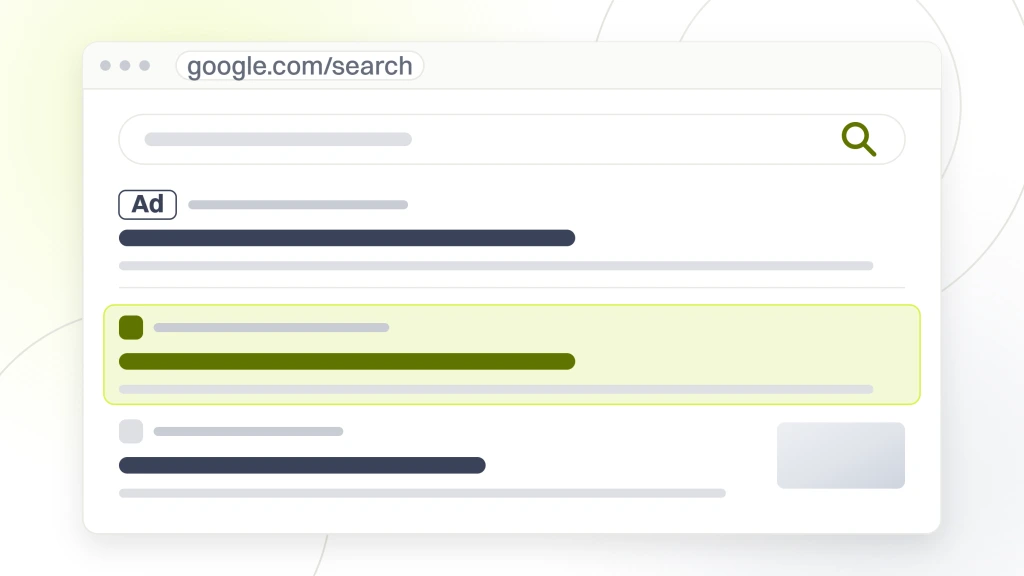
The Location plus Trust formula wins on local high-intent terms and it matches the searcher’s mental model. Someone typing “eye doctor near me” wants to see a local practice with a proof point on the first line of the ad. Headline 1 names the service and the city. Headline 2 lands a specific trust signal like star rating with review count. Headline 3 names the insurance carriers you accept. That combination sets the ad apart from every corporate chain ad running the same generic “Comprehensive Eye Care” copy on the identical keyword.
Offer plus deadline formula
The Offer plus Deadline formula wins on service-specific terms and it converts research intent into action intent. “New Patient Exam $95 This Week” beats “Full-Scope Eye Care Services” by 3x on click-through rate in most tests. Deadline creates urgency. Specific dollar figures build trust. Vague marketing language earns a scroll past. Every ad group targeting service terms should run at least one Offer plus Deadline variant against the Location plus Trust baseline and pick the winner by conversion volume after 200 clicks.
Question plus answer formula
The Question plus Answer formula is the third headline shape in how to write a great PPC ad for optometrist accounts. It wins on emergency and problem-aware terms. “Contact Lens Fell Out? Same-Day Refit Slots” mirrors the exact query the searcher just typed and reads as a direct reply on the results page. Pattern-matching the search string in the first headline sends a strong relevance signal to Google Ads too, so Quality Score climbs faster than any other formula on that keyword set. Reserve this shape for the highest-urgency ad groups in the account.
Five offers that convert PPC ads for optometrists
Every practical guide on how to write a great PPC ad for optometrist accounts turns on the offer. The offer is what makes the searcher call versus scroll. How to write a great PPC ad for optometrist accounts covers the offer as much as the headline. Every optometrist PPC ads account we run tests all five of the offers below across the campaign year. Two or three become the account’s long-term winners. The other two get retired after 30 days of underperformance. This is the exact offer library we start every new account with.
- New patient exam at a fixed price like $95 or $129 (covers exam plus one basic screening)
- Same-day exam availability for emergency terms and lost prescription searches
- Insurance-accepted headline for VSP, EyeMed, or Davis Vision searchers
- Kids exam special for back-to-school season and family scheduling
- Dry eye assessment consult for symptom-specific searchers
New patient exam at a fixed price
A fixed-price new patient exam offer works and it removes the price mystery. Someone searching for an eye doctor has hit “call for pricing” too many times before. Naming a specific number like $95 or $129 tells them exactly what walks in the door costs and takes the ambiguity off the table. Practices we’ve run this offer for consistently see it drive a top-3 share of paid bookings after the second month, and the exam price is usually paid back once when the patient picks frames or contacts on the same visit.
Same-day exam availability
Same-day exam availability wins on emergency terms where the corporate chains can’t compete. Chain locations book 2 to 3 weeks out. Independent practices with one or two flex slots per day can offer same-day slots and win the click at $4 to $7 CPC when the standard local high-intent term is going for $12 to $18. The ad copy names the same-day promise in headline 2 and the phone number in the call extension. Half those clicks skip the landing page and call directly to the front desk to book.
Insurance-accepted headline
Insurance-focused searchers know exactly what carrier they’re on, and any lesson in how to write a great PPC ad for optometrist accounts starts with naming the carrier in headline 2. They’re pre-filtering out any practice that doesn’t take it. “VSP and EyeMed Accepted” in headline 2 wins a click from every VSP or EyeMed searcher who saw a generic ad above yours and passed. Name the top 2 or 3 carriers by patient volume, not the full list, so the headline reads as specific and not as a wall of acronyms. Vision insurance intent converts at almost 2x the rate of a cold local high-intent click.
Kids exam special for back-to-school
A kids exam special runs July through September and it captures back-to-school scheduling intent. Parents book two exams on one trip, so the ad copy should name the family bundle in headline 2 and a specific savings figure in description 1. Practices that run this seasonal push land 25 to 40 percent of the year’s kids-exam bookings inside a 10 week window. Turn the offer off in October and put the ad group’s budget back into the year-round Location plus Trust ads.
Dry eye assessment consult
The last piece of how to write a great PPC ad for optometrist accounts is the symptom-specific offer. Symptom-specific searchers typing “burning eyes causes” or “eye drops not working” are hunting for a diagnosis, not a routine exam. A dry eye assessment consult offer meets that intent head on. Headline 1 names the symptom. Headline 2 names the assessment. Description 1 promises a same-week slot and a clear next step. Dry eye workups run at higher revenue per patient than a standard exam, so the CPC ceiling on this ad group can safely run 30 to 40 percent above the local high-intent term.
Description lines that turn clicks into calls
The second half of how to write a great PPC ad for optometrist accounts is the description. Description lines are where 70 percent of ad copy work happens and they carry twice the character count of the headlines. Buyers actually read them on the SERP. How to write a great PPC ad for optometrist accounts starts with the headline and finishes in the description. The description line rules are five patterns and no exceptions.
Description 1 carries the primary benefit and the call to action verb. Description 2 carries the secondary benefit and a proof point. Never repeat the headline in the description. Never end without a verb-forward CTA like Book, Call, or Schedule. Never write vague words like “quality” or “trusted” so they contribute zero to click intent. Every description line follows the same pattern across every ad in the account, and the winner from ad group A can port cleanly to ad group B for the next test cycle. See our PPC services for optometrists for the full copy library.
Benefit-first description writing
Benefit-first phrasing is the core rule in how to write a great PPC ad for optometrist description lines. Every description opens with the primary benefit to the searcher, not a description of your practice. “Book a same-day exam with a doctor who takes VSP” beats “We are a family-owned practice with 20 years of experience” every single time. The searcher doesn’t care about your practice biography on the SERP. They care about whether you can solve their problem today. Lead with the solved problem. The practice biography lives on the About page. It has no business on a paid ad description.
Specific proof beats vague reassurance
Description 2 carries the proof point. “18,400 patients seen since 2011” beats “experienced staff” every time. “4.9 stars on 300+ Google reviews” beats “highly rated” every time. Specific numbers make the click safe. Vague adjectives make the ad look like every other ad in the auction. Two hours of pulling specific numbers from your practice management system or Google Business Profile and rewriting every description line to use them will drive your account CTR up 20 to 30 percent inside 60 days.
The classic bad ad description reads like a wedding invitation. “Welcome to our practice, where every patient is family and eye health is our passion.” Nobody clicks that on a phone at 8:47 in the morning when their contact lens fell in the sink. They scroll to the ad that says “Same-Day Contact Refill · Book Now” and that practice books the exam. Passion belongs on your About page and it’s a click-killer on paid search. Save the poetry for the wedding registry.
Call to action rules for optometrist PPC ads
Every rule in how to write a great PPC ad for optometrist accounts ends at the CTA. The CTA is the last thing the searcher reads before they click or scroll. Every ad in the account ends description 2 with an action verb followed by a defined action. Book Now. Call Today. Schedule Online. See Slots. Never end with “Learn More” and it commits the searcher to nothing.
Different campaigns get different CTAs. Local high-intent campaigns use Book Now or Call Now and the searcher is ready to act. Service-specific campaigns use Schedule Online and the intent is one step less immediate. Emergency campaigns use Call Today and a phone booking beats an online form when time is tight. Match the CTA to the search intent. Vendors who write every ad with the same generic CTA are leaving 10 to 15 percent of CTR on the table.
Verb-first CTAs win
Every winning CTA starts with a verb. Book, Call, Schedule, See, Get, Save. The verb tells the searcher what happens when they click. Verb-first CTAs beat noun-first CTAs by 12 to 22 percent on click-through rate across every account we test. “Book Your Same-Day Exam” beats “Same-Day Exams Available” every time. Rewrite every CTA in every ad group to start with a verb inside the next month and watch the account CTR climb inside the first two weeks.
Specific CTAs beat generic CTAs
Specific CTAs beat generic ones on every metric. “Book Your $95 Exam” beats “Book Now” by 18 to 28 percent CTR in most tests. “Call Before Friday for Same-Day” beats “Call Now” by 22 to 35 percent CTR. The specificity gives the searcher a reason to act inside a defined window. Every specific CTA filters out low-intent clicks who would have never converted anyway. Tighter targeting produces cheaper cost per exam even when raw click volume drops slightly.
Ad extensions that double CTR
Ad extensions are free real estate on the SERP. Learning how to write a great PPC ad for optometrist accounts includes the four extension types every time. Every ad in the account should run four extension types at once. Call, sitelink, callout, and structured snippet. The right extension set adds 30 to 50 percent more visible pixels to the ad and pulls CTR up by 40 to 80 percent for zero incremental cost.
Call extensions add a click-to-call button on mobile that converts at 8 to 14 percent, higher than any landing page form. Sitelink extensions add four to six clickable subpages beneath the ad. Callout extensions add short benefit phrases like “Same-Day Exams” and “Family Owned Since 2011.” Structured snippet extensions add a category header and a bullet list like “Services. Adult Exams, Pediatric, Contact Fitting, Dry Eye Treatment.” All four running together is the standard configuration for a well-managed optometrist PPC account.
Call extension setup and tracking
Call extensions on mobile drive a click-to-call button next to the ad headline. That button converts at 8 to 14 percent on well-written ads, often higher than the landing page form conversion rate. Route the call through a CallRail or CallTrackingMetrics tracking number so each ring attributes back to the campaign, ad group, and keyword. Untracked call extensions produce phantom conversions that never show up in the report. See the Google Ads help on call extensions for the setup reference.
Sitelink extensions that convert
Sitelink extensions add four to six clickable subpages beneath your main ad. Each sitelink gets a 25-character headline and two 35-character descriptions. Sitelinks for optometry practices should point to Book Online, Insurance Accepted, Same-Day Slots, and Meet the Doctors. Each sitelink adds visible pixels to the ad on desktop and increases the total real estate by 30 to 50 percent. On mobile only two sitelinks show but the extension still drives CTR up. Rotate sitelink copy quarterly to prevent creative fatigue.
Case study on a great PPC ad for optometrist accounts
The clearest proof of how to write a great PPC ad for optometrist accounts sits in one case. Vision Express, an independent optometry practice known for vision therapy, dry eye treatment, and specialty contact lenses, came to us competing head on with corporate chains and losing. Their site was outdated. Online scheduling was hard. Premium services like vision therapy sat buried three clicks deep. Google Business Profile was under-optimized. The paid ad copy was generic and read like every other chain ad on the same local terms.
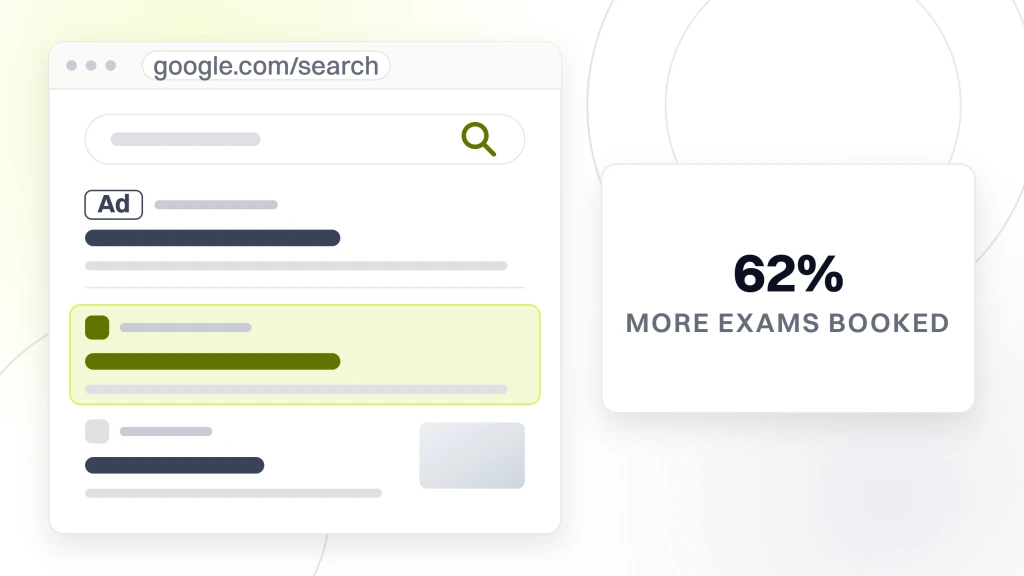
We rebuilt the paid ads using the three headline formulas and five offer patterns above, redesigned the service pages so each ad group pointed to a page built for its intent, optimized the Google Business Profile for map-pack calls, and ran location-based SEO for optometrists alongside the ad rewrites. Inside 6 months, Vision Express booked 62 percent more exams, organic traffic climbed 135.9 percent, and overall practice growth hit 71 percent. That’s the shape of movement a full copy, landing page, and Google Business Profile rebuild produces when all three pull in the same direction.
The winning ad copy pattern that stayed
The winning local high-intent ad for Vision Express read as follows. Headline 1. “Eye Doctor in [City].” Headline 2. “Same-Day Exams Available.” Headline 3. “VSP and EyeMed Accepted Here.” Description 1. “Book a same-day exam with a doctor who takes your vision insurance. Trusted by hundreds of local patients.” Description 2. “Independent practice, family owned. Book online in 60 seconds or call the front desk today.” That ad structure carried the account through the full campaign year and paired directly with the service page rebuild.
Lessons for your own account
Two lessons from the Vision Express rewrite apply to almost every optometry practice paid ad account. First, generic marketing language is what your competitors are already running. If your ad reads like theirs, you have zero click advantage on identical keywords. Second, specific numbers and named insurance carriers do the heavy work on trust. The searcher decides in 1.2 seconds whether to click. Specific proof points win that 1.2-second decision. Vague adjectives lose it.
Testing cadence for optometrist PPC ads copy
Testing cadence is where how to write a great PPC ad for optometrist accounts stops being a one-time exercise and becomes an operating rhythm. Every ad group runs three ads at all times. When one hits the 200-click threshold with a lower conversion rate than the other two, it gets paused and replaced. That single cadence produces 8 to 14 copy iterations per ad group per year and moves the account CTR steadily upward without ever running out of test variants.
The mistake most vendors make is testing headline changes against description changes in the same test. That produces overlapping variables and neither reading is clean. Test one element at a time. Headline 1 against headline 1. Description 2 against description 2. Give each test 200 clicks before calling a winner. Log the winner and its metrics in a shared document so year-end wins can carry into next year’s account without re-testing.
The 200-click minimum
200 clicks per variant is the minimum sample size for a clean copy test. Below that number, random variation swamps any real signal and you’ll pick a winner that isn’t actually winning. On a typical optometry ad group getting 40 to 80 clicks per week, each test runs 3 to 5 weeks. Faster than that and you’re chasing noise. Slower than that and you’re running the same underperforming ad longer than needed. 200 clicks is the honest floor.
One variable per test
Test one variable at a time. If you test a new headline 1 and a new description 1 in the same variant, you can’t tell which change caused the CTR movement. Isolate the change. Run headline tests separately from description tests. Run offer changes separately from CTA changes. That discipline produces clean readings and a copy log you can trust in year two when you inherit the account or hand it off to a new vendor.
Common ad copy mistakes across optometrist PPC ads accounts
Across the last three years of audits, five mistakes show up in nearly every optometrist PPC ads account we take over. Fixing all five takes about 6 hours of copy work and moves CTR upward by 25 to 40 percent inside the first month. If your current vendor isn’t fixing these on day one, you know exactly what the retainer isn’t doing.
- Homepage URL as the landing page for every ad group regardless of intent
- Same ad copy running for 18 months without a single test
- No call extension on the ad, which loses 30 percent of mobile conversions
- Generic CTAs like Learn More or Contact Us instead of Book or Call
- No specific proof point in description 2 (star rating, patient count, years in practice)
Homepage as landing page for every ad group
The first mistake in every how to write a great PPC ad for optometrist audit we run is the landing page. The homepage is not a landing page. It carries six competing calls to action, a staff bio slider, and a newsletter form. Paid traffic arriving on the homepage picks nothing and bounces at 65 to 75 percent. Every ad group needs a landing page built for that ad group’s intent. Local high-intent gets a dedicated booking page. Contact lens fitting gets a contact lens page. Emergency terms get a same-day slots page. Homepage traffic converts at 3 to 5 percent when dedicated landing pages hit 12 to 18 percent on the same clicks.
Stale ad copy killing Quality Score
The second common mistake in how to write a great PPC ad for optometrist accounts is stale creative. Ad copy that hasn’t been touched in 18 months has Quality Scores decaying to 4 or 5 across the account. Same keywords, same landing pages, dropping Quality Score. Google is showing your ad less often when the CTR is dropping relative to competitors who are rotating creative every 30 days. The fix is the monthly ad copy rotation cadence described earlier. Any vendor whose account report shows the same ad IDs for 6 consecutive months has never actually optimized creative on your file.
Where to start with ad copy for optometrist PPC ads
How to write a great PPC ad for optometrist accounts starts with a rewrite pass. Rewrite the ad copy in every ad group starting with the local high-intent campaign, then the top service-specific ad group, then everything else. Give each rewrite 30 days to build a Quality Score reading before you touch it again. Expect click-through rate to climb 20 to 40 percent inside the first quarter and cost per booked exam to fall 25 to 45 percent by month four on a competitive metro. That’s the same shape of movement Vision Express saw once the copy, landing pages, and Google Business Profile all pulled in the same direction.
Ready to rewrite the ad copy in your optometrist PPC account. Our PPC services for optometrists covers the full engagement including the copy library and monthly rotation cadence. For the account structure that pairs with great copy, see our optometrist marketing agency hub, and the full optometrist PPC management playbook. For the retainer plan at $1,499 per month, see our Optometrist marketing retainer.