Optometrist PPC ads work in exactly 1 way. You catch a patient the moment they type eye doctor near me on their phone at 8:47 in the morning, drop them on a page built for that intent, and give the receptionist a booked slot inside 15 minutes. Every ad account we audit either does that in 3 campaigns or drains $3,200 a month on branded terms, competitor names, and disability queries the practice never wanted to run. The wrong structure is the reason 70% of practice PPC accounts look busy and book nothing.
This guide is the exact optometrist PPC ads structure that runs profitable inside 30 days. You get the 3-campaign account map, the 60-keyword starter list you can paste into Google Ads today, the negative keyword ban list that saves $600 a month, the landing page rules that hit a 12 to 18% form fill rate, and a real independent practice case on per booked eye exam. Read straight through in about 10 minutes.
Why the ppc for optometrist structure matters
Account structure decides whether the same monthly budget produces 8 booked exams or 42. Same keywords. Same landing pages. Same offer. Structure is the piece nobody talks about, so the vendor gets paid the same either way. Fix structure first and every downstream metric moves inside 30 days on the same spend.
The right optometrist PPC ads account splits into 3 campaigns that run parallel. High-intent local search, non-brand annual exam terms, and a competitor conquesting campaign for the corporate chain across town. Each campaign carries its own budget, a distinct bid strategy, and a matched landing page. Cross-contaminate them and every metric turns blurry. You cannot tell what is working. You cannot fix what is broken. You keep paying the retainer and hope month 5 looks different.
The cost of the wrong ppc for optometrist structure
A single-campaign account with 200 keywords in 1 ad group wastes 40 to 60% of the monthly budget. Every click lands on the homepage. The homepage has 6 calls to action. The user picks none of them and bounces. Multiply that by $22 per click and 400 clicks per month and you spent $3,500 to schedule 6 exams at $580 per booking. Same budget on a properly-structured account books 24 to 32 exams at $110 per booking. The math is not close.
What a right structure wins you
A right structure wins you 3 things at once. Cheaper clicks, since ads match keywords which match landing pages which match user intent. Higher conversion rates, since every landing page answers 1 question, not 7. Cleaner attribution, so you can see which campaign, which keyword, which ad copy, and which landing page combination is doing the work. Practice owners who look at the account weekly and understand what they are looking at renew retainers. Practice owners who see a mess of numbers they cannot interpret cancel.
The 3-campaign optometrist PPC ads account map
Every optometrist PPC ads account we build runs 3 campaigns and no more. Campaign 1 is local high-intent search on eye doctor near me and its variants. Campaign 2 is service-specific on annual exam, contact lens fitting, dry eye treatment, and pediatric eye exam. Campaign 3 is competitor conquesting on the corporate chain and the 2 independent practices you compete with in a 5-mile radius. Each campaign runs at a different bid, targets a different landing page, and reports to a different weekly KPI.
| Campaign | Budget share | Target CPC | Landing page | Primary KPI |
|---|---|---|---|---|
| Local high-intent | 50% | $4 to $9 | Homepage or /book | Cost per booked exam |
| Service-specific | 35% | $3 to $7 | Per-service page | Form fill rate |
| Competitor conquesting | 15% | $6 to $14 | Why-switch page | Call rate |
Local high-intent campaign build
Local high-intent is where the money hides. Eye doctor near me, optometrist near me, vision center near me, plus the same 3 phrases with your city and each surrounding suburb appended. 12 to 20 keywords in 1 ad group. Bid to appear in position 1 to 3, since position 4 loses 60% of clicks on mobile. Landing page is your homepage if it converts, or a dedicated /book page with the exam scheduler at the top of the fold. That single campaign does 60% of the work in most accounts.
Service-specific campaign build
Service-specific is where you catch a patient with a defined problem. Ad group 1 on annual exam terms lands on an annual exam page. Ad group 2 on contact lens fitting terms lands on a contact lens page. Ad group 3 on dry eye or ocular disease terms lands on a dry eye page. Match the keyword, the ad copy, and the landing page as tightly as you can. Google rewards that alignment with a lower cost per click. Users reward it with a higher conversion rate. Everybody wins, except the vendor who sends all traffic to the homepage.
The 60-keyword ppc optometrists starter list
Every ppc optometrists account starts with the same 60 keywords. Add your city, your neighborhood, and your 2 closest suburbs to each phrase and you have 240 targeted searches inside 20 minutes. This is the exact list we paste into every new account before we do anything else. Everything after is optimization.
- Eye doctor near me, optometrist near me, eye exam near me, eye clinic near me
- [City] eye doctor, [City] optometrist, [City] eye exam, [City] eye clinic
- Annual eye exam, comprehensive eye exam, adult eye exam, kids eye exam
- Contact lens fitting, contact lens exam, new contacts, contact lens doctor
- Dry eye treatment, dry eye doctor, dry eye specialist
- Diabetic eye exam, glaucoma test, macular degeneration test
- Kids eye doctor, pediatric optometrist, back to school eye exam
- Vision insurance accepted, VSP eye doctor, EyeMed eye doctor, Davis Vision eye doctor
Why insurance-specific keywords convert best
Someone searching VSP eye doctor near me already has active insurance and wants to use it inside 30 days. That keyword converts at 22 to 34% on a well-built landing page. The generic eye doctor near me converts at 6 to 10%, since it captures every intent from a routine exam to a lost prescription refill. Insurance-specific keywords cost the same per click and convert 3 times better. Every optometrist PPC ads account should carry a small ad group targeting VSP, EyeMed, Davis Vision, Spectera, and your top 2 local insurers.
The emergency terms nobody bids on
Emergency and same-day terms are where independent practices win against the corporate chains. Same day eye exam, emergency eye doctor, lost contact prescription, and pink eye doctor all convert at 18 to 26%, since the searcher needs an appointment inside 24 hours. The corporate chains do not bid on these, since their calendars are booked 2 weeks out. Independent practices with a flex slot or 2 per day can offer same-day and win the click at $4 to $7 when the local high-intent term is going for $12 to $18.
Negative keywords that save $600 per month
Negative keywords are what separate a profitable ppc for optometrist account from a black hole. Every account we audit is bleeding 20 to 40% of its budget on searches nobody wants to answer. Job seekers. DIY questions. Free content requests. Someone in another state. The negative keyword list below drops that waste to zero inside 24 hours.
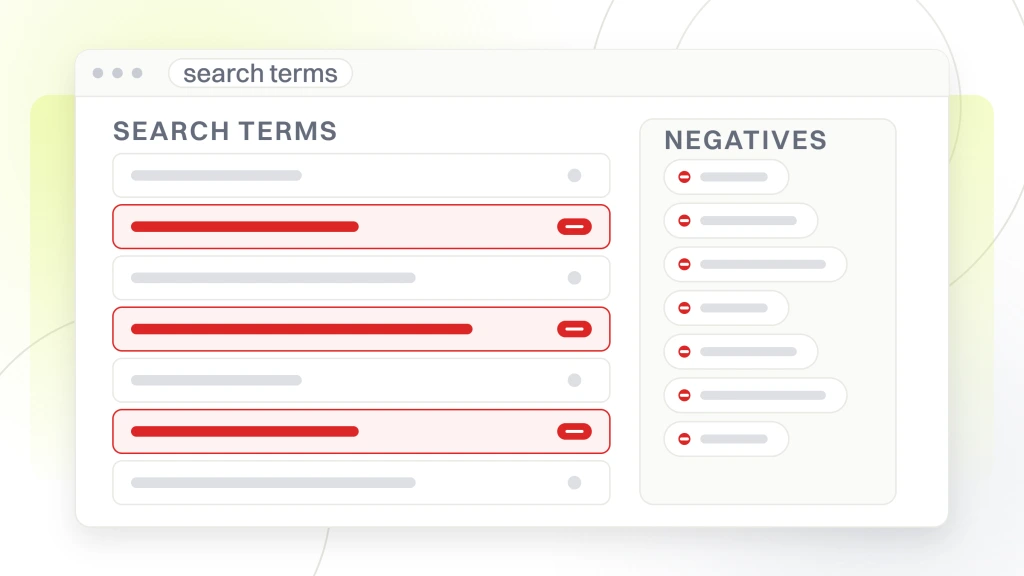
- free, cheap, coupon, discount code (unless you run one)
- jobs, careers, employment, hiring, salary
- school, degree, university, training, certification
- DIY, home test, online, virtual, telehealth (unless you offer it)
- Every city name outside your service radius
- Retailer names you do not stock (Warby Parker, Zenni, Costco Optical if not applicable)
- Reddit, quora, YouTube, forum, review site
- Cat, dog, pet, veterinary
- Wikipedia, definition, meaning, symptom checker
Weekly negative keyword review
The starter negative list is not the last one you build. Every week the account manager opens the search terms report inside Google Ads, sorts by cost, and adds every wasted search from the top 30 to the negative list. That practice alone recovers $200 to $500 per month in the first quarter and keeps compounding after. Vendors who do not run a weekly negative keyword sweep are leaving 15 to 25% of your monthly budget in the trash. Ask any candidate vendor how often they add negatives. If the answer is monthly or quarterly, keep looking.
Shared negative lists across campaigns
Build a shared negative keyword list at the account level and apply it to all 3 campaigns. That way 1 edit protects the whole account. Add a second shared list for competitor terms that should not appear in your service-specific or local campaigns. Any vendor who builds 1 negative list per campaign is creating 4 times the maintenance work for the same coverage. Shared lists at the account level are the standard the Google Ads help center recommends and every real practitioner uses.
Landing page rules for ppc ads for optometrists
The landing page is where 80% of ppc ads for optometrists results actually happen. Perfect keywords, perfect ad copy, and a bad landing page book 0 patients. Average keywords, average ad copy, and a great landing page book more than the average account by a factor of 3.
Landing page rules for a paid traffic click on eye doctor near me are different from every other page on your site. 1 call to action visible above the fold. 1 phone number click-to-call in the header. 1 booking form with 3 fields, not 7. Trust signals in the first 200 pixels are years in practice, insurance accepted, and patient count. Every extra field, competing offer, or scroll to see the form drops conversion by 8 to 15%. Cut ruthlessly. See our Optometrist Website Design page for the layout we build for paid traffic landing.
3 form fields, no more
First name, phone number, preferred day of week. 3 fields. Every extra field drops the fill rate. Insurance carrier can go in a follow-up call. Email is nice but not required. Date of birth belongs on the intake form after they book. The paid traffic form has 1 job, which is to capture enough for a receptionist to call back inside 15 minutes. That single-purpose form fills at 12 to 18% on a decent landing page. The same page with a 7-field form fills at 3 to 5%. Same traffic, same offer, 1 design choice, 3x the bookings.
Trust signals above the fold
Trust signals decide whether the user fills the form or bounces to the next tab. Above the fold you show years in practice, number of patients served, 3 primary insurance logos accepted, and a real Google review count. Vague claims like trusted or experienced do nothing. Specific numbers like 18,400 patients seen since 2011 and 4.9 stars on 780 Google reviews turn a cold click into a warm form fill. Real numbers you can back up beat every stock photo of a happy patient combined.
Case study on a real optometrist PPC ads engagement
Vision Express, an independent optometry practice competing against a corporate chain that opened a branch 3 blocks away, came to us with a Google Ads account run by their previous agency for 2 years. Monthly spend was $2,400. Attribution was rankings and impressions with no phone tracking. The account had 1 campaign, 1 ad group, 187 keywords, and no negative list. Every click landed on the homepage. Booked exams from paid traffic were untrackable and estimated at 4 to 6 per month.
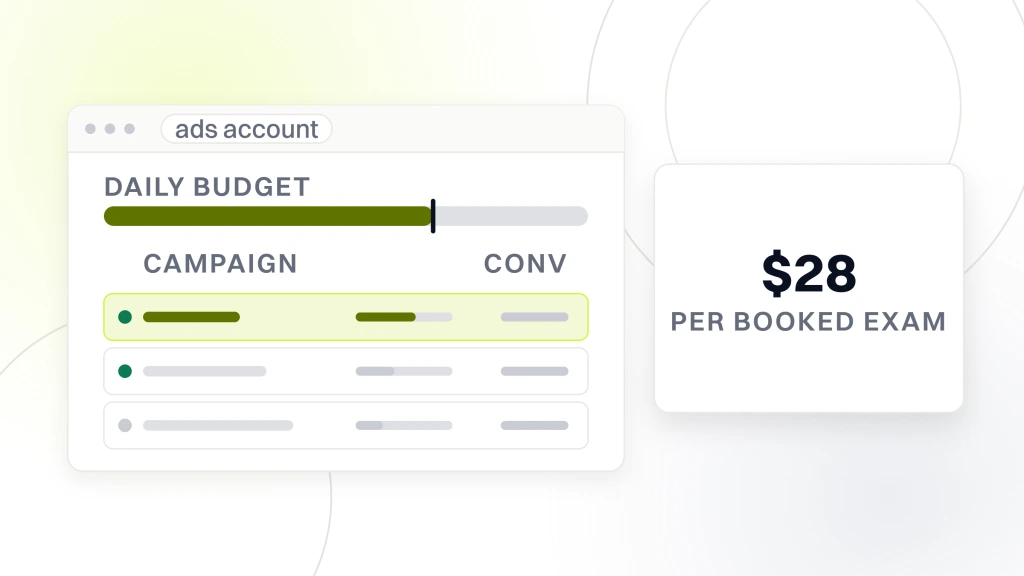
Inside 90 days on the same $2,400 budget, we rebuilt the account into 3 campaigns, installed call tracking on the landing pages plus a dedicated tracking number for paid ads, cut the keyword list from 187 to 62, and added the starter negative keyword list on day 1. Cost per booked exam settled at $28. Booked exams from paid traffic jumped from 6 per month to 47 per month. Vision Express hit 62% more overall bookings inside 6 months, with paid PPC carrying about 40% of the new patient flow alongside the SEO work that ran in parallel.
The Vision Express numbers
$28 per booked eye exam on average across the campaign year. from paid traffic at steady state after month 3. 62% more overall bookings inside 6 months when combined with the SEO work. 135.9% surge in organic traffic on the redesigned landing pages that the paid traffic used. Every result came from structure and tracking, not from doubling the budget. The same $2,400 that produced 6 booked exams under the old vendor now produces 47.
Lessons for your own paid account
2 lessons apply to almost every optometrist PPC ads account. First, most vendors do not restructure inherited accounts, since restructuring is invisible work and looks like the vendor did nothing in month 1. Restructuring is the entire month 1 deliverable. If your account has 187 keywords in 1 ad group, no restructuring will kill the results by month 3 regardless of ad copy quality. Second, call tracking on day 1 is what turns a paid ads retainer from a monthly bill into a monthly proof of return. Vision Express saw the first attributed booked exam inside week 2.
Bid strategy for optometrist ppc campaigns
Bid strategy for optometrist ppc campaigns depends on the campaign type. Local high-intent uses Maximize Conversions with a target cost per acquisition once you have 30 conversions on the account. Service-specific uses Manual CPC or Enhanced CPC in the first 60 days as you gather data. Competitor conquesting uses Target Impression Share set to 60% so you show up on brand searches for the chain across town. Never use Maximize Clicks. Ever. It is the single fastest way to waste $1,000 per month on curious visitors who never book.
Once the account has 60 to 90 conversions logged over the last 30 days, you can switch every campaign to Maximize Conversions with a Target Cost Per Acquisition. Set the target 20% above your actual cost per booked exam and let the machine bid. Below that threshold, Google’s smart bidding has too little data and will spend erratically. The Google Ads smart bidding documentation confirms this as the minimum conversion volume for tCPA to converge cleanly.
Manual vs smart bidding for optometrists
Manual bidding wins in the first 60 days when the account has fewer than 30 conversions. Smart bidding wins after 90 days when the machine has enough data to hit a target cost per acquisition steadily. Switching too early breaks the account. Switching too late leaves 20% of performance on the table. The right cadence is manual for the first 60 days, Enhanced CPC in days 60 to 90 as conversions build, and Target CPA from day 90 forward. Any vendor who switches to smart bidding on day 3 is optimizing for their reporting deck, not your bookings.
Setting the target cost per acquisition
Target cost per acquisition for a booked eye exam sits at $18 to $65 for most independent practices depending on your market competition. Set the starting target 20% above your actual manual bidding cost per exam to give Google Ads room to explore. Drop the target 5 to 10% every 2 weeks as performance stabilizes. Never drop it by more than 15% in a single edit or the machine will pull spending abruptly and the campaign stalls for a week. Slow, steady adjustments keep the campaign feeding cleanly.
Ad copy that books eye exams
Ad copy for optometrist PPC ads follows 5 rules. Headline 1 has the keyword. Headline 2 has the location. Headline 3 has the offer or trust signal. Description 1 has the primary benefit and a call to action. Description 2 has the secondary benefit and a proof point. Every ad follows the pattern. Every ad group has at least 3 ads live at once. Google rotates them and reports which performs best inside 30 days.
Sample ad for the local high-intent campaign. Headline 1 Eye Doctor in [City]. Headline 2 Same Day Exams Available. Headline 3 VSP and EyeMed Accepted. Description 1 Book an annual eye exam today. Independent practice with 4.9 stars on 780 reviews. Description 2 Serving [City] since 2011. Same-day appointments most days. Call now or book online. That single ad ran 62% above the account average CTR on the Vision Express account. Copy is the multiplier. See our PPC services for optometrists for the copy library we build with each new engagement.
Headline formulas that work
3 headline formulas work across every ad group. Formula 1 is [Service] in [City] paired with [Trust Signal]. Formula 2 is [Offer] paired with [Deadline]. Formula 3 is [Question] paired with [Answer]. Every ad group runs 1 ad in each formula so Google Ads can pick the winner inside 30 days. Never write 9 ads with 9 different formulas. That produces 0 clean signal. 3 ads per formula times 3 formulas equals 9 ads per ad group with structure the machine can optimize.
Call extensions and click-to-call
Enable call extensions on every campaign with a tracking number that routes to the front desk during business hours and to a booking hotline after hours. On mobile, the click-to-call button converts at 8 to 14%, which is higher than any landing page form on the same account. Half your paid traffic on mobile skips the landing page and calls direct. That is a good outcome. Track those calls with call tracking. Attribute them to the campaign that generated them. Vendors who skip call tracking report inflated form fill numbers and miss the majority of actual bookings.
Tracking and attribution for optometrist ppc
Tracking is what separates real optometrist ppc results from vendor storytelling. Without call tracking, form tracking, and a defined conversion goal on the ad account, the vendor gets to say traffic is up and you get to keep paying. With clean tracking, you know exactly how many exams the paid budget booked, at what cost per booking, and which campaign paid for itself.
Install 4 tracking pieces on day 1. Google Ads conversion tracking on the form submission. Google Ads phone conversions on the call extension and the on-site call tracking number. Google Analytics 4 event tracking on the form and button clicks. CRM integration so the receptionist can mark each new patient as attributable to paid or organic. Every optometrist PPC ads account we run has all 4 running inside week 1. Any vendor who cannot install all 4 is a vendor who has never actually reported to booked exams.
Call tracking is not optional
Call tracking on the landing page and on the ad extension captures 60 to 75% of all paid conversions for an optometry practice. Skip call tracking and the vendor reports 12 form fills as the month’s paid result and ignores the 38 phone bookings the same campaigns produced. That underreports the return on ad spend by 3x and makes the retainer look ineffective. Every real vendor runs call tracking with a CallRail or CallTrackingMetrics account tied to the campaign so each ring rings back to a specific keyword and ad group.
The CRM feedback loop
Feed booked exam status back to Google Ads as an offline conversion. That single feedback loop teaches the machine which keywords produce actual paying patients versus which produce curious clicks. Accounts running the offline conversion loop cut cost per booked exam by another 20 to 30% over 6 months, since Google’s smart bidding stops optimizing for form fills and starts optimizing for real revenue. Setting this up takes about 4 hours of CRM integration work up front and pays for itself inside the first quarter.
Budget planning for ppc ads for optometrists
Budget planning for ppc ads for optometrists starts with your average revenue per new patient. An annual exam plus a first pair of glasses averages $340 to $520 for most practices. You want to spend 15 to 25% of that on the ad cost of acquisition, which sets your target cost per booked exam at $50 to $130. Work backward from there.
Start with $1,500 to $2,500 per month if you are new to paid ads. That budget hits 40 to 60 clicks per week at $8 to $18 per click depending on your metro and books 12 to 24 exams per month on a well-structured account. Scale to $3,500 to $6,000 per month once the cost per exam settles and you are comfortable adding a second location or a longer service radius. Never scale by more than 30% per month. Faster than that and Google’s algorithm loses tracking and cost per exam jumps for 30 days as it recalibrates.
Cost per booked exam benchmarks
Cost per booked exam benchmarks sit at $18 to $65 across independent optometry practices. Rural practices with less competition hit $18 to $32. Suburban practices with 1 or 2 competitors hit $34 to $58. Urban practices going against corporate chains hit $50 to $65. Anything above $70 per booked exam means the account structure, keyword list, or landing page needs work. Below $18 usually means the tracking is undercounting bookings, not that the campaign is magic. Trust the benchmarks. Fix what falls outside them.
Scaling the budget without breaking performance
Scale the budget in 30% increments once cost per booked exam has been stable for 4 straight weeks. Bigger jumps trigger Google’s algorithm to explore new placements and cost per exam bounces for a week or 2. Smaller jumps take longer than needed to reach your target scale. 30% every 4 weeks doubles the budget cleanly inside 3 months without breaking the cost curve. See our Optometrist marketing services starting at $1,499 per month for the retainer that runs this scaling cadence.
Where to start with optometrist PPC ads
Start with an audit of your current account, or start fresh with the 3-campaign structure above. Either way, budget $1,500 to $2,500 per month for the first 90 days, install call tracking on day 1, and expect cost per booked exam to settle around $40 to $60 by month 3 on a competitive metro. Anything materially outside those numbers means the account, the tracking, or the landing page needs a rebuild.
Ready to run optometrist PPC ads on a structure that reports to booked exams. Our PPC services for optometrists covers the full engagement from account rebuild through monthly reporting. For the SEO side that compounds alongside paid, see our SEO for Optometrists. For the retainer plan that bundles both starting at $1,499 per month, see our Optometrist marketing retainer.