Client Dashboard →
Q4 capacity now open. Roadmap in 5 business days.
Schedule a free strategy session →
Book strategy call
Manufacturing Marketing Hub

Manufacturing Marketing
to Fill the RFQ Pipeline.

Websites, SEO, PPC, and lifecycle automation for industrial manufacturers, B2B fabricators, and multi-plant OEMs. We track every dollar to qualified RFQs in your ERP, not to click rate or form fills. Weekly written note on what's moved and what's next.

0
Manufacturers we run programs for
0
Avg qualified RFQ growth year one
$0
Median cost per RFQ after fixes
Manufacturing marketing growth dashboard from Redefine Web.
Selected manufacturing operators we run programs for
Alira HealthDelicate DentalHighTop HealthLifeStanceNC DentalPeaceful Mind PsychologyPEL Rehabilitation MedicineSmile DesignVP DentalArmaninoBSHGovernment Legal ServicesMarmaladeMontegraOxford CapitalPaquin CarrollPCO BookkeepersPeak Accounting SolutionsRiverSaaSRosenbaumStanhope CapitalStella MarisTilghman BuildersToyotaUptimeWillentz
30+ manufacturers under active retainer One strategist across every channel Tied to qualified RFQs not clicks $599/mo starting price
Reviews across 5 platforms
Verified by people who actually paid us.
Trustpilot
4.7/5
★★★★★
25+ verified reviews
5.0/5
★★★★★
40+ verified reviews
GGoogle
5.0/5
★★★★★
5+ verified reviews
DDesignRush
4.9/5
★★★★★
29 verified reviews
gGoodFirms
5.0/5
★★★★★
20 verified reviews
Where the money slips

Three problems every
Manufacturing manufacturer is losing qualified RFQs on.

These are the specific issues our first audit finds on most manufacturing sites. Any of them familiar?

Manufacturing pain point 1 illustration matching the card headline below.
Problem 1

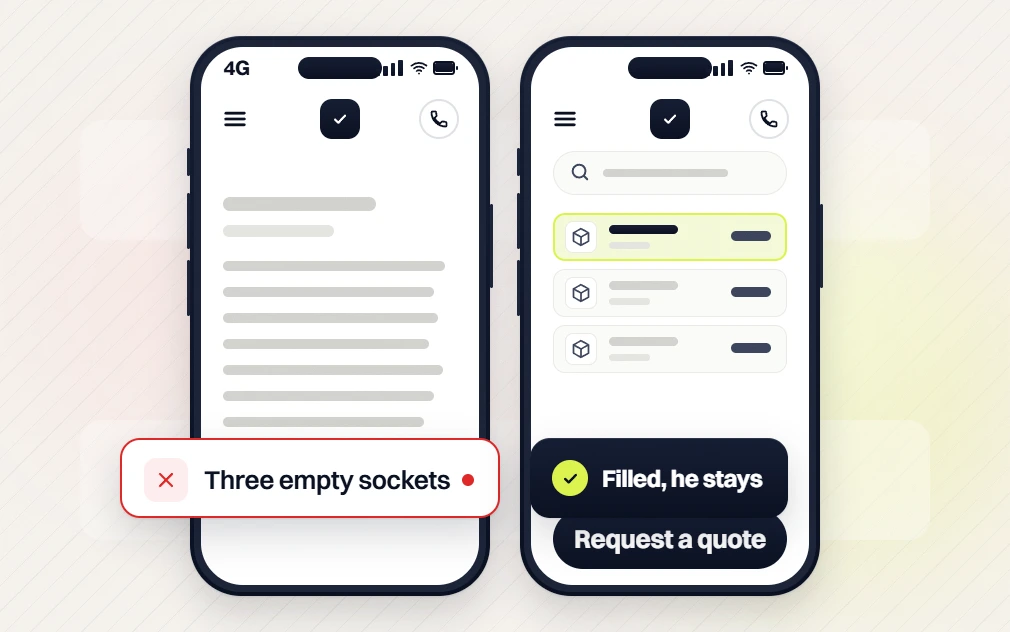
Product pages show specs but no clear RFQ path.

Engineers land on a spec table, scroll to the bottom, and see a generic "Contact Us" form. No configurator, no lead time answer, no CAD download. They bounce to a distributor.

Manufacturing pain point 2 illustration matching the card headline below.
Problem 2

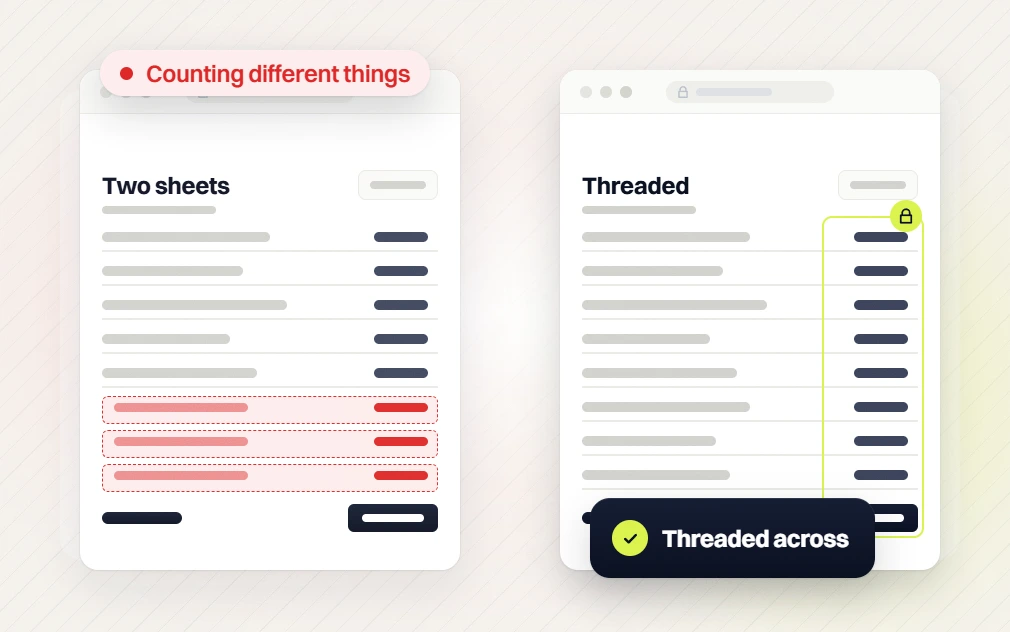
Distributor tier hides end-buyer intent.

You sell through 40 distributors and never see the OEM engineer who Googled the part. Marketing reports impressions. Sales reports RFQs. Nobody sees who the actual buyer is.

Manufacturing pain point 3 illustration matching the card headline below.
Problem 3

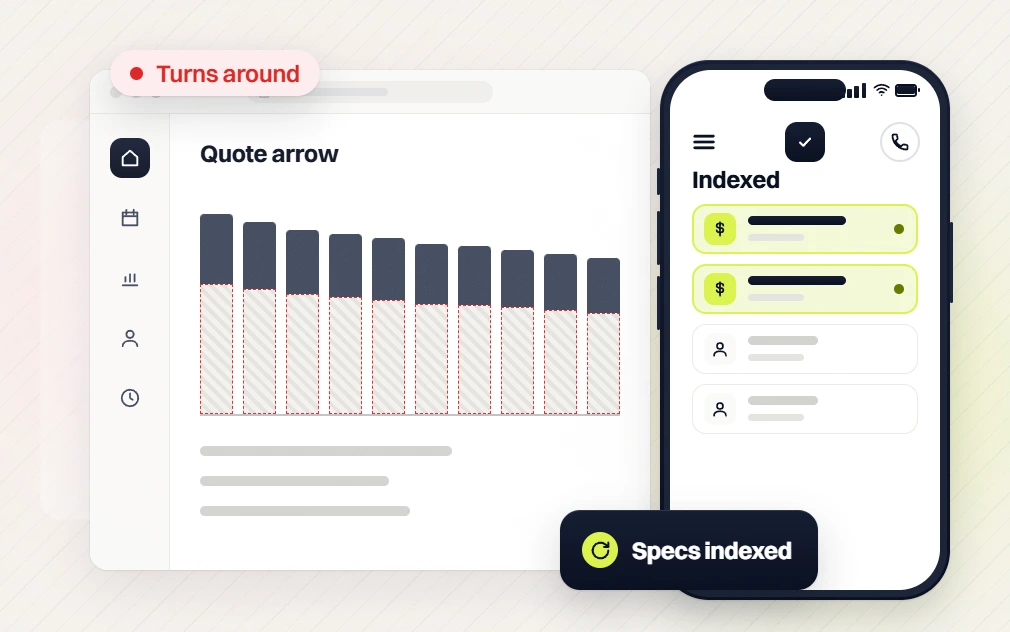
RFQ-to-quote turnaround takes 5 plus days.

By the time inside sales replies with a quote, the buyer already got 3 competing quotes and picked one. Not a pricing loss, a response-time loss.

How we run manufacturing accounts

Four stages.
Every step tied to booked outcomes.

Same rhythm on every manufacturer. Audit before we spend a dollar. Position before we launch an asset. Build against the RFQ. Scale against qualified RFQs and closed orders, not clicks.

01Week 1

Diagnose the funnel

Site, product pages, ad accounts, CRM, and distributor pipeline. Channel-by-channel teardown against qualified RFQs and closed orders per market.

3 fixes ready to apply
02Weeks 2 to 4

Sharpen the offer

Nail the product line, target buyer persona, and RFQ path. Every product page, ad, and sequence built off one positioning brief.

Product line + offer locked
03Weeks 4 to 12

Build the assets

Launch the site, product pages, RFQ flow, and CRM-linked tracking. Weekly written notes, nothing stalled in draft.

Assets live, fully owned
04Month 3 onward

Compound the growth

Compound paid, SEO, and distributor wins. Weekly review tied to qualified RFQs and closed orders, not vanity impressions.

RFQ + revenue tracking live
// What is included

What you actually get from our manufacturing marketing.

Fixed scope. Fixed timeline. Fixed outcomes. Each phase below has a defined deliverable, a written sign-off, and a date on the calendar.

Manufacturing marketing phase 01 · Discovery · multi-channel audit + CRM baseline + written 30-page report + top 3 revenue-moving fixes locked

Full brand audit + CRM baseline in week one.

Week one. Site + ad accounts + review flow + email flow all audited against conversion revenue. Written 30-page report with the top 3 revenue-moving fixes signed off by owner + ops lead before we spend a dollar.

Phase duration
1 week
Sign-off
Top 3 fixes locked
// Deliverables
  • Multi-channel audit
    Google Ads + Meta + SEO + email + review flow all scored against conversion revenue impact.
  • CRM baseline pulled
    CRM + attribution + LTV data captured as day-one baseline.
  • Written 30-page audit
    Every finding, every prioritized fix, every revenue projection in writing.
  • Top 3 revenue fixes locked
    What we do first is signed off, not sprung on you.
Manufacturing marketing phase 02 · Strategy · quarterly channel roadmap with revenue projection + priority service profitability sort + budget allocation per channel

12-month roadmap tied to service profitability.

Weeks two through three. 12-month quarterly roadmap sized against priority service profitability. Higher-margin services get prioritized. Every quarter has a written revenue projection so you know what should hit the pipeline.

Phase duration
2 weeks
Output
Quarterly roadmap + rev proj
// Deliverables
  • Quarterly channel roadmap
    Q1-Q4 planned by campaign, cluster, content piece. Every quarter has explicit sign-off gate.
  • Priority service profitability sort
    Highest-margin services first. Category expansion layered as base load.
  • Written revenue projection per quarter
    Q1, Q2, Q3, Q4 targets sized against real market data + capacity.
  • Budget scoping per channel
    How much goes to Ads, SEO, content, email each month. Adjusted quarterly.
Manufacturing marketing phase 03 · Execution · multi-channel dashboard: Google Ads + Meta + SEO + email + retention flows all tagged same accountable strategist

Every channel running under one named strategist.

Ongoing month 1+. Google Ads + Meta + Local SEO + review flow + content + email + retention flows all executed by a single accountable strategist. No handoffs between agencies. No cross-team blame. One number to call.

Cadence
Monthly execution rhythm
Team
One accountable strategist
// Deliverables
  • Google Ads + Meta
    Every paid channel run by the same strategist. Attribution built once, not fought over.
  • Local SEO + GBP + citations + schema
    Organic + local + review flow + citations all coordinated as one program.
  • Content + service pages
    Monthly editorial calendar tied to keyword priority + service page conversion leverage.
  • Retention flows
    Winback sequences, post-conversion review requests, follow-up all wired to your CRM.
Manufacturing marketing phase 04 · Optimization · weekly A/B test results across channels tied to CRM-verified conversion, written notes log

Weekly testing tied to CRM-verified conversions.

Every week. Cross-channel testing tied to CRM-verified conversions. Ad copy, landing page CVR, keyword targeting, review request timing, retention cadence - every test measured against the number that pays your bills.

Cadence
Weekly test cycles
Attribution
CRM-verified - not clicks
// Deliverables
  • Cross-channel attribution
    Every conversion tagged to the click, keyword, or retention trigger that drove it.
  • Weekly written test notes
    What we tested last week, what won, what shipped this week.
  • Landing page + conversion-flow CVR iteration
    A/B tests on hero, offer, form - measured against conversions, not form fills.
  • Budget shifting between channels
    If SEO is compounding faster than PPC, budget moves. Every shift signed off in the monthly report.
Manufacturing marketing phase 05 · Growth · quarterly revenue attribution report + next-quarter budget allocation with owner + ops lead sign-off

Quarterly scale reviews tied to real revenue.

Every 90 days. Quarterly review with the owner + ops lead showing what conversions drove, what closed revenue looks like, what next-quarter budget should be. Scale decisions grounded in your CRM + capacity, not agency spend targets.

Cadence
Quarterly scale review
Metric
Revenue + capacity
// Deliverables
  • Quarterly revenue attribution
    This quarter: conversions by channel, revenue from marketing, cost per conversion - all CRM-verified.
  • Scale-to-capacity model
    Ad spend + content velocity sized against your capacity + throughput.
  • Next-quarter budget locked
    Explicit sign-off on next quarter allocation across channels.
  • Year-over-year growth report
    12-month rolling report showing revenue growth, CAC trend, LTV trend.
Selected manufacturing work

Real practices.
Real receipts. No borrowed logos.

Three engagements where we tied the work to booked appointments. Numbers verified with the practice owner.

The 12-month math

See what our 3 free fixes could earn back.

Slide in your numbers. Assumes a 20% relative conversion improvement, which is what our first audit typically finds on non-optimized sites.

8,000
50060K
$9,500
$500$50K
1.8%
0.5%5%
What switching earns you
Right now
$273,600
With our 3 free fixes
$328,320
Extra per month
+$54,720/month
Over 12 months, that's +$656,640 back in your practice.
Directional numbers based on a 20% conversion improvement. An industrial strategist walks through your actual funnel on the 30-minute audit.
FAQ

Frequently
asked.

If your question is not here, book a 30-minute call. An industrial strategist answers on the call, not through a sales rep.

What is manufacturing marketing and how does a manufacturing marketing agency work?

Manufacturing marketing is the full stack of channels that pull qualified RFQs from procurement teams and engineers into your sales pipeline. Industrial SEO, technical PPC, spec-first web design, distributor portal support, and lifecycle email for long procurement cycles. A manufacturing marketing agency runs those channels under one accountable roadmap tied to signed contract value, not clicks or impressions.

Manufacturing buyers are different from consumer buyers. Procurement and engineering research for weeks or months before submitting an RFQ. They want spec sheets, cut sheets, CAD files, technical drawings, tolerance data, and material specifications before they will call. Marketing sites that hide that data behind gated forms lose to sites that publish it openly and rank on the technical queries buyers actually type.

At Redefine Web, every industrial marketing retainer starts with a joint RFQ pipeline model. We look at your average contract value, sales cycle, win rate, and current RFQ volume by channel. Then we work backward to a target qualified-RFQ volume and channel mix.

How much does manufacturing marketing cost per month?

Managed manufacturing marketing retainers at Redefine Web run between $999 and $6,500 per month depending on channel mix, content velocity, and media budget under management. Website builds are scoped separately as fixed-price projects starting at $1,500.

Entry retainers around $999 to $2,000 typically cover one channel deeply (usually industrial SEO or Google Ads for RFQ generation) with a modest technical content calendar. Mid-range retainers around $2,500 to $4,500 cover two or three channels with quarterly conversion sprints on spec pages. Enterprise retainers at $4,500 to $6,500 cover multi-channel execution with distributor portal support, ABM for target enterprise accounts, and complex CRM integration.

Ad spend is billed separately by the networks (Google Ads, LinkedIn, trade publications) and does not sit inside the management fee. Content and technical asset production is included in the retainer up to the scoped hours.

How long before B2B manufacturing marketing shows real RFQs?

Manufacturing PPC produces first qualified RFQs in 14 to 30 days. Manufacturing SEO shows first ranking gains on part number and spec queries in 6 to 10 weeks with steady traction by month 4. Website builds go live in 8 to 12 weeks and improve RFQ conversion immediately once spec-heavy content replaces the marketing fluff.

Signed contract revenue lags RFQs by the length of the sales cycle. Most industrial contracts carry 60 to 180 day cycles from RFQ to signed contract because procurement teams cross-check pricing, run internal approvals, and often re-quote. That gets modeled into the pipeline plan on week one so nobody expects month-one contract revenue on a channel designed to feed a long procurement cycle.

Distributor and rep channel work follows a different pattern. Distributor-driven demand shows up as pull-through orders, not RFQs, and needs different tracking against distributor portal engagement and rep enablement content usage.

Do you work with manufacturers outside the United States?

We focus on US-based manufacturers as our primary market. About 15 percent of our manufacturing roster is Canadian or Mexican manufacturers serving North American procurement, plus a small number of European manufacturers with US operations. We do not currently take on manufacturers whose primary market is outside North America.

For manufacturers with global export operations, we handle the North America go-to-market and coordinate with in-region agencies or channel partners for EMEA and APAC. That prevents brand-voice drift while keeping local technical and regulatory expertise where it needs to live.

Manufacturer digital marketing tuning matters more than geography. A US-based CNC machining shop selling into aerospace has different search intent, different compliance rules (ITAR, EAR), and different buyer research patterns than a Canadian pump manufacturer selling into oil and gas. We tune the playbook to the vertical, not just the geography.

How many manufacturing clients do you take per category?

One client per direct-competitor slot per manufacturing category and geography. We will not run SEO or paid acquisition for two CNC shops that compete for the same customers on the same part specs. Category and geographic exclusivity is written into every industrial marketing engagement.

Adjacent categories are fine. A precision machining shop specializing in aerospace and a sheet-metal fabricator specializing in food processing are not competitors and can both fit on the roster. Two aerospace-focused CNC shops in the same region cannot.

Enterprise manufacturers ($20M+ in revenue) get extended exclusivity across neighboring product lines on request. That protects deep account teams from context conflicts across accounts that share procurement teams or investors.

Do we own the ad accounts, analytics, and website?

You own everything. Google Ads, LinkedIn Ads, Meta Business Manager, GA4, Search Console, your CRM integration (HubSpot, Salesforce, Dynamics, or your ERP-adjacent system), and your website. All accounts are created in your name with your billing. Agency users get access as invited collaborators.

The reason is honest incentives. Agencies that own client accounts have leverage to hold data hostage on offboarding. We do not want that leverage because we do not want to keep clients who want to leave.

If you leave, you leave with everything intact: ad accounts, pixels, analytics history, CRM integrations, and the codebase for anything we built. Written offboarding is included in every contract.

What B2B manufacturing marketing channels give the best return on investment?

For most manufacturers under $20M in revenue, industrial SEO plus a spec-first website produces qualified RFQs fastest and cheapest. Google Ads on part number and spec queries closes the search intent gap while SEO compounds. LinkedIn Ads work for higher-consideration industrial products where the buying committee is titled at engineering and procurement leadership.

Trade publication placement (both editorial and paid) matters for categories where buyers still research inside industry publications. Distributor and rep enablement content matters when demand is channel-driven. Direct mail and industrial trade shows still work for specific verticals like custom fabrication and heavy equipment.

A real B2B manufacturing marketing agency recommends channels based on your buyer's research pattern, not a template. If we recommend the same channel mix to an aerospace machine shop and a plastic injection molder, we are guessing.

Do you handle manufacturing lifecycle marketing and long-cycle nurture?

Yes. Lifecycle email for long procurement cycles, dormant-RFQ reactivation, sales-assisted nurture for enterprise accounts, and post-contract expansion campaigns are core to every manufacturing marketing retainer above the entry tier. We build inside HubSpot, Marketo, Pardot, or your ERP-integrated CRM depending on what you already run.

Long-cycle nurture matters more in manufacturing than in most verticals because a 6-month sales cycle means marketing has to keep buyers engaged without being annoying. The right sequence pairs technical content (application notes, spec updates, material bulletins) with occasional soft check-ins from sales. That keeps trust building through the whole cycle.

Post-contract expansion sequences drive 15 to 30 percent of net-new revenue for manufacturers with cross-sell potential. Reorder campaigns, application cross-sell, and new product introduction to existing customers pay back higher than net-new prospecting.

What is the manufacturing marketing pricing model and contract length?

Managed manufacturing marketing retainers run on 6-month initial terms, then continue month by month with 30 days' notice from either side. Website builds are fixed-price projects with a written statement of work, milestone payments, and a defined go-live date. Four retainer tiers per service line: entry, growth, scale, and enterprise custom.

The 6-month term gives us runway to actually improve RFQ pipeline. Month 1 is onboarding, model calibration, and priority fixes. Months 2 through 4 are steady-state execution with weekly optimization. Months 5 and 6 are compounding wins from technical content that took time to rank.

Rate increases require 60 days' written notice. Scope changes require a written change order. If a program is not working, we would rather refund and part cleanly than churn a bad-fit account.

Can you scale manufacturing marketing across multiple product lines or facilities?

Yes. Multi-product-line and multi-facility manufacturing marketing sits at Scale and Enterprise tiers. Enterprise includes per-product-line content clusters, per-facility landing pages with capability details, and consolidated reporting for operations leadership.

Multi-product-line work adds category-specific keyword strategy so different product lines rank on their own technical queries without cannibalizing each other. Portfolio manufacturers with 5+ product lines usually graduate to Enterprise for portfolio-level information architecture.

Multi-facility work maps each facility to its own capabilities page with equipment lists, certifications (ISO 9001, AS9100, IATF 16949), tolerances achievable, and material specialties. That helps procurement teams find the right facility for their specific spec requirements.

How do you measure and report on manufacturing marketing performance?

Every industrial marketing engagement includes a live dashboard, a written monthly review, and a bi-weekly working session with the account lead. The dashboard shows RFQ volume by channel, RFQ-to-quote rate, quote-to-signed contract rate, cost per RFQ, cost per signed contract, and pipeline coverage against sales quota.

Attribution runs multi-touch (first-touch, last-touch, linear) so you see prospecting-driven awareness that closes on a later sales-assisted touch. Every claim ties back to Google Ads, LinkedIn Campaign Manager, GA4, and your CRM (HubSpot, Salesforce, Dynamics, or your ERP-adjacent system) so nothing is unverifiable.

The monthly review pairs numbers with narrative. What worked, what did not, what the next 30 days plan is, and what we need from your team on spec updates, engineering interviews, or facility capability documentation. Every workstream has an owner, a due date, and a written scope.

Does manufacturing marketing work for small custom shops or only for larger manufacturers?

Both. Small custom shops (1 to 20 people) benefit most from industrial SEO on niche capability keywords, Google Ads on specific part number searches, and a spec-first website that ranks on the technical queries their ideal customers search. Entry tier retainers at $999 to $1,500 per month typically cover this scope.

Mid-market manufacturers (20 to 200 people) need multi-channel programs with industrial SEO, technical content publishing, LinkedIn Ads for engineering audiences, and lifecycle email for long procurement cycles. Growth and Scale tier retainers at $2,500 to $4,500 per month handle that scope.

Enterprise manufacturers ($20M+ or 200+ people) need dedicated account teams with per-product-line or per-facility strategy leads, ABM for named enterprise accounts, and portfolio-level reporting. Enterprise retainers at $4,500 to $6,500 per month cover that depth.

Get started

Book a free 30-minute
Manufacturing marketing audit.

Senior manufacturing strategist on the call. Three vertical-specific growth fixes you can apply, with or without us. Written summary in your inbox the next business day.

No slide decks
No sales rep
Written recap included
Primary path

Book your free manufacturing audit.

Drop your email. An industrial strategist reviews your funnel and books the 30-minute audit within one business day.

  • This field is for validation purposes and should be left unchanged.
Free for manufacturers doing $5M+ in annual revenue. We reply within 4 business hours.
Avg. audit-to-fix time
14 days
Practices audited
180+
Median cost per RFQ after fixes
$84