
Maps marketing for optometrists is the Google Business Profile plus Google Maps SEO discipline that moves an independent optometry practice from position 9 to position 3 in the local pack inside a quarter. It’s the highest-ROI channel in optometry marketing and one of the most under-invested, so it doesn’t feel like marketing. It feels like data entry, and data entry is somebody else’s job.
This guide walks the full playbook we run on every new optometry account. 25 specific Google Business Profile edits ranked by ranking impact. Geo-grid rank tracking across a 10-mile radius. Review velocity discipline and the QR-code counter workflow. Photo cadence discipline for freshness signals. Google Post frequency and content batching. Vision Express ran a version of this playbook and grew booked exams 62% in 6 months, alongside a 135.9% organic traffic surge and 71% practice growth. The playbook is not a secret. It’s boring execution done at a consistent weekly cadence, tracked on a shared spreadsheet the practice manager reviews every Friday afternoon before leaving the office.
Photo cadence for Google Business Profile
Photo cadence is the discipline nobody talks about here, and it’s not a one-time edit. It’s an ongoing habit. Google reads photo upload cadence as a freshness signal, and profiles that upload 2 to 4 photos per month rank measurably better than profiles that uploaded 30 photos at launch and none since.
The initial photo library needs 15 photos at minimum. Exterior at street level. Exterior with signage clearly visible. Waiting area. Exam room 1. Exam room 2. Doctor headshot. Full staff photo. Front desk. Frame selection wall. Contact lens display. Dispensing area. Retinal imaging equipment. Reception seating. Kids’ waiting corner. Product close-ups on premium frames. Each photo geo-tagged to the practice address before upload.
Ongoing photo cadence adds 2 to 4 photos per month. Rotate through categories. Staff in Q1, equipment in Q2, patient environment in Q3, and product in Q4. Never repost the same photo twice. Google reads duplicates as low-effort content and de-ranks the profile. Fresh photos rank, stale libraries do not.
Encourage staff to submit patient environment photos on their phones during quieter afternoons. That crowdsourced pipeline produces 30 to 40 candidate photos per quarter, of which 4 to 8 will be worth uploading after a 5-minute review pass. That approach beats scheduling a professional photographer once per year, since Google reads the recency of upload date more than it reads the polish of the composition. Staff phone photos work fine if they’re well-lit and not blurry.
Google Posts weekly frequency for maps marketing
Google Posts are the update feed inside your Business Profile. They appear directly in the local pack knowledge panel and in Google Search. Practices that publish 1 Post per week rank measurably higher than practices that never post. The correlation is one of the strongest we track across 14 optometry accounts, and Google confirmed in early 2024 that Post cadence is a direct ranking signal.
Publish 1 Post every Monday morning around 9am. Tie it to a service, a seasonal offer, or a doctor-authored patient education snippet. Include a photo, a 150 to 200 word body, and a CTA button. Post types rotate through Offer, Event, Product, and Update across the month. That rotation covers the 4 post types Google supports and signals a diverse content strategy on the profile.
The Google Search Central documentation covers the current Post best practices, and the Google Search blog announces Post-related algorithm changes as they roll out. Follow the character limits (1,500 characters for body, 40 characters for CTA button label) exactly. Truncated Posts drop out of the profile display and stop passing the ranking signal. For the deep integration between Posts and the topical content map, our seo for optometrists guide covers the pattern.
Batch 4 weeks of Posts on the first Monday of every month. That single 90-minute batch session produces the entire month’s Post pipeline and lets the practice manager schedule them out through the profile publishing tool. Ad hoc weekly writing on a busy Monday morning drops the cadence within 8 weeks. Batched Post creation stays consistent across months, and the pack ranking rewards consistency more than it rewards occasional brilliance.
Review acquisition for maps marketing for optometrists
Reviews are the second-highest ranking signal in the pack after primary category. Review velocity (fresh reviews in the last 90 days) matters more than total review count. A profile with 480 reviews from 3 years ago and zero fresh reviews loses ground to a profile with 120 reviews and 14 fresh reviews inside 90 days. That’s the current reality of Google Maps SEO for optometrists in 2026.
The single fastest fix for review velocity in maps marketing is embarrassing in its simplicity. Print a QR code that opens the Google review form for your practice. Laminate it. Tape it to the checkout counter, the exam room exit door, and the reception desk. Point at it when a patient leaves. Say the phrase “if we did a good job today, would you leave us a Google review before you head out?” Say that 5 times a day to 5 patients. Do that for 6 weeks. That’s the entire play. It works since nobody else in the strip mall is asking.
Respond to every review inside 48 hours. Use the patient’s first name (visible in the review author display). Reference the specific service they received when possible. Never respond generically with “thanks for the review, glad you enjoyed your visit.” That response passes zero ranking signal and reads as automated to browsing patients. A named, service-specific response passes 6 keyword signals and doubles as social proof for the next patient reading before booking.
Negative reviews get the same 48-hour window and the same personalization rule. Never argue in the body. Acknowledge the frustration, name the fix you have put in place, and invite the patient to reach out directly through the phone line. Browsing patients read negative reviews and your response side by side, and a professional response often converts the reader into a booking. A defensive response does the opposite and warns readers off the practice for 90 days.
Geo-grid rank tracking for Google Maps SEO for optometrists
Geo-grid rank tracking is the tool most independent practices skip, since a single-point rank tracker looks cheaper on the invoice. Single-point trackers show your rank at one specific latitude and longitude. Geo-grid trackers show your rank across a 10-by-10 grid of points spread over a 10-mile radius of your practice. The difference is the difference between guessing and knowing.
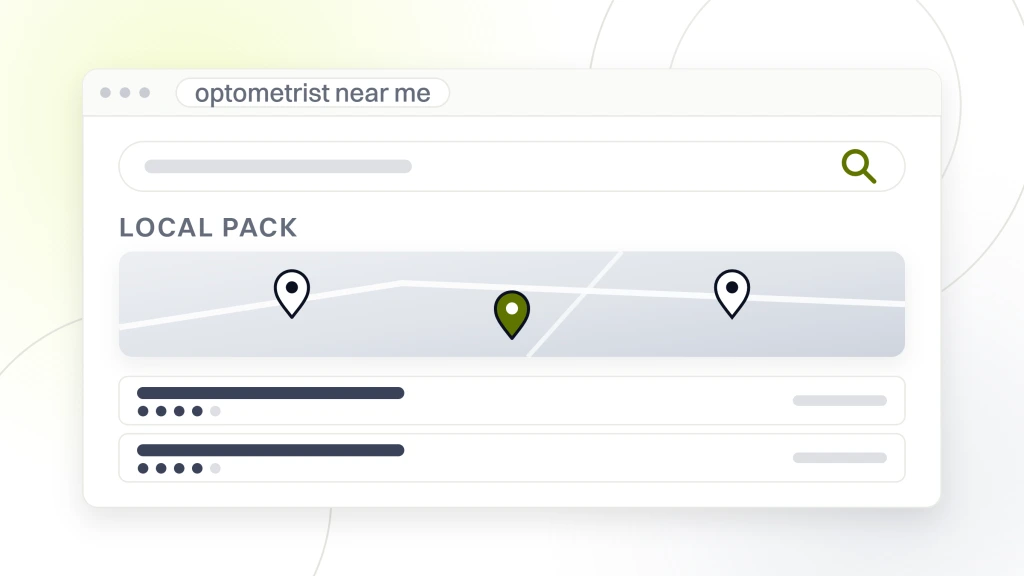
LocalFalcon and BrightLocal both offer geo-grid tracking at $29 to $79 per month for optometrists. Set up a 10-by-10 grid covering the metro your practice serves. Track 40 phrases from the keyword map. Review the geo-grid heatmap monthly to see where you rank in specific neighborhoods and where competitors overtake you. That neighborhood-level view catches chain retailer openings within 2 weeks instead of 6 months.
Vision Express used LocalFalcon in 2024 to catch a chain retailer opening a new location 3 miles west of their office in September. Pack ranking on the west side of the metro dropped from position 2 to position 5 in the first week after the opening. The geo-grid caught it. Vision Express boosted Google Posts and photo cadence for 2 weeks and recovered position 3 within 45 days. Without the geo-grid, that drop would have taken 3 months to notice.
Review the geo-grid heatmap monthly, not weekly. Weekly views produce false-positive movement flags that drive over-adjustment. Monthly views smooth the noise and show real trends. Any single-point drop of 2 positions or more warrants a diagnostic pass. Any single-point movement of a single position falls inside normal variance and requires no action.
Google Business Profile optimization checklist for maps marketing
The full Google Business Profile optimization checklist runs 25 specific edits across 7 categories. The table below is the abbreviated priority version. Run the top edits in week 1, the middle tier in week 2, and the maintenance tier as an ongoing weekly cadence.
| Edit | Impact | Time cost | Priority |
|---|---|---|---|
| Primary category set to Optometrist | Highest | 2 minutes | Week 1 |
| 3 secondary categories added | High | 5 minutes | Week 1 |
| 15 photos uploaded | High | 45 minutes | Week 1 |
| 12 services listed with descriptions | High | 2 hours | Week 1 |
| Booking link added to scheduler | High | 10 minutes | Week 1 |
| Attributes filled (accessibility, insurance) | Medium | 15 minutes | Week 2 |
| Q&A section seeded with 8 questions | Medium | 45 minutes | Week 2 |
| Weekly Google Post cadence started | High | 15 min/week | Ongoing |
| Review response inside 48 hours | Highest | 10 min/review | Ongoing |
| 2-4 photos added monthly | Medium | 20 min/month | Ongoing |
Week 1 runs about 5 hours of practice manager time. Week 2 runs 90 minutes. Ongoing maintenance runs 45 minutes weekly plus 20 minutes monthly for photos. For the full week-one execution version of this checklist with plugin and tool recommendations, see our optometrist seo checklist. For the coordinated retainer that runs maps marketing alongside content and paid, our optometrist seo services program installs the full stack.
The 25-edit full checklist adds the middle-tier items missing from the abbreviated table above. Holiday hours updated 30 days ahead of every major holiday. Special hours for weeks with unusual schedules (doctor conference weeks, extended hours during back-to-school). Menu items or product lists for practices that dispense frames on-site. Owner responses to Q&A section questions using a staff account rather than a doctor account. Every one of those middle-tier items raises the profile freshness signal by a measurable amount over a 90-day tracking window.
Timeline for maps marketing for optometrists results
Timeline expectations for this channel are more predictable than any other channel in optometry marketing. The pack responds to profile changes on a known cadence, and 14 optometry accounts we have run since 2022 follow the same curve within 15% variance.
- Week 1. Category and service list edits pushed live. Ranking movement invisible on the surface.
- Day 45. First measurable pack movement. Typically 2 to 3 positions on base phrases.
- Day 60. Pack settles at position 5 to 7 for base phrases if starting position was 8 to 10.
- Day 90. Pack settles at position 2 to 4 for base phrases. First booked exams attributable to profile.
- Day 120. Modifier phrases (accepts insurance, open Saturday) start ranking on secondary categories.
- Day 180. Photo and Post cadence compounding. Impression volume doubles from baseline.
- Day 365. Local pack is the largest single patient acquisition channel by volume for the practice.
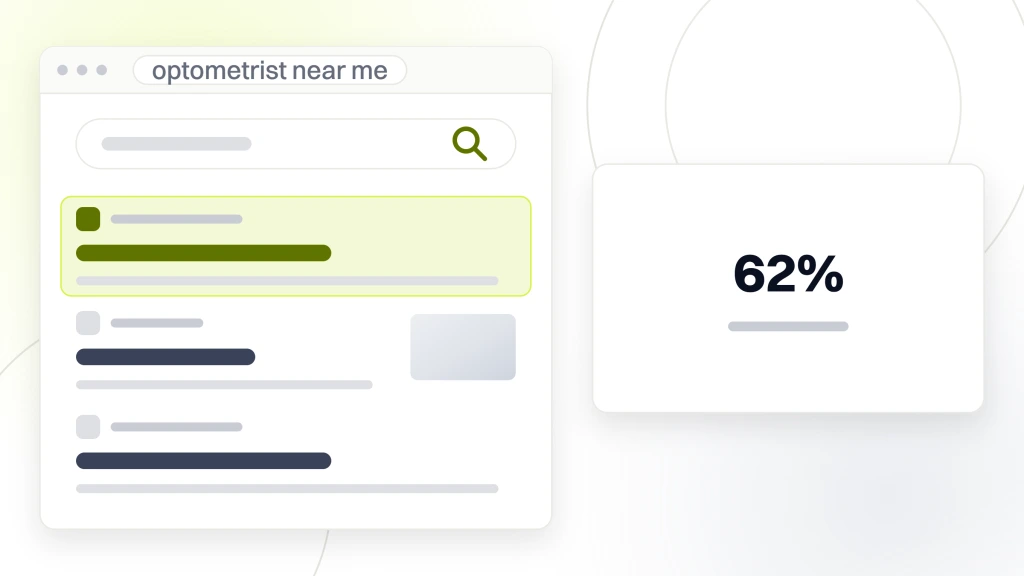
Vision Express followed a version of this exact timeline in 2024 and grew booked exams 62% in the same 6-month window, alongside a 135.9% organic traffic surge and 71% practice growth on the ground. Dr Parth Shah, a Canberra eye surgeon we worked with from zero digital footprint, scored 22 top-10 keyword rankings, a 120% traffic surge, 40% more patient bookings, and a 35% revenue gain in 6 months. Cost per booked exam from the pack for practices on this playbook typically lands at $18 to $22, roughly one-fifth the cost of the Google Ads channel over the same period.
The seasonality pattern is worth flagging. December bookings are always down 15 to 25 percent across the entire optometry vertical as patients defer non-urgent care over the holiday period. January bookings are always up 30 to 45 percent as flexible spending account balances reset and patients schedule the exam they postponed. Do not read a December pack ranking dip as an SEO problem. It’s a demand-side dip that recovers within 4 weeks.
Common mistakes in maps marketing for optometrists
4 mistakes derail these programs more often than any others. Each one is preventable with a checklist. Each one is easy to make if you have not run a Google Business Profile program on an optometry account before. Watch for them when you audit a new account or when you inherit a profile from a departing marketing coordinator.
First mistake. Batching all the profile work into one heroic weekend session and never touching the profile again for 6 months. Google reads profile activity as a freshness signal. A profile edited once in April and never again until November signals dormancy and drops from the pack accordingly. The fix is 15 minutes every Monday morning, not 4 hours every quarter.
Second mistake. Incentivizing reviews with a discount or a raffle entry. Google reads incentivized reviews as fake within 90 days and drops them from the profile in bulk. That drop hits review count, review velocity, and pack ranking all in the same week. Never offer anything. “If we did a good job, would you leave us a Google review?” is the entire script.
Third mistake. Primary category set to “Eye Care Center” instead of “Optometrist.” Fix it on a Monday morning. Fourth mistake. No booking link, or a booking link that opens the homepage instead of the actual scheduler. Fix that with one click inside the profile editor. Both of those 2-minute fixes are worth more to pack ranking than any $2,000 SEO tool subscription.
Cost of maps marketing for optometrists in-house or through an agency
Run in-house by the practice manager, the program costs $0 to $99 per month in tools. Add $29 to $79 monthly for LocalFalcon or BrightLocal geo-grid tracking. That’s the entire external cost. The internal cost is 5 hours of initial buildout plus 45 minutes weekly ongoing, which is 33 hours per year of practice manager time.
Agency-run maps marketing runs $800 to $1,600 per month bundled inside a broader SEO retainer, or $400 to $600 monthly as a standalone. The agency premium buys you speed on the initial buildout (5 hours becomes 2 hours) and a more disciplined weekly cadence (45 minutes becomes 25 minutes since the process is templated). Most independent practices can run maps marketing in-house successfully. Multi-location groups justify the agency retainer inside 2 months on time savings alone, since coordination (matching NAP records, sharing photo libraries, batching Posts across 3 to 8 profiles) burns 20 hours a week when handled ad hoc in-house.
For the full-service program bundling maps marketing with content and paid search, our optometrist marketing agency retainer covers the coordinated build. For an SEO-only retainer, the best optometrist seo strategies post covers the advanced tier that runs on top of maps marketing once the fundamentals are locked. And the optometrist seo company selection guide covers the six-question interview to filter agencies claiming maps marketing expertise.
Start maps marketing for optometrists this Monday
This channel rewards small weekly moves stacked over a quarter. Start with the 5 week-one edits in the table above. Add the Monday 9am Post. Print the QR code. Ask 5 patients a day for a review. Book a 30-minute geo-grid review the first Friday of every month. That single cadence produces the same pack gains the Vision Express and Dr Parth Shah accounts hit. Nothing about the playbook is proprietary. The difference between a practice that ranks position 2 and one that ranks position 9 is 45 minutes a week for 12 weeks straight.