Optometrist Web Design Services to Book More Eye Exams
Optometrist website design tuned for online exam booking, vision-plan clarity, and mobile speed. Patients pick a slot at 11pm on a Tuesday. Local SEO wired into every page. Builds start at $1,500 and go live in 4 to 6 weeks.
Three ways optometry sites lose eye exams before patients start
VSP and EyeMed booking widgets stall the mobile exam flow
Vision-plan filter widgets reflow on every dropdown and time slot. 42% of mobile patients abandon before they can pick an exam time. The out-of-the-box widget is the fastest install and the worst booking flow. Every dropped mobile session is an eye exam going to LensCrafters or Costco Optical.
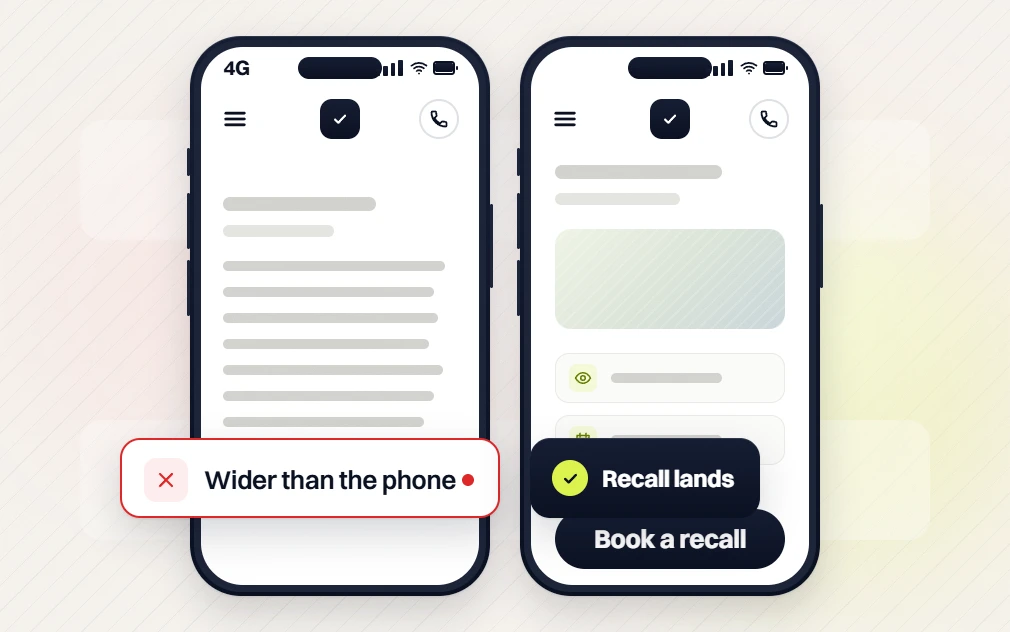
RevolutionEHR and Compulink portal iframes render at desktop width
RevolutionEHR and Compulink patient portals load in an iframe built for a desktop grid. On a phone the buttons overflow and the recall link fails. Lost recalls average $1,180 per month for a single-doctor practice. Contact lens refill orders quietly move to 1-800-Contacts.
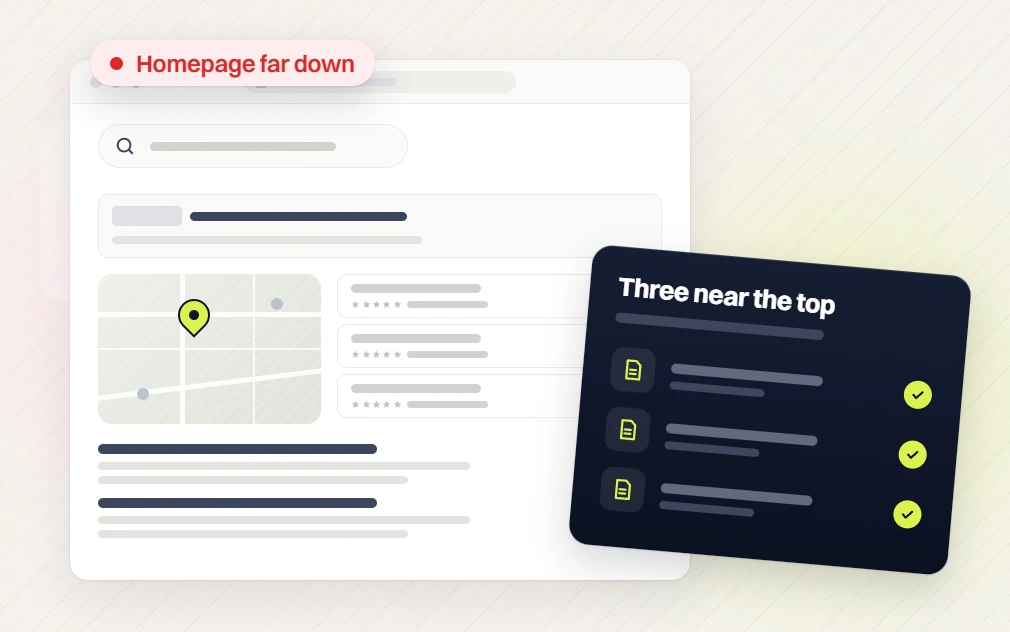
No dry eye, myopia, or scleral pages means no specialty rankings
Without a page per specialty, a dry eye query lands on your homepage and ranks #31 on average. Dry eye, myopia management, and scleral fit patients carry 3x the lifetime value of a routine exam. The traffic goes to whichever OD in town wrote the page first.
Three outcomes every optometrist web design build delivers
Conversion-first architecture and a shorter path from click to booked exam. Every optometrist website design build beats your prior baseline in 60 days.
Schema, targeted metadata, and search intent live in URL slugs from day one. Dry eye, myopia, and scleral pages ready for map-pack ranking at launch.

Your name on the domain, your logins on the CMS, your team trained. RevolutionEHR, Compulink, GBP, GA4, and Search Console stay in your accounts.
Four stages. Every step ends in a sign-off
Fixed scope, written sign-offs, dates on the calendar. Nothing moves to the next stage until the deliverable is approved. Your calendar does not slip.
Discovery that earns the brief
Owner interview, technical audit of your current site, RevolutionEHR plus analytics plus ad accounts, competitor benchmark of five optometry peers, and RevolutionEHR data mapping. The output is a written brief your leadership signs before we design a pixel or write a line of code.
Design built around your optometry patient
Mobile-first design system with conversion patterns baked in from wireframe stage. Every component engineer-validated the same week it is drawn. You get a Figma file your team owns, not a slide deck you cannot edit.
Engineering + integrations that survive your next RevolutionEHR upgrade
WordPress with custom PHP or Next.js by default. LiteSpeed and edge CDN, Core Web Vitals treated as an acceptance criterion, WCAG 2.1 AA verified before launch. RevolutionEHR, Compulink, Uprise on the EHR side. GA4, Meta CAPI, Google Ads pixels wired in.
Launch, then daily monitoring live from day one
Production DNS cutover, 301 map from the old site, uptime and Core Web Vitals monitoring live, and a 30 to 90 day post-launch support window. On day 31 you take the keys and go, or roll into a maintenance retainer.
What you actually get from our optometrist web design services
Five workstreams, every item listed. Nothing lives in a proposal appendix or a phase-two column.
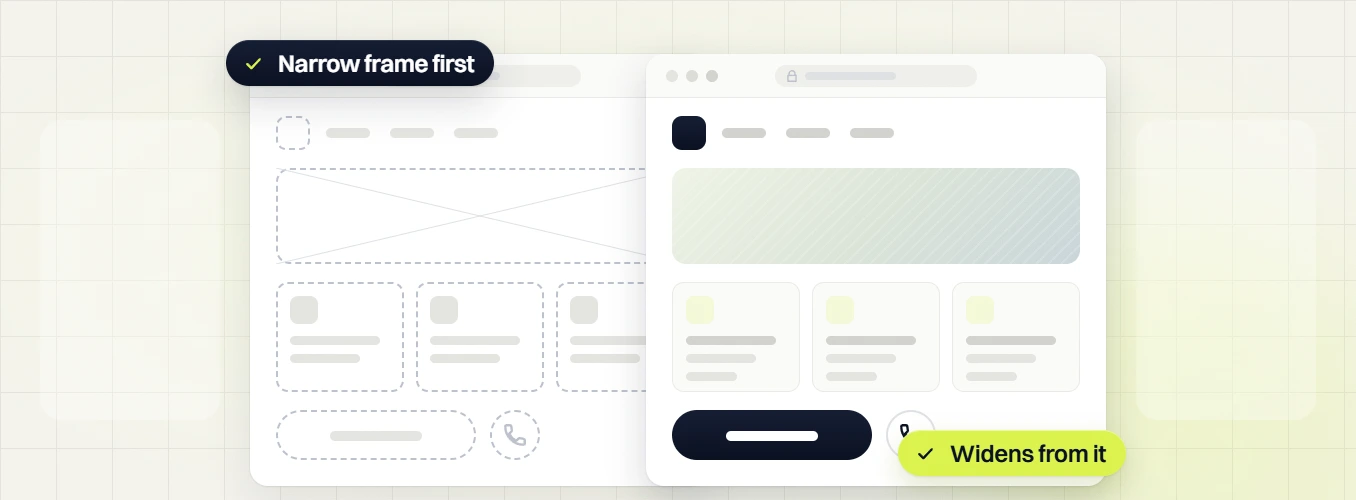
Design that fits how patients pick an eye doctor
Every optometry site opens on a mobile screen with a patient checking VSP or EyeMed coverage. Design starts at 375px, not at a desktop grid. Conversion patterns get built into wireframes, not bolted on at the end. You get a Figma file your team owns from day one and a component library any future developer can pick up without a rewrite.
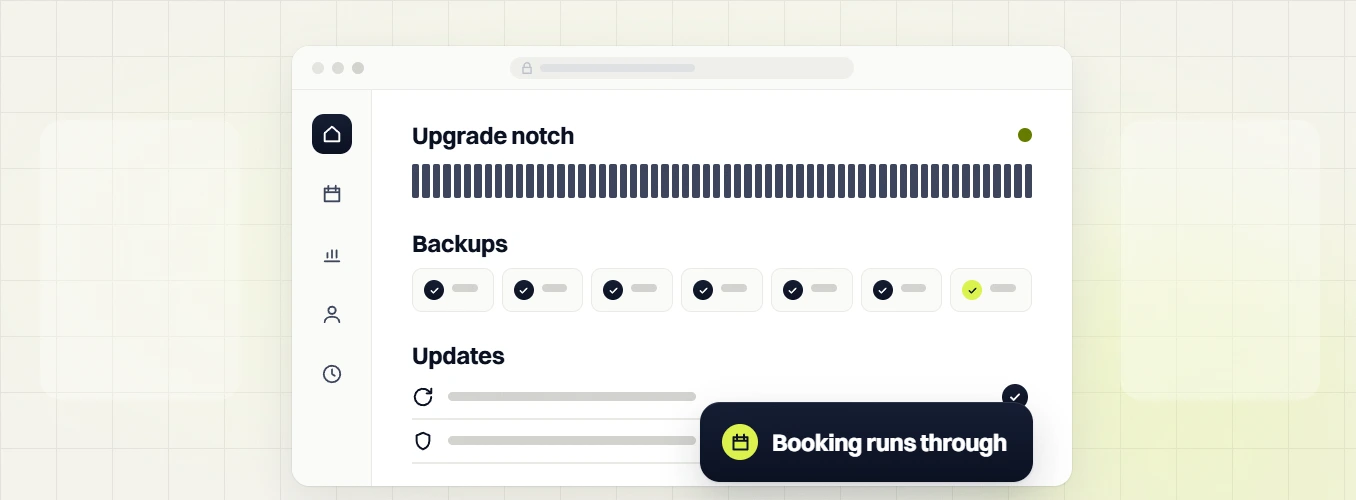
built at 375px, then scaled up. Not the reverse. Every layout survives a thumb-only exam booking flow.
buttons, forms, plan filters, sticky headers, and specialty page templates that you own after handoff.
plan-first hero, one-thumb booking, vision-plan clarity above the fold, click-to-call sticky in the header.
your team, your exam lanes, your frame boutique. Stock optometry photos flag Google duplicate-content filters.
WCAG 2.1 AA colors, focus states, and keyboard flow validated at design, not caught at QA.
every field a copywriter or clinician will edit lives in the Figma file, not in a Google Doc appendix.
WordPress or Next.js built to survive EHR upgrades
Optometry sites live inside a stack that changes every six months. RevolutionEHR pushes API updates, Compulink rewrites its portal, LiteSpeed ships a cache change. We pick technology and patterns that absorb those upgrades without breaking eye exam booking. Core Web Vitals green, WCAG 2.1 AA verified, LCP under 1.8s on a real Pixel over LTE.
the theme is written for your practice, not stitched from a page builder that drops 40 plugins.
multi-location OD groups, headless CMS setups, and marketing sites needing edge rendering.
LCP under 1.8s, CLS under 0.05, INP under 200ms on the acceptance test. Not a hope.
intake and insurance verification route through servers we manage; email sends via Paubox, LuxSci, or MailHippo.
native booking UI that calls the EHR API in the background so mobile does not crash on iframe.
wired without duplicated events, with server-side capture where the pixel breaks first.
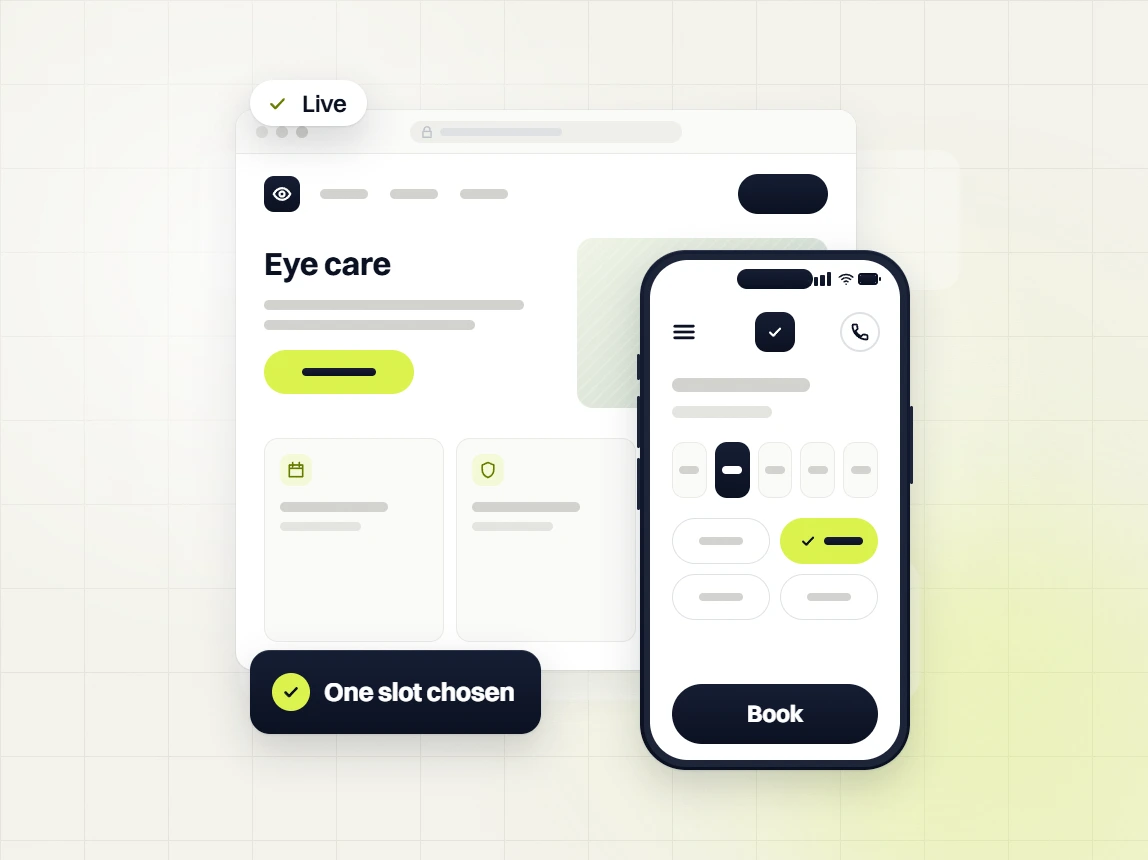
An eye exam booking flow that fits on one thumb
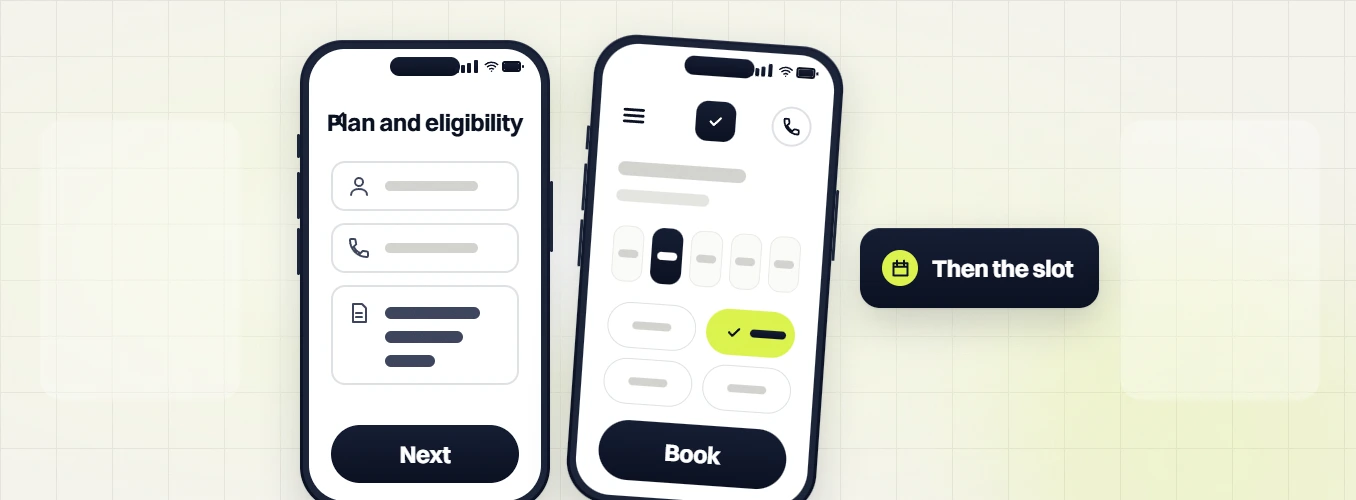
The booking flow is the reason the site exists. Everything else supports it. We build a native front-end UI that calls RevolutionEHR, Crystal PM, or Weave in the background, avoiding the mobile iframe crash that drops 42% of stock widget bookings. Insurance verification splits into two steps: pick your plan first, verify eligibility after. New-patient offers surface in the hero and follow the visitor down the page.
calls RevolutionEHR, Crystal PM, or Weave in the background so no iframe, no crash, no lost sessions on iOS Safari.
pick the plan first, verify eligibility after. Cuts the 42% abandonment rate in half in most builds.
VSP, EyeMed, Davis Vision, Superior Vision, Spectera plus cash-pay. Patients quit sites when they cannot see coverage.
one-tap dial from every scroll position. Older patients call the practice before they book online.
no-cost frame with exam, kids exam special, or dry eye evaluation surfaces first paint. Repeats in the sticky footer.
one-tap refill on the phone keeps orders in the practice instead of quietly moving to 1-800-Contacts.
Every optometry page ready to rank at launch
Optometry sites lose six months of ranking when SEO is bolted on after launch. We build search intent into the URL slugs, put Optician and MedicalWebPage schema on every page, and write a specialty page per treatment cluster at launch. Doctor bios run 600+ words with credentials and specialty certifications so E-E-A-T scores start earning trust from day one.
dry eye, myopia management, scleral lens, orthokeratology, kids exams, glaucoma screening, pediatric. 1,500+ words each.
validated with Google Rich Results Test on every page before publish. Author schema on OD bios.
credentials, education, specialty certifications, review date. YMYL E-E-A-T floor covered.
patient reviews structured for map-pack stars and answer-box eligibility.
`/dry-eye-treatment/` not `/services/service-3/`. Ranks on the query, not a category ID.
Optometrist primary category, three secondaries, services listed, Q&A seeded from front-desk logs.
A launch that does not vanish rankings
The DNS cutover is where most optometry site rebuilds lose organic traffic. We map every ranking URL from the old site, stage the redirects, run a pre-launch crawl comparison, and flip DNS on a Tuesday morning so Search Console has the full week to reindex. Post-launch monitoring runs daily for 14 days: 404s, impression drops, and Core Web Vitals field data all watched.
every URL, every ranking, every internal link inventoried before a single redirect is written.
old-to-new mapping approved by your team before staging goes to production. No orphaned redirects.
crawler runs against staging with the old sitemap to catch every miss before DNS.
not Friday, not Monday. Tuesday gives Search Console the week to reindex before weekend traffic.
404s, impression drops, and CWV field data monitored for 14 days post-launch.
you take the keys on day 31 or roll into maintenance at $199 to $499/mo.
Four web design tiers for every stage of growth
Every line item listed. The quote you get is the invoice you pay. Take any tier as a project fee, or split it into the flat monthly plan.
Fast, credible site converting existing reputation.
Full booking engine: scheduling, checkout, customer reporting.
One brand, every office found, location-level tracking.
Design system the whole group launches on. Ops-team-spec integrations.
Every web design feature, tier by tier
HOVER ANY FEATURE FOR A PLAIN-ENGLISH EXPLANATIONWebsite + design +
Booking + patients +
SEO + visibility +
Care + support +
Real practices, real numbers
See what a $400/mo dental site could book back.
Slide in your practice numbers. Assumes a 32% relative conversion improvement, below the median gain on our dental rebuilds.
Common optometrist web design questions
Straight answers on cost, timeline, EHR integrations, vision plans, and what actually gets built. If your question is not here, book the audit call.
How much do optometrist web design services cost?
+
Optometrist web design services at Redefine Web start at $1,500 and run to $25,000+ for multi-location OD groups. Every tier is a one-time fixed-price project quoted before work starts, not a monthly bill. Launch is $1,500 for single-doctor practices that need to book more exams fast, with a conversion-ready site, core service pages, vision plans stated, a booking widget, and mobile click-to-call. Growth is $3,500 for single-location practices turning paid and organic traffic into booked exams, and adds VSP, EyeMed, and Davis Vision landing pages, eyewear-brand pages, and optometry SEO foundations. Scale is $7,500 for 2 to 10 location OD groups with location-aware URL architecture, per-office pages, per-location analytics, per-office GBP wiring, and a shared component library your team can extend. Enterprise starts at $25,000 for DSOs, PE-backed rollups, and 11+ location operators, with security review, phased rollout, and M&A handoff for acquired practices. Ongoing optometrist website maintenance is priced separately starting at $199/mo and scales to $499/mo for multi-location groups. Care plans cover hosting, weekly patches, nightly backups, and a monthly written report.
How long does an optometrist website design project take?
+
Most projects at Redefine Web launch in 30 days for single-location practices. Multi-location OD groups and franchise builds take 8 to 12 weeks depending on the number of locations and eyewear catalog depth. Launch tier ($1,500) runs 3 to 4 weeks from kickoff to live, covering discovery, design, WordPress build, and DNS cutover. Growth tier ($3,500) runs 4 to 6 weeks and includes deeper vision-plan content plus EHR booking integration with Crystal PM, Compulink, or RevolutionEHR. Scale tier ($7,500) runs 6 to 8 weeks with multi-location URL structure, per-office pages, per-location analytics, and per-office GBP wiring. Enterprise ($25,000+) runs 8 to 12 weeks with a DSO stack, security review, phased tranche rollout, and ongoing optimization scope. The timeline is signed in the SOW before work starts, and every sprint ends in a written sign-off from your team. If we miss a milestone the delay sits with Redefine Web, and we credit maintenance months as makegoods so your practice is not out of pocket for the slip.
What is included in a custom optometrist website design?
+
Every build at Redefine Web includes eight moving pieces so the site launches ready to book eye exams and sell eyewear on day one. Discovery and strategy come first, followed by custom design with no template kits and no page-builder overhead. WordPress or custom PHP powers the build. EHR integration covers Crystal PM, Compulink, RevolutionEHR, Uprise, MaximEyes, and Yocale. Vision plan UX filters cover VSP, EyeMed, Davis Vision, and Superior Vision. Specialty service pages cover comprehensive eye exams, dry eye treatment, myopia management, scleral and specialty contact lens fittings, and pediatric optometry. An eyewear catalog covers frame-brand pages from Ray-Ban, Oakley, Prada, and Tom Ford plus independent designers. Schema and analytics cover Optician, MedicalProcedure, and FAQPage schema plus GA4 and Search Console. Every optometrist site build includes a 30 to 90 day post-launch support window and a written handoff doc covering every credential and integration key. Rollover into maintenance or take the keys and go.
Does your optometrist web design integrate with Crystal PM, Compulink, and RevolutionEHR?
+
Yes. Every optometrist website Redefine Web designs integrates with the major EHR and booking platforms out of the box. Crystal PM gets a booking widget, patient intake form, and read-only appointment feed for reporting. Compulink gets the same booking and intake plus dormant-patient reactivation triggers and per-doctor slot rules. RevolutionEHR gets booking, insurance verification, recall flow, and slot sync every 90 seconds so the front desk never sees a double-book. Uprise, Officemate, Eyefinity, MaximEyes, Yocale, and Weave get the same feature set with cloud-native integration. Where possible we push booked-exam conversions back into Google Ads via Enhanced Conversions and to Meta via CAPI so the ad platforms optimize on actual booked appointments, not raw form fills. EHR deep integration with real-time slot sync and in-network vision plan pre-qualification is included on Scale and Enterprise tiers, and available as an add-on on Launch and Growth for practices that want it. Handoff includes credentials in your practice name and a written runbook for the front desk.
What conversion rate does an optometrist website design typically produce?
+
Well-designed optometrist websites convert 4% to 8% of qualified traffic into booked exams. The Redefine Web client baseline after redesign averages 5.6% visitor-to-booked-exam conversion, measured monthly against the EHR record, not against form fills. Four inputs move the conversion rate up or down. Mobile speed with LCP under 2.5s is the first. Vision plan visibility with in-network plans listed above the fold is the second. Click-to-call placement with a sticky phone bar on mobile is the third. Service and frame depth with one page per service line plus frame-brand pages is the fourth. A stock ChiroMatrix or PatientPop template converts at 1% to 2% for the same practice traffic, which is why practices see 3x more booked exams inside the first quarter after a Redefine Web optometrist website design build. Attribution runs through GA4, the EHR record, and a monthly reconciliation call so you see the same number the front desk sees, not a marketing dashboard number.
Do you handle vision plans like VSP, EyeMed, and Davis in optometrist website design?
+
Yes. Vision plans are a first-class part of every build. Patients search on plan name and filter on in-network first, so the site has to match. Plan-specific landing pages for VSP, EyeMed, Davis Vision, Superior Vision, and Spectera include in-network confirmation, exam-plus-frame allowance explainer, and a plan-specific booking widget. An in-network filter sits on the booking widget itself so patients can qualify before they pick a slot. Plan-name SEO targets the queries patients actually run like VSP eye doctor near me and EyeMed provider open Saturday. Plan-specific CTAs run buttons like Book with VSP and Book with EyeMed. Plan-tied analytics track which plans book, which attach to frame purchases, and get reported monthly against the EHR and POS. On multi-location Scale and Enterprise web design builds, plan pages get per-office variants so a search for VSP eye doctor Brooklyn lands on the Brooklyn office, not the flagship. Plan pages get updated every quarter as VSP and EyeMed rewrite their coverage rules.
Can you redesign an optometrist website without losing rankings?
+
Yes. Every redesign runs through a 5-step SEO preservation process. Rank inventory pulls a full Google Search Console plus Ahrefs report so every ranking URL is inventoried before staging. A 1-to-1 redirect map covers every legacy URL with no 302s and no chains. Content parity keeps H1, meta, and internal-link structure intact on migrated pages. Schema migration ports Optician, MedicalProcedure, and Review schema to the new stack without breaking rich result eligibility. Post-launch Search Console and rank tracker monitoring runs for 90 days so any drop is caught inside the recovery window. On the last 20 optometrist site redesigns Redefine Web ran in the last 18 months, organic traffic held or grew inside 30 days post-launch on 19 of 20 sites. Ranking recovery averages 21 days on a clean migration. The single project that dipped was a legacy site with 12,000 orphaned URLs that took a second sweep to fix, and it recovered inside 60 days once the second sweep was live.
Do you offer multi-location optometrist website design for OD groups?
+
Yes. Scale ($7,500) fits 2 to 10 location groups. Enterprise (from $25,000) fits PE-backed rollups, franchise systems, and 11+ location operators. Multi-location web design at Redefine Web includes location-aware URL architecture using /locations/[city]-[neighborhood]/, per-location optometry SEO with GBP-tied metadata, per-location analytics rolled up in GA4, unified brand across every office with per-location OD bios, and per-office CMS accounts so each office manager can update hours and staff without touching the flagship. Enterprise adds security review, phased tranche rollout for 10+ locations, and M&A handoff for acquired practices that join the group mid-build. Every location gets a page that competes on local intent, not a copy of the flagship page with a swapped address. Per-location schema, per-location review streams, and per-office GBP wiring all live at launch. The 90-day post-launch window covers per-office rank monitoring so no location gets left behind, and multi-office reporting rolls up weekly into a single dashboard your marketing lead can share with the DSO or PE partner.
What CMS do you build optometrist websites on?
+
Redefine Web builds optometrist websites on two stacks. WordPress with a lean custom theme covers most practices. Custom PHP fits teams that want zero page-builder overhead. Both hit Core Web Vitals green at launch with LCP under 1.8s, CLS under 0.05, and INP under 200ms on the acceptance test. WordPress is the default because most practices already run on it and the marketing team can edit copy without a developer. Custom PHP is the pick when speed is non-negotiable for large OD groups and high-traffic sites, or when the practice has an in-house engineer. Neither stack uses Elementor, Divi, Wix, Squarespace, or GoDaddy Builder. Whichever stack, the practice owns the codebase, hosting, and every integration key at handoff. Nothing sits behind a proprietary builder we control. If you leave Redefine Web after launch, the whole optometrist site system comes with you and any future developer can pick it up without a rewrite.
Do we own the optometrist website at handoff?
+
Yes. Every optometrist website from Redefine Web is built in your practice name with your logins. Codebase in your GitHub or Bitbucket. Hosting in your name. EHR integration keys stay with the practice. Ad accounts and analytics in your name from day one, per HIPAA Journal guidance on vendor risk. A written handoff doc covers every account, credential, and third-party dependency the site touches, from Cloudflare to GA4 to your EHR API keys. If you part ways with Redefine Web after launch, the whole optometrist website comes with you and any future developer can pick it up without a rewrite or a proprietary lock-out. Post-launch, every build includes 30 to 90 days of support at no extra cost. After that, monthly maintenance plans start at $199/mo and scale to $499/mo with hosting, weekly patches, nightly backups, and a written monthly report. Care plans renew on a 6-month agreement and cover a full rebuild credit if a site metric misses.
What software do optometrists use?
+
Independent optometry practices run on a small stack of tools: an EHR and practice management system, a booking widget, an insurance verification portal, an eyewear POS, and a marketing site tied to Google Business Profile. The most common EHR platforms Redefine Web integrates during an optometrist website design build are RevolutionEHR, Compulink, Crystal PM, Uprise, MaximEyes, Officemate, and Yocale. For scheduling and comms, Weave and Solutionreach handle two-way text and recall reminders. Insurance verification runs through VSP eServices, EyeMed Enrollment, Availity, and the plan-specific portals. Eyewear POS covers Officemate, Eyefinity, VisionWeb, and Uprise Retail. Rank tracking and analytics run on GA4, Search Console, and Ahrefs. On the marketing side, patients search first on Google Business Profile, then hit the site, so the map pack is where the buying decision starts. Every optometrist website we build treats these tools as first-class integrations, not add-ons. Booking, insurance verification, recall data, and eyewear order tracking flow between the site and the EHR without patients seeing seams.
What is the 3 second rule in website design?
+
The 3 second rule is the idea that a visitor decides to stay on a website or leave within about three seconds of first paint. On an optometrist website design, three seconds is the time you get to answer one question: is this the right eye doctor for me and my vision plan. The winning approach is a plan-first hero that names your top vision plans like VSP, EyeMed, and Davis Vision, a booked-exam CTA above the fold, a click-to-call phone bar sticky on mobile, and one clear photo of the practice or the doctor. Nothing else fights for attention. Every web design build at Redefine Web targets LCP under 1.8s so the first paint arrives inside the 3-second window on a mid-range Android on LTE, tracked with American Academy of Ophthalmology content standards in mind. If the hero has to load fonts, wait for a slider, or pull a third-party widget, the 3 second rule breaks and the visitor bounces to a competitor.
Can I pay someone to design a website for me?
+
Yes. Paying a specialist agency for optometrist web design work is the norm for practices past year two. Redefine Web quotes fixed-price web design tiers from $1,500 to $25,000+ so you know the invoice before work starts, not after a scope creep memo lands in month three. Launch tier at $1,500 fits solo ODs who need a conversion-ready site fast. Growth at $3,500 fits single-location practices adding vision-plan landing pages and eyewear-brand pages. Scale at $7,500 fits 2 to 10 location groups with per-office pages and per-location analytics. Enterprise from $25,000 fits DSOs, PE-backed rollups, and 11+ location operators. Every tier includes discovery, custom design, WordPress or custom PHP build, EHR wiring for Crystal PM and Compulink, vision-plan UX for VSP and EyeMed, specialty page SEO for dry eye and myopia clusters, schema, GA4, and a 30 to 90 day post-launch support window. You own the codebase, domain, hosting, and every integration key at handoff. See guidance from the American Optometric Association on picking a marketing partner that fits an eye care practice.