
Retail SEO gets used as a synonym for ecommerce SEO, and if that is all you mean then you want the ecommerce version and this article is the wrong one. The word earns its own treatment only in one case, which is a business that sells both through a website and through places customers can walk into. That combination creates signals, problems and measurements that a pure online store does not have and cannot use.
So this is written for the second case. Everything here assumes you have at least one physical location, and the catalog mechanics that both kinds of business share are handled separately in our guide to search engine optimization for ecommerce. If you have no stores, read that one instead and skip this entirely.
What retail SEO is, and the reader it is actually for
The distinction worth drawing is not between kinds of product. It is between businesses that exist only as a website and businesses that also exist somewhere with a door. That second kind can appear in results the first kind is not eligible for, and that eligibility is the whole subject.
It matters because the two get conflated constantly, including by people selling the service. A retailer with a dozen stores buying an ecommerce SEO engagement will get catalog work, which is genuinely useful, and will get nothing at all for the half of its business that people find by searching nearby. Those are different workstreams with different evidence and different reporting.
The reverse mistake is just as common. A retailer buys local search work, gets the profiles tidied up, and nobody touches the category pages that would have earned the non-local traffic. Both halves are real and they are usually sold by different suppliers, which is how a business ends up with two competent programs and no one joining them up.
So the useful framing is that this is not a third discipline. It is the overlap, and the work that lives there is the work neither specialist picks up by default.
The three signals Google says decide a local result
This is unusually well documented, which makes it a good place to start. Google publishes what drives local results, and the first thing its page does is close off a question people keep asking.
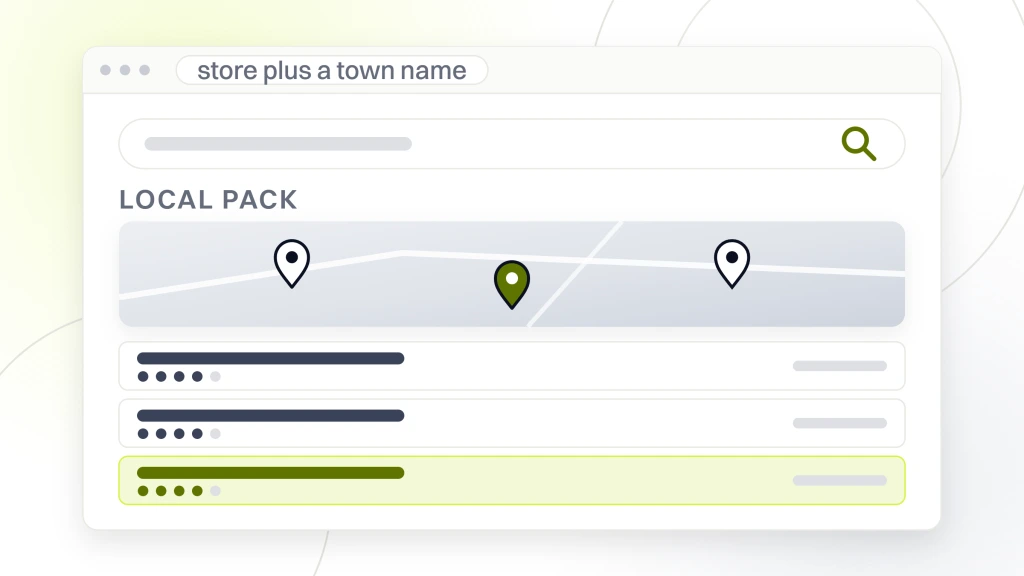
It states plainly that “There’s no way to request or pay for a better local ranking on Google.” That sentence is worth keeping to hand, because it is the answer to anybody offering guaranteed placement in the map results (Google Business Profile Help, read 16 September 2026).
On what does drive it, the page says “Local results are mainly based on relevance, distance, and popularity”, then defines each. Relevance is “how well a Business Profile matches what someone is searching for”. Distance “refers to how far each business is from the customer who’s searching”, and it adds that “If a customer doesn’t share where they are, Google uses what it knows about their location”. The third it calls prominence, explaining that it “means how well-known a business is” and that the factor is “also based on info like how many websites link to your business and how many reviews you have”.
Read those three as a set and the strategic shape falls out. Distance you cannot change, short of opening somewhere else. Relevance is largely an information-completeness problem and is mostly clerical work you can finish. Prominence is the slow one, and it is the only one of the three that behaves like conventional SEO, since it responds to links and to reviews accumulating over time.
That ordering tells you where to spend. Finish the clerical work first because it completes, then work on prominence because it compounds, and stop trying to influence distance because you cannot.
It is worth being concrete about what completing the clerical half means, because people read it as having filled in the form once. The category a location is filed under has to be the one customers would use rather than the one that flatters the business. Hours have to be right including the days you close differently, since a profile showing open when the door is locked is a worse outcome than an incomplete one. Attributes that describe what the place actually offers need setting per location rather than copied across the estate. None of that is interesting and all of it is relevance, which is the one factor Google describes as an information problem you can simply finish.
What qualifies as a location, and what does not
Before any of that, the location has to be eligible, and the rules are stricter than most retailers assume. They are also published, so there is no need to guess.
Google states that “If your business rents a physical mailing address but doesn’t operate out of that location, also known as a virtual office, that location isn’t eligible for a Business Profile.” On shared space it is equally specific, saying businesses “can’t list an office at a co-working space unless that office maintains clear signage, receives customers at the location during business hours, and is staffed during business hours by your business staff”.
There is a physical requirement too, which surprises people. The guidance says businesses showing an address “should maintain permanent fixed signage of their business name at the address”. So a counter inside somebody else’s shop, a locker, or a desk in a building with no sign on it are all weaker than they look.
The rule that catches chains is about duplication. “Do not create more than one page for each location of your business, either in a single account or multiple accounts.” Duplicates arrive by accident, usually from a store being claimed twice over the years by different people, and they split the signals for that location between two entries. Auditing for duplicates is unglamorous and it is frequently the single highest-value thing available on a multi-store account.
Location pages, and the mistake almost every chain makes
Every multi-store retailer ends up building a page per store, and most of them build the same page per store with a different address dropped into it. That is the characteristic failure of this category and it is worth understanding why it fails rather than just being told not to do it.
A templated location page carries almost no information that distinguishes it from its siblings. If forty pages differ only in a postal address and a map embed, there is very little for a search engine to prefer one over another on, and very little reason for a person to stay on one. The pages exist, they are indexable, and they do nothing.
What makes a location page worth having is information that could only be true of that location. What is actually stocked there, which is often not the full range. Whether it does the services some branches do and others do not. Parking, access, and how to find it in an awkward building. Which staff are there and what they know. None of that generates from a template, which is exactly why it is worth something.
The practical test is to read one location page with the address removed and ask whether you could identify which store it is. If you cannot, neither can anybody else, and the page is a placeholder rather than an asset. That is also the honest reason to have fewer, better location pages if writing genuine ones for every branch is not realistic.
Where the information genuinely exists, the person holding it is usually the branch manager rather than anybody in marketing, and that is the practical obstacle. Getting three or four specific facts per store out of the people who run them is a coordination problem, not a writing one, and it is the step where these projects stall. A short structured request asking for the same handful of things from every branch works far better than an open invitation to describe the store, which returns either nothing or a paragraph of the same marketing language you were trying to escape.
In-stock as a search signal, which a pure online store cannot use
Here is the clearest example of something available only to the reader this article is for, and it is the reason retail SEO is not simply a subset.
Google’s guidance describes adding your in-store products to your profile, saying that when you do, “your in-store products might show in local search results and customers can find out what’s in stock”. A business with no physical location has nothing to put in that field. A retailer does, and it connects the two halves of the business in the one place where a searcher is deciding whether to travel.
The reason this is powerful is about intent rather than about ranking. Somebody searching for a specific product near them has already decided to buy it. The only open question is where, and the answer to that question is availability plus distance. Being the nearest shop that has it is a stronger position than any amount of content can buy.
It also raises the bar on your inventory data, which is where most retailers discover the real project. Publishing stock levels that are wrong is worse than publishing none, because the failure lands on a customer who made a journey. So the honest sequence is to fix the accuracy of store-level inventory first and publish it second, and if store-level stock is not tracked reliably, this whole opportunity is a systems project before it is a search one.
The same data allows the thing that resolves the channel argument, which is letting somebody buy online and collect, or reserve and pay in the branch. That turns a visit into a recorded transaction, so the online half gets credit for an outcome it genuinely caused and the branch gets the customer. It is the rare case where a technical capability settles an organizational dispute rather than creating one, and it is a large part of why retailers who get store-level stock right stop arguing about attribution.
When the store and the website compete with each other
This is the tension nobody mentions, and it is structural rather than a mistake anybody made. The two halves of a retail business are frequently measured in ways that put them in opposition.

A search that ends with somebody driving to a branch produces no online transaction. If the website is judged on its own revenue, that outcome looks like a failure, and the work that produced it looks unjustifiable. Meanwhile the branch counts a walk-in with no idea what caused it. The same visit is invisible to one system and unattributed in the other.
The consequences are practical and they shape what gets built. Teams paid on online revenue will not prioritize a store locator, will resist showing local stock that diverts a shippable order, and will treat branch information as an overhead. None of that is irrational given how they are measured, which is why the fix is a measurement decision taken above both teams rather than an argument between them.
If you are commissioning retail search work, settle this before the work starts. Decide whether a store visit counts as a result, decide roughly what it is worth, and write it down. Every prioritization argument for the next year traces back to that one answer, and our breakdown of what belongs in an SEO report covers getting it into the document.
Reviews, which are a ranking input and an operational problem
Reviews sit awkwardly between marketing and operations, and for a retailer they are one of the few prominence inputs Google names explicitly.
The guidance on prominence says the factor is “also based on info like how many websites link to your business and how many reviews you have”, and adds that “More reviews and positive ratings can help your business’s local ranking”. That is about as direct as this documentation gets, and it makes review volume a legitimate thing to work on rather than a vanity metric.
What makes it hard for a multi-store retailer is that reviews are earned per location by the people working there. A chain with one excellent branch and one poorly run one will see that difference in its local results, and no marketing activity corrects it. The reviews are measuring something real.
So treat the distribution rather than the average. A company-wide rating hides the branch that is dragging, and the branch that is dragging is the one losing searches in its own area. Reading reviews by location turns a marketing report into an operations one, which is uncomfortable and usually where the value is.
Replying is worth the effort for a reason that has little to do with ranking. A public answer is read by the people deciding whether to visit, not by the person who complained, so the audience for a reply is everybody who reads it afterward. That argues for answering the specific point rather than posting the same apology under every criticism, since a template signals that nobody read it. It also argues for whoever manages the branch having a hand in the reply, because they are the only person who knows whether the complaint was fair.
What this shares with ecommerce SEO, and where to go for it
Most of a retailer’s search work is not retail-specific at all, and pretending otherwise would waste your time. Three boundaries, stated so you can go straight to the right guide.
- The catalog mechanics are identical. Faceted URLs, variants, supplier-written descriptions, category pages and products that sell out behave the same whether or not you have stores, and they are covered in search engine optimization for ecommerce.
- Online conversion is its own subject. What to change on a product page and a checkout is covered in our guide to increasing ecommerce conversion rate, and none of it changes because you also have branches.
- Platform choice is a capability question. Which system handles search best is worked through in our comparison of the best ecommerce platform for SEO, and the local half rarely decides it.
What is left after those three is genuinely this article’s subject. Eligibility and profile accuracy, location pages worth having, store-level stock, the measurement problem between channels, and reviews earned in branches. That list is short, and its shortness is the honest answer to whether retail SEO deserves separate treatment.
One more boundary worth naming. Finding what is broken across a large catalog is an audit rather than a strategy, and that is set out in our guide to an ecommerce site audit.
How to measure it when the sale happens offline
This is the hardest part of retail search and the part most reporting quietly avoids, because the outcome you care about happens somewhere your analytics cannot see.
Start by accepting that you will not get a clean number. What you can get are several partial signals that together tell a consistent story. Profile actions such as direction requests and calls are recorded and are the closest thing to intent to visit. Store locator use on your own site is yours to measure and is frequently the single most predictive page. Branch-level trends over a long enough window will show whether the areas you worked on moved differently from the ones you did not.
None of those is attribution and none should be presented as revenue. What they support is a directional claim, and a directional claim recorded honestly is worth more than a precise-looking number that somebody will eventually audit and find hollow.
Of those signals the store locator is the one most worth instrumenting properly, because it sits on your own site where you control the measurement. Record which branch was chosen rather than only that the page was used, and you get a demand map by location that no profile reporting gives you. It will occasionally show interest concentrated somewhere you have no branch, which is a commercial finding rather than a search one and tends to be the most valuable thing the work produces all year.
Set the baseline before you change anything, because retail is seasonal and a store network is noisy. Record where each location stands and pick the date you will look again. Our guide to benchmarking SEO covers doing that without fooling yourself, and what this kind of work costs is set out in our piece on local SEO cost.
What we would do first, and what to ask us
Given a retailer with stores and a website, we would spend the first day on the clerical half, because it finishes and the rest does not. Confirm every location has exactly one profile and no duplicates. Check the information is complete and correct on each, since relevance is described as an information problem. Then read the reviews by branch rather than in aggregate.
Only after that would we look at location pages, and the first question there is not how to improve them but how many deserve to exist. A smaller number of pages that say something true about each place beats a complete set that says nothing.
Now point this at us. Agencies like being hired for the interesting half, and on a retail account the interesting half is content while the valuable half is often duplicate profiles and wrong opening information. So ask any supplier what proportion of the first month is clerical, and treat a low number as a warning rather than as ambition. Ask how they will report a store visit, and if the answer is that they will not, ask how they plan to justify the work. Those questions apply to us as much as to anyone, and we would rather answer them at the start than at the first review.
The step that costs nothing is searching for two or three of your own branches and seeing what comes back, including whether anything appears twice. If you would rather have somebody look properly, our free website audit is where to start, and the ongoing work is what we sell as ecommerce SEO services.