
Three different numbers get called your SEO ranking, and only one of them is a ranking. There is your position in a result page for one query. There is a score out of 100 that a free checker hands your page in about nine seconds. There is an authority number a tool vendor invented and sells access to. The first is a position. The other two are grades, and nothing inside a search engine reads them.
Mixing them up costs you the ability to tell whether anything you did worked. You lift a checker score from 62 to 88, nothing happens to your traffic, and you conclude that search is rigged. Or you watch an average position slide and start rewriting pages that were fine. All three numbers are real and all three measure something. None measures what most people assume, and the distance between those two facts is where wasted quarters come from.
The three numbers that all get called your SEO ranking
Before anything else, separate them, because every argument about whether SEO is working turns out to be an argument about which number somebody is looking at.
| The number | Who produces it | What it actually measures | What it cannot tell you |
|---|---|---|---|
| Position | The search engine, at the moment somebody searches | Where your link appeared in one result page, for one query, for one person | What anybody else saw, or what you will see tomorrow |
| Score out of 100 | A tool vendor, from its own checklist | How many of that vendor’s checks your page passes | Anything about your competitors, or about whether you rank |
| Authority number | A tool vendor, from its own crawl of links | That vendor’s estimate of how well linked your site is against other sites in its index | Anything a search engine uses, because no search engine receives it |
Only the first row is a ranking in the ordinary sense of the word. The second and third are grades issued by companies that also sell the software you would use to improve them, which is not a conspiracy but is worth holding in mind while you read your dashboard. If you are trying to work out what belongs in a proper review of a site rather than a score, our SEO audit page sets out what gets examined and in what order.
The rest of this article takes the three apart one at a time, says who issues each, shows what you can check yourself, and ends with the short list of numbers that are actually worth watching every month.
Your position in Google, and why it is not one number
A position is not a property your page holds. It is produced fresh for every search, and the inputs include things about the person searching that have nothing to do with your site.
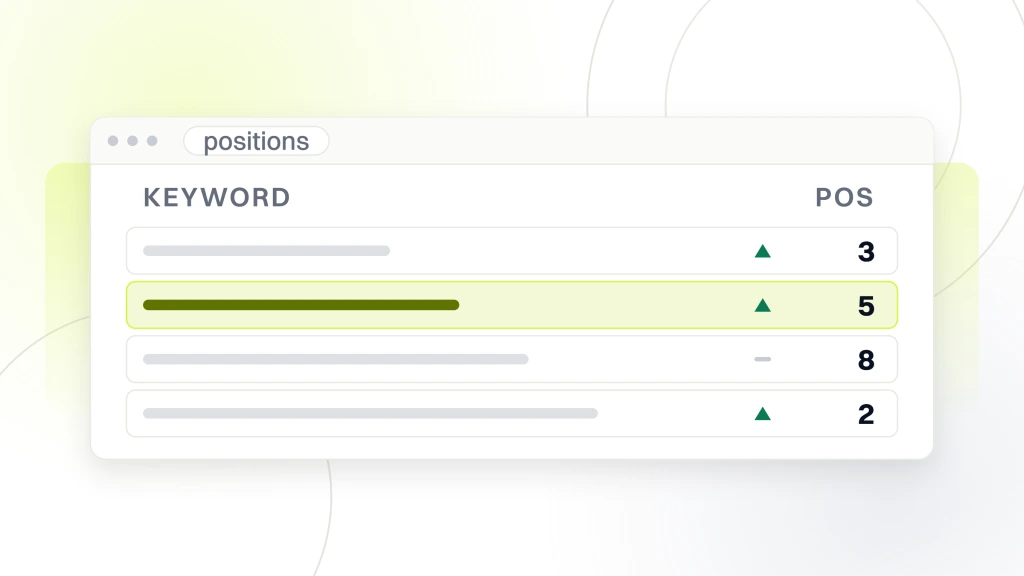
Google’s own explanation of how it ranks results says the weighting is not even fixed across queries. Its documentation states that “the weight applied to each factor varies depending on the nature of your query”, and gives freshness as the example, which counts for more on a news query than on a definition. It also states that “the language of your query determines how most results will be displayed”. So the same page can hold different positions for two phrasings of the same question, asked by two people, in the same minute.
This is why the question “what is my position” has no single answer, and why two colleagues comparing screens will never reconcile their numbers. They are not looking at the same result page. They never were.
What follows from that is practical rather than philosophical. A position is only meaningful as a distribution, which is why the useful version of the question is not where you rank but how often you appear and roughly how high. Every serious measurement below is an attempt to turn a thing that varies per search into a number you can compare month to month, and every one of them loses something in the conversion. Knowing what each one drops is the whole skill.
The score out of 100, and what it is actually grading
Paste a URL into a free checker and you get a number within seconds. That number feels like a verdict. It is a checklist result. Some vendors sell the same thing as an SEO test, which is the identical checklist wearing a word borrowed from science.
Seobility’s checker is a fair example because it publishes its own bands. It describes itself as evaluating “over 200 SEO-relevant factors” and calculating “an SEO score for your page which reflects how well the page is currently optimized for Google and other search engines”. Its published reading is that above 80 percent is a strong foundation, 30 to 79 percent means optimization potential, and below 30 percent means critical issues. Its five categories are meta information, page quality, page and link structure, server configuration, and external factors.
Read that list again and notice what is absent. There is no query in it. Nothing in those five categories compares your page to the pages you are competing with, because the tool was never given a keyword. It graded your page in isolation and then expressed the grade as a percentage, which is a format borrowed from exams and carries an authority the underlying method does not have.
SEO Site Checkup runs a different set, describing its page-level audits as covering more than 70 SEO factors, and is unusually blunt about the gap between a score and a position. Its own page states that “your Google #1 ranking might score 0/100 for AI-readiness”, which is a vendor conceding that the top result in the world can fail its test. If you want the longer comparison of what these tools examine and where they disagree, our breakdown of website checkers goes through them one by one.
The authority numbers, and who decides them
The third number is the one that gets quoted in sales emails. It is a two-digit figure describing how strong your domain supposedly is, and every major tool has its own version under its own name.
The mechanism is straightforward. The vendor crawls the web, builds its own index of links, and scores each domain against the others in that index. The number is therefore relative to a private crawl, and two vendors looking at the same site routinely disagree, because they are ranking it inside two different populations.
The part that matters is the direction of travel. No search engine receives these numbers. They are computed downstream, by companies with no access to the ranking systems, from a crawl that is necessarily smaller than the real web. A rising authority score is evidence that a vendor’s crawler found more links pointing at you, which is often a genuinely good sign, and it is still a measurement of the vendor’s index rather than of your standing.
Use them the way you would use a thermometer with an unknown offset. The absolute reading means little. The change over time, on the same tool, with the same settings, is informative. Comparing your number from one tool against a competitor’s number quoted from another tool is not a comparison at all, and any proposal that does it has told you something about its author.
How to check your SEO ranking without fooling yourself
The most widely repeated method is also the least reliable, and it is repeated by pages that rank well for this exact question. Semrush’s guide, one of the better editorial results on this topic, tells readers in its own FAQ that “you can check your SEO ranking by searching your target keyword in an incognito browser window and noting where your page appears”.
A private window removes your account and your session history. It does not remove your location, your language, your device, or the ordinary variation between one search and the next. Google’s own help documentation, answering a reader whose report said position five while their own search showed position eight, explains the discrepancy as a matter of “many variables, such as your search history, location, and so on”. History is one item in a list, and the private window removes only that item.
So a manual search tells you one true thing, which is what one person saw once. That is genuinely useful for spotting something broken, a wrong page ranking or a title rendering badly. It is worthless as a trend line, and it is actively misleading when somebody runs it, sees a good result, and reports it as the position.
The reliable version is to stop asking what your position is and start reading the distribution in Search Console, which is the only place your own data lives. Our guide to checking a site properly walks through the order to do it in.
What average position in Search Console really measures
This is the number most teams report to each other every month, and Google documents exactly how it is built, which almost nobody reads.
The documentation states that the position shown in the performance report is “the topmost position occupied by a link to your property or page in search results, averaged across all queries in which your property appeared”. Two words in that sentence do most of the damage. Topmost means that if you appear twice on one page, only the higher appearance is counted. Averaged across all queries means the figure you are looking at is a blend of every search term the filter includes, which for an unfiltered report is all of them. Hold on to that closing clause too. Two sections from here it turns out to be the most consequential phrase in the definition.
So a site-level average position is an average over a set of queries you did not choose, weighted by nothing you control. It can move because one page changed, or because a seasonal query came into season, or because you published something new that appears at position 40. None of those are the same event, and the single number cannot tell them apart.
Google addresses that mismatch in the same document. The report shows the average for all searches, and any individual search may differ. The report is not wrong and neither is the person. They are different measurements with the same name.
Why your average position can fall while you are winning
This is the single most useful thing in this article and it follows from one sentence in Google’s documentation that reads like housekeeping.
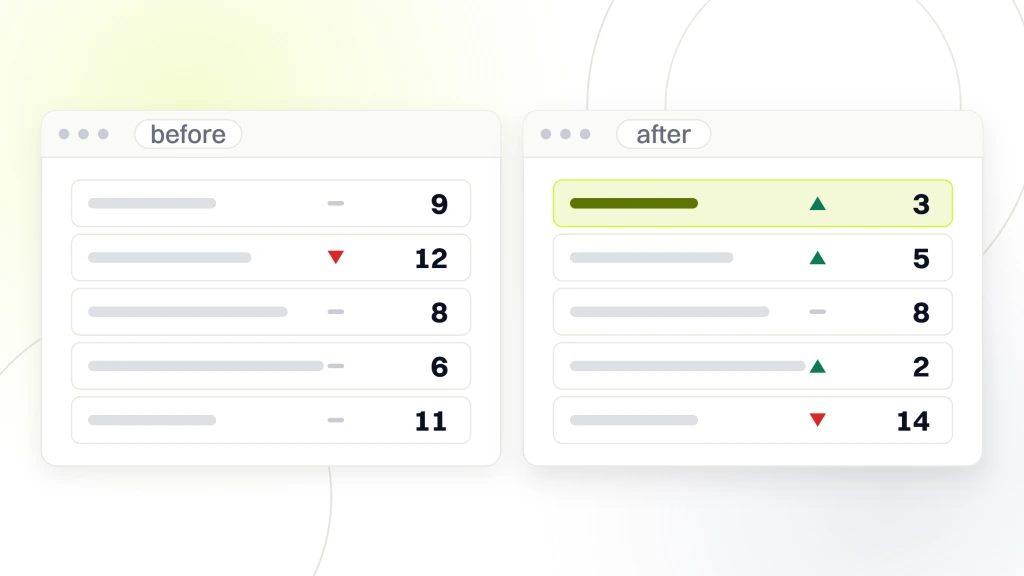
The documentation states that “a link must get an impression for its position to be recorded”, and that if a result does not get an impression, its position is not recorded for that query at all. Your average position is therefore an average over the queries where you were seen, not over the queries where you exist. Everything you never appeared for is simply missing from the calculation.
Now follow what happens when the work starts going well. Your site begins surfacing for queries it never reached before. Those first appearances arrive low, because new entries to a result set usually do. Each one is recorded and pulled into the average. Your average position gets worse in the month your reach expanded, and the report is accurate.
The reverse trap is uglier. A site losing visibility can show an improving average position, because the low-placed queries stop generating impressions and drop out of the calculation, leaving only the strong ones behind. The line goes up while the traffic goes down. Anyone reporting average position on its own, without impressions beside it, can be handed either story and will not know which one they are holding.
What a rank tracker is doing when it hands you a number
Rank trackers exist because the average position problem is real and everybody wants a per-keyword number instead. They solve it by producing their own, and the method is worth knowing.
A tracker does not watch your visitors. It performs its own searches, or reads a stored index of searches it performed earlier, then finds your domain in the result and reports the row it landed on. Ahrefs, for one, describes its free rank checker as returning a ranking position alongside search volume, difficulty, estimated traffic and the ranking URL, drawn from a database it describes as roughly 500 million keywords updated monthly.
Read the word monthly. A number from a database refreshed on that cycle is a snapshot of a search somebody else ran, for a generic searcher, at a time you did not choose. That is a legitimate and useful instrument. It is not your customers’ experience, and the page does not tell you which of the two it is offering.
The practical rule is to treat any tracked position as an index rather than a fact. Watch its direction on a fixed keyword set, never compare a number from one tracker to a number from another, and never let a tracked position overrule what Search Console says about impressions and clicks, because only one of the two is built from searches that really happened to real people.
Where ranking factor lists come from
Search for how ranking works and you will find numbered lists of factors, often with weights attached. It is worth knowing how those are produced, because the method is not what the presentation implies.
The most recent widely reported example was covered by Search Engine Land on 9 September 2026, reporting a survey that asked 131 SEO professionals to rate 103 possible factors, gathering 13,665 ratings in total. Relevance and search intent was picked as a top-three signal by 57.1 percent of respondents and backlinks by 54.8 percent. It is careful, large by the standards of this genre, and useful.
It is also a survey of belief. Nobody in it has access to the ranking systems. The publication describes the result as a snapshot of what those professionals believe the systems value, which is an honest framing that gets stripped away the moment the findings are reposted as a list of factors with percentages next to them. A percentage in that table is the share of practitioners who chose an item, not the weight a search engine assigns it.
Treat these lists as a map of professional consensus, which is worth having, and never as documentation. The difference shows up the moment someone tells you a factor is worth a specific percentage of your ranking. No such number has ever been published by anyone in a position to know it.
What Google says about ranking in its own documentation
The primary source is short, free, and almost never quoted directly in the pages that rank for this topic. It is worth opening yourself rather than reading somebody’s summary of it.
On guarantees, the starter guide is unambiguous. “There are no secrets here that’ll automatically rank your site first in Google (sorry!)” is its own wording, parenthesis included. It also states plainly that “there’s no guarantee that any particular site will be added to Google’s index”, which is a stronger statement than most people expect from the company that runs the index.
On specific beliefs, it settles several arguments in single sentences. “Google Search doesn’t use the keywords meta tag.” “The length of the content alone doesn’t matter for ranking purposes.” And on domains, “from a ranking perspective, the keywords in the name of the domain (or URL path) alone have hardly any effect beyond appearing in breadcrumbs.” Each of those contradicts advice still sold as a service.
The value here is not that the documentation is complete, because it is not, and it deliberately avoids describing how the systems weigh anything. The value is that it is the only source in this entire subject written by the party that actually decides. When it contradicts a tool, a survey or a proposal, it wins, and it costs you nothing to check.
Which of your numbers are worth watching, and which are noise
Here is the short list, built from everything above. Four things repay monthly attention and the rest can be looked at when something has already moved.
- Impressions and clicks on a fixed set of queries. Real searches by real people, counted by the search engine. This is the only category of number in this article with no vendor between you and the event.
- Average position, filtered to one query or one page, never site-wide. Filtered, it answers a question. Unfiltered, it blends everything and answers none.
- The count of queries you appear for at all. Expansion and contraction of reach show up here long before they show up in a position, and this is the number that explains a falling average.
- Clicks against impressions on your best queries. A page appearing often and being chosen rarely has a titles and snippets problem, not a ranking problem, and the fix is hours rather than months.
Everything else is context. A checker score is worth running when you have changed a template, because it catches mechanical breakage quickly. An authority number is worth a glance each quarter. A tracked keyword position is worth watching in a set, as a trend, and never quoted as a single figure in a meeting. Our explainer on what visibility actually measures covers the aggregate version of this problem, because visibility scores have the same vendor-index issue as authority numbers.
How long before any of these numbers moves
The honest answer is documented, and it is less satisfying than either the optimistic version or the cynical one.
Google’s starter guide says that every change takes some time to be reflected, that “some changes might take effect in a few hours, others could take several months”, and that “in general, you likely want to wait a few weeks to assess whether your work had beneficial effects”. That is the range from the only party that knows, and it spans two orders of magnitude, which is itself the finding.
The three numbers also move at different speeds, which catches people out. A checker score changes the second you republish the page, because it is recomputed on demand from the page in front of it. A tracked position changes when the tracker next runs, which on a monthly index is up to a month behind. Impressions in Search Console begin moving when the change is recrawled and real searches start happening, which is neither of the other two schedules.
So a page can show an improved score today, an unchanged tracked position for weeks, and rising impressions somewhere in between, all correctly, all describing the same edit. If you are judging a provider on this, the thing to agree in advance is which number is the scoreboard and over what window, which our guide to choosing SEO services covers alongside what else belongs in the agreement.
What we would check first
Start in Search Console rather than in any tool that offers you a score, because it is the only dataset built from searches that actually happened on your site.
Take your ten most commercially important queries, filter the performance report to each one in turn, and write down impressions, clicks and average position for a period and the same period before it. Three columns, ten rows. That table answers more questions in twenty minutes than a quarter of dashboard watching, because it separates reach from placement from appeal, and almost every diagnosis lives in one of those three.
Then read the rows against each other rather than one at a time. Impressions up and position down is expansion. Impressions down and position up is contraction dressed as progress. Impressions flat with clicks falling is a snippet problem. Only the row where impressions and position both fall is the thing people usually assume they are looking at, and it is the least common of the four.
The judgment underneath all of it is which number you will let decide things, agreed before the numbers arrive rather than after, because a team without that agreement will always find one chart that says the work is going well. If you want that read done on your own site, along with what to fix in what order, our guide to what belongs in an SEO report sets out the format, and our comparison of website checkers covers the tools worth pointing at it. The work itself sits inside our website design and SEO packages if you would rather hand it over than run it.