On this page+
Dental website design cost is the number that stops most practice owners cold. You call 3 vendors, one quotes $2,500, one quotes $8,900, one quotes $22,000, and none of them will explain the gap in a way that helps you decide. Every deliverable list sounds the same. Every vendor claims custom. The math stays impossible until somebody breaks it into real bands with real included work.
This guide is the honest breakdown of dental website design cost in 2026 for practice owners tired of guessing. 4 real price bands mapped to practice size. The 6 line items every legitimate quote itemizes with real dollar ranges. Hosting and maintenance math after launch, timeline expectations, an NC Dental Clinic case study that returned 1,000% patient growth on a rebuilt WordPress site, and the negotiation levers that trim 15% off a bloated quote without cutting scope. Read straight through in about 12 minutes and you’ll know what to ask on Monday.
Dental website design cost broken into 4 honest price bands
Dental website design cost splits into 4 real bands the market actually pays. Band 1 is the SMB template tier at $799, $1,299, or $1,999 for a small-practice site with limited customization. Band 2 is a responsive web design refresh at a flat $1,500 for practices who like their content but need a mobile-first rebuild. Band 3 is pay-monthly at $99, $199, or $349 per month for owners who want to spread the fee across 12 to 24 months. Band 4 is fully custom at $18,000 or more for a multi-provider or DSO-scale site with bespoke design, integrations, and a full SEO baseline.
The band you pick should map to page count, provider count, and how many new patients per month you’re targeting from organic search. A 5-page single-provider practice site fits SMB Foundation at $799 and pays back inside 6 months if the copy is honest and the local SEO baseline is set. A 20-page multi-provider practice site with online booking, HIPAA-safe forms, and per-service pages fits fully custom at $18K+ and pays back inside 12 to 18 months for practices targeting 8 or more new patients per month.
What the 6 quote line items actually cover
Every legitimate dental website design cost proposal itemizes 6 line items. Discovery and information architecture at $600 to $2,400. Design mockups at $1,200 to $6,000. Development and block build at $2,000 to $9,000. Content and copy at $2,000 to $6,000. SEO baseline (schema, sitemap, per-page targeting) at $800 to $3,000. Training and handover at $300 to $1,600. Add these up and you land close to the band your practice size fits. Vendors who bury this into one lump-sum number are hiding either padding or missing scope. Ask for the itemization on paper before the second meeting.
Where the dental website cost gap between vendors actually sits
The gap between a $2,500 quote and a $22,000 quote is not markup. It’s scope. The $2,500 vendor sells you a 5-page template with stock imagery and no SEO baseline. The $22,000 vendor sells you 20 pages of custom design, per-service pages with local intent, provider bios, HIPAA-safe forms, integrations with LocalMed or Weave, and a real SEO baseline. Both are honest offers for what they are. Neither is honest as a like-for-like comparison until you force the same 6-line-item scope onto both proposals and see what falls out.
Cost of dental website design after launch: hosting and maintenance
Cost of dental website design does not end on launch day. Managed WordPress hosting runs $25 to $150 per month for a small practice site, $150 to $500 per month for a multi-provider site, and $500 to $2,000 per month for a multi-location or DSO-scale site. Post-launch maintenance retainers run $199, $299, or $499 per month for the tiers most practices pick, and $2,000 to $4,000 per month for retainers that also cover SEO or paid ads on the same site. Budget the annual all-in on day one, not the build fee in isolation.
Cheap hosting is where most practices lose the money they saved on the build. A $12 per month shared hosting plan on a big-box provider costs you an extra 400 milliseconds on every page load, which tanks your mobile page speed score, which loses you rankings, which costs you 20% of the organic traffic you were paying the build to earn. Managed WordPress hosting at $35 to $90 per month is worth the difference on any practice site. See our dental website content writeup for how content structure ties into hosting choice.
Premium plugin renewals
Premium plugins add real cost every year. Advanced Custom Fields Pro at $249 per year. Gravity Forms at $259 per year. WP Rocket for caching at $59 per year. RankMath Pro at $199 per year. Integration plugins for booking systems (LocalMed, YAPI, Weave) at $199 to $399 per year. A real dental site runs $800 to $1,600 per year in plugin licenses alone. Vendors who never mention plugin renewals in the original quote are the vendors who send you a $980 invoice in month 13 for the renewals you didn’t know were coming.
Compliance and security add-ons
Dental sites need ADA accessibility compliance (an $89 per month plugin or a one-time $2,400 audit and remediation), HIPAA-safe form handling (a specific plugin or a HIPAA-safe CRM integration), and standard WordPress security (Wordfence Premium at $99 per year or Cloudflare Pro at $20 per month). Total compliance add-on cost lands at $500 to $2,000 per year on top of hosting and plugins. Skip these on a low-traffic personal site. Include them on any practice site that handles patient inquiries. See our dental marketing for dentists hub for the compliance framing.
Dental website design timeline against your launch date
Dental website design timeline runs 4 to 24 weeks depending on scope. A child-theme small-practice site ships in 4 to 8 weeks. A fully custom build ships in 8 to 14 weeks. A multi-location DSO project ships in 12 to 24 weeks. Timelines slip when the practice side is slow on content, revisions, or approvals. Every week of practice-side delay pushes launch back by 2 weeks on the vendor side, since the vendor rebooks the team on other work. Lock the content, the copy, and the single approver on day one.
You can compress a timeline by staging deliverables and paying a rush fee. A 12-week custom build compresses to 8 weeks when the practice commits to 2-day revision turnarounds and pays a 15% rush fee. Any tighter than 8 weeks on a custom build risks either a shortcut in the SEO baseline or a rushed content pass that reads like it was written on a plane. Rush is not always worth it. Ask why the timeline matters and whether launching 2 weeks late is actually a business problem.
Phase breakdown across a 12-week build
A 12-week custom dental website build follows a predictable phase breakdown. Weeks 1 and 2 are discovery, sitemap, and information architecture. Weeks 3 through 5 are design mockups and revisions. Weeks 6 through 9 are development, block building, and content input. Week 10 is QA, cross-browser testing, and accessibility review. Week 11 is practice review and revisions. Week 12 is soft launch, DNS switch, and post-launch monitoring. Slip any phase and the whole timeline slides. Vendors who share this breakdown at kickoff run an organized project. Vendors who can’t describe the phases are winging it.
Practice-side delays are the real killer
Vendors get blamed for timeline slips. The truth is practice-side delay causes 70% of missed launch dates. Slow content approvals, an owner traveling for 2 weeks during design signoff, a change of mind on the homepage headline in week 9 that triggers 3 cascading redesigns. All of it slides the timeline. Lock a single approver on day one. Give them 2 business days to respond to every deliverable. Any slower than that and the timeline gets pushed by the exact number of extra days you spent approving.
Case study: NC Dental Clinic 1,000% patient growth on a rebuilt site
NC Dental Clinic in Vista, CA had 20+ years of offline reputation and almost no digital presence. Their old website was insecure, slow, and unranked. No top-10 search positions, inconsistent citations, weak Google Business Profile, and fragmented marketing managed by multiple vendors. They averaged 1 to 2 new patients per month from digital. The practice needed a real site and a coordinated strategy, both scoped honestly.
We rebuilt the website on a secure HTTPS foundation with mobile-first design, conversion-focused service pages, and a full local SEO structure. We paired the build with advanced local SEO (NAP cleanup, citation consistency, keyword-mapped service pages), a targeted Google My Business PPC campaign, and local video marketing. Over the 6-year engagement window, NC Dental Clinic went from zero digital traction to 12 to 16 new patients per month, 1,000% patient growth, 385% organic traffic growth, and 500% ROI on marketing spend. The website was the foundation everything else compounded on. Stack: WordPress, GMB, Google Ads, GA4.
The dental website design cost that returned 1,000% growth
The NC Dental Clinic rebuild landed in the fully custom band. Custom design, mobile-first structure, secure HTTPS, per-service pages with local intent, provider bios, and full SEO baseline. Six-figure ROI on a mid-five-figure investment inside 24 months. The build paid back inside the first year since the website was scoped against a patient-growth target, not against a lump-sum negotiation. The vendor who quoted $4,000 for a template with a color swap could not have delivered any of these numbers, since the template would have been the same broken site NC Dental Clinic started with.
What to steal from the NC Dental Clinic build
Steal the scope-against-patient-target discipline. Pick a monthly new-patient number and scope the site to hit it. Steal the mobile-first plus HTTPS plus service-pages structure. Every dental website needs all 3 or it won’t rank in 2026. Steal the coordinated marketing posture. The website alone did not produce the 1,000% growth. The website plus local SEO plus GBP plus video produced it. Skip any 1 channel and the return drops significantly. See our dental website marketing writeup for the full coordinated approach.
Negotiation levers that trim a dental website design proposal
Every dental website design proposal has 10 to 20% of soft cost you can negotiate without cutting scope. The soft cost lives in 3 places. First, the discovery phase, which most vendors overweight relative to actual hours. Second, the copywriting line, which you can bring in-house if you have a marketing lead or an internal writer. Third, the training and handover session, which most vendors can compress from 4 hours to 2 without losing anything. Ask the vendor to break out those 3 line items and offer to compress each one. That is a 15% trim on most proposals.
Do not negotiate on development hours. That is where the vendor’s margin lives, and cutting it makes the vendor rush the build. Do not negotiate on the SEO baseline. That is where your ranking traction gets set, and cutting it costs you 6 months of organic growth. Do not negotiate on the post-launch retainer. That is where your site keeps earning after launch, and cutting it means month 7 brings a $2,400 emergency fix bill on a site the vendor no longer feels obligated to maintain properly. Negotiate on the soft costs. Leave the technical spine intact.
Bring copywriting in-house
Vendor copywriting runs $2,000 to $6,000 depending on site size. If you have a marketing lead or an internal writer, you can bring that in-house and save the full line item. Provide the vendor with clean copy for every page at the start of the design phase. Keep it to spec. Vendors love this since content delays are the biggest cause of missed launch dates. You save the money, they hit the timeline, everybody wins. Don’t do this if you do not have a real writer. Vendor-written copy from a proper writer beats owner-written copy from an owner who is not a writer.
Compress the training session
Most vendors quote a 4-hour training and handover session at $700 to $1,600. You can compress it to a 90-minute recorded walkthrough for $300 to $500. That saves the difference and gives you a video you can rewatch later. The tradeoff is that a live session lets you ask questions in real time. If your team is already familiar with WordPress, the recording works. If nobody on your team has touched WordPress before, take the live session. The negotiation is about which one you actually need.
Red flags that inflate dental website cost
Every dental website cost conversation has 3 red flags that predict a bad build at any price. First, a vendor who quotes without asking about page count, integrations, or provider count. That vendor is guessing and the invoice will surprise you in month 2. Second, a vendor whose portfolio has no live dental sites. That vendor will learn on your dime, and the dental website cost you pay covers their education. Third, a vendor who cannot name the theme or the plugins they plan to use. That vendor is subcontracting the work.
The 4th red flag is a proposal that reads like a legal contract instead of a scoping document. Real scoping documents describe what gets built in plain English, with page counts, template counts, integrations, and content assumptions. Legal-heavy proposals with 12 pages of liability language and 2 pages of deliverable description are protecting the vendor at your expense. Ask for a scope document you can read in 10 minutes. If the vendor can’t produce one, they are not organized enough to run the project on time. See the ADA practice management resources for baseline expectations on vendor selection.
Deposit signals hidden in the payment schedule
Legitimate vendors take 30 to 50% of dental website design cost as a deposit, 30 to 40% at design signoff, and the balance at launch. Vendors who ask for 100% up front are running a cash-flow game, not a project. Vendors who require the deposit in cryptocurrency, wire transfer with no invoice, or an unnamed offshore account are running something worse. A real deposit lands on a proper invoice with your practice name and the vendor’s tax ID. Anything else is a signal to walk away before the contract signs.
Portfolio inflation as a cost signal
Vendors who list 200 dental practice logos on their portfolio but can only show live work for 8 or 10 of them are inflating their track record. The 190 logos are usually one-off small engagements from years ago. That inflation predicts a high dental website cost that never quite matches the deliverable. Ask for live dental sites launched inside the last 18 months. Any vendor who cannot produce 3 examples with mobile PageSpeed scores you can verify is a vendor whose price does not match their portfolio.
The classic quote conversation with the wrong vendor goes like this. You send an RFP describing a 10-page dental site with online booking and provider bios. 3 vendors respond. One quotes $3,200. One quotes $12,500. One quotes $34,000. You ask the $3,200 vendor what is included and they say a website. You ask the $34,000 vendor what is included and they say strategy. Neither answer helps you decide. The $12,500 vendor sends a 2-page itemized quote with hours per phase and gets the meeting. Turns out clarity beats charisma, and neither one is expensive.
Dental website design cost: DIY vs freelancer vs agency
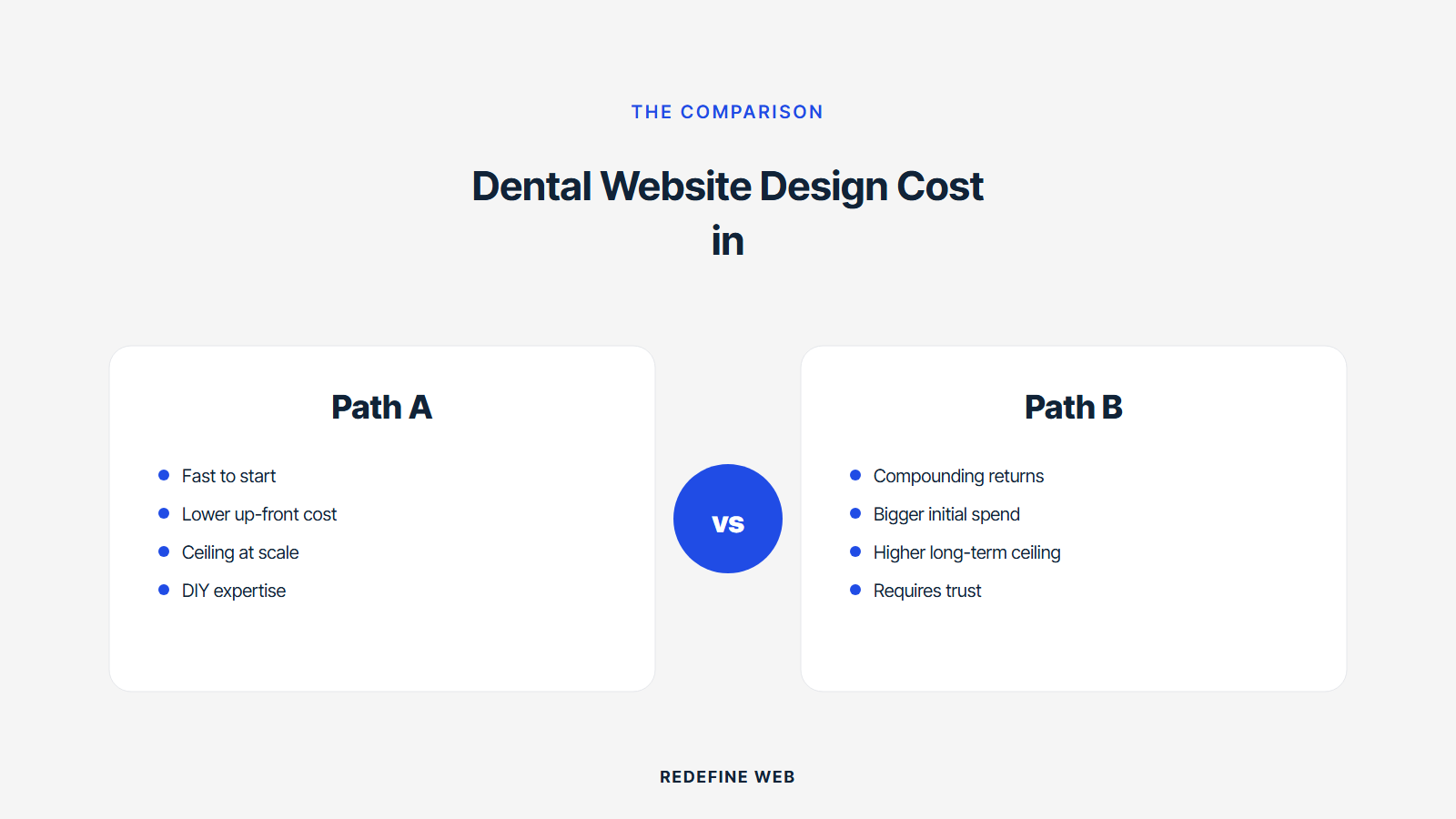
Dental website design cost varies dramatically by build path. DIY on Squarespace or WordPress costs $200 to $600 in software and 40 to 80 hours of your time (which is not free). A senior WordPress freelancer costs $6,000 to $18,000 for a full custom build and ships in 8 to 12 weeks. A dental-specialty agency costs $12,000 to $28,000 for the same scope and ships in 10 to 14 weeks. The gap is not markup. Agencies split the work across a designer, developer, project manager, SEO lead, and sometimes a copywriter. That coordination is where the extra spend lands.
Pick the freelancer when your brand assets are locked, your copy is written, and your scope is under 15 pages. Pick the agency when you need brand strategy, information architecture, copy, SEO, and development coordinated as one program. Pick DIY only for a temporary business-card site while you decide what a real practice website should look like. Match the choice to whether your internal team is already senior enough to run strategy in-house.
When DIY is the right call
DIY dental website design cost makes sense in 3 situations. A brand-new practice that needs a placeholder site for 6 to 12 months while cash flow stabilizes. A specialty practice with a locked patient base that does not need lead generation from the site. A practice inside a DSO where the corporate marketing team runs a shared template and the local practice site is just a location page. Outside these 3 cases, DIY costs you more in lost patient revenue than a real build would have cost in fees.
When to pick an agency over a freelancer
Pick an agency over a freelancer when the practice has multiple locations, when the marketing scope includes SEO and paid ads beyond the site build, or when the internal team does not have someone senior enough to manage a freelancer. Agencies bring project management, coordinated specialists, and post-launch continuity that freelancers can’t match at scale. Freelancers bring lower cost, faster turnaround on smaller scopes, and direct communication without account-executive middleware. Neither is universally better. Match the choice to the scope. See our dental marketing for dentists hub for the broader agency-versus-freelancer decision.
Frequently Asked Questions about dental website design cost
Practice owners scoping a dental website design cost project ask the same 7 questions on every discovery call. The answers below reset expectations against the 4 real bands, the ongoing spend after launch, and the traps that inflate a proposal without adding value.
Where to start scoping your dental website design cost
Dental website design cost is easy to compare when you send the same 6-line-item request to 3 vendors. Discovery. Design. Development. Content. SEO baseline. Training. Same list, same page-count assumption, same integration list. Compare the numbers side by side. The vendor whose numbers cluster around the middle of the market with clean itemization is the vendor you invite to a full scope call. The vendor 40% below the middle is either missing scope or cutting a corner you can’t see yet. The vendor 40% above the middle is padding.
Ready to scope a dental website build with real itemization, our dental website marketing writeup covers the full engagement scope. For the copywriting side that ties into every quote, see our dental website content writeup. For measurement of the return after launch, see our dental marketing ROI writeup. For a broader website pricing benchmark, see HubSpot on website pricing patterns. For authoritative Core Web Vitals benchmarks that dictate hosting choice, see the web.dev Core Web Vitals reference.
Frequently asked questions
What is dental website design cost in usa
In the United States, a professional dental website typically runs from about 3,500 dollars for a small template build to 25,000 dollars or more for a fully custom, conversion-focused site with booking integrations. Most single-location practices land between 6,000 and 12,000 dollars for a modern, mobile-first design that includes 8 to 15 pages, HIPAA-aware forms, and basic on-page SEO. Multi-location groups and DSOs often pay 18,000 to 60,000 dollars for location schema, service-line templates, and analytics wiring. Ongoing hosting, security, and content updates add roughly 100 to 400 dollars per month. Cheaper offshore builds exist near 1,500 dollars, but they rarely convert visitors into booked appointments, so the effective cost per new patient ends up higher than a mid-tier custom project.
How much does it cost to design a dental website?
In 2026, a dental website typically runs from about $3,500 for a small template build to $25,000 or more for a fully custom, high-end site. Standard single-location practices land in the $4,500 to $9,000 range on WordPress with 8 to 15 pages, real photography, HIPAA-safe forms, and on-page SEO. Costs climb past $15,000 when you add multi-location routing, custom photography and video, deep insurance integrations, or booking widgets tied to your practice management software. Complexity, page count, and level of custom design drive the gap far more than the vendor's zip code. Ask any vendor to show a line-item quote before you agree, since flat bundles hide the real math.
What factors change the price of a dental practice website?
Six factors move the price the most. First, page count, a 6-page brochure site is cheaper than a 40-page service and location build. Second, design depth, template themes cost less than custom Figma comps and illustration. Third, integrations, tools like NexHealth, Weave, LocalMed, Dentrix, or Open Dental add setup fees per connection. Fourth, content, copywriting for 15 service pages by a dental writer runs 150 to 400 dollars per page. Fifth, SEO scope, technical audits, schema markup, and local citation cleanup add 1,500 to 5,000 dollars. Sixth, ongoing care, hosting, security, backups, and monthly edits usually add 150 to 350 dollars per month. Practices that scope these upfront avoid mid-project change orders that inflate the final invoice.
Is it worth paying more for a custom dental website?
For most single-location practices, a mid-tier custom site pays back within 6 to 10 months. A well-built custom design usually loads in under 2 seconds on mobile, ranks for local service queries, and converts 4 to 8 percent of visitors into booked consults. A cheap template often loads in 5 to 7 seconds and converts at 1 percent or less. If a practice sees 1,500 monthly visitors, the difference between 1 percent and 5 percent is about 60 extra new patient inquiries per month. At a conservative 800 dollar case value, that is 48,000 dollars in added monthly production. Against a one-time 9,000 dollar build fee, the math favors the custom route for any practice with real growth goals.
How long does it take to build a new dental website?
A standard build takes 6 to 12 weeks from kickoff to launch. Week 1 covers discovery, brand review, and sitemap approval. Weeks 2 and 3 handle wireframes and homepage design. Weeks 4 and 5 cover interior page design and copywriting. Weeks 6 through 8 involve development, integration wiring, and content loading. Weeks 9 and 10 cover QA on mobile, tablet, and desktop, plus accessibility and speed testing. Weeks 11 and 12 handle final revisions, DNS migration, and post-launch monitoring. Rushed 3-week builds skip technical SEO, schema markup, and cross-browser QA, which usually shows up 90 days later as flat rankings. Practices with an active blog, multiple locations, or complex integrations should plan on 14 to 20 weeks instead.
What ongoing fees come with a dental website?
After launch, plan for four recurring costs. Hosting runs 30 to 150 dollars per month for managed WordPress or a similar platform tuned for speed and uptime. Security, backups, and plugin updates add 50 to 150 dollars per month if handled by a maintenance retainer. Domain renewal is 15 to 25 dollars per year. SSL is usually free through the host. On top of that, most growing practices spend 500 to 2,500 dollars per month on SEO content, review generation, and paid search management. A reasonable all-in monthly figure for a single-location practice sits between 700 and 1,800 dollars once marketing is factored in. That spend keeps rankings climbing, forms filling, and the phone ringing month after month.
Can a dental practice build its own website cheaply?
A DIY build on Wix, Squarespace, or a basic WordPress theme can go live for 300 to 900 dollars in the first year, counting the template, domain, and hosting. That path fits a brand new practice with almost no budget and no immediate need for organic search traffic. The trade-off shows up in three places. Load speed on DIY builders is usually 40 to 60 percent slower than a hand-built site, which hurts mobile rankings. Local SEO fundamentals like schema markup, NAP consistency, and location pages are rarely set up correctly. And the visual gap between a DIY site and a competitor with a custom design costs booked consults every week. Most practices upgrade within 18 months once the revenue loss becomes clear.