
Fashion Web Design Services That Convert First-Time Shoppers
Fashion web design services for apparel and accessories brands on Shopify or WooCommerce, live in 4 to 8 weeks. Fit finder, size chart PDP, drop templates, and Klaviyo wired in. Every order traced back to the page that earned it.
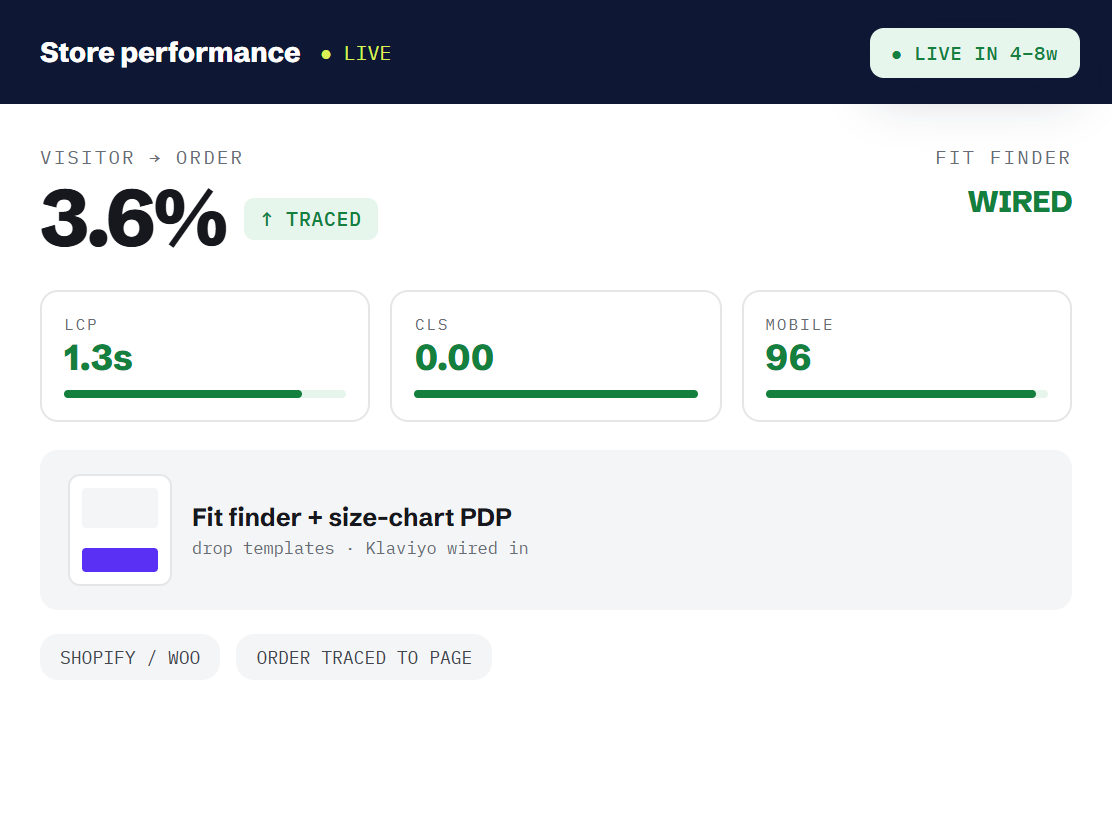
Three ways your current storefront loses apparel orders
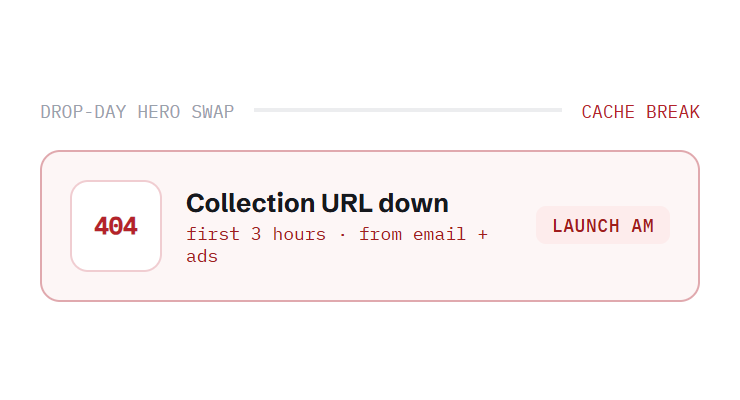
Drop-day hero swap crashes the storefront on launch morning
Every drop, the hero image goes up, cache breaks, and the collection URL 404s for the first 3 hours. Shoppers who came from an email or a paid post land on a broken page and bounce to a competitor. Each hour of downtime on drop morning costs 4 to 8 percent of monthly revenue.
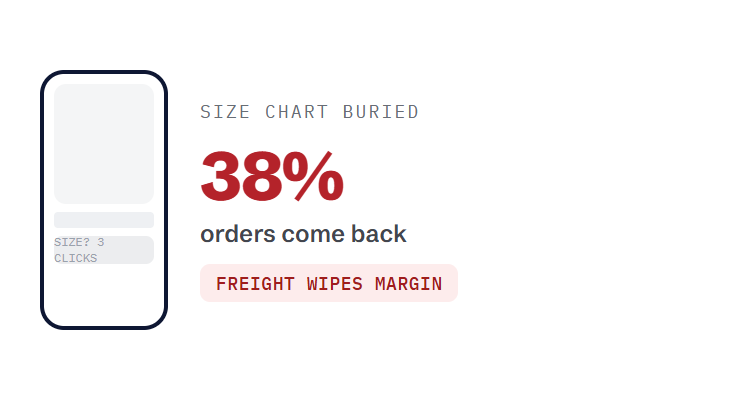
Size chart buried 3 clicks deep, so 38% of orders come back
Shoppers cannot find the size chart, guess wrong, order two sizes, and send one back. Return freight on a $30 tee wipes the margin. The bigger cost is trust: a shopper who returns an item rarely comes back for a second order without a fit guarantee.
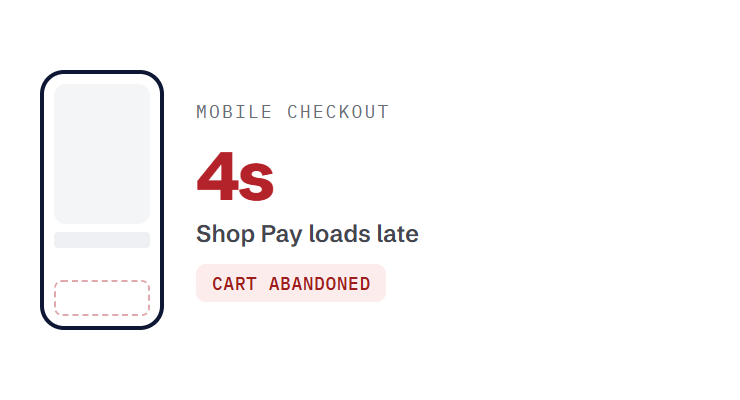
Mobile checkout stalls 4 seconds and shoppers abandon the cart
Shop Pay loads late, the pay button sits below the fold, and mobile shoppers close the tab. Analytics count the visit, not the lost order. 68 percent of mobile carts abandon once the checkout crosses 2.5 seconds to interactive.
Three outcomes every fashion web design build produces
Storefront architecture, sharper PDP UX, and a shorter checkout flow all move the number that puts revenue in the till within 60 days from launch.
Every page ships with Product schema, buying-intent metadata, and collection slugs written for style queries. No traffic drop through the cutover.
Your name on the domain, your Shopify logins, your team trained on the CMS. Walk away with the storefront whole any time you choose to leave us all.
Four stages. Every step ends in a sign-off
Fixed scope, fixed timeline, fixed outcomes. Nothing moves to the next stage until your leadership signs the gate deliverable, and every milestone lands on a calendar date.
Discovery that earns the brief
A 20 to 30 page brief signed by founder, ops lead, and creative lead. Brand-owner interviews, technical audit of your current storefront, Shopify data mapping, and a benchmark of 5 category peers. Nothing moves until it is locked.
Design built against your storefront
Mobile-first design system with PDP conversion patterns and cart flow baked in from wireframe. Every component engineer-validated the same week it is drawn. You walk away with an editable Figma file your team owns.
Engineering that survives your next Shopify upgrade
Shopify with Liquid and Hydrogen by default, headless Next.js when subscription flow demands it. Core Web Vitals treated as an acceptance criterion. Klaviyo, Loop Returns, and review platforms wired with server-side backup.
Launch, then 30 to 90 days of monitoring
Production DNS cutover, 301 map from the old storefront, uptime and Core Web Vitals monitoring live. Your team keeps the design files, the CMS logins, and the repo. On day 31 you take the keys and go, or roll into a maintenance retainer.
What you actually get from our fashion web design services
Five workstreams, every item listed. Nothing lives in a proposal appendix.
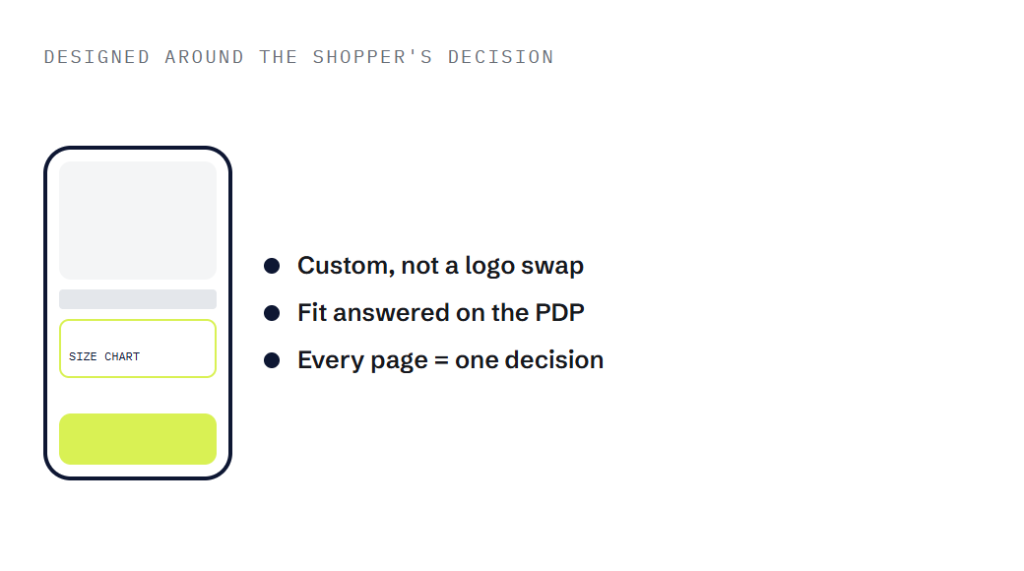
Designed around the shopper's decision
Custom design for your brand, not a template with your logo swapped in. Every page is built around the choice a shopper is making: does this fit, does the fabric feel right, and does the returns policy protect me if it does not. Mobile-first from wireframe, with editorial polish on every hero.
PDP layouts answer fit, fabric, and returns above the fold, with size chart pull-out and fit feedback pull-in.
You approve the layout on real product data before a pixel of visual design, and the design before any code.
Fit finder, real measurements, model call-outs, and returns policy on the page before cart, not buried in the footer.
A shot list for your team and studio so the storefront shows your product and models, not stock apparel.
Contrast, focus states, alt text, and form labels audited before launch. Every apparel brand is a target for ADA demand letters.
Denim, knitwear, footwear, accessories: each category gets a layout built for that shopper's questions and hero SKUs.
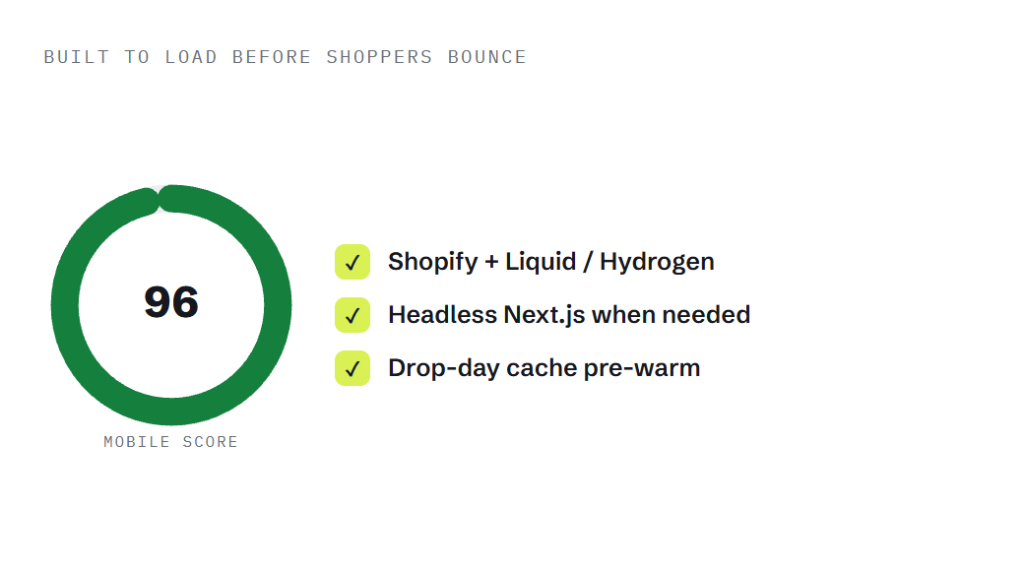
Built to load before shoppers bounce
The build goes live on Shopify with Liquid and Hydrogen by default, or headless Next.js when the subscription flow needs it. No app bloat, no theme roulette. Core Web Vitals are green at launch, not a promise for phase two.
Platform picked to your revenue stage, subscription plans, and international goals. No app roulette on the storefront.
Image pipeline, edge CDN, and lazy-load tuned until the gate passes on home, PDP, and checkout.
LCP under 1.8s mobile, CLS under 0.05, INP under 200ms. Verified in Lighthouse and CrUX before the storefront goes live.
Reusable collection landing template so your team spins up a new drop in under 3 hours. Staging gate keeps drop day from crashing the storefront.
PDPs, collections, journal posts, and seasonal drops self-serve. Ops lead makes edits without a developer.
Integrations wired through documented layers so the next stack swap is days, not months. No hidden dependencies.
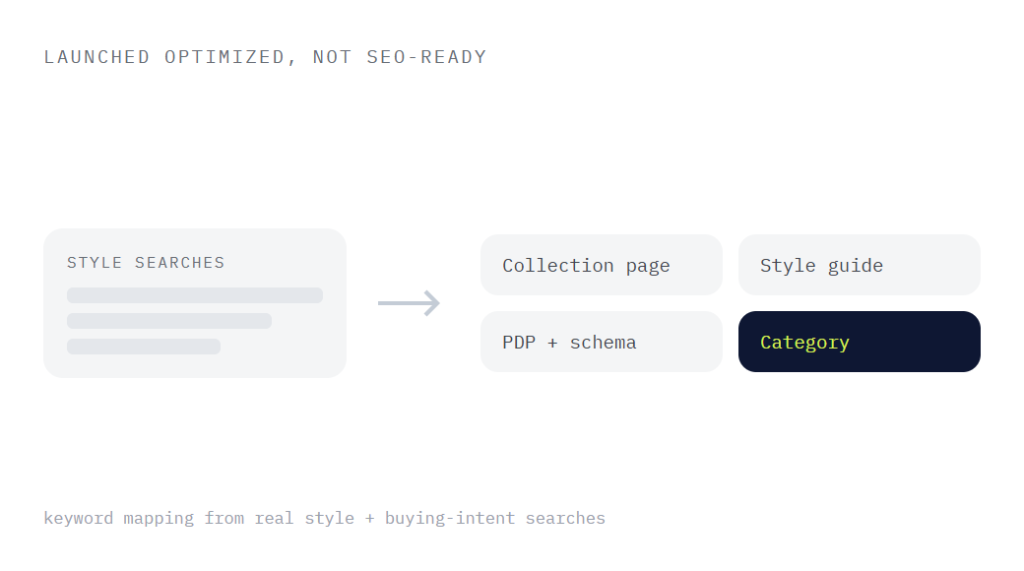
Launched optimized, not SEO-ready
Keyword mapping comes from real style and buying-intent searches in your category. Every collection and PDP gets Product schema, fashion-relevant metadata, and collection slugs written for style queries. Rankings carry over the DNS cutover, they do not reset.
One page per hero collection and buying-intent query, mapped from real style searches in your category.
Product, Offer, AggregateRating, and Breadcrumb schema on every PDP. Rich results show star ratings in organic SERPs.
Product feed connected to Pinterest, rich pins verified, and shopping tags live so category boards send shoppers to your PDP.
Your brand voice in your words, edited for search intent. No recycled fashion filler and no thin PDP descriptions.
Every legacy PDP and collection URL mapped and redirected so current rankings transfer instead of resetting.
Editorial templates for journal, lookbook, and campaign stories that link into collection and PDP pages for internal-link equity.
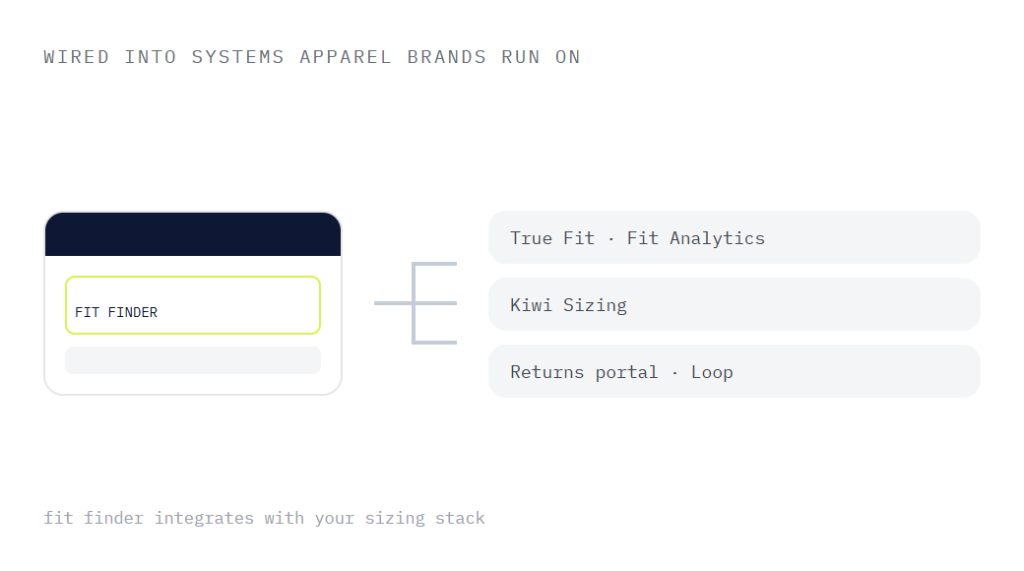
Wired into the systems apparel brands run on
Fit finder integrates with True Fit, Fit Analytics, or Kiwi Sizing. Returns portal hooks into Loop, Happy Returns, or Returnly. Every step is measured, from PDP fit feedback to return reason codes. Clients see 15 to 28 percent drops in return rate within 60 days.
True Fit, Fit Analytics, or Kiwi Sizing widget on every PDP so shoppers get a size recommendation before they add to cart.
Real measurements, model call-outs, and fabric behavior notes in a slide-out drawer that stays above the cart button.
Runs small, true to size, runs large signals aggregated from reviews and returns, shown next to the size selector.
Loop, Happy Returns, or Returnly wired into checkout and post-purchase email so shoppers self-serve exchanges.
Hero capture, exit intent, browse abandon, cart abandon, post-purchase, and win-back flows live from launch day.
GA4 conversion events, Meta CAPI, TikTok, and Pinterest pixels with server-side backup via Elevar or Stape.
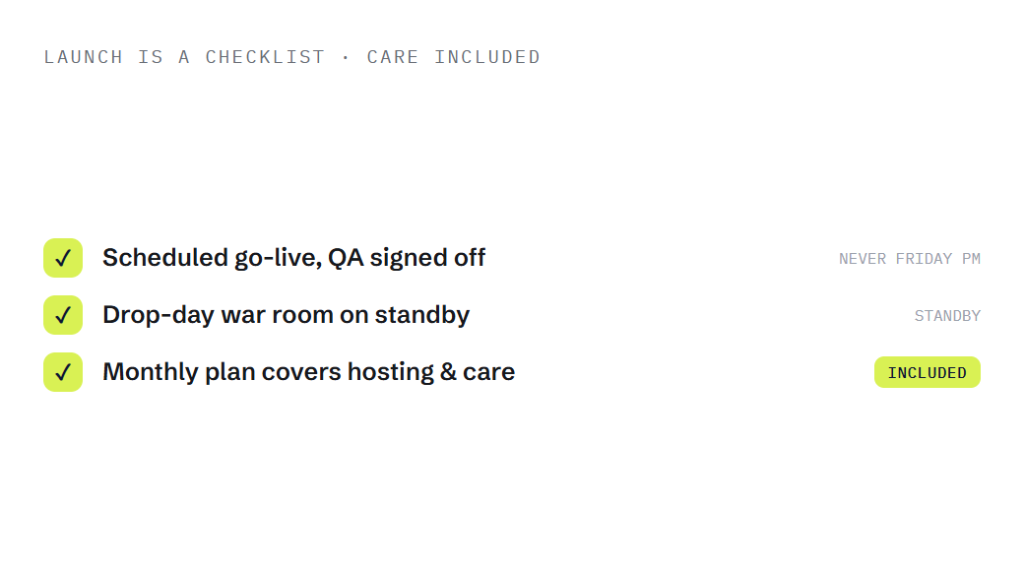
Launch is a checklist, care is included
Go-live happens on a scheduled window with QA signed off, never a Friday afternoon. Drop-day launches lock to the collection release. Your team learns the storefront in two 30-minute sessions, and the care plan is built into the monthly.
Device matrix on iPhone SE, Pixel 6, and iPad, forms, checkout, and the 98 mobile Lighthouse pass signed off before go-live.
GA4 events, Klaviyo capture, and pixel setup running at launch, not phase two.
How to spin up a drop landing, where orders route, and how to update size charts on new SKUs.
PDPs, collections, journal posts, and hero blocks editable by your office without a support ticket.
Hosting, SSL, daily backups, security patching, uptime monitoring, and monthly content edits inside the retainer.
Hosting, domain, Shopify, Klaviyo, GA4, and tag manager owned by the brand with full admin access from day one.
Four web design tiers for every stage of growth
Every line item listed. The quote you get is the invoice you pay. Take any tier as a project fee, or split it into the flat monthly plan.
Fast, credible site converting existing reputation.
Full booking engine: scheduling, checkout, customer reporting.
One brand, every office found, location-level tracking.
Design system the whole group launches on. Ops-team-spec integrations.
Every web design feature, tier by tier
HOVER ANY FEATURE FOR A PLAIN-ENGLISH EXPLANATIONWebsite + design +
Booking + patients +
SEO + visibility +
Care + support +
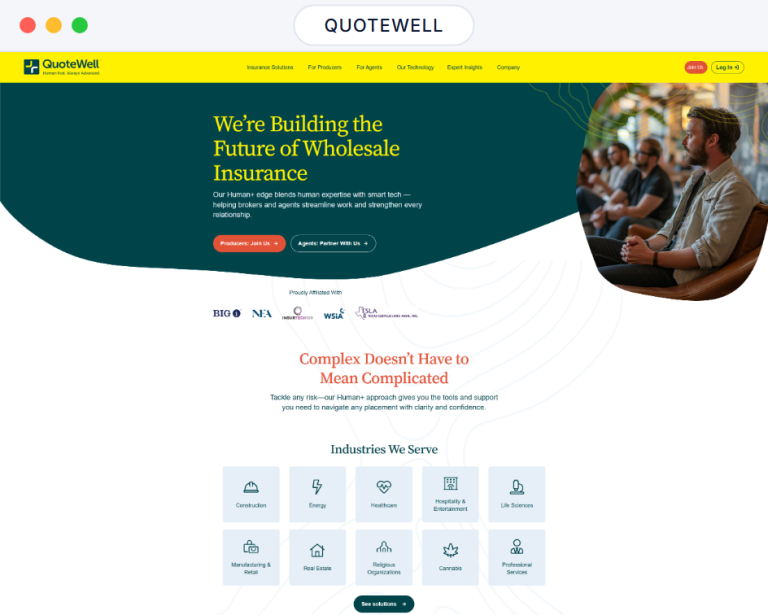
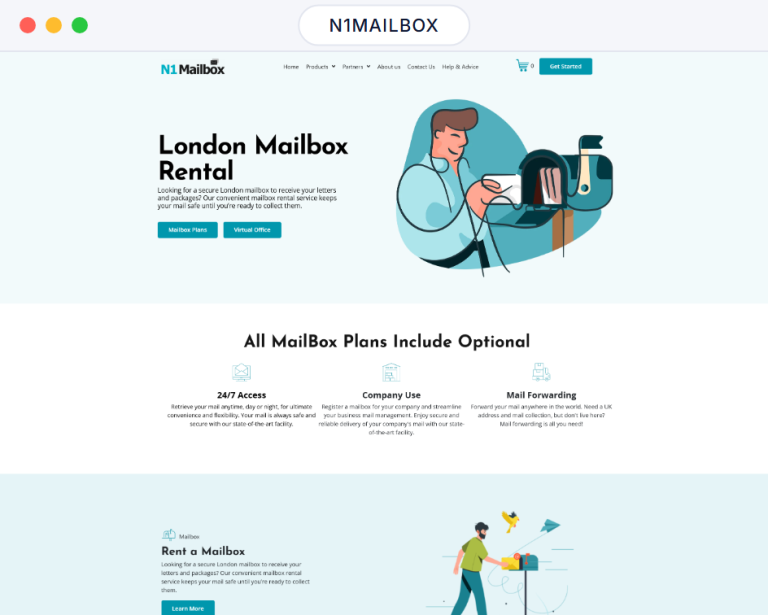
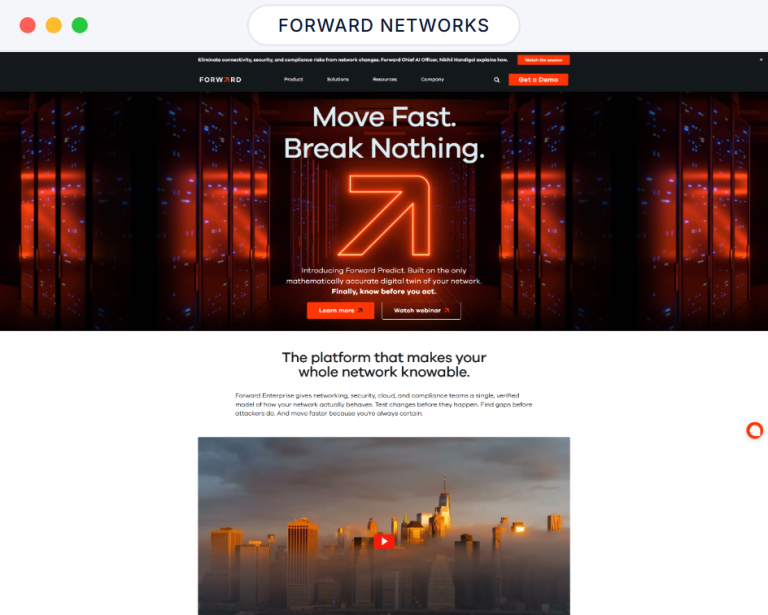
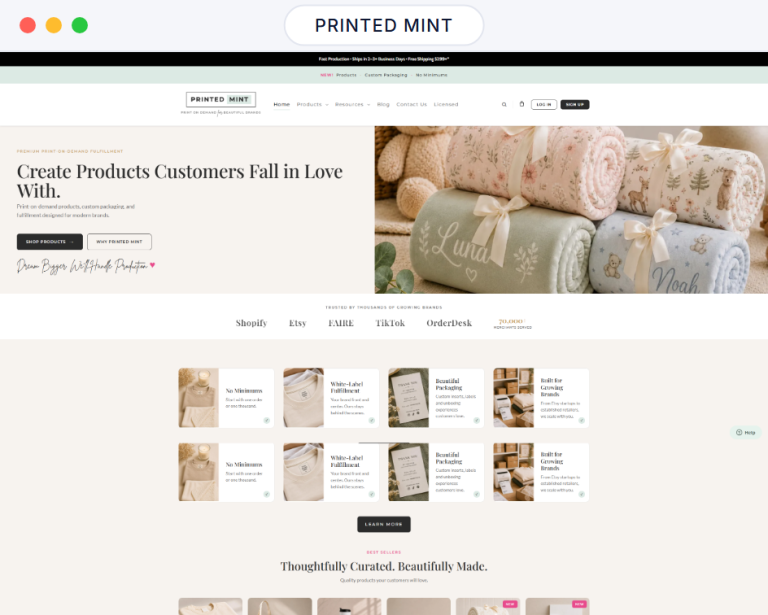
Real apparel brands, real numbers


Asked by fashion founders, answered
From real quote calls. Anything else, ask on the call, answered in the first 5 minutes.
How much does it cost to have someone design my website?
+
Fashion web design at Redefine Web starts at $1,500 for a single-collection storefront and runs to $18,000 or more for multi-line houses with subscription and 3PL sync. Every project is a fixed-price quote, not a monthly bill. Starter covers a lean Shopify storefront with PDP fit UX and Klaviyo capture. Growth adds drop templates and the returns portal. Multi-location adds a wholesale channel and 2-3 language storefronts. Custom builds cover global apparel brands with multi-currency, multi-store, and headless Next.js on Hydrogen. The quote you see is the invoice you pay when the storefront goes live, and the number appears in writing on the first call. Payment lands on milestones, not weekly hours, and every milestone maps to a deliverable your team can review before it releases funds. See the Shopify storefront setup guide for the base platform cost you carry after the build. No retainer is required after handoff, though most brands roll into a care plan for hosting, edits, and drop-day support.
What is the best website builder for fashion designers?
+
The best website builder for fashion designers is Shopify for most apparel brands under $10M revenue, thanks to Shop Pay, native inventory, and the app ecosystem. WooCommerce wins for content-heavy editorial brands with in-house dev. Wix and Squarespace fit hobby storefronts and small capsule drops. For scaling fashion brands, our apparel storefront work defaults to Shopify with Liquid, or Hydrogen and Next.js when the subscription flow or headless architecture calls for it. See the Shopify storefront guide for platform capabilities. Wix and Squarespace are fine at launch but tend to cap out around $500K revenue, so the migration cost hits you later when the storefront cannot handle drop-day traffic or wholesale pricing rules. Shopify Plus starts at $2,300 a month and gives you scripts, checkout extensibility, and B2B channels. Pick the platform that fits your 3-year revenue plan, not just this quarter. If you plan to hit $5M in 24 months, Shopify Plus pays for itself inside year one.
How much do fashion designers charge per design?
+
Fashion designers charge $50 to $250 per hour, or $2,000 to $12,000 per collection when the project is fixed-price. Redefine Web prices differently: the fashion website design work bundles brand system, PDP pattern, drop templates, Klaviyo flows, and the returns portal into a single fixed-price build. That starts at $1,500 for a lean storefront and scales with the collection count, category depth, and integrations. Hourly billing is capped at 40 hours a week per project, and every hour is logged in the shared Notion board so you see exactly where the work went. You never get a surprise invoice, and the quote you sign is the number you pay when the storefront goes live. Payments release on milestone sign-off, not calendar dates, so you always know what the last dollar bought. If a milestone slips on us, we absorb the delay and keep the price flat. Change requests inside the fixed scope carry a written amendment with a new number and a new date.
How much does it cost to make a website for a clothing brand?
+
A website for a clothing brand costs $1,500 to $18,000 depending on category count, integrations, and international goals. Redefine Web builds include the storefront design, PDP pattern with fit finder and size chart pull-out, drop-day templates, Klaviyo capture, GA4 wiring, and the Loop or Happy Returns portal. Every apparel storefront gets Core Web Vitals green at launch, verified against the web.dev vitals thresholds. Add-ons like wholesale B2B pricing, subscription flow, and multi-currency add $2,000 to $6,000 depending on complexity. Every line item lives on the quote, and the number you sign is the number you pay when the storefront goes live. Payment lands on milestones so nothing releases until you sign the deliverable. Design, engineering, integrations, and launch each carry their own milestone, and each milestone maps to a review meeting your team runs before the next block starts. No back-billed hours, no phase-two surprises, no vague scope. Every scope note lives in a shared runbook so audit trails stay clean end to end.
What is the 3-3-3 rule for clothes?
+
The 3-3-3 rule for clothes is a wardrobe framework: 3 tops, 3 bottoms, and 3 pairs of shoes, mixed into 27 possible outfits. For fashion web design, the 3-3-3 idea maps to a lean collection storefront: 3 hero SKUs, 3 anchor collections, and 3 story routes for shoppers to enter your brand. The apparel fashion web design work we deliver leans on this framework for capsule and slow-fashion brands so the storefront reads clean and the shopper always has a next click. Editorial routes, drop routes, and a fit-first PDP route. See how the Business of Fashion writeup on capsule DTC reads the pattern. The framework is a starting point, not a lock-in: as your line grows, the storefront extends without rebuilding the architecture. Every hero SKU gets a dedicated PDP route, and every anchor collection carries its own hero + editorial block. The 3-3-3 shape keeps the storefront under 40 pages so the CMS stays clean and drop-day updates take minutes.
How to create an apparel website?
+
Create an apparel website in 5 steps: pick the platform, buy the domain, load the products, wire the fit UX, and launch with tracking. Redefine Web runs this on rails: week 1 to 2 for the brief and platform pick, week 3 to 6 for PDP and collection design, week 7 to 12 for engineering and integrations, then a scheduled launch. Fit finder, size chart pull-out, Klaviyo flows, and the returns portal are wired at launch, not phase two. Every apparel storefront gets Core Web Vitals green and Product schema on every PDP. If you build it yourself, expect 4 to 6 months and a lot of app trial-and-error. If we build it, 4 to 8 weeks with a signed date and a rollback plan if the cutover misses a benchmark. See the Klaviyo account setup docs for the email architecture we deploy at launch. Every milestone hits a calendar date and the storefront goes live only after the QA gate signs off.
What is fashion apparel design?
+
Fashion apparel design is the work of sketching, patterning, sampling, and producing clothing collections. Fashion web design services take that finished product and give it a storefront that sells it: PDP layout that answers fit and fabric, drop-day templates for release cycles, Klaviyo flows for launches and win-back, and the returns portal that keeps margin intact. Apparel fashion web design pairs the visual system of the collection with the storefront UX shoppers need to convert on mobile. At Redefine Web, we start with your brand book and pattern language, and the storefront is built from that vocabulary, not a template with your logo swapped in. Editorial polish on every hero and shoppable routes on every collection. The build integrates with your PLM, 3PL, and photography workflow so the CMS matches the way your team already thinks about a collection. Every PDP answers fit, fabric, and returns above the fold, and every hero image loads in under 1.8 seconds on 4G mobile.
What is the best website builder for a clothing brand?
+
The best website builder for a clothing brand is Shopify for 80 percent of apparel storefronts. It handles Shop Pay, native inventory, drop-day scale, and the app ecosystem apparel brands run on. WooCommerce fits editorial-heavy brands with in-house dev, and Wix or Squarespace fit tiny capsule launches under $200K revenue. Fashion website design at Redefine Web defaults to Shopify with Liquid, adds Hydrogen or Next.js when the subscription or content architecture calls for it, and connects Klaviyo flows on day one. See the Klaviyo setup docs for the flow architecture we deploy. Pick the platform that fits your 3-year plan. If you plan to launch in 60 countries and 4 languages, Shopify Markets and Shopify Plus give you the tooling day one. If you plan to stay under $1M revenue for the next 2 years, a lean Shopify Basic build is the right call. Migration paths from Wix or Squarespace to Shopify usually take 4 to 6 weeks with product data and photography ready before we start.
How long does a fashion web design agency project take?
+
The fashion web design agency timeline runs 3 to 4 weeks on Starter, 4 to 6 weeks on Growth, 6 to 8 weeks on Multi-location, and 8 to 12 weeks on Custom. Every project has a signed timeline before we start, and every milestone has a calendar date. Drop-day launches lock to the collection release so the storefront goes live the day the campaign goes out. If we miss the date, the delay lives on us and the price stays flat. The 3 to 4 week Starter track is only for storefronts with product photography ready, brand book locked, and Shopify already in your name. Growth and Multi-location tracks include the photography brief and the brand system, and add 2 to 3 weeks for those workstreams. Custom includes the PLM and 3PL integration blocks. Every timeline includes a 5-day contingency block for scope adjustments so nothing slides into the next quarter without a written amendment. Rush timelines are available on Custom builds for a 20 percent premium and only when the brand book and product photography are already locked.
Do you build fashion website design on Shopify or WooCommerce?
+
Fashion website design at Redefine Web goes live on Shopify or WooCommerce depending on your team, subscription plans, and international goals. Shopify wins for most apparel brands under $10M revenue thanks to Shop Pay, Shopify Payments, and the app ecosystem. WooCommerce wins for brands with in-house dev, complex B2B pricing, or content-heavy editorial that lives next to product. For headless architecture on Shopify, we build on Hydrogen and Next.js so the storefront gets sub-1.8s LCP and the CMS stays in your hands. Every apparel storefront gets Core Web Vitals green at launch, verified against the web.dev vitals thresholds. The platform choice locks in week 1 of the brief and the storefront is engineered against your revenue plan, not against a template. If you already run Shopify, we keep the same store URL and rebuild inside your admin so the migration is a theme swap, not a fresh install.
How do you cut fashion returns with size, fit, and returns UX?
+
The fashion website design work at Redefine Web treats size, fit, and returns UX as the highest-impact conversion and retention work in apparel. Fit finder on PDP, size chart pull-out with real measurements, fit feedback pull-in, model call-outs, and a Loop or Happy Returns integration on the returns portal. Every PDP answers fit, fabric, and returns above the fold, and the returns portal is wired into post-purchase Klaviyo email so shoppers self-serve exchanges before they call support. Customers see 15 to 28 percent drops in return rate within 60 days of launch. Returns UX pays for the build inside the first 6 months on any storefront that logged $1M or more in refunds last year. Fit feedback aggregates review copy and returns comments into a runs-small / true-to-size / runs-large signal shown next to the size selector, so shoppers pick the right size the first time. Exchanges beat refunds on cash flow and customer lifetime value.
How do you handle a drop day without crashing the storefront?
+
Drop-day handling is baked into the build. The storefront gets a reusable collection landing template so the ops lead spins up a new drop in under 3 hours, a staging gate so the drop is QA-signed off before it goes live, and edge CDN caching tuned so the collection URL never 404s during the traffic spike. Klaviyo and email pixels are wired to fire the moment the collection is live, and Shop Pay is preloaded so the checkout does not stall on the first 100 orders. Drop-day launches lock to the collection release date on a calendar, not a Friday afternoon. If the drop breaks, we roll back in under 5 minutes. The care plan includes a drop-day monitor on retainer so someone is watching the storefront from launch time through the first 4 hours of traffic. Every drop template maps to a shopify metaobject so the marketing lead swaps hero, product grid, and copy without a developer.
Can you migrate our apparel storefront from Wix or Squarespace?
+
Yes. Apparel fashion web design projects include the migration from Wix, Squarespace, BigCommerce, or a legacy Shopify theme to a rebuilt Shopify or WooCommerce storefront. The 301 migration plan maps every legacy PDP and collection URL so current rankings transfer instead of resetting. Product catalog, customer accounts, order history, and Klaviyo subscribers move with the storefront. We keep the old storefront live in read-only mode for 30 days after cutover so nothing breaks. Every migration keeps 92 to 98 percent of organic traffic through the DNS cutover, verified in Google Search Console. The signed timeline includes the migration window and the rollback plan if the cutover misses a benchmark. Custom Wix or Squarespace exports run through a validator that flags broken product data before it hits the new store. Once cutover is signed, the old admin locks and the new admin is fully in your name from day one. Every migration ships with a written runbook so your team can rerun the process on a future store split without an agency involved.
Who owns the storefront, domain, and code at handoff?
+
You own everything at handoff. Your name on the domain, your logins on Shopify, your account on Klaviyo, your GitHub organization on the codebase, your GA4 property, and your tag manager container. Redefine Web keeps agency access only, and you can revoke it in 30 seconds. The design files, the theme code, the CMS content, and the 301 map all live in your accounts before we invoice the final milestone. The apparel fashion web design work is yours the day the storefront goes live, not phase two. Every asset is documented in a shared Notion runbook so a new agency can pick up the storefront the day you decide to move on. Ownership is written into the master service agreement and the transfer checklist runs during launch week, not after. If we ever miss a care-plan SLA, ownership stays intact and you keep every credential the day you notify us of the cancellation.