AI marketing for ecommerce is the copy-generation, product-tagging, personalization, predictive-segmentation, and answer-engine stack that decides whether a DTC brand hits its growth curve or stalls at $4M yearly revenue. Most founders we advise burn $60,000 to $180,000 on tooling that duplicates coverage across two or three vendors inside the first year. The pattern repeats. A shiny personalization tool goes in before predictive segmentation, the cold-start window eats the first quarter, and the founder blames the vendor when the fault sits in the sequencing.
This guide covers what the AI stack owns today across seven job families, how the Shopify-native stack compares to the leader tier, what pricing looks like at a mid-market DTC brand, how AI Overviews reshape product-page SEO, and where the payback lands fastest in the first 90 days. You get the exact stack sequence we hand every founder who asks what to buy first, plus the math that keeps the tooling budget honest against gross margin.
AI marketing for ecommerce covers 7 job families across the DTC stack
The stack splits cleanly into seven job families that map to distinct P and L lines. Copy generation for product descriptions, ads, and lifecycle email. Product tagging and on-site search. Storefront personalization with recommendations and dynamic content. Predictive segmentation for retention flows. Ad creative variant production. Customer service resolution. Reporting and business intelligence. Each job family has an established leader, a fast-growing challenger, and a free or Shopify-native option. Buying the enterprise tier before the brand needs it wastes $40,000 to $180,000 yearly on seats that stay dormant.
Ownership of the seven families rarely lives in one team. Copy sits with brand and content. Tagging sits with merchandising or engineering. Personalization sits with growth. Predictive segmentation sits with lifecycle or CRM. Ad creative sits with paid social. Customer service sits with ops. Reporting sits with finance or analytics. That fragmentation is why these projects stall. Nobody owns the stack end-to-end, so vendor overlap goes unnoticed for two to three quarters at a time.
Copy generation scope for a DTC brand
Copy generation covers product descriptions, PDP body content, ad copy variants for Meta and TikTok, subject lines and preview text for lifecycle email, plus SMS message drafts. Jasper and Copy.ai lead this category. Shopify Magic covers the entry tier free with any Shopify plan. Copy generation drops cost per description by 62 to 84% and shortens time-to-launch on new collections by 3 to 5 weeks. The tool takes over the first draft. A human editor still owns final approval so on-brand voice stays intact, since auto-publish degrades tone fast.
Product tagging and on-site search scope
Product tagging is the least glamorous job family and the one with the highest revenue-per-dollar payback. Syte and Vue.ai lead the visual tagging category. Shopify Search and Discovery covers the native entry tier. Auto-generated tags feed on-site search, filters, and recommendation surfaces. Brands with 400 to 4,000 SKUs typically leave 12 to 28% of on-site search revenue on the table since manual tagging misses long-tail queries. A tagging fix pays back inside 45 to 90 days on any catalog above 300 SKUs.
Storefront personalization scope
Personalization covers homepage merchandising, category page reordering, PDP recommendations, cart cross-sell, and post-purchase upsell. Dynamic Yield and Rebuy lead the category. Shopify Segments plus Rebuy Personalization Engine covers the mid-tier install. Personalization needs a 90-day cold-start window before ROI reads honestly. Brands that judge the tool at day 30 kill the pilot before the model has enough signal. Any vendor promising sub-30-day proof on personalization is running an A/B test on a canned use case, not the real catalog.
AI marketing for ecommerce on Shopify-native vs the leader tier
The Shopify-native AI stack now covers most needs under $4M yearly revenue. Shopify Magic handles copy generation. Search and Discovery handles tagging and search. Shopify Segments plus Klaviyo AI covers predictive segmentation for lifecycle. Shopify Inbox with AI replies covers a chunk of customer service load. Total tooling cost lands under $600 monthly across the native stack plus Klaviyo. That budget is unbeatable for a brand under $4M revenue where every dollar of tooling has to compete with paid media allocation.
Between $4M and $15M revenue, add one challenger tool per job family where the native option leaves measurable revenue on the table. Rebuy for personalization on catalogs above 400 SKUs. Bloomreach or Klaviyo AI premium for predictive segmentation on lists above 80,000 subscribers. Gorgias AI for customer service on ticket volume above 800 monthly. Above $15M revenue, the leader tier earns its cost through event volume, integration depth, and dedicated customer success. Skipping tiers costs more than it saves once event volume crosses the free-tier ceiling on any single vendor.
| Job family | Native tier | Challenger tier | Leader tier |
|---|---|---|---|
| Copy generation | Shopify Magic | Copy.ai | Jasper |
| Product tagging | Search and Discovery | Vue.ai | Syte |
| Personalization | Shopify Segments | Rebuy | Dynamic Yield |
| Predictive segmentation | Klaviyo AI base | Klaviyo AI premium | Bloomreach |
| Ad creative | Meta Advantage+ | Pencil | AdCreative.ai |
| Customer service | Shopify Inbox | Gorgias AI | Kustomer AI |
| Reporting and BI | Shopify Analytics | Triple Whale | Northbeam |
Where the native stack caps out
The native stack caps out on event volume and integration depth. Shopify Segments hits a rebuild-time wall above 400,000 customer records. Search and Discovery has weak long-tail query handling above 2,000 SKUs. Shopify Magic tone drift shows on any brand with a distinct voice. Klaviyo AI base tier misses cross-channel signal since it does not read on-site behavior outside its own tracking pixel. Every cap has a fix, and the fix costs $600 to $4,800 monthly per job family added on top of the native base.
Challenger tier fit at $4M to $15M
Challenger tools fit brands at $4M to $15M that need one job family upgraded without the enterprise contract. Rebuy runs $499 to $2,400 monthly for personalization at that scale. Copy.ai runs $99 to $399 monthly per seat for copy generation. Triple Whale runs $299 to $1,200 monthly for attribution and reporting. Total challenger-tier spend across three or four job families lands at $1,800 to $4,800 monthly. That budget beats a Bloomreach or Dynamic Yield contract by 4 to 12 times for the same functional coverage.
Leader tier fit above $15M
Leader tier vendors earn their cost above $15M revenue on event volume, catalog depth, and integration surface. Dynamic Yield handles 8 million events monthly on a mid-market install without model drift. Bloomreach ties on-site behavior to email and SMS in one segmentation model. Northbeam pipes multi-touch attribution across paid social, paid search, email, SMS, and organic in a single revenue view. Below $15M, the event volume never justifies the $8,000 to $22,000 monthly cost floor.
AI marketing for ecommerce pricing at each DTC revenue stage
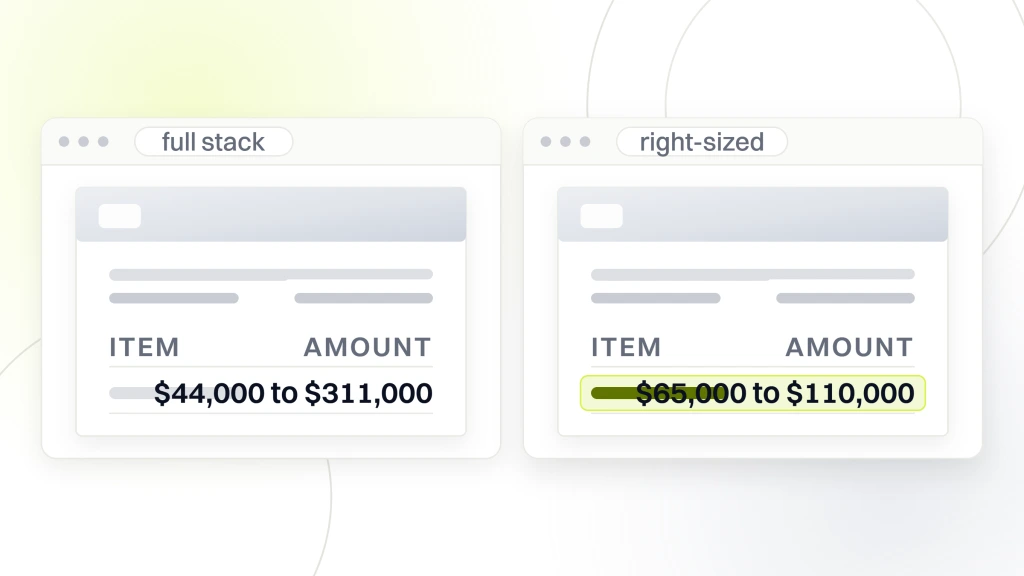
AI tools for ecommerce marketing at a $15M DTC brand run $44,000 to $311,000 yearly for a full stack across all seven job families. The right target for most brands at that revenue tier is $65,000 to $110,000 since full-stack buildouts almost always duplicate coverage across two or three tools. Right-sizing at the audit stage saves the duplication cost and puts $80,000 to $200,000 yearly back into paid media or hiring. That reallocation moves growth curve numbers in a way the extra tooling never would.
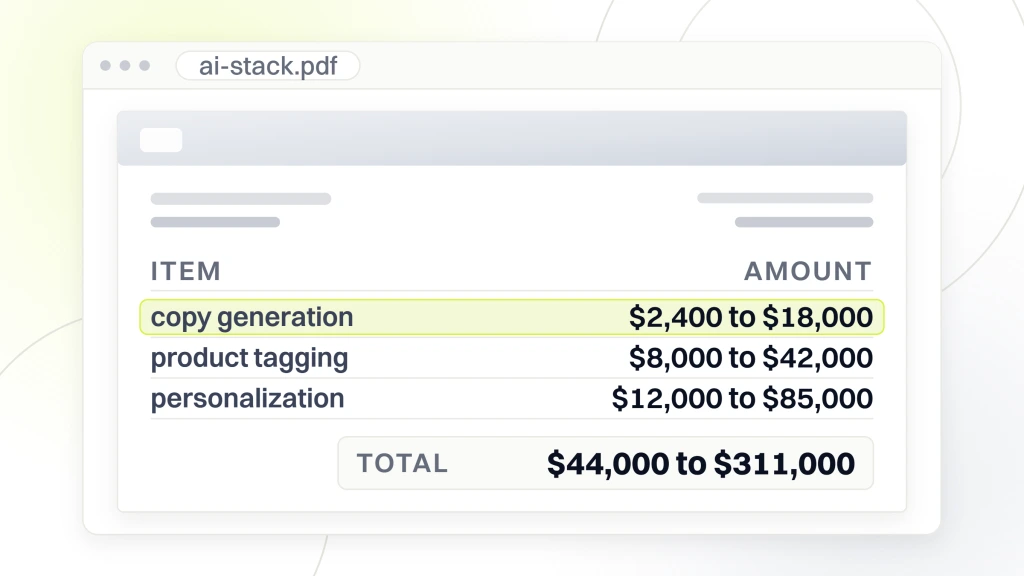
Pricing bands scale with catalog size, list size, and event volume. Copy generation runs $2,400 to $18,000 yearly. Product tagging runs $8,000 to $42,000. Personalization runs $12,000 to $85,000. Predictive segmentation runs $6,000 to $54,000. Ad creative runs $3,600 to $28,000. Customer service runs $4,800 to $36,000. Reporting and BI runs $7,200 to $48,000. Any brand quoted outside these bands is either buying a tier they do not need or getting undersold on integration scope that shows up as change orders in month three.
Under $4M revenue budget model
Under $4M revenue, AI tooling should stay under $7,200 yearly total. Shopify Magic and Search and Discovery are free with Shopify. Klaviyo starts at $60 monthly and scales to $180 monthly at 25,000 subscribers. Gorgias starts at $50 monthly. Triple Whale free tier covers basic attribution. Any brand at this revenue stage spending above $7,200 yearly on AI tools has misallocated the tooling budget away from paid media where every dollar has 3 to 6 times the revenue impact.
$4M to $15M mid-market budget model
Between $4M and $15M revenue, the AI budget lands at $28,000 to $72,000 yearly across the seven job families. Add Rebuy at $2,400 to $8,400 yearly. Klaviyo AI premium runs $6,000 to $18,000. Triple Whale runs $3,600 to $14,400. Copy.ai or Jasper for a paid team runs $1,200 to $4,800. Gorgias AI add-on runs $2,400 to $9,600. Total build lands in a range that ties cleanly to gross margin so tooling scale never breaks the contribution margin line.
Above $30M enterprise budget model
Above $30M revenue, the full-stack build runs $180,000 to $420,000 yearly across leader-tier vendors. Dynamic Yield or Bloomreach at $96,000 to $180,000. Northbeam at $36,000 to $72,000. Kustomer AI at $24,000 to $48,000. Enterprise Jasper at $12,000 to $24,000. Syte or Vue.ai at $24,000 to $60,000. The math works at this scale since event volume, catalog depth, and integration surface all cross the threshold where leader-tier tools clear their monthly floor.
How AI ecommerce marketing applications handle AI Overviews
Artificial intelligence ecommerce marketing applications now include a dedicated SEO discipline for Google AI Overviews and ChatGPT product answers. Informational-intent queries lost 22 to 41% of their organic click-through between Q3 2025 and Q1 2026 since the AI answer above the results handles the query without a click. Product-intent queries stayed roughly flat with higher purchase intent per visitor. The composition of organic traffic shifted, and the pages that win now are the ones the answer engine cites as source material.
Winning product pages carry Schema.org Product plus AggregateRating plus Offer markup, structured spec tables, use-case sections, and comparison paragraphs. Pages built for AI answer citation see cited-share climb from under 1% to 8 to 22% inside a quarter of rewrites. That shift shows up in referral traffic from ChatGPT, Perplexity, and Google AI Overviews in Search Console filtered on those source strings. See our ecommerce SEO agency guide for the source-page checklist.
Schema priority set for product pages
The priority schema set for product-page citation is Product, AggregateRating, Offer, and FAQPage. Product carries name, description, SKU, brand, and image. AggregateRating carries ratingValue and reviewCount. Offer carries price, priceCurrency, availability, and priceValidUntil. FAQPage carries three to seven common questions and answers pulled from PDP body content. Pages carrying the full set get cited 3 to 8 times more often than pages carrying Product schema alone.
Spec table format for answer engines
Answer engines pull from structured spec tables with clean two-column format. Attribute in the left column. Value in the right column. Rows for material, dimensions, weight, warranty, care instructions, and country of origin. HTML table markup, not CSS grid, since parsers still favor table tags. Any PDP without a spec table loses citation to any competitor PDP that has one, holding all other factors constant. This is the single lowest-effort win in ecommerce SEO right now.
Use-case sections that answer specific queries
Use-case sections on PDPs answer distinct buyer queries the answer engine wants to cite. Best for hiking. Best for daily commute. Best for gifting. Best for cold-weather storage. Each use case gets a short paragraph with the product benefit tied to the use context. Pages with six to ten use-case blocks see 34 to 68% more citations on long-tail queries where the answer engine picks the most narrow source. This is content design work, not SEO trickery.
Where AI for ecommerce marketing pays back fastest
AI for ecommerce marketing pays back fastest in copy generation and predictive segmentation since baseline is easy to measure and the ROI window is short. Copy generation drops cost per description by 62 to 84% and shortens time-to-launch on new collections by 3 to 5 weeks. Predictive segmentation raises flow revenue per recipient by 24 to 55% and cuts unsubscribe rates by 32 to 48%. Both prove out inside 30 to 60 days on a well-run pilot with a clean baseline recorded on day zero.
Product tagging pays back inside quarter two. Personalization pays back inside quarter three after the 90-day cold-start window closes and the model has enough signal to serve confident recommendations. Ad creative pays back once the paid team has a strong performance baseline to compare against. Customer service pays back on ticket-volume compression once the AI handles 32 to 58% of tier-one tickets. Reporting and BI pays back on decision quality more than direct revenue, which is harder to measure but real.
- Start with copy generation and predictive segmentation in month one since baseline math is clean
- Add product tagging in month two once catalog audit surfaces long-tail search gaps
- Introduce personalization in month three with the 90-day cold-start clock stated upfront
- Layer ad creative tools once paid social hits the $18,000 monthly spend threshold
- Bring customer service AI in when ticket volume crosses 800 monthly
- Install reporting and BI last since attribution needs the other layers running first
Quick-win sequencing in the first 30 days
The first 30 days should surface two quick wins. Copy generation cutting time-to-launch on a new collection or paid social variant batch. Predictive segmentation growing flow revenue per recipient on the abandoned cart or post-purchase flow. Both wins get measured against a 90-day trailing baseline recorded before the tool went live. Any pilot that skips the baseline capture forfeits the payback proof and turns into a subjective vibe-check when the CFO asks whether the tool worked.
90-day scorecard for the pilot
The 90-day scorecard for any pilot carries seven numbers. Time-to-launch on new content. Cost per description. Flow revenue per recipient. On-site search revenue share. Unsubscribe rate. Ticket resolution time. Cited-share on branded queries. Compare each number to day zero. Anything moving less than 15% by day 90 either has a cold-start clock still ticking or the tool is not earning its keep. Cut the tool at day 120 if the number stays flat.
Cold-start honesty on personalization
Personalization tools need a 90-day cold-start window before ROI reads honestly. Killing the pilot at day 45 wastes the setup work and forfeits the learning that would have driven the day 60 to 90 gains. The window exists since the model needs enough sessions to build reliable segments and enough conversion events to score recommendations against real buying behavior. Founders who understand the clock upfront run the pilot to completion. Founders who do not kill it at day 30 and repeat the mistake with the next vendor.
Consolidating an AI marketing for ecommerce stack after buildout
Most DTC brands running these tools for 18 months carry two to four overlapping tools they no longer need. Klaviyo AI and Bloomreach both handle predictive segmentation. Rebuy and Dynamic Yield both handle personalization. Jasper and Copy.ai both handle copy generation. Overlap creeps in during quick evaluation windows when the team layers a new tool before killing the old one. Overlap costs $40,000 to $180,000 yearly across the stack and adds coordination overhead that slows decisions.
A quarterly consolidation audit surfaces the overlap. List every tool by job family. List the workflow each tool owns end-to-end. Any workflow served by two tools gets a 30-day head-to-head test on live traffic. The winner keeps the workflow. The loser gets canceled at renewal. This process usually cuts 22 to 38% of tooling spend inside two quarters without losing coverage on any job family. Redefine Web runs this audit for clients on request. See our ecommerce conversion rate optimization guide for the CRO-side view.
Consolidation workflow that surfaces the overlap
The consolidation workflow starts with a stack inventory sheet. Columns for tool name, job family, monthly cost, primary workflow, secondary workflow, and integration surface. Overlap shows in the primary and secondary workflow columns. Any row where secondary workflow matches another row primary workflow is a candidate for consolidation. Run the review with product, growth, and finance in the room since each team defends different tools and the resolution requires trade-offs those three teams have to agree on together.
Head-to-head testing on live traffic
Head-to-head testing runs the two overlapping tools on split traffic for 30 days. 50/50 traffic split. Same audience. Same measurement window. Compare on the metric the workflow is supposed to move. Personalization compares on recommendation click-through and revenue per session. Predictive segmentation compares on flow revenue per recipient. Copy generation compares on approval rate and edit time. The winner is the one that moves the metric more, not the one with the friendlier UI or the better account manager.
Renewal cadence that catches waste early
Renewal cadence for these tools should sit at quarterly review, not annual. Annual renewal locks the brand into 12 months of a tool that stopped earning its keep at month 4. Quarterly review with a hard justification requirement catches waste inside one billing cycle. Any tool that cannot show a metric it moved above baseline in the last 90 days gets canceled at renewal. This discipline usually saves 15 to 28% of tooling spend across the stack every year.
A DTC case study on AI marketing for ecommerce buildout
Redefine Web ran a paid-media buildout for Boogie Board, the reusable-writing-tablet DTC brand, tightening keyword targeting and landing-page flow across Google Ads and LinkedIn on a $650K managed budget. Cost per sale settled at $31 across the annual curve, and the conversion rate rose 11% after the landing pages were rebuilt for shopping intent. The stack running the campaign was Google Ads, LinkedIn Ads, and email automation. Nothing exotic, just the seven-family scorecard applied on a live budget.
The same discipline transfers to any stack review. Consolidate segmentation before personalization since the segmentation model feeds the personalization surface. Kill overlapping tools before adding new ones since integration debt compounds fast. Give the surviving tool 90 days of clean signal before judging performance since half-traffic signal reads worse than full-traffic signal for at least a quarter. Any brand running those three plays in order will cut spend and grow revenue in the same buildout cycle.
Three lessons any DTC brand can apply this quarter
Three lessons transfer from the Boogie Board work to any brand on a stack review. First, tie every tool to a metric it must move by 15% inside 90 days or cut it. Second, run head-to-head tests on any pair of tools that touch the same workflow, and let the numbers pick the winner. Third, keep tooling spend inside a fixed percent of gross margin so budget growth never outruns contribution. Boogie Board hit its $31 cost-per-sale number by holding to that same discipline on Google and LinkedIn paid media.
Translating the pattern across DTC categories
The consolidation pattern translates across DTC categories with adjustments for catalog complexity. Beauty and skincare with 40 to 120 SKUs need less tagging depth than apparel with 800 to 2,000 SKUs. Home goods with high AOV can sustain heavier personalization tools since revenue per session justifies the cost floor. Supplement brands with subscription-heavy revenue need predictive segmentation tuned for churn signal, not first-purchase probability. The underlying kill-overlap-first sequence stays constant across every DTC category we have audited.
Team structure that runs AI marketing for ecommerce well
Team structure for the AI stack changes with revenue stage, and no single shape fits every brand. A pre-launch or early DTC brand under $2M annual revenue should never staff internally for AI tooling ownership. A generalist growth marketer plus a Shopify Plus partner covers the setup. A brand at $2M to $12M can hire one lifecycle and CRO lead who owns the tooling stack end-to-end plus an agency partner for niche channel work. The lead sits on the org chart in growth, not IT, since the tooling decisions map to revenue outcomes.
Between $12M and $30M revenue, the internal team grows to 3 to 5 people covering lifecycle, on-site, paid social, and analytics. The tooling stack lives with the analytics or growth ops role since ownership of the source-of-truth data model matters more than any single tool. Above $30M revenue, a dedicated marketing ops or growth ops role owns the AI marketing for ecommerce stack full-time. That role writes the quarterly consolidation audit, negotiates renewals, and evaluates new vendors against a scoring rubric that ties to gross margin.
Under $2M revenue team structure
Under $2M revenue, one growth generalist plus a Shopify Plus partner runs the stack. Total cost of $120,000 to $180,000 fully loaded plus $600 monthly in tooling covers copy generation, tagging, and basic lifecycle. This structure keeps the founder focused on product and retail relationships rather than tool evaluation. The Shopify partner handles setup work the generalist cannot handle alone, and the arrangement scales to about $4M revenue before the generalist bandwidth hits its ceiling.
$4M to $15M team structure
Between $4M and $15M, hire a lifecycle and CRO lead who owns the stack end-to-end. Fully loaded cost of $140,000 to $220,000 plus $2,400 to $6,000 monthly in tooling covers the challenger-tier stack. Add an agency retainer of $6,000 to $14,000 monthly for paid social creative production and Amazon Advertising work. The lead runs the quarterly consolidation audit and reports to the head of growth or the founder directly on stack decisions above $10,000 in monthly commitment.
Above $30M enterprise team structure
Above $30M revenue, a dedicated marketing ops or growth ops role owns the stack full-time. Fully loaded cost of $180,000 to $260,000 for the role plus $180,000 to $420,000 yearly in tooling covers leader-tier vendors across all seven job families. The role coordinates with lifecycle, on-site, paid social, and analytics team leads on tool selection. Quarterly consolidation audit becomes standard operating rhythm rather than one-off cleanup. See our ecommerce marketing agency guide for the agency-partner view.
Building an AI marketing for ecommerce stack that pays back
Redefine Web runs AI stack audits and buildouts for DTC brands between $2M and $60M annual revenue. The engagement starts with a stack inventory, a 90-day baseline capture on the seven job family metrics, and a consolidation recommendation with dollar impact math attached. SEO and PPC retainers land at $999, $1,499, $2,499, or from $4,500 per month depending on scope. Every buildout ties tool selection to gross margin so tooling scale never breaks the contribution margin line.
Book a 30-minute audit call and we will walk you through the seven-job-family scorecard on your current stack, name the tools we would cut, and share the sequencing plan we would run in the first 90 days. The call ends with a written recommendation you can take to any agency or in-house team. Reach out through the contact page or read our ecommerce email marketing guide for the lifecycle-first angle on the same stack.