Most dental marketing tips fail when practices treat channels as separate wins. Real growth comes from stacked, small moves that compound month over month. This guide gives you 30 practical dental marketing tips you can put to work this week, plus the numbers a healthy practice hits at each step. You will find guardrails for Google Ads, site fixes that lift form-fills, recall flows that fill next month’s calendar, and measurement moves that keep the plan honest.
We built this list after helping practices grow bookings 100 to 1,000% across multi-year programs. The tips work best in order, but any single fix can move the needle. Pick the section that maps to your weakest link, run the play for 30 days, and watch the numbers before adding the next one.
Dental marketing tips for PPC guardrails
Google Ads can drop 20 to 40 patients a month into your chair, or burn $3,000 in a weekend on clicks that never call. The difference is guardrails. Start with these three and audit them every Monday.
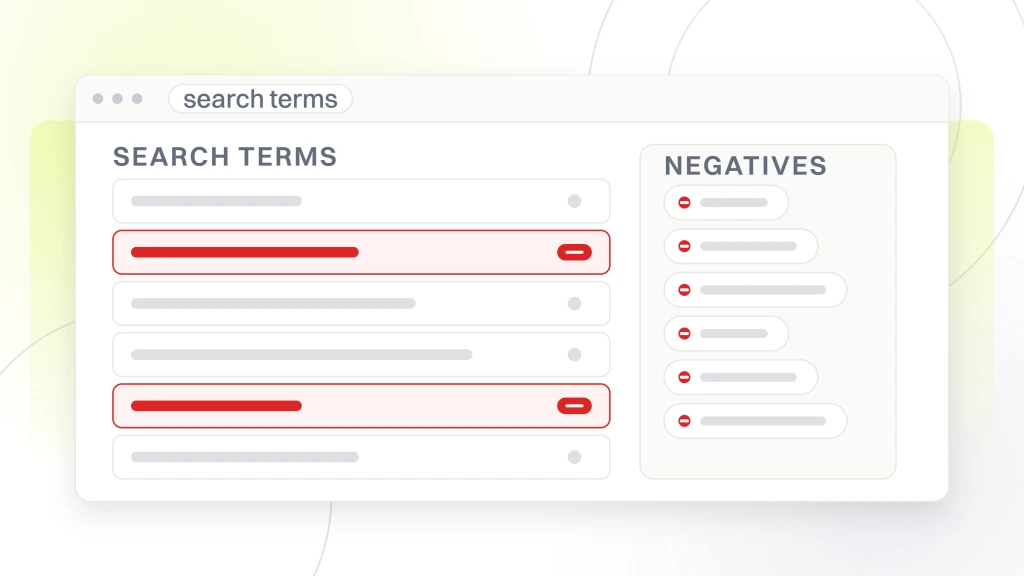
Build a starter negative keyword list of 200 plus terms
Every dental Google Ads account leaks 15 to 30% of its spend to searches like “free dental clinic,” “dental school prices,” or job queries. Add these as negatives at the account level on day one. Pull the Search Terms report weekly for the first 90 days and add 10 to 20 new negatives each pass. Practices that skip this step pay 40 to 70% more per booked patient than those that maintain the list, and the fix takes 20 minutes a week.
Turn ads off outside answering hours
Clicks that ring a voicemail rarely become patients. Pull your last 60 days of call data, find the hours your front desk actually answers within 20 seconds, and set the ad schedule to those windows plus 30 minutes on either side. Most practices cut wasted spend 15 to 25% on the first pass. Keep Saturday emergency ads on if you handle same-day calls, and add an “after-hours” landing page that captures a callback request when someone lands past hours.
Send each ad group to a service-specific landing page
Implant ad clicks that hit your homepage convert at 1 to 2%. The same click landing on an implant-specific page with pricing, financing, and a booking form converts at 6 to 12%. Build one page per high-value service ad group. See dental PPC landing pages for the layout that works. Match the ad headline, the page H1, and the primary photo. The ad-to-page mismatch is the single most common paid-search leak we find in audits.
Dental marketing tips for site fixes that move form-fills this month
Your website does more heavy lifting than any single channel. A dental site that loads in 2 seconds and puts a phone number in the top-right converts 3x better than the average practice site. Ship these three fixes this week.
Sticky click-to-call header on mobile
75 to 85% of dental site traffic is mobile. A visible phone number that stays fixed as the user scrolls lifts calls 20 to 40% on its own. Use a click-to-call link with the phone number as anchor text so search engines index it. Keep the button 44 pixels tall so thumb-taps register on the first try, and put the practice name plus phone in the same bar so brand and action stay together.
Callout. If your mobile pages load slower than 3 seconds, fix speed before any other marketing spend. Every second of load time cuts form-fills 7 to 12%, and Google discounts your Ads quality score in parallel.
Above-the-fold three-field form
Name, phone, reason for visit. That is the form. Every extra field cuts fills 7 to 12%. Put it on the right side of the hero on desktop and directly under the H1 on mobile. Auto-focus the first field, use large touch targets, and confirm submission with a thank-you page (not a modal) so you can track it as a goal. Practices that swap a 6-field form for a 3-field form see 30 to 60% more form-fills in the first 14 days.
Insurance strip above the fold
Roughly 60% of patients decide where to book based on whether you accept their plan. Show 6 to 8 logos in a strip above the fold and link the strip to a full insurance page. This one move lifts booking-rate on cold traffic 10 to 20% for general dentistry sites. Keep the logos in the same order every quarter so returning visitors find their plan at a glance, and add an “out-of-network” note if you offer superbills.
Dental marketing tips for content that ranks and converts
Dental content marketing that ranks looks nothing like the blog-post-a-week model most agencies sell. What works is a small stack of pages built around the treatments that actually pay your bills. See dental content marketing for the full method.
Callout. Publish 6 tight service pages before your first blog post. Service pages carry 4 to 8x the booking value of blog traffic and clear the local-intent ranking bar in half the time.
Write for local intent, not national rankings
“Best teeth whitening in Miami” pays your rent. “The history of teeth whitening” does not. Every page you publish should mention the city, a nearby landmark, and 2 to 3 neighborhood names in the copy. Local intent pages rank in 8 to 12 weeks with 6 to 10 well-placed geo mentions. National-intent posts take 8 to 14 months and rarely book a patient. Google’s own local-search data shows 76% of people who search for something nearby visit a business within 24 hours.
Build service pages before blog posts
Rank a page called “Dental Implants in [Your City]” before you rank a blog on “5 signs you need an implant.” Service pages carry pricing, financing, doctor bio, before-and-after photos, and a booking form. That single page tends to book 3 to 6 patients a month once it hits the map pack. Build one per high-margin service. Blog posts feed the funnel later, once service pages carry the practice.
Add FAQ clusters to every service page
An 8 to 12 question FAQ block near the bottom of each service page picks up featured snippets, PAA slots, and voice search queries. Answer the exact questions your front desk hears every day. Pair the FAQ page with fresh dental marketing ideas each quarter so the content stays sharp. Add schema.org/FAQPage markup so Google can pull the answers into search results. Practices that add FAQ clusters see 20 to 45% more organic impressions per page within 60 days, and the answers double as scripts your team can use on live calls.
Email and recall tips that fill next month’s calendar
Your patient list is the highest-ROI channel you own. A well-run recall program books 4 to 8x the return of paid ads at a fraction of the cost. Set up dental email marketing flows in your PMS or a light platform like Mailchimp, then run these three plays every month.
Send recall reminders at 5 months and 3 weeks
Most practices send one recall text a week before the ideal 6-month visit. That misses the patients who need to shuffle their week to book. Send the first reminder at 5 months out with an easy “pick your slot” link, then a second at 3 weeks out, then a day-of text confirmation. Practices that run this cadence lift recall show-rate from 55 to 65% up to 78 to 88%, worth $50,000 to $150,000 in preserved recurring revenue on a 1,500-patient book.
Run a reactivation flow for patients dormant 12 to 18 months
Every dental PMS holds a list of patients who used to show up and stopped. Pull the segment quarterly, send a 3-email flow with a soft check-in, a helpful piece of oral-health content, and a specific booking link. Reactivation flows recover 8 to 15% of dormant patients. On a 2,000-patient book, that is 160 to 300 returning patients a year, or $80,000 to $180,000 in recovered lifetime value with almost no ad spend attached.
Send a birthday text with a check-in link
A 2-line birthday SMS with a “book your next cleaning” link books 5 to 10% of recipients within 14 days. It earns real goodwill too, so patients mention your practice at book club and gym. Keep the copy warm and human. No promotions, no coupons, no discounts. The message reads as care, not marketing, and that is exactly why it works.
Referral loops that fund practice growth
Word of mouth still drives 60 to 70% of new dental patients in most markets. The tips below convert passive referrals into a system your team can measure. Run all three in the same quarter and you can double referrals in 90 days.
Callout. A patient referred by a friend has a 4 to 6x higher lifetime value than a paid-search patient. Build the referral flow before scaling ad spend.
Give the front desk a 2-line referral ask
At check-out, after a positive visit, the team member hands the patient a printed card with the ask, “If you have a friend who needs a dentist, we’d love to take great care of them too. Here’s a card for them and one for you.” That single script, run at every check-out, produces 3 to 6 new referrals a month per full-time hygienist. No app, no discount code, no complicated referral platform needed.
Send a hand-written thank-you the same week
When a patient refers someone new, mail a hand-written thank-you note within 5 business days. Do not text it. Do not email it. Handwrite it on a real card with a stamp. Practices that send hand-written thank-yous get 2 to 3x more referrals from the same patient over the next year. The card costs $2 and 4 minutes. The lifetime revenue lift is easily $2,000 to $8,000 per repeat referrer.
Maintain 3 to 8 partner cross-referral relationships
Orthodontists, oral surgeons, periodontists, and pediatric dentists send patients to general practices every week when the relationship is warm. Meet with 3 to 8 partners a quarter, share your patient-experience wins, and put a “referred by” field on every new-patient form to track dental patient referrals cleanly. Partner referrals close at 40 to 60% versus 15 to 25% for cold Google Ads leads, and the volume compounds every year as the trust deepens.
Measurement tips that keep the plan honest
You cannot grow what you cannot measure. Skip these tips and every other section turns into guesswork. Set up the three moves below once and you will spot a broken channel in a week, not a quarter. Read dental marketing ROI for the numbers behind each play.
Assign a call tracking number to every paid channel
Use CallRail, CallTrackingMetrics, or your PMS phone module to give each channel (Google Ads, GBP, organic, direct mail, referral) a unique tracked number. Without this, 40 to 60% of your calls attribute to “unknown” and you cannot spot which channel is broken. Setup runs $50 to $200 a month. Practices that install call tracking cut wasted ad spend 20 to 35% within the first billing cycle by killing the channels that drop calls but book no patients.
Tag every form submission with a hidden source field
Add a hidden UTM-source field to every website form so Google Ads, organic, and referral form-fills land in your CRM tagged by channel. Pair it with a “how did you hear about us” dropdown on the first-visit form, and reconcile the two sources monthly. Digital-only attribution understates word-of-mouth by 30 to 50%. The dropdown catches the offline referrals your tracking misses so you fund the right channels in next quarter’s budget.
Run a weekly dashboard with 4 numbers
New patient calls, new patient booked appointments, cost per booked patient, and same-week show rate. Track those 4 numbers on a single sheet every Monday. Anything else is noise for the first 90 days. Practices that run a 4-number weekly review spot broken funnels in 7 to 10 days, not 60 to 90. The habit matters more than the tool.
Budget tips for right-sizing dental practice marketing spend
The average dental practice spends 3 to 7% of collections on marketing. Newer practices should push to 8 to 12%. Established practices with strong recall can hold 3 to 5%. See dental marketing cost for a full breakdown. The tips below keep the spend accountable so you never write a blank check to an agency.
Callout. A practice under 5% of collections in marketing spend usually leaves 15 to 30 new patients on the table each month. Under-investing is the more expensive mistake.
Stop paying an agency for reporting you never read
If your agency sends a 12-page PDF every month that you skim in 3 minutes, you are paying for the wrong deliverable. Ask for a 1-page weekly summary with the 4 numbers above, plus 1 line on “what we changed this week and why.” Choosing a dental marketing company that reports weekly and in plain English beats a monthly novel every time. Cut vendors that cannot summarize the work in 60 seconds on a call. Read our dental PPC management guide for the weekly-review format that keeps a paid program honest.
Set a floor and a ceiling on channel spend
Every channel gets a floor (below this, results stall) and a ceiling (above this, diminishing returns kick in). Google Ads floor for a single-location practice is roughly $1,500 a month, ceiling $6,000. SEO retainer floor $999, ceiling $3,500. Set the two numbers, stay inside the band, and only raise the ceiling after 3 straight months at target volume. Read the dental marketing plan template for full channel allocations.
Run a quarterly audit against your own baseline
Every 90 days, compare the current 4-number dashboard to the same 4 numbers from a year ago. If new-patient calls are flat but ad spend is up, you have a leak. If cost per booked patient is climbing 15%+ year over year, one channel is fatiguing. The quarterly baseline check catches problems that monthly reports miss and it forces the agency to defend flat numbers with a plan, not a chart.
Seasonal dental marketing tips that time the calendar
Dental demand rides a predictable annual curve. Practices that time promotions to the curve book 2 to 4x the response of practices that run the same offer year-round. Run these 3 seasonal plays on autopilot.
January insurance reset campaign
Most PPO plans reset benefits January 1. Email your patient base December 26 to January 15 with a “use your benefits or lose them” reminder tied to their remaining balance. Include a booking link and a specific hygienist name. The January reset campaign books 20 to 40 extra cleanings for a 1,500-patient practice at almost zero cost. It catches high-value treatment plans patients postponed in November and December.
Summer family cleaning window
June through August is the highest-volume window for family cleanings, back-to-school checkups, and orthodontic consults. Run a “book the whole family in one visit” campaign starting mid-May. Practices that ship the campaign 6 weeks early book 30 to 50% more summer family visits than practices that wait until June. Bundle sibling cleanings in the same appointment slot and the front desk saves 20 minutes per family.
November use-it-or-lose-it push
Mirror the January play at year-end. Text patients with unused benefits November 1 through December 15 with a specific booking link. The urgency of expiring benefits doubles the click rate versus a generic recall reminder. Practices that run the November push generate $30,000 to $80,000 in incremental December collections without a single new-patient acquisition. This is the highest-ROI 4-week email flow in the calendar.
Real practice, real numbers, dental marketing that compounds
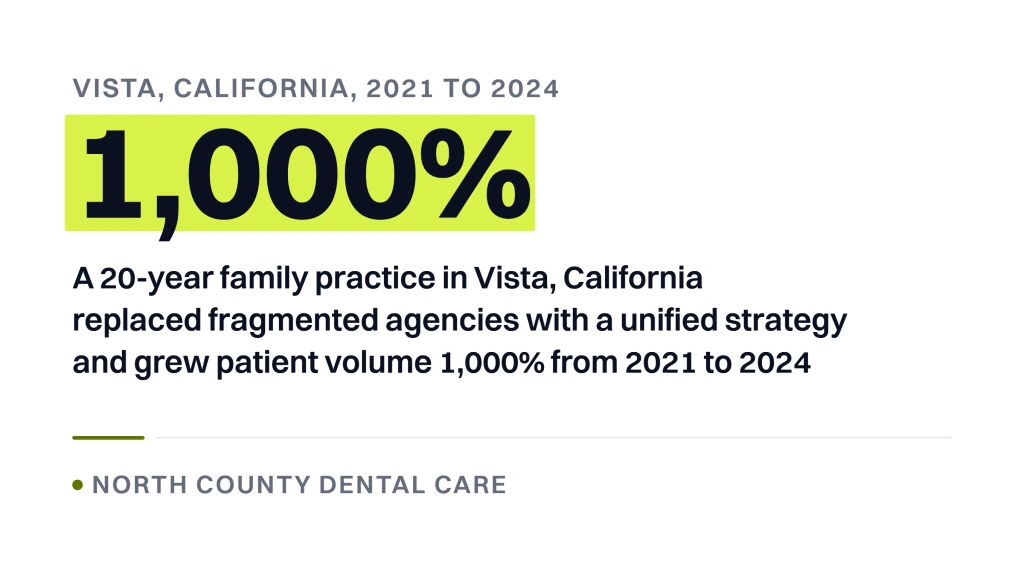
North County Dental Care, a 20-year family practice in Vista, California, replaced fragmented agencies with a unified strategy and grew patient volume 1,000% from 2021 to 2024. The engagement started with a secure, mobile-first website rebuild, layered advanced local SEO with citation cleanup, and added a GBP-driven PPC campaign for high-intent map-pack searches. Organic traffic climbed 385%. Marketing ROI hit 500%. The practice now books 12 to 16 new patients a month, up from 1 to 2 before the program started.
The play behind the numbers is not exotic. It is a secure site, local SEO, and targeted ads, run in the right order with steady measurement. See our dental office SEO and dental Google Ads management guides for the specific dental SEO tactics that carried the growth. If your practice sits somewhere on the same curve, the fixes are more available than most owners think.
Before you spend another dollar on marketing, run the audit implied in this piece. Pull your last 90 days of call tracking, form-fills, and new-patient acquisition cost. Sort the 30 tips by which one solves your biggest gap. Ship it. Measure it for 30 days. Then move to the next tip. Compound the plays and dental marketing stops feeling like guesswork. It starts booking patients on a schedule. Ready to compare custom dental website design packages or line up an agency partner? The ADA practice management library and ADA News are two of the few sources worth your time as you build the plan.