Picking the best SaaS SEO tools saves a B2B team about $8,000 a year, or quietly burns it. Every category has an all-in-one platform at $300 a month that claims to cover everything, plus three or four specialists that beat the all-in-one on a single workflow. Teams that hit the sweet spot pay $400 to $1,200 a month for a working three-tool stack. Teams that overpay hand over $2,500 a month for feature overlap the marketing lead never opens twice.
This guide ranks the best SaaS SEO tools by how a real B2B SaaS team uses them across keyword research, technical audits, rank tracking, backlink analysis, competitor gap analysis, and content brief generation. You get pricing tiers for small, mid-market, and enterprise budgets, the three-tool stack that covers 90% of the workflow, the pattern for when a specialist earns its spot, and the shortlist we run inside our own SaaS SEO retainer for client accounts.
Best SaaS SEO tools for the all-in-one slot
The all-in-one slot is the anchor of every SaaS stack. Pick one platform and commit for at least six months so the team builds real workflow depth. Switching every quarter breaks reporting and wastes the first month on retraining. The three that carry most B2B SaaS accounts in 2026 are Ahrefs, Semrush, and SE Ranking.
Ahrefs for backlink and content gap work
Ahrefs runs $129 to $1,499 a month across Lite, Standard, Advanced, and Enterprise tiers. Standard at $249 is the sweet spot for mid-market SaaS teams that need serious backlink depth without the enterprise seat count. The Site Explorer keeps the freshest backlink index on the market, and the Content Gap report cuts hours off competitor keyword research. Teams that rank on link-heavy queries pick Ahrefs first and rarely regret it.
Semrush for keyword breadth and paid overlap
Semrush runs $139 to custom pricing on Business and Enterprise deals. The keyword database is wider than Ahrefs, and the paid search side plugs into the SEO workflow so one team owns both channels. The AI Overviews Tracker as a $119 add-on is the fastest way to measure LLM answer share on Google’s SERP without a separate tool. Teams that run PPC and SEO under one roof land on Semrush as the platform of record.
SE Ranking as the budget all-in-one
SE Ranking runs $65 to $259 a month and covers 80% of the workflow the big two do, at 30 to 40% of the price. Small B2B SaaS teams under 15 people that need keyword tracking, site audit, and backlink data on one bill land here. The reporting is cleaner than either big-name tool, and the white-label option matters for agencies serving SaaS clients on a fixed retainer.
Rank tracking picks for SaaS accounts
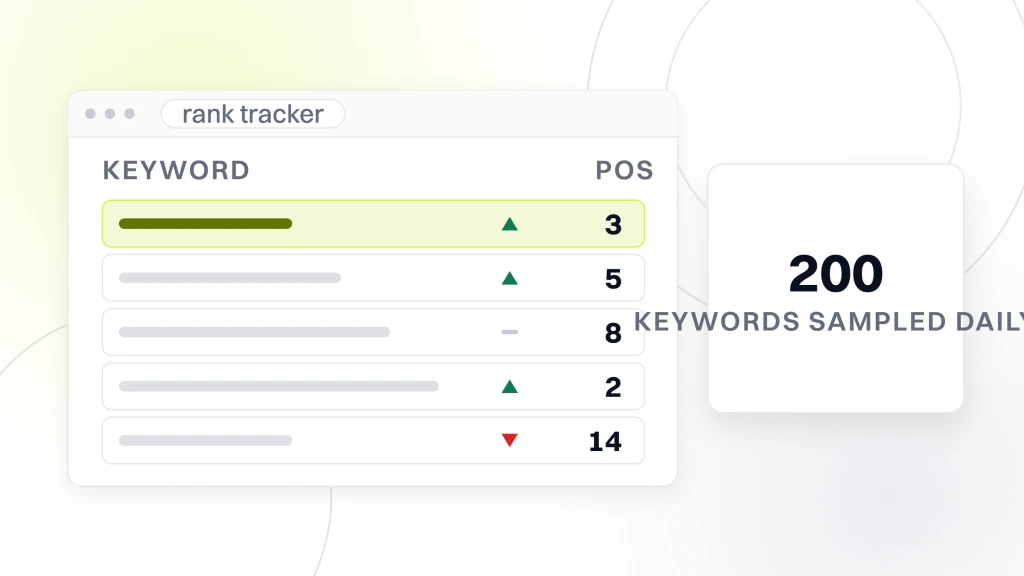
Rank tracking specialists sample keyword positions more often and more accurately than the trackers baked into all-in-one platforms. Daily sampling on the top 200 target keywords beats weekly sampling on 5,000 keywords since most SEO calls happen inside a 7-day window on a small set of high-priority queries.
AccuRanker for daily precision
AccuRanker runs $109 to $499 a month based on tracked keyword count. Daily sampling with a device split (desktop vs mobile) and a location split (city-level in most markets) beats every all-in-one built-in tracker on precision. B2B SaaS teams that make weekly ranking calls pick AccuRanker as the tracker of record even when the all-in-one bundles rank tracking. The precision gap matters most on the top 20 queries, where small position changes drive real traffic swings.
SE Ranking rank tracker as budget option
SE Ranking runs a standalone tracker at $30 to $80 a month outside the full suite. Daily sampling on the top 200 keywords works well at the budget tier. Location and device split are more limited than AccuRanker but fine for teams that mainly care about desktop rankings in one or two markets. Small B2B SaaS teams that can’t justify AccuRanker’s $109 floor land on SE Ranking’s tracker as the middle option between free Google Search Console data and AccuRanker precision.
Backlink analysis picks for B2B SaaS
Ahrefs pulls ahead on backlink analysis since its index is the largest and freshest on the market. Semrush’s backlink data still works for competitor analysis. Moz Pro’s is thinner but fine for small teams. Every dedicated backlink tool sits behind Ahrefs on depth. For a B2B SaaS team the call is usually easy. Pick Ahrefs and accept that other tools might win on other workflows.
When Moz Pro still earns a spot
Moz Pro at $99 to $599 a month still earns a slot on small-team stacks where the marketing lead prefers the Moz UI or the team already reports on Moz Domain Authority. Moz Local as a bundled add-on carries local SEO features Ahrefs and Semrush charge separately for. Teams already inside the Moz ecosystem find switching costs high enough to stay put even when Ahrefs would be marginally better on backlink depth. Small teams on legacy Moz contracts often keep Moz Pro through renewal and add Ahrefs Lite as a supplementary backlink source for competitor gap work, since a full stack migration in one quarter usually costs more in retraining than the marginal data gain returns inside six months.
AI and LLM optimization picks for SaaS
AI SEO tools split into two categories in 2026. Content generation and brief tools use AI to speed up mechanical writing work. LLM SEO tracking tools monitor share of voice inside ChatGPT, Perplexity, and Google AI Overview answers. B2B SaaS teams need both on the stack since the two workflows don’t overlap.
LLM SEO tracking tools
LLM SEO tracking tools include Semrush AI Overviews Tracker at $119 a month as an add-on, Otterly at $59 to $269 a month standalone, and Peec at $99 a month for share of voice across ChatGPT and Perplexity. Manual prompt sampling in a shared spreadsheet works for small teams tracking under 30 target prompts. Once the list crosses 100 prompts, an automated tool pays back inside the first quarter. Our writeup on LLM SEO for SaaS covers the full measurement stack for teams that want AI answer share of voice tracked properly alongside traditional Google rank tracking.
AI content brief tools
Clearscope AI, Surfer AI, and MarketMuse AI produce first-draft briefs 40 to 60% faster than manual brief writing. What AI doesn’t replace is editorial judgment on brand voice, the strategic call on which topics to cover, or the analytics read on why rankings moved. Teams that use AI to speed the mechanical work and keep human judgment on strategy hit the sweet spot on volume versus quality. Teams that hand AI full editorial control produce mediocre content that ranks briefly and falls off.
The SaaS SEO tool shortlist compared side by side
The tools that carry most B2B SaaS SEO stacks in 2026 span all-in-one platforms, technical audit specialists, rank trackers, content brief tools, and LLM SEO trackers. The table below compares the working shortlist on the numbers a marketing lead cares about when writing the budget.
| Tool | Category | Monthly price | Best used for | Weakness |
|---|---|---|---|---|
| Ahrefs | All-in-one | $129 to $1,499 | Backlink depth, content gap, site audit | Keyword research breadth less than Semrush |
| Semrush | All-in-one | $139 to Custom | Keyword breadth, PPC integration, AI Overviews | Backlink data less deep than Ahrefs |
| SE Ranking | All-in-one budget | $65 to $259 | Small team stack, budget-friendly | Less depth on backlink and audit |
| Screaming Frog | Technical audit | $259 annually | Deep site crawls, engineering-led teams | Steep learning curve, older UI |
| AccuRanker | Rank tracker | $109 to $499 | Daily precision on top 200 keywords | Rank tracking only, no other features |
| Clearscope | Content briefs | $170 | High-quality brief templates and grading | Higher price than Surfer for similar output |
| Surfer SEO | Content briefs | $79 to $219 | Fast briefs plus Google Docs integration | Brief quality drops on complex topics |
| Otterly | LLM SEO tracker | $59 to $269 | Share of voice across AI answer surfaces | Narrow feature scope compared to Semrush |
The working three-tool stack for a mid-market B2B SaaS team is Ahrefs Standard at $249, AccuRanker at $109, and Clearscope at $170, totaling $528 a month. The five-tool stack for a larger team adds Screaming Frog at $22 amortized plus Otterly at $99, totaling $649 a month. Above $700 a month is usually feature overlap or seat multiplication, not category expansion. The workflow sequence that turns these tools into a real content operation runs alongside our SaaS SEO checklist, which covers how the tool stack integrates into the weekly and monthly cadences a mature SaaS content team runs.
SaaS SEO tool stacks inside real accounts
Every tool call above shows up differently once a real SaaS account runs it. Three client rebuilds tell the pattern clearly. The fuller take on picking a partner for the work lives in our guide to the best SaaS SEO agencies, which walks through the vetting criteria we apply to our own retainer scope.
Rocket Software, Inc. SEO tool stack reference
Rocket Software, Inc. ran a full B2B SaaS SEO program with our team over a 14-month engagement. The account started on Semrush Guru with no rank tracker, no technical audit specialist, and no content brief tool. Publishing ran 6 posts a month from a shared Google Doc brief template the marketing lead wrote by hand each week.
The rebuild happened in three phases across the first quarter. Month one added AccuRanker at $189 a month for daily rank sampling on the top 200 target keywords. Month two added Screaming Frog at $259 a year as the technical audit specialist for a quarterly deep-crawl cadence. Month three swapped Semrush Guru for Ahrefs Standard so the marketing lead could pull deeper backlink data for competitor analysis on a category comparison refresh. Content briefs stayed on the manual template through month six, then Clearscope entered at $170 a month once publishing climbed past 10 posts a month.
Monthly tool spend went from $250 (Semrush Guru alone) to $637 (Ahrefs, AccuRanker, Clearscope, Screaming Frog amortized) across the 14-month program. The launch push tied to the new stack drove a 300% activation lift, 3,000 customers in the first week, and 400+ daily subscribers post-launch. The added spend paid back inside four months since tighter rank tracking caught and fixed ranking drops that used to take weeks to notice, and the brief tool cut the marketing lead’s brief-writing time from 6 hours a week to 90 minutes.
Simply.Coach and Custimy on the growth stack
Simply.Coach came in as a coaching SaaS platform fighting a new-domain authority gap. The stack built around Ahrefs Standard for backlink outreach targeting, AccuRanker for weekly rank sampling on the top 150 keywords, and Clearscope for briefs. Inside 48 days the account posted 80% organic lead growth and 120% paid lead growth on lower overall spend, since the tool stack surfaced the exact commercial-intent queries the manual workflow kept missing.
Custimy, a customer data platform for e-commerce, ran a matching stack with heavier emphasis on the content brief tool. Publishing cadence went from 4 to 12 posts a month once Clearscope templates cut brief production time in half. Twelve months in the account was ranking for 500+ first-page keywords and pulling 25,000+ monthly organic visits at a 165-second average session duration, all of which the marketing lead traced back to tighter keyword targeting driven by the tool stack.
SaaS SEO tool mistakes teams keep making
The SaaS SEO tool mistakes cluster around six patterns we see on almost every audit. Fix all six inside 60 days and the stack budget drops 20 to 40% without losing workflow coverage. Cheap to fix, expensive to leave alone across a full year.
- Paying for the everything platform tier. Business or Enterprise tier features the team never opens. Downgrade to Standard or Pro until the team hits the seat cap.
- Skipping rank tracking since the all-in-one includes it. Bundled rank trackers sample weekly, not daily. Add AccuRanker or SE Ranking’s rank tracker.
- Buying a content brief tool before the team is publishing consistently. Expensive briefs go unused. Delay the brief tool until 8+ posts monthly.
- Running two all-in-ones on the same stack. Ahrefs plus Semrush is duplicate spend for teams under 20 people. Pick one.
- Ignoring LLM SEO tracking through 2026. AI answer share of voice matters. Add Semrush AI Overviews or Otterly.
- Paying for enterprise seats when 3 team members log in. Seat multiplication is the silent budget killer. Match seats to actual login patterns.
- No tool audit at annual renewal. Churn the tools the team never opens. Save the budget for the tools that get used.
Order to fix them
Fix the everything-platform overspend first, since it delivers the largest single-line savings. Add rank tracking second so the weekly decisions get real data. Add LLM SEO tracking third since answer-surface share climbs quarter over quarter. Delay the content brief tool until publishing cadence earns it. Consolidate to one all-in-one once the team is stable. Audit the stack at annual renewal and churn what nobody opens. Teams that batch the six fixes over 60 days, rather than shuffling the whole stack in a week, get cleaner analytics on what moved the numbers.
SaaS SEO tool market outlook through 2028
The outlook through 2028 hinges on three shifts. AI SEO features consolidate inside the all-in-one platforms rather than staying standalone, which pressures point solutions like Otterly and Peec to consolidate or expand into full platform play. LLM SEO tracking becomes a standard feature inside Semrush and Ahrefs subscriptions instead of a paid add-on. Traditional rank tracking specialists like AccuRanker face pressure as built-in trackers close the daily-sampling gap.
Consolidation pressure on specialists
Consolidation pressure on specialists compounds through 2027 and 2028 as the all-in-ones bundle more workflows. Screaming Frog and AccuRanker are the two most likely to survive since both cover their specific workflow at a depth the all-in-ones can’t match without engineering investment those companies haven’t prioritized. Clearscope and Surfer face more pressure as Semrush and Ahrefs bundle AI content brief tools into existing subscriptions. B2B SaaS teams building the stack in 2026 should plan renewal cycles with contract flexibility.
AI SEO features and pricing
AI SEO features inside Ahrefs and Semrush follow the same pricing pattern as their traditional releases. AI functionality launches as a paid add-on for six to twelve months, then rolls into the standard subscription once adoption plateaus. B2B SaaS teams that wait until the features consolidate into their existing subscription save 15 to 25% on total stack spend across 2026 and 2027 versus teams that add every AI point solution at launch.
Start with the best SaaS SEO tools this quarter
Start with three moves this quarter. Pick one all-in-one (Ahrefs Standard for backlink-heavy accounts, Semrush Guru for keyword-heavy accounts, SE Ranking for budget-first accounts) and commit for 6 months to build workflow depth. Add AccuRanker or SE Ranking rank tracker with daily sampling on the top 200 target keywords. Track baseline data for 60 days before adding a third tool. That baseline surfaces the real workflow bottleneck instead of the imagined one.
Then plan the 90-day stack build. Month one lays the all-in-one plus rank tracker foundation. Month two adds the technical audit specialist if the team runs monthly audits, or a content brief tool if publishing is above 8 posts a month. Month three adds the LLM SEO tracker to capture AI answer share of voice. Teams that follow the phased ramp avoid the everything-at-once overwhelm that kills adoption. Retainer pricing for SaaS accounts that want the workflow layered on top of the stack runs $999, $1,499, $2,499, and from $4,500 a month depending on publishing cadence and technical scope. The paired SaaS SEO scope where the tools plug into the working operation lives inside our SaaS SEO services retainer, which handles tool selection and workflow integration as part of the standard onboarding scope.
Picking the best SaaS SEO tools comes down to matching the tools to how the team really works, not to the feature matrices on comparison posts. Pick one all-in-one, add rank tracking, layer in specialists only when the workflow depth is real, and audit the stack every 12 months. That’s the working framework.