Enterprise search engine optimization services solve a coordination problem, not a keyword problem. When a 500-employee brand hires an SEO partner, the work spans product, legal, engineering, content, and PR at the same time. You’re not shopping for a scrappy freelancer with a keyword tool. You’re shopping for a partner that speaks fluent Jira, understands staging environments, and can push a technical rollout without breaking site speed during a Black Friday cycle. This guide covers what those services include, what they cost in 2026, how they get scoped in an RFP, and how to tell a real enterprise partner from a boutique that repackaged its retainer with new slides.
You get pricing bands from live 2026 deals, the seven workstreams that show up on every enterprise scope, the team structure that actually works, and the internal signals that tell you the program is on track before the traffic curve confirms it. Read straight through in about twelve minutes. Written for VPs of marketing, heads of growth, and enterprise SEO managers who need to defend the budget line at the next board meeting. Redefine Web runs SEO retainers from $999 per month at the small-business band up to enterprise scope, and the numbers below reflect what we see across public benchmark data plus our own client work.
Enterprise SEO pricing and retainer bands in 2026
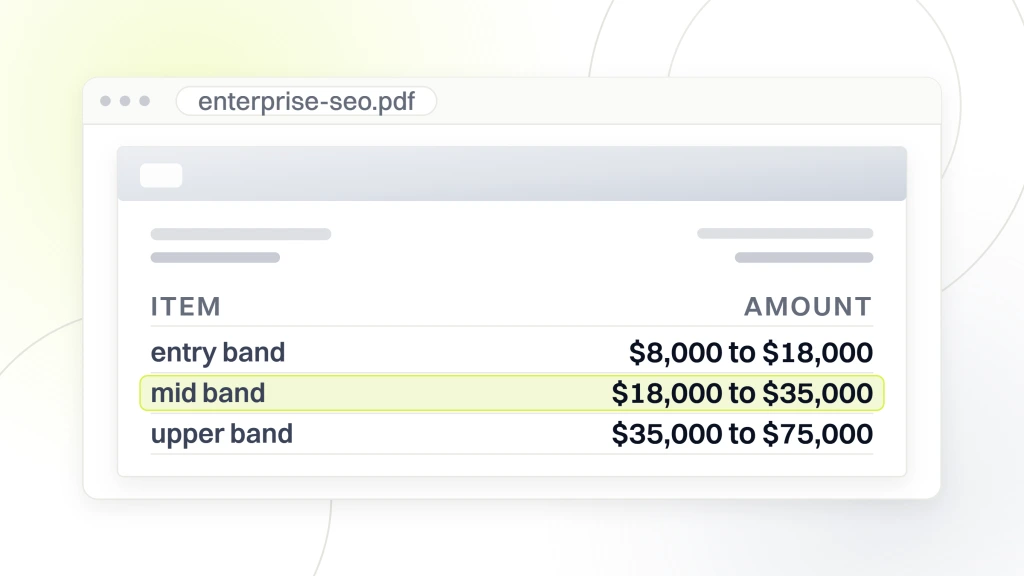
Enterprise SEO retainers land in three bands in 2026. Entry band runs $8,000 to $18,000 per month and buys a strategist plus part-time technical and content help. Mid band runs $18,000 to $35,000 per month and buys a full pod including strategist, technical lead, content lead, link acquisition, and analytics analyst. Upper band runs $35,000 to $75,000 per month and adds international coverage, digital PR at scale, and dedicated product-vertical specialists. Public Clutch benchmark data pegs enterprise SEO at roughly $90 per hour, and a real program burns 80 to 240 hours per month.
The upper-band fee is not a status flex. A $2 billion revenue company with 40,000 product pages and eight regional sites can’t run on four people. The pod behind that program is 12 to 20 headcount at the agency side, with 60 to 80 percent of the fee going to salaries. Vendors quoting under $8,000 per month for a Fortune 1000 site are either underscoping deliberately to win the contract or planning to hand the account to a junior after signing. Independent guidance from Google Search Central covers the technical fundamentals, but scope math starts with headcount.
| Band | Monthly retainer | Team size | Typical fit |
|---|---|---|---|
| Entry | $8,000 to $18,000 | 3 to 5 people | Mid-market, single product, US-only |
| Mid | $18,000 to $35,000 | 6 to 10 people | Enterprise, multi-product, 2 to 3 markets |
| Upper | $35,000 to $75,000 | 12 to 20 people | Global enterprise, 5+ markets, multi-brand |
| Project add-ons | $50,000 to $450,000 | Variable | Migrations, launches, category expansions |
Case study Automation Anywhere and what enterprise partnership looks like
Automation Anywhere, the San Jose based robotic process automation platform, ran a global paid and organic program from 2020 through 2024 that cut cost per lead 97 percent and scaled 100 times more customers into their enterprise RPA funnel. Ad impressions grew 300 percent over the same window. The core work was PPC optimization, landing page strategy, offer development, and multi-region campaign management across Google Ads, Performance Max, and LinkedIn Ads. The SEO layer of that engagement built the topical authority that let the paid campaigns land on pages Google already trusted, which is why the cost per lead dropped to $63.
The lesson from the Automation Anywhere program applies straight to enterprise search engine optimization services scoping. Organic and paid have to be scoped together at enterprise scale, because paid dollars amplify organic authority and organic pages carry paid traffic to close. When the SEO agency owns pillar content and the PPC team owns bid strategy on the same landing page architecture, cost per acquisition drops in both channels. Splitting the two into siloed vendors costs 30 to 50 percent efficiency at that scale. Enterprise buyers should ask any prospective SEO vendor how they coordinate with the paid team and expect a specific answer.
The team structure behind an enterprise SEO program
Enterprise SEO delivery needs six roles on the agency side and three on the client side. Missing any one causes the same failure mode. Strategy without execution, execution without measurement, or measurement without organizational buy-in. On the agency side you need a strategy director, a technical lead, a content lead, a link and PR lead, an analytics analyst, and a project manager. On the client side you need an SEO owner, an engineering liaison, and a content operations lead. When any of those seats is empty the program stalls inside 90 days.
- Strategy director owns roadmap, quarterly business reviews, and board-level updates
- Technical lead runs crawl budget, rendering QA, log analysis, and structured data
- Content lead runs cluster planning, editorial calendar, and brand voice compliance
- Link and PR lead runs digital PR campaigns, industry surveys, and publisher outreach
- Analytics analyst runs GA4, Search Console, BigQuery, and custom dashboards
- Project manager runs sprint planning, stakeholder communications, and deliverable QA
Measurement, attribution, and reporting cadence
Measuring enterprise SEO services is not a monthly ranking report. You get a weekly technical health dashboard, a monthly content and links progress report, and a quarterly business review that ties organic to revenue and pipeline. Anything less granular is under-serviced. Anything more granular is theater. Last-touch attribution undervalues SEO by 40 to 60 percent because organic sits early in the buyer journey. Multi-touch attribution helps but requires a stitched data pipeline across GA4, the CRM, and the marketing automation platform, which is engineering work that runs $60,000 to $150,000 in year one.
The weekly technical health dashboard tracks crawl errors, indexation status, Core Web Vitals, log-file anomalies, and any structured data breakage. Anomalies get flagged inside 24 hours with a triage recommendation. The dashboard gets built once and maintained, not rebuilt in a slide deck each week. The quarterly business review is where the SEO program earns its next quarter of funding. Expect a 90-minute meeting with the CMO or VP of marketing covering organic revenue trajectory, ranking share of voice against named competitors, technical debt burn-down, content publishing throughput, and pipeline attribution. Any vendor that shows up with a ranking report instead of a revenue report at the QBR is not the enterprise SEO services partner you thought you hired.
How to shortlist and select an enterprise SEO partner
Shortlist five to seven vendors, request written proposals, run reference calls on three, and negotiate the final two. The full cycle takes 10 to 14 weeks. Skipping any step usually costs six to nine months of program time when the wrong vendor gets picked and unwound. The RFP process filters by capability. Reference calls filter by execution. Negotiation filters by cultural fit. Enterprise SEO is a two-year relationship at minimum, and cultural fit matters as much as capability. A brilliant vendor whose team clashes with your marketing culture will underperform a merely competent vendor whose team gets along with yours.
- Show us three enterprise SEO services examples that ran 24 months or longer, with named metrics
- What percentage of your revenue comes from your top 3 clients
- Who leads day-to-day on our account and what is their availability
- How do you handle a client engineering team that blocks technical recommendations
- Walk us through your attribution model for organic revenue
- What did you get wrong on a client program in the last 24 months and how did you fix it
- Who owns the deliverables if we terminate the contract
The technical workstream inside a large enterprise SEO program
Technical SEO at enterprise scale is a systems engineering problem. You’re managing crawl budget on 500,000 to 40 million URLs, coordinating rendering behavior across a headless React front-end and a legacy templating system, and running weekly regression tests on structured data. The technical lead spends 60 percent of their time on log-file analysis and rendering QA, not on running Screaming Frog crawls. Log-file analysis is where the highest-value findings come from. Googlebot’s crawl budget follows internal-linking depth, sitemap freshness, and server response speed.
Content strategy and editorial production at enterprise scale
Content at enterprise scale is not about writing more blogs. It’s about publishing the right pages, in the right cluster shape, with editorial quality that survives brand review. The content lead spends 40 percent of their time on strategy, 30 percent on stakeholder alignment, and 30 percent on editorial QA. A common failure pattern shows up when the enterprise content team publishes 20 pages per month across scattered topics, each ranking well individually but never compounding into topical authority. The fix is to consolidate around three to six pillar topics, publish 40 to 80 pages per topic over 12 to 18 months, and interlink aggressively.
Links, digital PR, and authority-building at enterprise scale
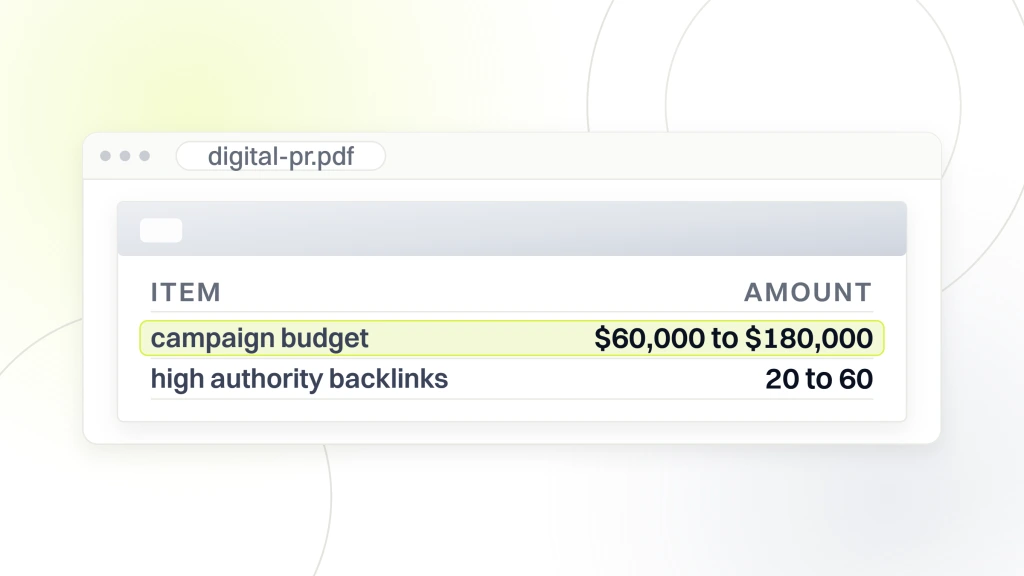
Enterprise link-building is digital PR, not directory submissions. You run one or two original research reports per year, pitch them through a real PR firm partnership, and earn coverage in Bloomberg, Forbes, TechCrunch, or vertical trade press. Each campaign generates 20 to 60 high-authority backlinks plus brand mentions that grow the domain authority curve for 12 to 24 months. Original research is expensive. Budget $60,000 to $180,000 per campaign for survey infrastructure, data analysis, report design, and PR distribution.
International and multi-region SEO for global brands
Global SEO requires hreflang architecture, country-code top-level domains or subdirectory logic, in-country content, and regional link acquisition. The mistake we see on 60 percent of international rollouts is US-first thinking applied globally. The fix is native content strategy per market with dedicated regional owners. Hreflang implementation on 5 to 20 markets is a full quarter of technical work. Every URL variant needs a bidirectional hreflang tag pointing to every other language and region version. Errors get flagged inside the International Targeting report in Search Console.
Analytics, dashboards, and stakeholder reporting
Analytics at enterprise scale means a stitched pipeline across Search Console, GA4, BigQuery, the CRM, and the marketing automation platform. The analyst spends 60 percent of their time on dashboard maintenance and 40 percent on ad-hoc analysis. Reporting cadence runs weekly technical, monthly program, quarterly business review. The BigQuery layer is where enterprise analytics diverges from mid-market. You push raw Search Console data to BigQuery daily, join it with GA4 event data, layer in CRM lead status, and produce a stitched dataset.
Working with enterprise SEO vendors past year one
The enterprise SEO relationship works on 24-month cycles. Year one is technical debt cleanup and content foundation. Year two is compound growth and market defense. Year three is category expansion or international rollout. Vendors that only serve year one produce a good foundation and leave money on the table. Vendors that stay for years two and three compound the value. The best enterprise engagements we see share three habits. Monthly executive stand-ups with the CMO, quarterly on-site strategy sessions with the full agency team on the client’s floor, and one shared Slack channel with response SLAs. For the operating stack, our search engine optimization services retainer covers the core deliverables that map cleanly to enterprise scope.
Wrapping up enterprise search engine optimization services
Enterprise SEO services are a two-year commitment to a partner who can coordinate across product, engineering, content, PR, and analytics. The retainer runs $18,000 to $75,000 per month depending on scope. The team runs 6 to 20 people on the agency side plus 3 dedicated seats on the client side. The playbook covers seven workstreams, and any vendor missing two or more is running a mid-market program on an enterprise fee. If you’re running the vendor selection right now, use the seven RFP questions, run three reference calls, and check cultural fit as hard as capability.
The best enterprise SEO relationships compound past year two and produce the market defense that no single-quarter tactic ever will. For a broader take on the discipline, our search engine optimization services for small business post covers the compounding logic at the other end of the spectrum, and our local search engine optimization services guide covers the map-pack side. When you’re ready to scope a program, our search engine optimization consulting services post covers the diligence path in more depth, and our SEO retainer starts at $999 per month at the small-business band and scales up on a defined ladder.