SaaS Website Design Agency for B2B SaaS Growth Teams
SaaS website design for growth-stage B2B teams. Buyer-segmented landing pages, a pricing page that actually explains the offer, and a demo flow that writes straight into HubSpot. Live in 8 to 12 weeks. Our last 20 B2B SaaS redesigns hit a 5.8% average visitor-to-demo conversion rate.
Four numbers every B2B SaaS marketing lead can hold us to
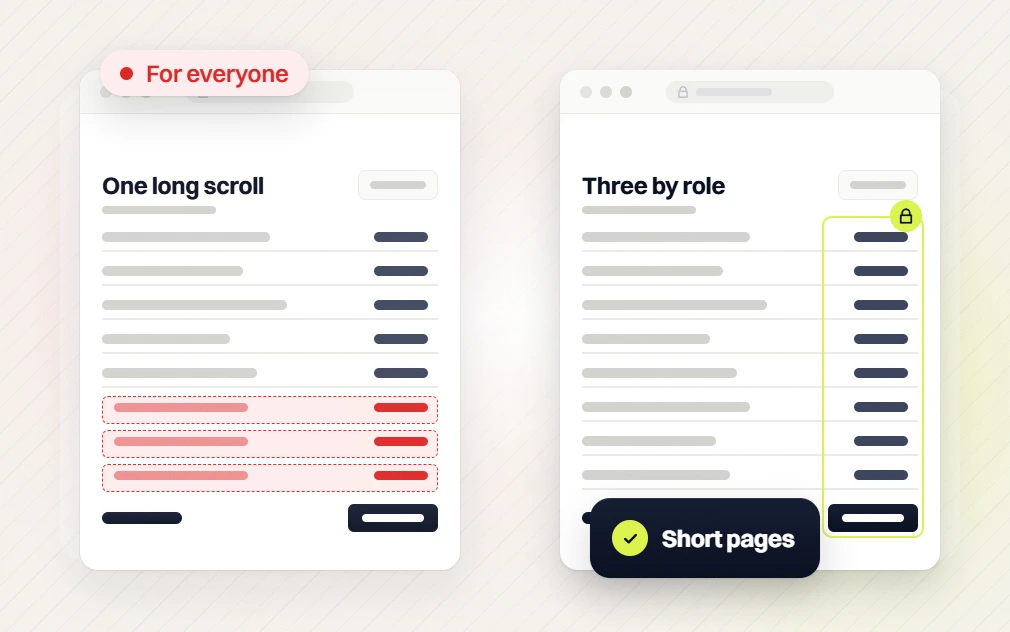
SaaS sites die after the hero on a 4,000-word feature dump
Most SaaS marketing sites go live with one giant scroll of features and no ICP anchoring. 68% of buyers bounce past the hero and pipeline funds Google Ads, not sales. We build ICP use-case pages plus an interactive product tour, so each buyer sees the software doing their job in the first 20 seconds.
Contact-us pricing pushes 47% of Series B buyers to a G2 competitor
Series B procurement builds the business case on the pricing page before Sales ever sees the lead. Hiding tiers behind a form kicks the buyer to G2 and Capterra for a competitor with public seat math. We publish tiered pricing with a seat calculator plus a clear enterprise slot for MEDDIC deals.
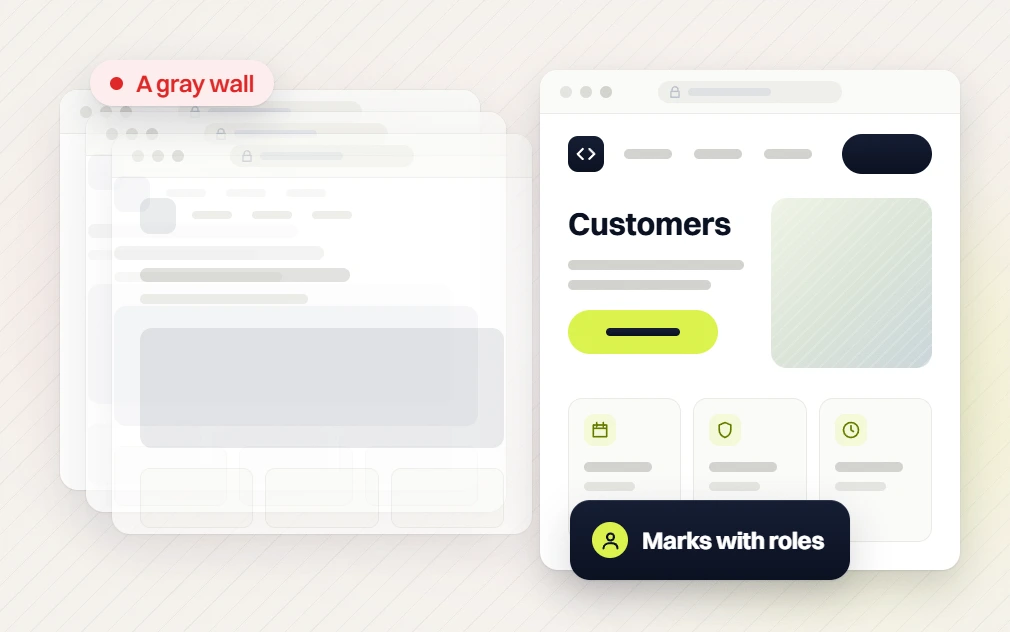
Static screenshots convert 3.2x worse than animated product visuals
A hero screenshot and a grayscale logo bar without named outcomes read as brochureware. Named case studies with logo, role, and outcome beat stock product shots by 3.2x on demo-request conversion. We wire Storylane or Navattic tours plus logo-plus-outcome proof strips into every ICP page.
3 outcomes every B2B SaaS build produces
Site architecture and qualifying UX at every step move demos onto the board. Our post-redesign visitor-to-demo rate averages 5.8% in HubSpot MQL flags.
Every ICP page launches with SoftwareApplication schema, targeted metadata, and intent-mapped slugs. Vs comparison pages average 194% organic growth year one.
Your name on the domain, your logins on the CMS, your team trained on the platform. If we part ways, codebase, hosting, and HubSpot keys stay yours.
4 stages. Every step ends in a sign-off
Fixed scope, fixed timeline, fixed outcomes. Nothing moves to the next stage until your leadership signs the gate deliverable.
Discovery that earns the brief
A 20-to-30 page brief signed by owner, RevOps lead, and marketing lead. Leadership interviews, technical audit of your current site, HubSpot and ad accounts, competitor benchmark against 5 B2B SaaS peers, and HubSpot data mapping. Nothing moves until it is locked.
Design built for your B2B SaaS buyer, not a Dribbble reel
Mobile-first design system with B2B SaaS conversion patterns baked in from wireframe. Every component engineer-validated the same week it is drawn. You walk away with an editable Figma file your team owns for future changes.
Engineering that survives your next HubSpot upgrade
WordPress with custom PHP by default, headless Next.js when your stack asks for it. Core Web Vitals treated as an acceptance criterion. HubSpot, Salesforce, Segment on the CRM side. GA4, Meta CAPI, and demo routing wired in.
Launch, then 30 days of daily monitoring
Cutover runs off-hours with the whole team on a bridge. Search Console, error logs, HubSpot demo events, and Core Web Vitals watched daily for 30 days. On day 31 you take the keys and go, or roll into a maintenance retainer.
What you actually get from our SaaS build
Fixed scope, fixed timeline, fixed outcomes. Every workstream below has a defined deliverable and a written sign-off, on a date you can put on the calendar with your RevOps team.
Designed around the SaaS buyer choice
Custom design for your product, not a template with your logo swapped in. Every page is built around the choice a buyer is making. Pricing answered, product tour visible, demo request never more than one tap away. Design sign-off before development starts.
ICP pages answer pricing, integrations, and "what changes in week 1" above the fold.
Figma tokens and components your team can extend without a developer.
or Navattic, showing the software doing the job in 20 seconds.
logo, role, and outcome beside every H1 hero. No generic marquees.
so procurement can build the business case without a demo call.
built to rank on "vs" queries for your top three competitors.
Built to load before SaaS buyers bounce
The build runs on a bespoke WordPress theme with no page-builder bloat and no plugin roulette, or headless Next.js when your stack asks for it. Nothing launches below a 95 mobile Lighthouse score, because Series B buyers evaluate on a phone in between meetings.
no page-builder bloat, no plugin roulette; your team edits copy without a ticket.
when your stack calls for it, with Contentful, Sanity, or Payload as the CMS.
green LCP, INP, and CLS on production, not just staging. No launch below the bar.
accessibility audited before launch. Legal risk closed, not deferred to Q3.
sub-second TTFB on the paid landing pages you spend real ad money on.
no per-seat CMS pricing, no vendor lock-in when your team scales past 30 pages.
Launches fully optimized, not just SEO-ready
Keyword mapping comes from real buyer searches in your category. Every named ICP gets its own page, and "vs" comparison pages, where SaaS buyers actually decide, are wired in from day one. Copy is written from customer interview, not filler.
built from 5 to 10 customer interviews per ICP, not a Google Suggest scrape.
one page per named buyer (RevOps, Head of Data, IT Ops), with role-specific copy.
ranked pages for your top 3 competitors, with a fair scorecard and clear win condition.
plus Product schema on pricing and Review schema on case studies. Rich results ready.
by industry or company size, generated from a single template with per-page copy.
exact buyer language pulled from 30-minute customer calls, not agency-invented phrasing.
Wired into HubSpot before launch, not after
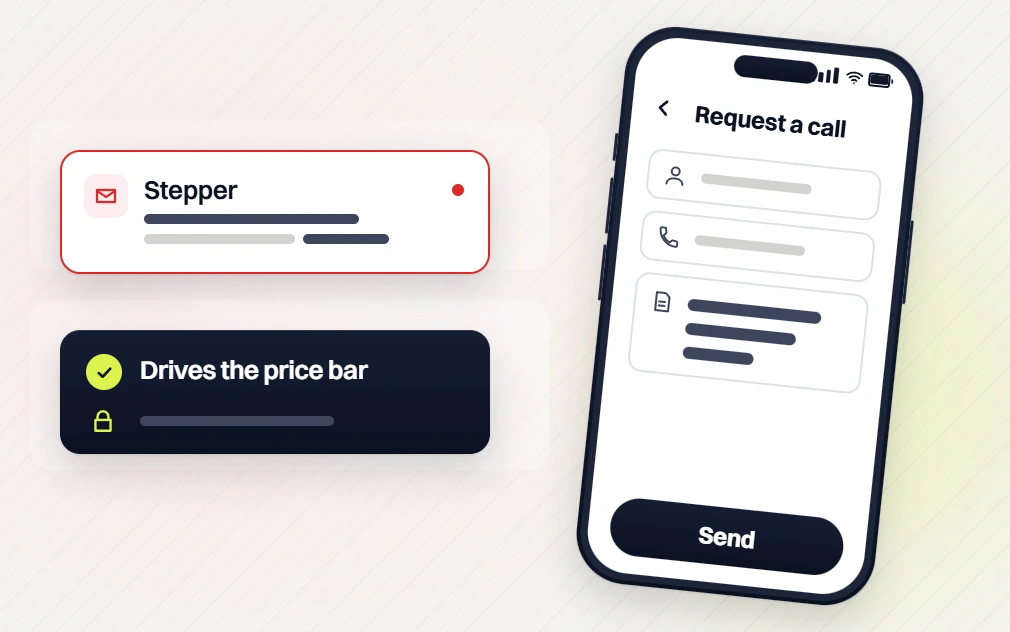
Demo requests route into HubSpot or Salesforce with round-robin AE assignment, campaign-source tagging, and MEDDIC field mapping. Every form, click, and session gets tagged for multi-touch attribution. Round-robin tested with 20 dummy submissions across owners, time zones, and territories.
demo requests hit the right AE in under 2 minutes with owner assignment and SLA alerts.
supported on Growth tier and above for teams running a non-HubSpot CRM stack.
event pipeline built for product analytics that survives your next tool swap.
Marketo, Customer.io, or Braze on the drip side, tagged from session one.
server-side event forwarding for iOS 14+ conversion loss recovery on paid channels.
20 dummy demo submissions across owners, time zones, and territory rules. Real coverage.
Launch is a checklist, care is included
Go-live happens on a scheduled window with QA signed off, never a Friday afternoon. Your team learns the site in two 30-minute sessions, and the monthly plan covers hosting, security, and content edits without a ticket queue.
off-hours DNS flip with the whole team on a bridge. No Friday afternoons.
top 50 to 200 URLs by organic sessions mapped one-to-one before launch.
daily for 30 days. Rollback on any URL that drops more than 20% of organic sessions.
30 minutes each on editing copy, publishing pages, and QA before push live.
hosting, security patches, and 4 hours of content edits per month on the retainer.
domain, code, HubSpot keys, and design tokens transfer to your team on day 31.
Four web design tiers for every stage of growth
Every line item listed. The quote you get is the invoice you pay. Take any tier as a project fee, or split it into the flat monthly plan.
Fast, credible site converting existing reputation.
Full booking engine: scheduling, checkout, customer reporting.
One brand, every office found, location-level tracking.
Design system the whole group launches on. Ops-team-spec integrations.
Every web design feature, tier by tier
HOVER ANY FEATURE FOR A PLAIN-ENGLISH EXPLANATIONWebsite + design +
Booking + patients +
SEO + visibility +
Care + support +
Real SaaS teams, real numbers
SaaS site build questions, answered
From real quote calls with growth-stage SaaS teams. Anything else, ask on the call and we answer in the first 5 minutes.
What is SaaS in web design?
+
SaaS in web design means the marketing website for a software-as-a-service product, built to convert paid and organic traffic into trial signups or demo requests. A SaaS website is different from a brochure site. It needs a product tour, public pricing, ICP-named use cases, comparison pages, and a demo request form wired straight into HubSpot or Salesforce. Every section has a job, and the job is pipeline, not brand awareness. Buyers rarely read the site linearly. They land on a “vs competitor” page from Google, jump to pricing, watch 20 seconds of the product tour, and book. Your SaaS marketing site has to make each of those jumps easy and answer the buying question at every step. See Google Search Central for the structured data and Core Web Vitals rules that every SaaS site now competes on.
What is a SaaS website?
+
A SaaS website is the marketing site for a software product buyers subscribe to instead of install. It sits in front of your product signup or demo flow and does 4 jobs at once. It names the exact buyer (RevOps lead, Head of Data, IT Ops manager) in the H1 so visitors know the page is for them. It shows the software in a 20-second product tour, not a marquee of feature icons. It lists tiered pricing on-page with seat math so procurement can build the business case without a call. It routes demo requests into HubSpot or Salesforce in under 2 minutes. A SaaS marketing site that skips any of the 4 wastes the pipeline the marketing team spent real ad budget to earn. Every SaaS site we build gets all 4 wired before launch, not after.
How to structure a SaaS website?
+
A SaaS website structure that converts uses 6 core page types. Homepage that names the ICP and outcome in one sentence. Product pages, one per named feature or use case. Solutions pages by industry or company size. Pricing page with public tiers and a seat calculator. Comparison pages that rank on “vs” queries. Customers page with logo, role, and outcome per case study. Every page has one primary CTA, either Start free trial or Book a demo, matched to buying model. Product-led SaaS leans on trial signup. Sales-led SaaS leans on demo request. Mixed motion runs both, with a dominant primary. Navigation stays flat. No mega menus with 40 links, no product taxonomy the buyer has to learn. Internal linking follows the buying path, hub-and-spoke from each ICP page out to proof, pricing, and comparison. See Core Web Vitals on web.dev for the load-speed floor every page needs to hit.
What is an example of a SaaS website?
+
Stripe, Notion, Linear, Figma, HubSpot, and Attio are the SaaS marketing site examples most B2B teams benchmark against. Each of them names an ICP in the H1, lists public pricing, embeds an interactive product tour, and puts named case studies with logo plus outcome above the fold. Linear ranks the highest on visual polish and load speed. Stripe sets the bar on documentation-driven marketing pages. Attio and Notion show what tiered pricing with per-seat math looks like when procurement is the real buyer. Copying the shape of any of these is fine. Copying the copy is not, because the buyer language pulled from your customer interviews is what actually converts. The mistake most teams make is picking one of these as a reference and hiring a design agency that has never wired a HubSpot demo flow or a comparison page that ranks. Design is the visible part. Pipeline is the point.
How do I market my SaaS website?
+
Marketing a SaaS website starts with search intent, not channel. Rank on the 5 to 10 “job-to-be-done” queries your ICPs type into Google. Rank on the “vs competitor” queries your buyers use when shortlisting. Run paid on the same queries with landing pages that mirror the SEO version, not a generic form page. Feed the CRM. Route demo requests into HubSpot or Salesforce with round-robin AE assignment and campaign-source tagging. Layer in product-led signals: trial signups, activation events, and PQL scores tied to sales alerts. See HubSpot developer docs for the API and workflow patterns that hook a marketing site into the revenue system. Do content marketing on the exact buyer questions your ICPs ask on demo calls. Skip generic “SaaS growth” blog posts. Every marketing move ties back to a page on your SaaS website, and every page ties back to a specific pipeline outcome.
How much does SaaS website design cost?
+
SaaS website design at Redefine Web runs 4 fixed-price tiers. Launch at $799 for pre-seed and seed teams standing up a first marketing site. Growth at $1,299 for seed to Series A SaaS turning paid traffic into demos. Scale at $1,999 for Series B teams with 2 to 5 ICPs and multi-segment go-to-market. Enterprise custom builds start at $18,000 for Series C+ and public SaaS needing SOC 2, multi-region, and full compliance workflows. Ongoing retainers run $499 to $3,500 per month, covering hosting, security, content edits, and monthly A/B tests. Every tier includes a fixed 30-day launch window, a 90-day rebuild commitment, and full ownership of the site, domain, and data on day 31. Quote you sign on the call is the invoice you pay. No scope creep, no change-order surprises. Split any tier into a flat monthly plan if cash flow needs it.
How long does it take to build a SaaS website?
+
Launch and Growth tier SaaS website projects go live in 6 to 8 weeks. Scale tier goes live in 8 to 12 weeks. Enterprise custom builds run 12 to 20 weeks depending on integrations, multi-region rollout, and compliance requirements. Every project runs on a written milestone tracker with owner names and dates from week one, so your marketing team can plan campaign launches against the site launch date without guesswork. Late gates trigger a written recovery plan, not a silent slip. Discovery locks in weeks 1 to 2 with a signed brief. Design lands in weeks 3 to 6 with a signed design system. Engineering runs weeks 7 to 12 with staging sign-off. Launch happens on a scheduled off-hours window, never a Friday. 30 days of daily Search Console and HubSpot monitoring follow launch, then handoff. If a milestone slips, we tell you the same day and adjust the tracker in the shared doc.
What separates a SaaS web design agency from a generalist agency?
+
A SaaS web design agency knows the patterns that turn SaaS visitors into pipeline. ICP use-case page templates. Pricing pages that serve self-service and enterprise buyers on one URL. Product tour pages that show the software doing the job. Vs comparison pages that rank on competitor queries. HubSpot or Salesforce routing wired before launch. Generalist agencies build brand sites and hand you a Figma file. SaaS specialists build revenue infrastructure and hand you a rep-attributed pipeline number in month 3. The difference shows up in the questions the agency asks on the first call. A generalist asks about brand personality and moodboards. A SaaS specialist asks about your ICP list, your CRM, your comparison SERP, and your last quarter demo-to-close rate. Every SaaS site build we deliver runs around the buyer decisions, not the visual metaphors. Design quality still matters, but pipeline is the acceptance criterion.
Should a SaaS website use Framer, Webflow, or a custom CMS?
+
Framer and Webflow are great for pre-seed and seed SaaS teams that need to launch a marketing site in 3 to 4 weeks with no dev. Once you cross Series A, custom WordPress with SCF or Next.js with a headless CMS (Contentful, Sanity, Payload) makes more sense. Cheaper at scale, no per-seat CMS pricing, better integration with HubSpot workflows, and no vendor lock-in when you cross 30 pages. Every option we build launches at 98+ mobile Lighthouse and WCAG 2.1 AA. The right CMS is the one your marketing team will actually use, so we let RevOps and Marketing weigh in on the choice during discovery. If your team already writes in Notion or Google Docs, we wire a docs-to-CMS sync so publishing feels like editing a doc, not filing a ticket. Every SaaS site engagement includes 2 team training sessions on the CMS before launch.
Do you integrate the SaaS website with our CRM and marketing stack?
+
Yes. Every SaaS site engagement includes CRM integration (HubSpot, Salesforce, Pipedrive, Attio, or Close), marketing automation (Marketo, HubSpot, Customer.io, or Braze), and product analytics (Segment, RudderStack, Amplitude, Mixpanel, or PostHog). All wired before launch so demo requests hit the right AE in under 2 minutes and every session is tagged for multi-touch attribution. Round-robin routing tested with 20 dummy submissions across owners, time zones, and territory rules before we push live. Server-side event forwarding for GA4, Meta CAPI, and LinkedIn Insight recovers the conversion loss iOS 14+ caused on paid channels. Segment or RudderStack sits in front of the analytics stack so a future tool swap is a config change, not a rebuild. Marketing automation gets wired to product events on day one, so drip campaigns can fire on trial activation, feature use, or PQL score, not just page visits.
Can you redesign our SaaS website without losing organic rankings?
+
Yes. Redesigns are the majority of our SaaS site redesign work. The process starts with a full organic traffic and ranking audit. We identify the top 50 to 200 URLs by organic sessions, map each one to a new equivalent, and lock the 301 redirect strategy before content or design work starts. Search Console monitored daily for 30 days post-launch, with rollback on any URL that loses more than 20% of its organic sessions. Ranking drops during a SaaS redesign are a botched process, not an inevitable cost. Content parity matters more than URL parity. If a top-ranking page loses 40% of its word count on the new site, Google will drop it even with the 301 mapped correctly. We rewrite for voice and conversion but preserve topical coverage on every URL that was earning organic sessions before the redesign. Rollback plan is written into the launch checklist, not a fire drill.
What conversion rate should a SaaS website hit?
+
A well-built SaaS website converts 4 to 8 percent of qualified traffic on the primary demo request or trial signup CTA. Product-led SaaS with freemium signup runs higher, 6 to 12 percent on trial signup. Sales-led SaaS with a longer buying committee runs lower, 2 to 5 percent on demo request since the ask is harder. Anything under 1.5 percent on either model is an underperforming funnel, usually a mismatch between traffic intent and the CTA the page asks for. Our post-redesign average across 40 B2B SaaS builds lands at 5.8% visitor-to-demo, measured in HubSpot against MQL flags. Conversion rate is the top-line number, but qualified pipeline is what the CFO cares about. We instrument every funnel with MEDDIC field capture so Sales sees budget, authority, and timeline before the AE picks up the phone. That is the number your board can hold you to.
Do you write the SaaS website copy or do we?
+
Copywriting is included on Growth ($1,299) and above. Launch ($799) assumes your team writes copy from a positioning brief we hand over, which keeps the price low. Scale ($1,999) and Enterprise ($18,000+) cover copywriting for the full site plus 2 to 3 weeks of positioning and messaging work up-front, driven by 5 to 10 customer interviews per ICP. Our copywriters have built SaaS site copy for 40+ B2B teams and know the buyer language in your category. We pull the exact phrases prospects use on demo calls, quote them back on the page, and skip agency-invented jargon. Positioning work covers ICP definition, category framing, competitor differentiation, and a message architecture doc your team owns after handoff. Every page launches with 2 rounds of copy revision built into the fixed price. Extra rounds run at $199 per hour, tracked in a shared time log, so you always know what a change costs before you approve it.