Dental SEO Services That Rank in the Local Map Pack
Dental SEO services that put your practice in the Google map pack for "dentist near me" and every procedure you run. Real pages for implants, Invisalign, and emergency. Average $24 organic cost per booked appointment.
Three ways your practice is losing patients to search
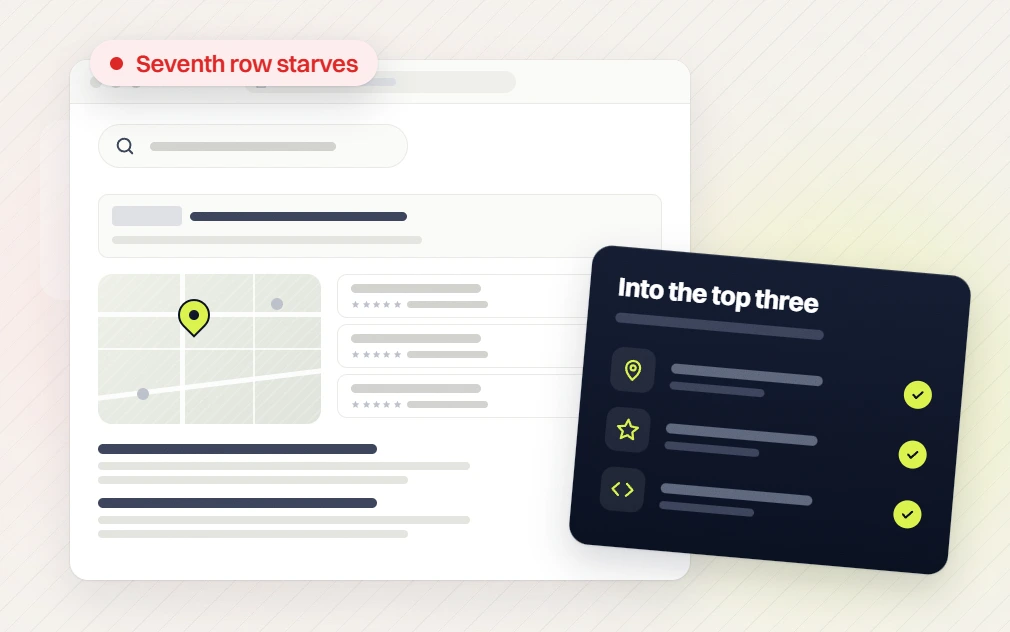
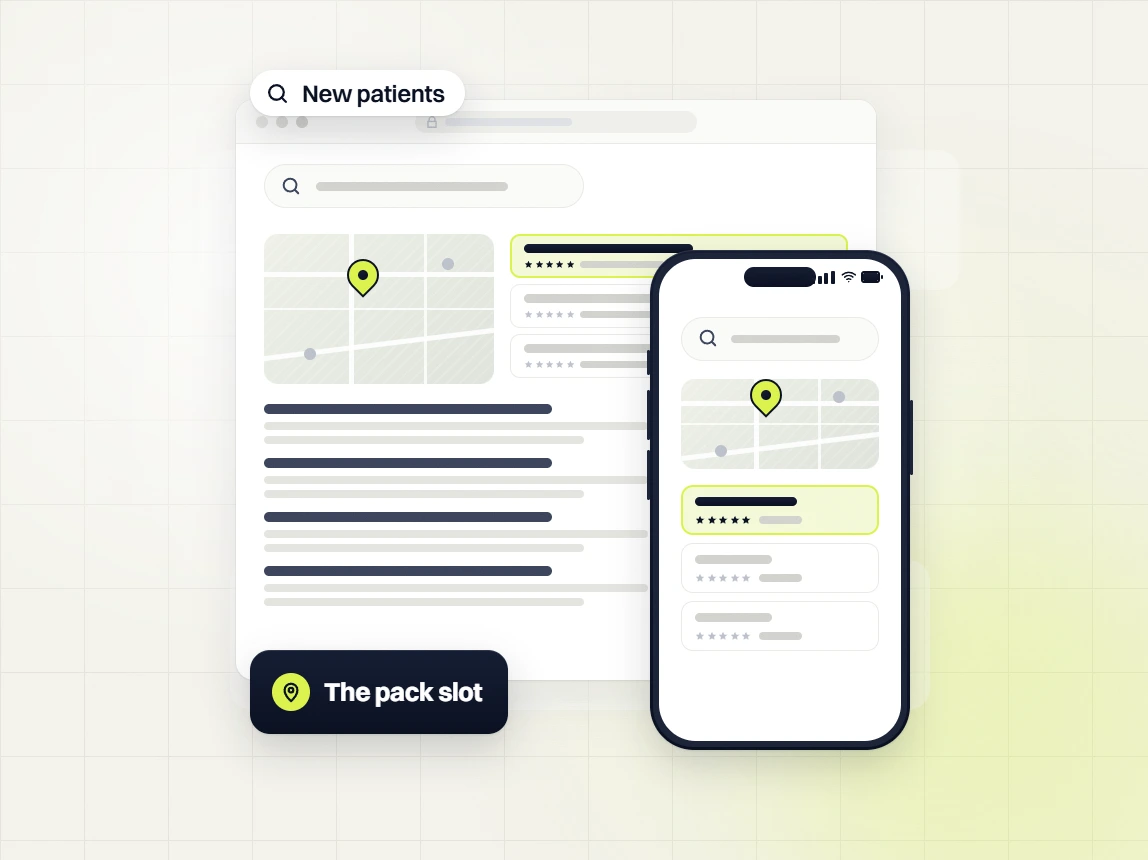
Aspen Dental and Smile Direct outrank you on your own zip code
Franchise groups and DSOs grab 44% of local map clicks at rank 1. You sit at #7 and lose 20 to 40 new-patient calls a month to the practice that rents the top slot. The map pack decides local dental. Ranking anywhere else is a rounding error.
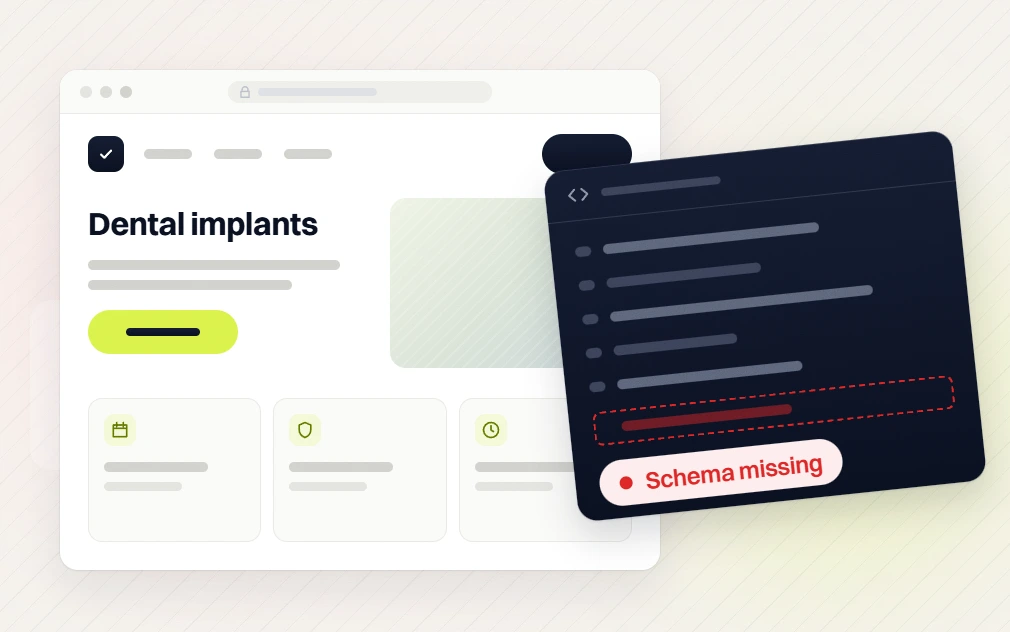
DentalPractice schema is missing so Google reads you as generic
Without DentalPractice, MedicalProcedure, and LocalBusiness schema, Google reads your site as a generic small business. Full schema stacks add 25 to 60% map impressions on the same content. Most dental sites launch with none of it wired in.
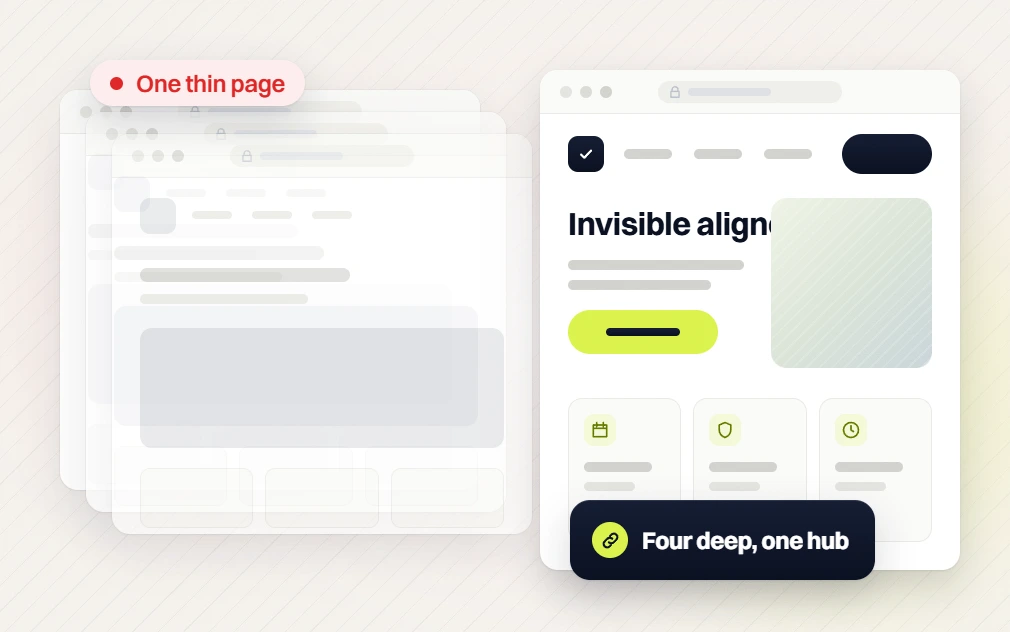
One "Services" page hides implants, Invisalign, and emergency care
A single 300-word Services page cannot rank for implants, Invisalign, and emergency dentist. Each money treatment needs its own 1,500-word page with intent-matched copy, dental schema, and internal linking that Google can actually parse.
Three outcomes every dental SEO retainer produces
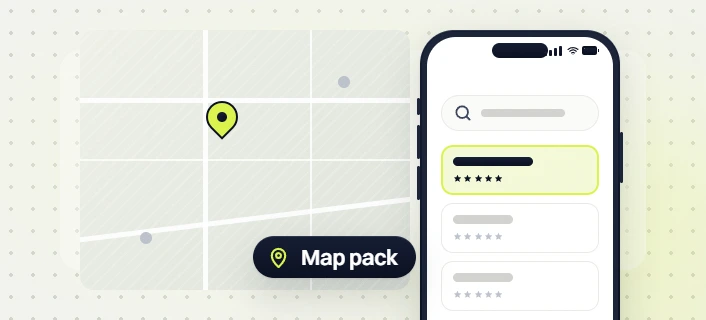
A clean Google Business Profile, structured review requests, and consistent citations across 62-plus directories. Your practice shows in the local 3-pack.
One page per treatment live with dental schema. Cleanings, implants, Invisalign, cosmetic, and emergency. Every page built to earn page-one rankings.

A live ranking dashboard every week and a written recap every month. Every ranking gain tied to appointments your PMS logged, not a keyword count.
Four stages. Every step ends in a sign-off
Fixed scope, written sign-offs, dates on the calendar. Nothing moves to the next stage until the deliverable is approved. Your calendar does not slip.
Audit that finds the money
Technical, content, backlink, and local audits scored against Core Web Vitals, 15 dental procedure clusters, toxic links, and 62+ citation directories. Written 30-page report.
Keyword strategy tied to revenue
Dental keyword cluster map for implants, aligners, emergency, cleaning, cosmetics. Each cluster gets an MRR projection so you see which content pays back first. 90-day queue signed off.
On-page + technical fixes weekly
Four procedure pages published weekly with DentalPractice + FAQPage schema, thin content expanded, broken links fixed, Core Web Vitals to green. Every push in your weekly report.
Scale, GBP, digital PR, reporting
GBP management, 4 earned placements a quarter in local news, citation cleanup, 300+ keyword rank tracking, and a monthly PMS-reconciled report. Ongoing, not a one-time push.
What you actually get from our dental SEO services
Five workstreams, every item listed. Nothing lives in a proposal appendix or a phase-two column.
Diagnose before we prescribe
Every dental SEO engagement opens with a full audit across four disciplines, scored and prioritized by revenue impact. You see the fixes that pay back first, the toxic links pulling rankings, and the local footprint gaps your competitors are exploiting. Sign-off before any content or link work starts.
crawl, indexation, render blocking, LCP / CLS / INP scored against dental competitors in your metro.
implants, aligners, emergency, cosmetics, hygiene, family, pediatric, sedation, restorative, and 6 more.
every referring domain scored, spam and PBN patterns flagged, disavow file drafted for Google review.
GBP, NAP consistency, and citation coverage across 62+ dental-relevant directories checked and mapped.
DentalPractice, MedicalProcedure, FAQPage, and LocalBusiness markup validated against Google guidelines.
every fix scored by traffic impact and booked-patient value, so week-one work pays back first.
One page per money procedure
Every high-value dental treatment gets its own 1,500-word page written in-house by a dental content lead. Implants, Invisalign, cosmetic, emergency, sedation. Each page ships with dental-specific schema, clean internal linking, and copy built around the real questions patients search before they book.
implants, Invisalign, cosmetic, emergency, sedation, cleaning, whitening. Each built for search intent.
1,500+ words minimum with cost, insurance, timeline, and "what happens at the first visit" answered on-page.
DentalPractice, MedicalProcedure, FAQPage, and Service schema validated before publish.
real questions sourced from front-desk logs and PAA data, structured for AI-extraction and rich snippets.
topical clusters linked back to money pages so authority flows to the pages that book patients.
shot list for your team, rooms, and providers so the pages look like your practice, not a template.
Own the local map pack
Roughly 60% of local dental discovery happens on Google Business Profile, not on the practice website. We rebuild the profile from categories to services to Q&A, seed real front-desk questions, wire structured review requests to your PMS, and clean the citation trail across 62+ dental directories.
categories, services, photos, and Q&A seeded from real front-desk questions across every location.
62+ dental-relevant directories audited, corrected, and monitored monthly for drift.
Dentrix, Eaglesoft, Open Dental, and Curve wired to automated SMS review requests inside week 4.
grid-based tracking across your metro so you see where you rank on every intersection, not just downtown.
one map-rich page per address with providers, parking, hours, and services offered at that location.
offers, procedure spotlights, and case highlights published weekly to keep the profile active and ranked.
Earned links, not bought links
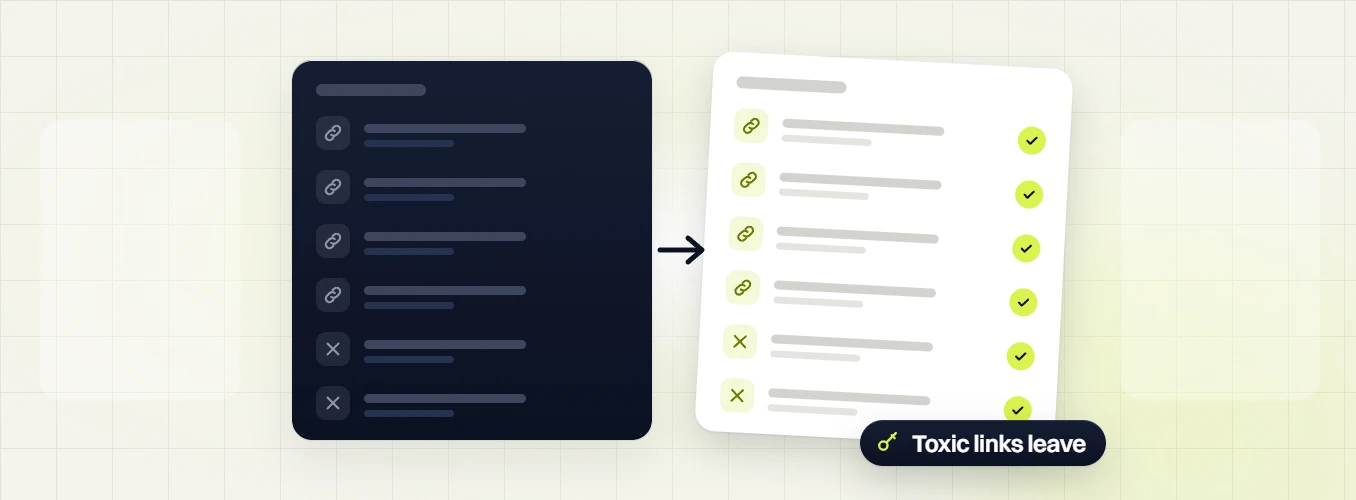
Ranking above Aspen Dental and franchise groups takes real authority. We earn placements in local news, dental publications, and community outlets your competitors miss. Every link is manually reviewed, and toxic prior links are disavowed so ranking gains hold instead of vanishing in the next algorithm update.
community-angle pitches to metro news outlets and lifestyle press placed by a real PR lead, not a bot.
guest features and expert commentary in dental industry outlets your patients and referrers actually read.
local sports, schools, charities, and events matched to your practice for defensible authority signals.
spam and PBN links inherited from prior agencies filed in a disavow file for Google review inside 30 days.
404 links on dental-relevant sites replaced with links to your treatment pages through direct outreach.
Google-recognized author profiles for your providers so E-E-A-T scores rise on every procedure page.
Every report ties to booked patients
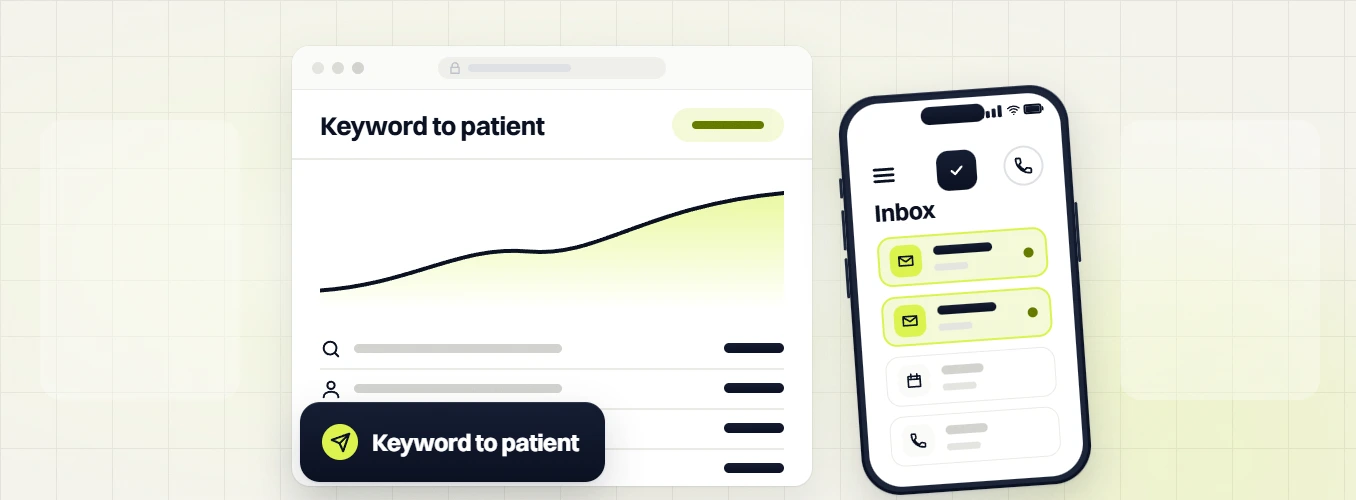
A live ranking dashboard tracks 300+ dental keywords in real time, and a written monthly report reconciles organic traffic against PMS-booked appointments. You know exactly which keyword bought which patient, and how much production every ranking gain delivered. Rank #1 with an empty schedule does not count.
300+ keywords, refreshed weekly, with movement flags on money terms so you see gains before month-end.
organic sessions tied to booked appointments and production value, not to keyword counts.
every call and form attributed to source, campaign, and landing page with no PHI in analytics.
map pack impressions, calls from GBP, direction requests, and review velocity trended monthly.
monthly delta vs Aspen, Smile Direct, and your 3 closest local competitors on every money term.
GBP, Search Console, GA4, and Tag Manager stay in the practice accounts. Leave us, the footprint stays.
Four SEO tiers for every stage of growth
Pick the tier that matches your practice today. Move up or down with 30 days notice. Hover any feature name for a plain-English explanation of what it moves in your funnel.
Single-location testing local SEO, or recovering from a bad agency.
Growing brands owning the local pack. Organic tied to bookings.
Two to ten locations, organic across service areas and lines.
Enterprise or 11+ locations. Systematic SEO for new openings.
Every SEO feature, tier by tier
HOVER FOR DETAILPages + content +
SEO + local +
Reporting + analytics +
Support + onboarding +
Compliance + enterprise +
Team + service level +
Other +
Real practices, real numbers
See what a $400/mo dental site could book back.
Slide in your practice numbers. Assumes a 32% relative conversion improvement, below the median gain on our dental rebuilds.
Common dental SEO questions
Straight answers on pricing, timelines, GBP, and what actually ships each month. If your question is not here, book the audit call.
How much do dental SEO services cost per month?
+
Dental SEO services at Redefine Web start at $499/mo and scale to $3,500+/mo for DSOs. Four tiers are priced against how competitive your metro is and how many locations need coverage. Foundation at $499/mo fits a solo practice in a low-competition market and covers on-page, schema, and Google Business Profile basics. Traffic at $999/mo suits a growing single-location practice and adds citation cleanup plus procedure-page publishing. Dominance at $1,999/mo covers 2 to 10 locations with earned link outreach and per-location rank tracking. Enterprise from $3,500/mo fits DSOs and 11-plus location operators, with digital PR, per-market GBP management, and roll-up reporting. Every tier is a 6-month agreement so the compounding math has time to land. You see the recommended tier and the reasoning behind it inside the audit call, and you sign nothing until you agree with the plan and the price. Prices are all-in with no ad-spend markup, and every tier upgrade path is written into your first contract.
How much does dental SEO cost?
+
Dental SEO in the US typically runs $500 to $5,000 per month for a single practice and $5,000 to $25,000 per month for DSOs and multi-location groups. Price scales with metro competition, the number of procedure pages needed, and whether earned links and digital PR are in scope. Our four dental SEO tiers land at $499, $999, $1,999, and from $3,500 per month. Foundation covers a solo practice in a low-competition metro with a clean site foundation. Enterprise covers 11-plus locations with roll-up reporting, per-market GBP management, and a dedicated account lead. Every tier is a monthly fee with no long-term lock past the initial 6 months. Every quote comes with the tier we recommend and why, based on your current rankings, your named competitors, and the treatments you want to fill. You can read the current Google Business Profile ranking factors for context on why local dental pricing sits above generic small-business SEO. Six-month agreements are the standard because compounding math needs runway, and every quote holds for 30 days.
How long does dental SEO take to show ranking results?
+
Most dental SEO campaigns show first ranking gains in weeks 6 to 8 and steady map-pack presence for money treatments by month 4. Full compounding organic traffic and cost-per-new-patient drops arrive by month 6 to 9. The exact curve depends on where your site starts. A site with a clean Google Business Profile, valid dental schema, and no toxic backlinks moves faster than a site with a manual penalty, thin content, and a spammy directory trail. Recovery work in the first 60 days always slows the growth curve, and we tell you inside the audit call which bucket your practice falls into. Anyone promising page-one in 30 days is either paying for ads under an SEO label or hiding a black-hat method that will crater your rankings inside a year. The dental SEO retainers we run are 6 months minimum so the compounding math has room to land honestly, and every monthly report shows the ranking curve against your booked-patient count so you can grade the work as it happens.
What is included in dental SEO services?
+
Every dental SEO retainer covers seven workstreams so ranking, traffic, and cost per new patient move together. Technical fixes and Core Web Vitals in the green. Procedure pages at 1,500-plus words each, one per money treatment. Full dental schema stack including DentalPractice, MedicalProcedure, and LocalBusiness, aligned with the Google structured data specification. Google Business Profile management with weekly posts and Q&A seeding. Citation cleanup and consistency across 62-plus dental directories. Earned links from local news, dental publications, and community outlets. PMS-reconciled monthly reporting that ties ranking gains to appointments your front desk actually booked. Foundation tier covers the core work at $499/mo, higher tiers add scale, per-location coverage, and digital PR. The tier we recommend depends on your metro, your current rankings, and the specific treatments you want to grow next quarter. Every deliverable ships with a written spec, a sign-off step, and a monthly recap so nothing lands as a surprise.
What is SEO in dentistry?
+
SEO in dentistry is the practice of ranking a dental office in Google search results and the local map pack for the queries patients use before they book. It covers on-page work (procedure pages, DentalPractice schema, patient-facing copy), technical work (site speed, Core Web Vitals, crawlability), local work (Google Business Profile, citations, reviews), and off-site authority (earned links from local news and dental publications). It is different from generic small-business SEO because dental buyers search by treatment and by geography together, so a single practice needs one page per money procedure and heavy local proof. The American Dental Association publishes clinical accuracy guidance any dental content should follow. See the ADA resources for evidence-based patient education standards. Done well, dental SEO produces a steady flow of new-patient appointments at a lower cost per case than paid ads, and it compounds year over year instead of stopping the day you pause spend.
How to do SEO for dental clinic?
+
Start with a full audit across four disciplines: technical, content, backlink, and local. Score every fix by revenue impact and sign off on a 90-day queue. Then publish one 1,500-word page per money treatment with DentalPractice schema and copy built around real patient questions. Rebuild the Google Business Profile from categories to services to Q&A, wire structured review requests to your PMS, and clean citations across the top dental directories. Earn links from local news, dental associations, and community outlets. Disavow toxic prior links so ranking gains hold. Report monthly with the ranking dashboard reconciled against actual booked appointments, so every ranking gain traces back to production dollars. The full sequence is a six to nine month build for compounding traffic, and the first ranking movement usually shows in weeks 6 to 8. Practices that skip the audit and jump to link buying almost always regress inside a year, and rebuilding the site after that costs more than doing the SEO work correctly the first time.
What is a Google map pack?
+
The Google map pack is the 3-listing local block that shows above organic results for location-based searches, including “dentist near me” and treatment-plus-city queries like “invisalign chicago.” Each listing pulls from a Google Business Profile, and ranking inside the map pack is the single highest-intent traffic source for local dental. Roughly 60% of local dental discovery happens on the map pack and Google Business Profile, not on the practice website. Franchise groups like Aspen Dental grab about 44% of local clicks at rank 1 in the map pack. If your practice sits at rank 7, you lose 20 to 40 new-patient calls a month to whoever rents the top slot. Ranking factors are proximity, prominence, and relevance, documented inside Google Business Profile Help. Winning the map pack takes GBP optimization, review flow, and dental-specific schema working together over months, not weeks. Our dental SEO retainers wire every one of these together from day one so the ranking curve holds through algorithm updates.
How to get on Google Maps pack?
+
Claim and verify your Google Business Profile, pick the correct primary category (Dentist, Cosmetic Dentist, or Emergency Dental Service depending on your fit), list every service you offer, and add real photos of the practice and team. Post weekly, seed real front-desk questions inside the Q&A, and wire a structured review-request flow to your PMS so every post-visit patient gets a review link within two hours. Add DentalPractice and LocalBusiness schema on your website so Google can connect the profile to the site. Clean citations across the top dental directories and match NAP data exactly on every listing. Reviews and proximity are the two biggest ranking factors for the map pack, and consistent NAP data is what stops Google from splitting your listing across duplicate entries. Full detail on ranking factors sits inside the Google Business Profile Help center. Most practices see map-pack movement inside 8 to 12 weeks, and the compounding curve holds as long as the GBP stays active and reviews keep flowing at a steady cadence.
How to get in Google 3-pack?
+
The Google 3-pack is the same as the map pack, the three local listings shown above organic results for local search queries. Getting into it takes a fully built Google Business Profile, a steady review flow (10-plus new reviews a month for competitive metros), NAP consistency across 60-plus dental directories, and dental-specific schema on the website that ties the profile to the site. Proximity to the searcher is a factor Google will not let you edit, but you can win the other two. Prominence comes from earned links and steady review volume. Relevance comes from the categories and services you list on the profile, matched by procedure pages on the website. Practices with 200-plus reviews at 4.7 stars and up almost always outrank practices with 40 reviews at the same star rating. The full ranking-factor documentation lives inside Google Business Profile Help. Expect movement inside 8 to 12 weeks for competitive metros and 4 to 6 weeks for lower-competition markets where the review flow is the primary lever.
Is SEO dead or evolving in 2026?
+
SEO is not dead in 2026. It is evolving. Google now serves AI Overviews above organic results for a growing share of queries, so pages built to be cited by AI models are winning share that used to flow to rank 1. For dental, that means procedure pages written in extractable prose, direct-answer 40 to 60 word blocks under every question-form H2, and dental schema that AI systems can parse. The map pack is still the highest-intent local surface, and dental buyers still click a listing before they book. What has died is thin content, keyword-stuffed pages, and directory-only strategies. What is growing is topic authority, entity-linked schema, and review-driven local ranking. Dental practices that publish real procedure pages, keep their Google Business Profile active, and earn local citations still pull steady new-patient traffic. Everyone else is bleeding share to franchise groups and AI Overviews, and the gap widens every quarter as more query volume moves to AI answers and away from the classic blue links.
How much does an SEO agency typically cost?
+
A general SEO agency in the US typically bills $1,000 to $10,000 per month for small to mid-size businesses, with enterprise retainers running $10,000 to $50,000 per month. Freelancers charge $75 to $200 per hour, and most one-off audits run $2,500 to $10,000 as a project fee. Dental SEO sits inside this range but skews higher at the low end because of the procedure-page, schema, and PMS-integration work involved. Our four dental SEO tiers land at $499, $999, $1,999, and from $3,500 per month, and every tier includes on-page, technical, local, and reporting inside the base fee. Watch for agencies that quote under $500 per month without naming deliverables, because the math on real dental SEO does not work below that number without cutting scope somewhere. Six-month agreements are the standard because compounding takes time to land. Our audit call includes the tier we recommend for your metro and why, plus a rough monthly forecast for booked patients across the first six months so the retainer math is honest before you sign.
How much should I expect to pay for SEO?
+
Expect to pay $500 to $5,000 per month for local dental SEO, depending on metro competition, the number of procedure pages you need, and whether earned links are in scope. Practices in low-competition metros with a solid site foundation can grow on the Foundation tier at $499 per month. Practices in metros with three or more franchise competitors usually need the Traffic or Dominance tier ($999 or $1,999 per month) to make ranking gains that hold. Multi-location groups and DSOs run $3,500 per month and up because per-location GBP work and roll-up reporting add real hours. Anyone quoting under $300 per month is either running templated work that will not move rankings or hiding a black-hat method. Anyone quoting above $10,000 per month for a single-location dental practice is usually padding the retainer with scope you do not need. The audit call sizes the right number for your practice, and the recommended tier is written into the proposal with the reasoning behind it so nothing is a mystery.
How much does SEO cost for orthodontists?
+
Orthodontic SEO usually runs $1,000 to $5,000 per month for a single-location practice and $5,000 to $20,000 per month for multi-location orthodontic groups. Orthodontics sits at the high end of dental SEO pricing because Invisalign and clear-aligner queries carry more competition and higher case values, so the procedure-page and earned-link work is more intensive. Our Traffic tier at $999 per month fits a single-location orthodontic practice with steady case volume and a clean site foundation. The Dominance tier at $1,999 per month covers 2 to 10 orthodontic locations and adds digital PR aimed at Invisalign, clear-aligner, and adult-orthodontic queries. Enterprise from $3,500 per month fits large orthodontic groups. Every quote reflects your current rankings, your named competitors, and the metros you serve. Six-month agreements are the standard so the compounding math has time to land. Orthodontic practices with a strong existing referral pipeline usually see faster ranking movement because branded search volume compounds with the new procedure-page traffic. Consultation-request forms tied to the site are the primary conversion event we track for ortho, not raw traffic.
Do you offer dental SEO for multi-location groups and DSOs?
+
Yes. Multi-location dental SEO lives on the Dominance tier at $1,999/mo for 2 to 10 location groups and the Enterprise tier from $3,500/mo for DSOs and 11-plus location operators. Every location gets its own map-rich page, its own Google Business Profile management, and its own local citation trail. Reporting rolls up to the group level with per-location rank tracking sitting under it. Cross-location content, franchise-style link building, and per-market digital PR live on the Enterprise tier. We handle brand-level authority work at the corporate site while every clinic page targets the queries buyers actually use inside that metro. NAP consistency across the group is audited monthly so duplicate listings do not split ranking signal. Six-month agreements are the standard so the compounding math has time to land and cost-per-new-patient drops show across every location. Group-level onboarding runs 3 to 4 weeks and includes a per-location kick-off call with the office manager on each site.
Can dental SEO recover rankings after a previous agency hurt them?
+
Yes. Dental SEO recovery is one of Redefine Web’s most common project types. The first 60 days of a recovery program focus entirely on undoing damage before growth work starts. That means toxic backlink disavow, thin content audit, penalized-page cleanup, and structured data validation against Google guidance. Only after the site is safe do we start publishing new procedure pages and earning links. Recovery timelines run 4 to 8 months depending on how deep the prior damage goes. A manual penalty inside Google Search Console adds 30 to 60 days to the timeline. A thin-content problem across 40-plus pages adds another 30 days. We track the recovery inside Google Search Console so you see impressions and rankings restore alongside our monthly PMS-reconciled report. Every recovery client sees the full damage audit inside the first two weeks so the plan and price stay honest from day one, and the 60-day damage-repair phase is billed at the same tier rate as the full retainer.