
Ecommerce SEO Services That Grow Organic Orders for DTC Brands
Rank category pages, product pages, and buying guides for the queries DTC customers type before they buy. Shopify Plus and BigCommerce technical work, product schema, and cart-aware architecture. Median $18 organic cost per new customer across the book.
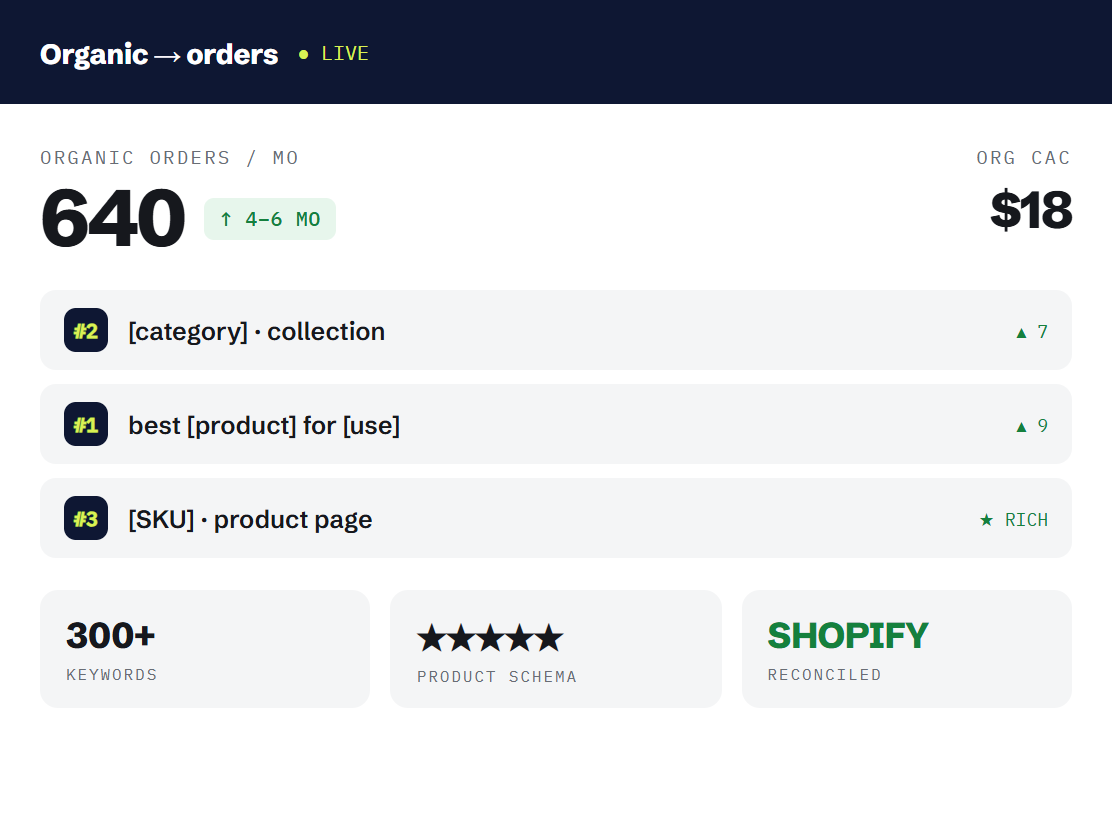
Three ways your store is losing organic orders to search
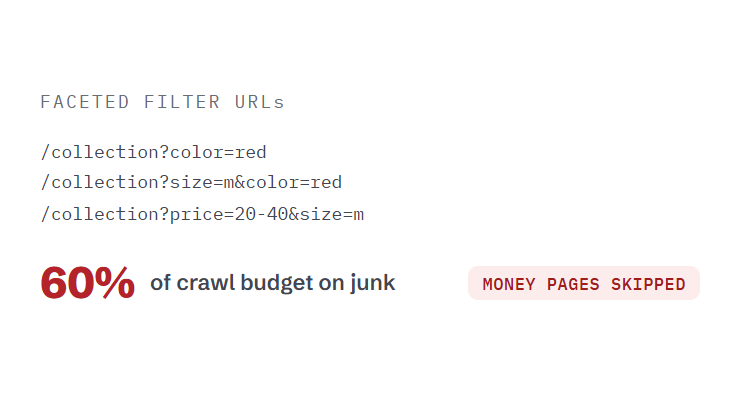
Faceted filter URLs bloat your index and burn crawl budget
Shopify and BigCommerce spawn duplicate URLs on every color, size, and price filter. Google crawls the junk and skips your money categories. Roughly 60% of ecommerce crawl budget gets wasted on faceted noise. Your best pages get seen once a month while filter URLs get hit daily.
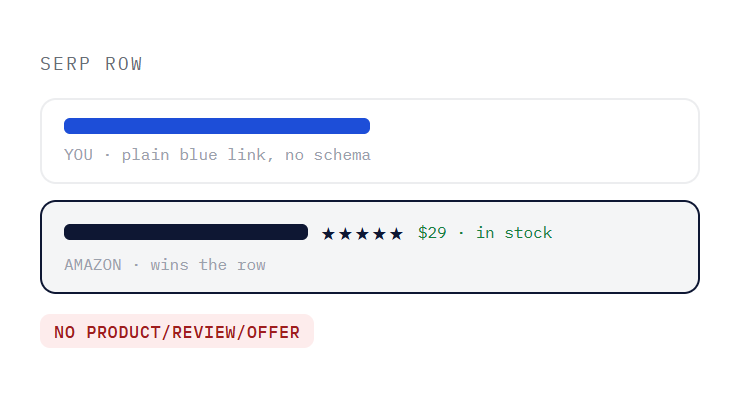
PDPs without Product, Review, and Offer schema get zero rich results
Product pages missing Product, Review, and Offer JSON-LD show as plain blue links while Amazon wins the SERP row with stars, prices, and stock. Amazon eats 40% of the branded click on your own catalog. Full schema stacks add 25 to 60% product-page impressions on the same content.
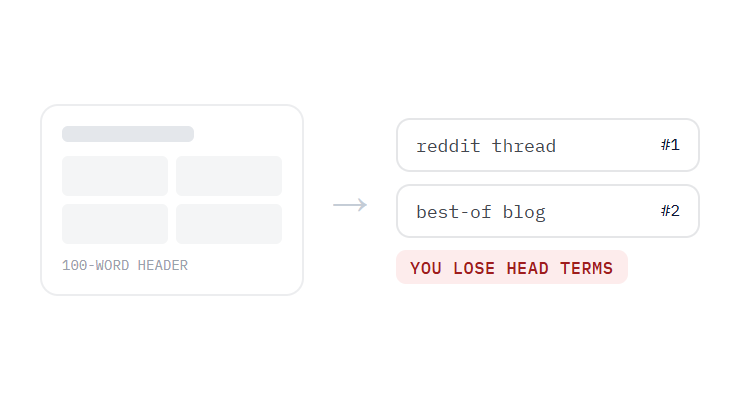
Category pages under 150 words lose to Reddit and best-of lists
A 100-word category header stuck above a product grid cannot rank for head terms. Reddit threads and best-of blogs answer the query and take the traffic. Category pages need 800-word buying guides above the grid to earn commercial rankings, and most Shopify themes launch with nothing.
Three outcomes every ecommerce SEO retainer produces
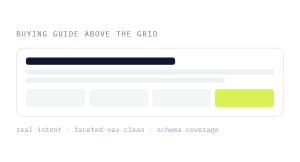
Real category pages built around buyer intent, not filter permutations. Buying guides above the grid and product schema across every PDP win more clicks.
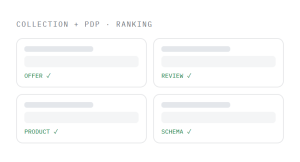
One collection per money category, one PDP per SKU, full Product plus Review schema, and internal links flowing authority from guides to grids each week.
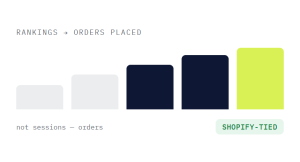
A live ranking dashboard weekly, a written recap monthly. Every ranking gain reconciled to orders your Shopify or GA4 report captured that month.
Four stages. Every step ends in a sign-off
Fixed scope, written sign-offs, dates on the calendar. Nothing moves to the next stage until the deliverable is approved. Your roadmap does not slip.
Audit that finds the money
Technical, content, backlink, and store audits scored against Core Web Vitals, 15 ecommerce category clusters, toxic links, and PDP schema coverage. Written 30-page report.
Keyword strategy tied to revenue
Ecommerce keyword cluster map for "buy online" plus 14 more category clusters. Each cluster gets a revenue projection so you see which content pays back first. 90-day queue signed off before work starts.
On-page + technical fixes weekly
Four category and PDP pages published weekly with Product, Review, and FAQPage schema. Thin content expanded, broken links fixed, Core Web Vitals pushed green. Every push in your weekly report.
Scale, digital PR, and revenue reporting
4 earned placements a quarter in DTC and lifestyle press, review flow tuned for volume and rating growth, citation cleanup, and 300+ keyword rank tracking. Monthly report reconciles organic traffic to Shopify Plus orders.
What you actually get from our ecommerce SEO services
Five workstreams, every item listed. Nothing lives in a proposal appendix or a phase-two column.
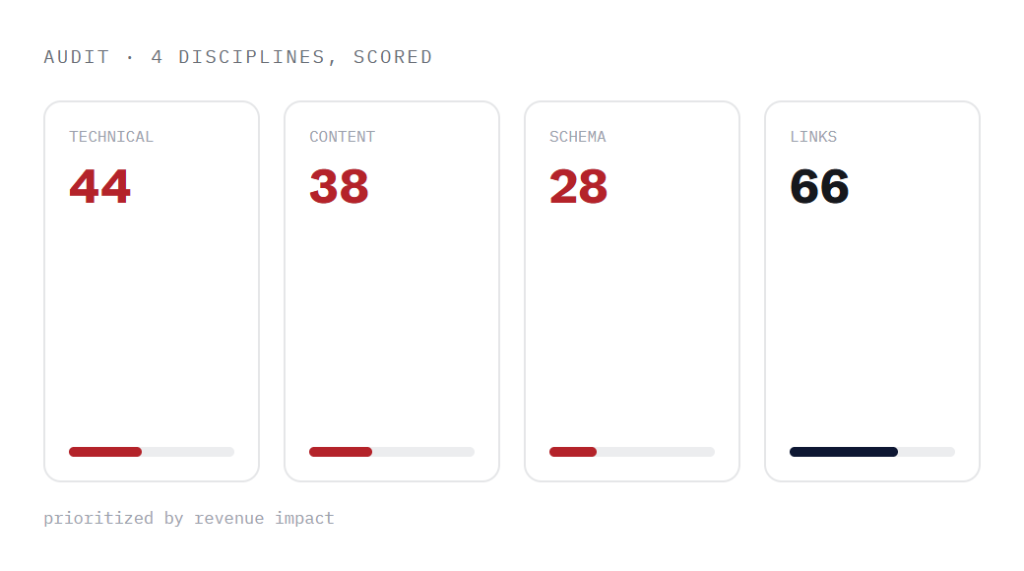
Diagnose before we prescribe
Every ecommerce SEO engagement opens with a full audit across four disciplines, scored and prioritized by revenue impact. You see the fixes that pay back first, the toxic links pulling rankings, and the category coverage gaps competitors are exploiting. Sign-off before any content or link work starts.
crawl, indexation, render blocking, LCP / CLS / INP scored against ecommerce competitors in your category.
buy online, best of, category collections, comparison, buying guides, product roundups, and 9 more.
every referring domain scored, spam and PBN patterns flagged, disavow file drafted for Google review.
Shopify and BigCommerce faceted URL sprawl mapped, canonical and robots rules drafted, crawl waste sized.
Product, Review, Offer, FAQPage, and BreadcrumbList markup validated against Google guidelines.
every fix scored by traffic impact and order-placed value, so week-one work pays back first.
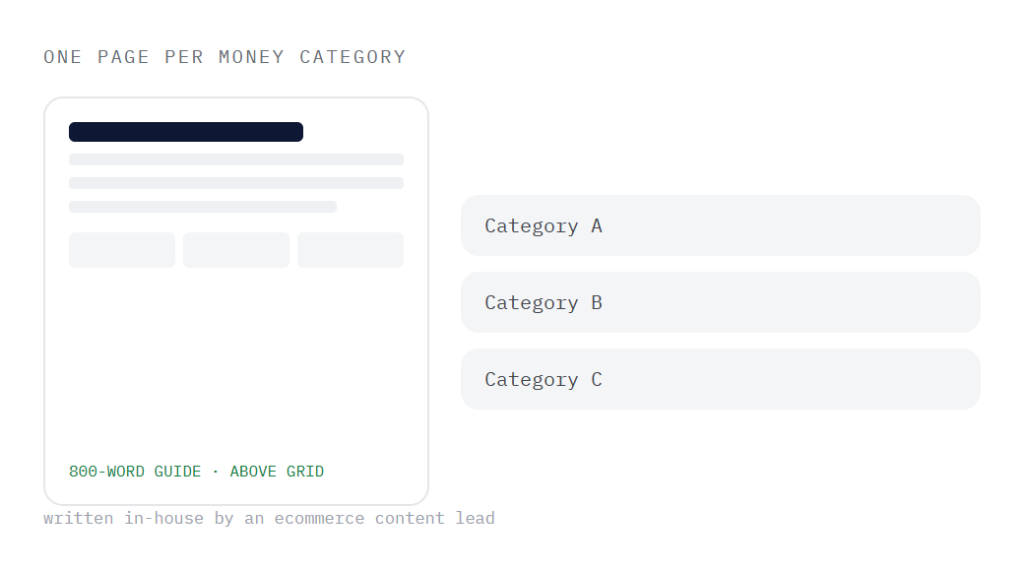
One page per money category
Every high-value ecommerce category gets its own 800-word buying guide above the grid, written in-house by an ecommerce content lead. Best-of roundups, comparison pages, and PDPs. Each page goes live with product schema, clean internal linking, and copy built around the real questions customers search before they buy.
best-of, comparison, buyer intent, and PDP roundup pages. Each built for search intent, not filter permutations.
800+ words minimum with sizing, materials, use case, and "how to choose" answered above the product grid.
Product, Review, Offer, FAQPage, and BreadcrumbList JSON-LD validated before publish.
real questions sourced from support tickets and PAA data, structured for AI-extraction and rich snippets.
topical clusters linked back to money categories so authority flows to the pages that book orders.
shot list for your team, lifestyle sets, and unboxing so category pages look like your brand, not a template.
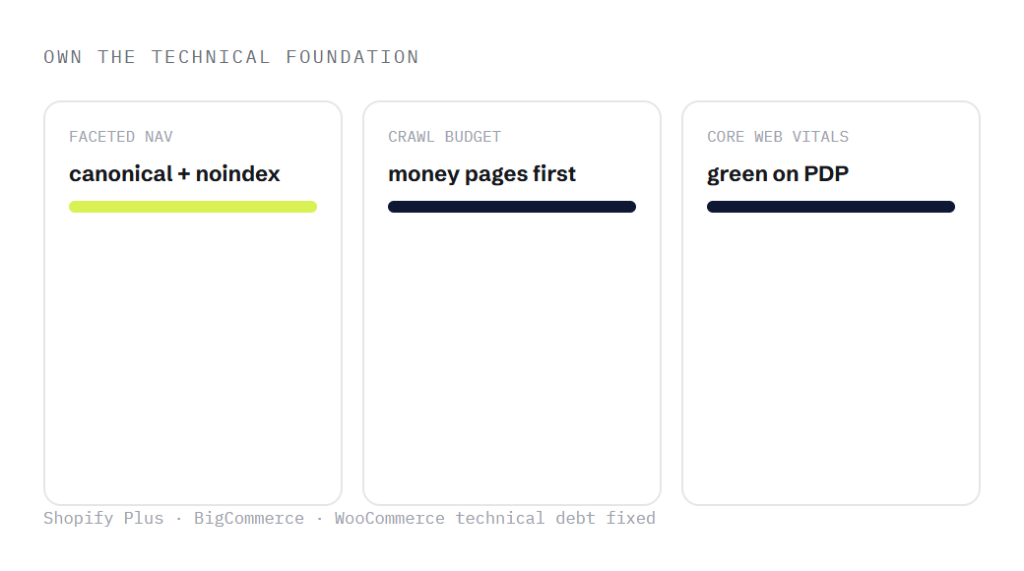
Own the technical foundation
Shopify Plus, BigCommerce, and WooCommerce launch with technical debt that costs organic revenue. We rebuild the faceted-nav rules, wire canonicals and robots on filter URLs, add product schema stacks across every PDP, and push Core Web Vitals green before content goes live.
canonical rules, noindex on filter URLs, and robots.txt cleanup across Shopify and BigCommerce catalogs.
LCP under 1.8s, CLS under 0.05, INP under 200ms on every category and PDP. Verified in CrUX field data.
JSON-LD on every PDP so stars, prices, and stock badges show in your SERP row instead of Amazon's.
category-first sitemap structure, robots rules on faceted URLs, and Search Console re-submission.
buying guides linked to collections, collections linked to PDPs. Authority flows from top-of-funnel to cart.
clean event layer for order tracking, GA4 ecommerce config, Search Console properties verified per storefront.
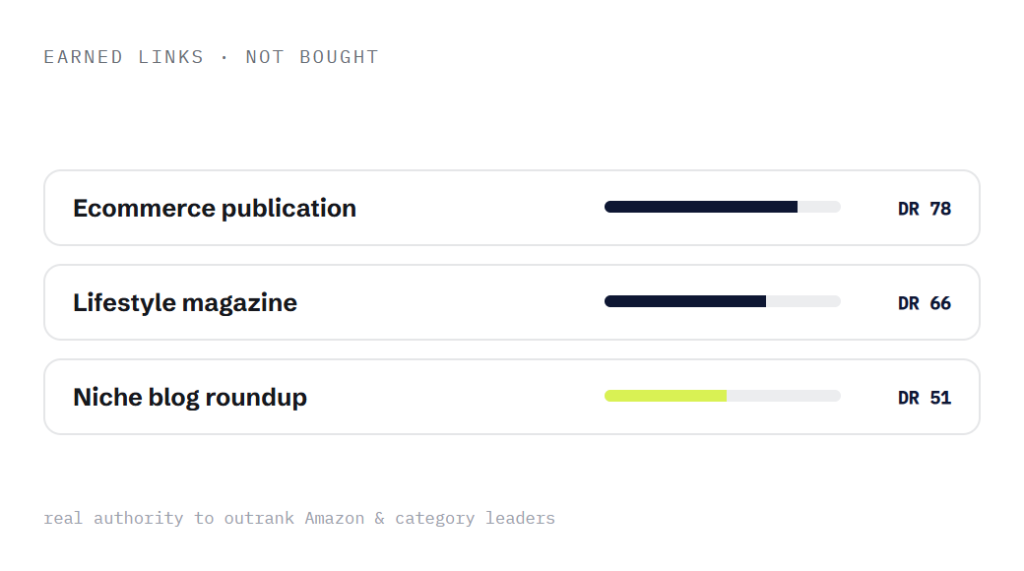
Earned links, not bought links
Ranking above Amazon and DTC category leaders takes real authority. We earn placements in ecommerce publications, lifestyle press, and buyer guides that map to your category. Every link is manually reviewed, and toxic prior links are disavowed so ranking gains hold instead of vanishing in the next algorithm update.
trend and buyer-angle pitches to lifestyle press and DTC publications placed by a real PR lead, not a bot.
guest features and expert commentary in buying-guide outlets your customers actually read before they buy.
brand mentions across the web converted to backlinks through direct outreach and relationship work.
spam and PBN links inherited from prior agencies filed in a disavow file for Google review inside 30 days.
404 links on ecommerce-relevant sites replaced with links to your category pages through direct outreach.
Google-recognized author profiles for your content leads so E-E-A-T scores rise on every buying guide.
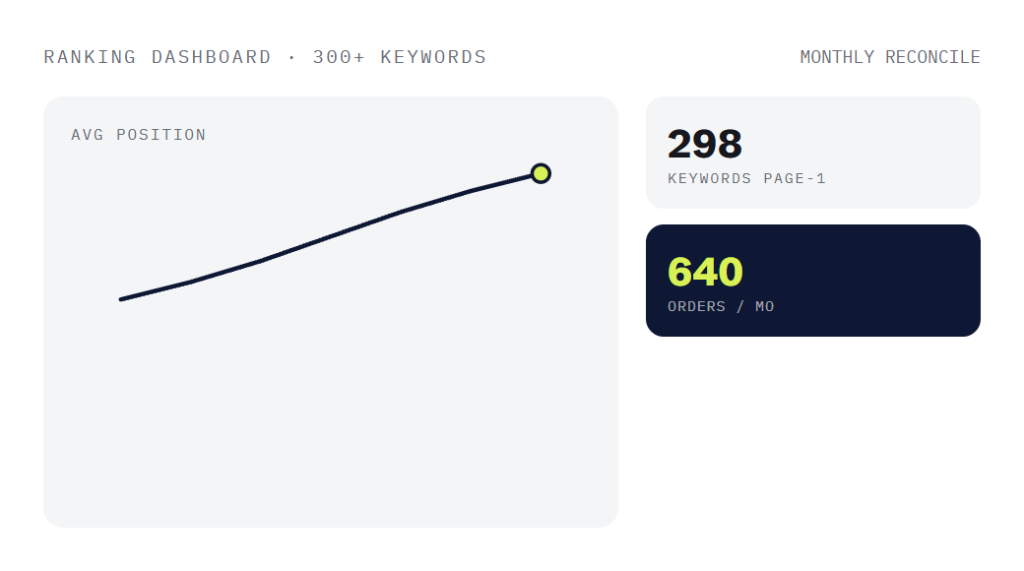
Every report ties to orders placed
A live ranking dashboard tracks 300+ ecommerce keywords in real time, and a written monthly report reconciles organic traffic against Shopify Plus orders. You know exactly which keyword bought which order and how much AOV every ranking gain delivered. Rank #1 with an empty cart does not count.
300+ keywords refreshed weekly, with movement flags on money terms so you see gains before month-end.
organic sessions tied to orders and AOV, not to keyword counts nobody signs checks for.
organic assisted revenue traced through Triple Whale or Northbeam, blended cost per new customer tracked.
impressions, click-through, and average position trended weekly by category cluster, not lumped in totals.
monthly delta vs Amazon and your 3 closest DTC competitors on every money category term.
Search Console, GA4, Tag Manager, and Shopify stay in your accounts. Leave us, the footprint stays.
Four SEO tiers for every stage of growth
Pick the tier that matches your practice today. Move up or down with 30 days notice. Hover any feature name for a plain-English explanation of what it moves in your funnel.
Single-location testing local SEO, or recovering from a bad agency.
Growing brands owning the local pack. Organic tied to bookings.
Two to ten locations, organic across service areas and lines.
Enterprise or 11+ locations. Systematic SEO for new openings.
Every SEO feature, tier by tier
HOVER FOR DETAILPages + content +
SEO + local +
Reporting + analytics +
Support + onboarding +
Compliance + enterprise +
Team + service level +
Other +
Real DTC brands, real order numbers



Common ecommerce SEO questions
Straight answers on pricing, timelines, Shopify work, and what actually goes live each month. If your question is not here, book the audit call.
What are ecommerce SEO services?
+
Ecommerce SEO services are a bundled program that grows organic revenue on a Shopify Plus, BigCommerce, or WooCommerce catalog. At Redefine Web, every retainer covers seven workstreams so ranking, traffic, and cost per new customer move together. Technical fixes and Core Web Vitals. Category buying guides at 800 words or more. Full product schema stacks across every PDP, validated against Google’s Product structured data guidelines. Faceted-nav lockdown with canonical and robots rules. Earned digital PR from ecommerce and lifestyle publications. Toxic backlink disavow. Shopify-reconciled reporting tied to orders, not sessions. Foundation ($499/mo) covers the core work for early DTC stores. Growth ($999/mo) suits $1M to $10M brands owning category and comparison search. Authority ($1,999/mo) fits $10M to $50M multi-SKU catalogs. Enterprise (from $3,500/mo) covers $50M+ omnichannel operators running international programs and programmatic SEO across dozens of storefronts. Every tier ships with a written sign-off before work advances stages and a 6-month term you can extend or exit cleanly.
How much do ecommerce SEO services cost per month?
+
Ecommerce SEO services at Redefine Web start at $499/mo and scale to $3,500+/mo for omnichannel brands. Four tiers priced against store scale and category competition. Foundation ($499/mo) fits an early DTC brand building product and brand-term presence. Growth ($999/mo) suits a $1M to $10M DTC store owning category and comparison search. Authority ($1,999/mo) covers $10M to $50M multi-SKU brands with paid-plus-organic reporting. Enterprise (from $3,500/mo) fits $50M+ omnichannel operators running international and programmatic SEO. Every tier is a 6-month term with fixed scope, a written sign-off before work moves stages, and a 30-day launch window. The quote you get is the invoice you pay each month for the retainer term. Any extra scope (new storefront, extra language, new PIM integration) is a written change order before it starts. You keep ownership of the site, domain, and every account we touch when the term ends, so nothing you paid for walks out the door with us. Every tier lists deliverables on the pricing block above, so you compare like for like before the audit call.
How much should SEO services cost?
+
SEO services for ecommerce brands typically fall between $500/mo at the low end and $10,000+/mo at the top end, and the range is driven by scope, not vanity. A DTC store under $1M in revenue can rank for brand and category terms on $499 to $1,000/mo with a lean retainer. Stores in the $1M to $10M range need $1,000 to $2,500/mo to cover technical work, weekly content, and earned links. Multi-SKU catalogs above $10M or omnichannel operators pay $2,500 to $5,000/mo for full-scope programs with international coverage and digital PR. Anything under $299/mo is either a one-tool subscription or link-farm work. Anything over $10,000/mo on a single storefront usually pays for a large content team and paid press placements. Compare on deliverables per month and reporting depth, not on a headline number. Ask any agency for a written monthly scope, not a slide. If a proposal hides deliverables behind a phase-two column or a “custom quote after call” gate, that is a signal the scope will flex against you once the retainer starts.
How long does ecommerce SEO take to show ranking results?
+
Most ecommerce SEO campaigns show first ranking gains in weeks 6 to 8 and steady category-page presence on money terms by month 4. Full compounding organic traffic and cost-per-new-customer drops arrive by month 6 to 9. Timelines depend on 3 variables: the size of the toxic-link and thin-content backlog, the strength of your product catalog schema at week 1, and how quickly your team signs off on category briefs. Stores with a clean domain history and Shopify Plus templates ready to accept schema move on the faster end. Stores recovering from a Google core update or a prior agency’s link-farm activity spend the first 60 days undoing damage before growth work starts. Anyone promising page-one in 30 days is either paying for ads or hiding a black-hat method that will crater rankings inside a year. The compounding organic channel takes patience. It also outlasts every paid campaign you run in parallel. A typical 12-month retainer delivers organic traffic worth 4 to 8 times the retainer spend by month 12 for stores in the $1M to $10M range.
What is SEO for ecommerce?
+
SEO for ecommerce is the discipline of ranking category pages, product pages, and buying guides for the queries customers type before they buy. It differs from B2B or content-site SEO because the conversion event is a cart, not a form fill, and the catalog scale multiplies every technical decision. A single faceted-navigation rule can create or destroy 20,000 URLs overnight. A missing schema tag on a template affects every SKU published to it. The core work sits in 4 layers. Technical (faceted-nav rules, product schema, Core Web Vitals). Content (category buying guides, PDP copy, FAQ blocks). Authority (earned links from ecommerce and lifestyle press). Reporting (rankings reconciled to orders in Shopify or GA4, not just sessions). Ecommerce SEO also touches Google Merchant Center feed structure, which shares the same product data layer as your organic PDPs. Done well, the two channels compound: better organic rankings feed the paid Shopping surface, and a cleaner feed lifts organic PDP eligibility for rich results.
Who's the best in ecommerce SEO?
+
No single agency is the best for every DTC brand. The right partner depends on catalog size, platform, current organic baseline, and whether the store is recovering rankings or building from scratch. Under $1M in revenue, a lean retainer with a small team fits better than a $5,000/mo shop. Above $10M, agencies with in-house content leads, digital PR, and international coverage matter more than headline case studies. Redefine Web wins on 3 axes for DTC and multi-SKU brands: transparent tiered pricing from $499 to $3,500+/mo, in-house content written by an ecommerce lead (not offshore farms), and reporting reconciled to Shopify orders rather than session counts. If your store is on Shopify Plus, BigCommerce, or a headless WooCommerce build, we have run the exact platform combination before. Ask any shortlisted agency for 3 client references at your revenue tier and 2 losses. Real operators share both. A partner that hides losses on a call is a partner that will hide missed deliverables in month 3 of the retainer.
What is Shopify SEO and does it differ from regular SEO?
+
Shopify SEO is the discipline of optimizing a Shopify or Shopify Plus store for organic search. It shares fundamentals with any SEO work but adds platform-specific tasks: faceted-nav lockdown, collection template rewrites, product schema on every PDP, and app-based Core Web Vitals cleanup. Roughly 70% of our ecommerce SEO retainers run on Shopify Plus, so every tier includes Shopify-native technical work as a first-class deliverable. Shopify’s default templates ship with duplicate collection URLs from filter combinations, thin category headers under 150 words, and product schema that misses Offer and Review fields. Fixing the platform defaults is stage-one work on every new engagement. We rewrite the collection template, wire canonicals on faceted URLs, and add a full JSON-LD schema block per Shopify’s own SEO guidance. Reporting hooks into your Shopify Admin so every ranking gain reconciles to orders placed, not sessions counted. If you run headless Shopify, we work with the front-end framework (Hydrogen, Next.js, Remix) so the SEO layer stays intact.
Is SEO worth it for ecommerce brands?
+
Yes, for stores that plan to hold customers longer than one paid ad click. Paid ads run at $40 to $80 blended cost per new customer for DTC brands. Ecommerce SEO builds a compounding organic channel with a $14 to $22 blended cost per new customer at maturity. The trade-off is timeline: paid works in 2 weeks, organic works in 6 to 9 months and then keeps working without a media budget attached. A well-built organic program also feeds the paid channel. Better product schema improves Google Shopping placement. Higher category-page rankings raise brand-search demand, which drops the cost of your branded paid campaigns. Stronger PDPs boost conversion rate on every ad that lands there. Stores that skip SEO usually watch paid CAC climb every quarter with no organic floor to catch it. Stores that invest in both compound over time and stop bidding for every session. A $1M DTC brand running $999/mo Growth-tier ecommerce SEO services typically recovers the retainer inside 4 months once the compounding traffic kicks in.
How do you optimize a product page for SEO?
+
Every PDP inside a Redefine Web retainer includes Product, Review, and Offer JSON-LD schema, a unique 300+ word product description written to buyer intent, breadcrumb structure with BreadcrumbList schema, and internal links from the parent collection and buying guide. FAQPage schema sits below the fold with the top 4 to 6 real customer questions pulled from support tickets and PAA data. Meta title carries the product name plus one commercial modifier (“buy,” “review,” “size guide”) and stays under 60 characters. Meta description lands one benefit and one differentiator against Amazon’s row above yours. Images are lazy-loaded below the fold, WebP-encoded, and named with the product SKU plus a descriptive slug so image search picks them up. Core Web Vitals land LCP under 1.8s, CLS under 0.05, INP under 200ms in CrUX field data. Every PDP ships with a canonical to itself, never to a parent collection. Reviews render on-page (not in a lazy-loaded widget) so the schema validates and shoppers see the star count without scrolling.
What SEO tools do you use for ecommerce?
+
Every ecommerce SEO retainer uses a standard stack shared across every client so reporting is consistent tier to tier. Google Search Console per storefront for impressions, clicks, and index coverage. GA4 with the Shopify or BigCommerce ecommerce event layer wired for order and AOV tracking. Google Tag Manager for event-layer governance. Ahrefs for competitor content gap analysis and backlink monitoring. Screaming Frog for technical crawls on catalogs above 5,000 URLs. Sitebulb for on-page audits. Semrush for keyword cluster mapping across the 15 ecommerce category clusters. Triple Whale or Northbeam for blended paid-plus-organic attribution where the store already runs one. Every tool sits in your Google account, your Shopify Admin, and your billing so the footprint stays yours when the term ends. We add read access to our team, never take ownership. Every dashboard export is emailed at month-end so the record is portable to any successor. Tool subscriptions we cover on our end (Ahrefs, Semrush, Sitebulb) stay on our license. Tool subscriptions in your name stay yours.
Do you write ecommerce SEO content in-house?
+
Yes. Every category page, buying guide, and blog post is written in-house by an ecommerce content lead, not outsourced to overseas farms or generated by a raw ChatGPT prompt. Every piece cites real product sources, matches your brand voice from a kickoff interview, and goes live with product-specific schema. You approve the content brief before writing starts and the draft before publish. Turnaround runs 5 business days per category buying guide (800+ words) and 3 business days per blog post (1,200 to 1,800 words). Every draft ships with meta title, meta description, image alt text, internal-link plan, and schema JSON-LD ready for one-click publish inside Shopify Admin. Two-round revisions are baked into the retainer. If a draft misses your brand voice or product accuracy, the rewrite is on us. Content stays your property when the term ends. No licensing clauses, no clawback, no re-use clause. If your team wants to write content in parallel, we edit and schema-wire your drafts at the same turnaround as our own.
Can ecommerce SEO recover rankings after a Google core update?
+
Yes. Ecommerce SEO recovery is one of Redefine Web’s most common project types. The first 60 days of a recovery program focus entirely on undoing damage before growth work starts. Toxic backlink disavow, thin category cleanup, PDP schema validation, and duplicate-URL consolidation. Only after the store is safe do we start publishing new buying guides and earning links. Recovery timelines depend on how deep the damage runs. Stores hit for thin category content usually recover partially within 60 days and fully by month 4 to 6. Stores hit for link-farm activity from a prior agency take 6 to 9 months because Google needs multiple crawl cycles to trust the disavow file. Stores hit for Product Reviews Update violations recover the fastest once genuine review content is added and low-value affiliate patterns are cut. Every recovery starts with a written diagnostic report that pins the root cause before any work runs. No guesswork, no shotgun fixes, no dumping every rewrite into the same week and hoping Google rewards effort.
Do you handle multi-storefront and international ecommerce SEO?
+
Yes. Multi-storefront ecommerce SEO lives on the Authority tier ($1,999/mo) for 2 to 3 storefronts and the Enterprise tier (from $3,500/mo) for 4+ storefronts or international rollouts. Every storefront gets its own hreflang architecture, its own category cluster map, and its own local citation trail where relevant. Reporting rolls up to the brand level, and per-storefront rank tracking sits under it. International rollouts follow a standard playbook. Domain strategy first (ccTLD versus subfolder versus subdomain), then hreflang wiring, then per-region schema, then per-region content. Currency, tax, and shipping copy on PDPs is written per market by a local editor. Regional Merchant Center feeds are structured to match the organic PDP layer. Rank tracking runs per country in Semrush and per storefront in Search Console. Every market gets its own monthly report reconciled to Shopify orders in the local currency and translated to a rolled-up brand view for leadership. Language work runs through native-speaker editors, not machine translation piped through a plugin.
Do you optimize the Google Shopping feed alongside organic SEO?
+
Yes on request. Google Shopping feed optimization is a supplementary deliverable inside the Authority and Enterprise tiers. Product titles rewritten to match organic search intent, GTIN and MPN fields validated, custom labels wired for campaign structure, and feed rules synced with the same product schema live on your PDPs per Google Merchant Center best practices. Organic SEO and Shopping ads share the same product data layer, so both move together when the layer is clean. A typical feed cleanup catches 20% to 40% of products flagged in Merchant Center for missing GTINs, mismatched pricing, or thin descriptions. Fixing those opens eligibility for free listings, Shopping ads, and Performance Max campaigns without any extra media spend. The organic ranking work and the feed work stay coordinated so every product publishes to Google’s index with matching title, price, availability, and schema on both surfaces. Foundation and Growth tiers cover the organic-side product schema; the feed work upgrade sits on Authority and above.
Can we cancel our ecommerce SEO retainer?
+
Every Redefine Web ecommerce SEO retainer runs on a 6-month term with a written cancellation clause after month 6. You cancel with 30 days written notice at any point once the initial 6-month term completes. Nothing is auto-renewed for another 6 months without your signature. On cancellation, every deliverable created during the term stays your property. Content, schema, tracking configuration, disavow files, category briefs, keyword clusters, and every dashboard. We remove our team from your accounts within 5 business days of the last billing cycle. You keep Search Console, GA4, Tag Manager, Shopify Admin, and any third-party tool subscriptions in your name from day 1. There is no clawback on content already published. There is no re-use clause on strategy documents. The 6-month floor exists because ecommerce SEO gains compound between months 4 and 9, and a shorter term rarely reaches the compounding window before the retainer ends. That is bad for you and bad for us.