Manufacturing SEO Services That Rank for Part Numbers Buyers Search
Rank across every part number, capability page, and spec sheet engineers search when they source. Real HTML pages for CNC, castings, gaskets, fasteners, hydraulics, and more. Every ranking traces back to RFQs logged in HubSpot, Salesforce, or your CRM. Retainers start at $499 per month.
Three ways buyers find your competitor before you
ThomasNet outranks your product page for your own part numbers
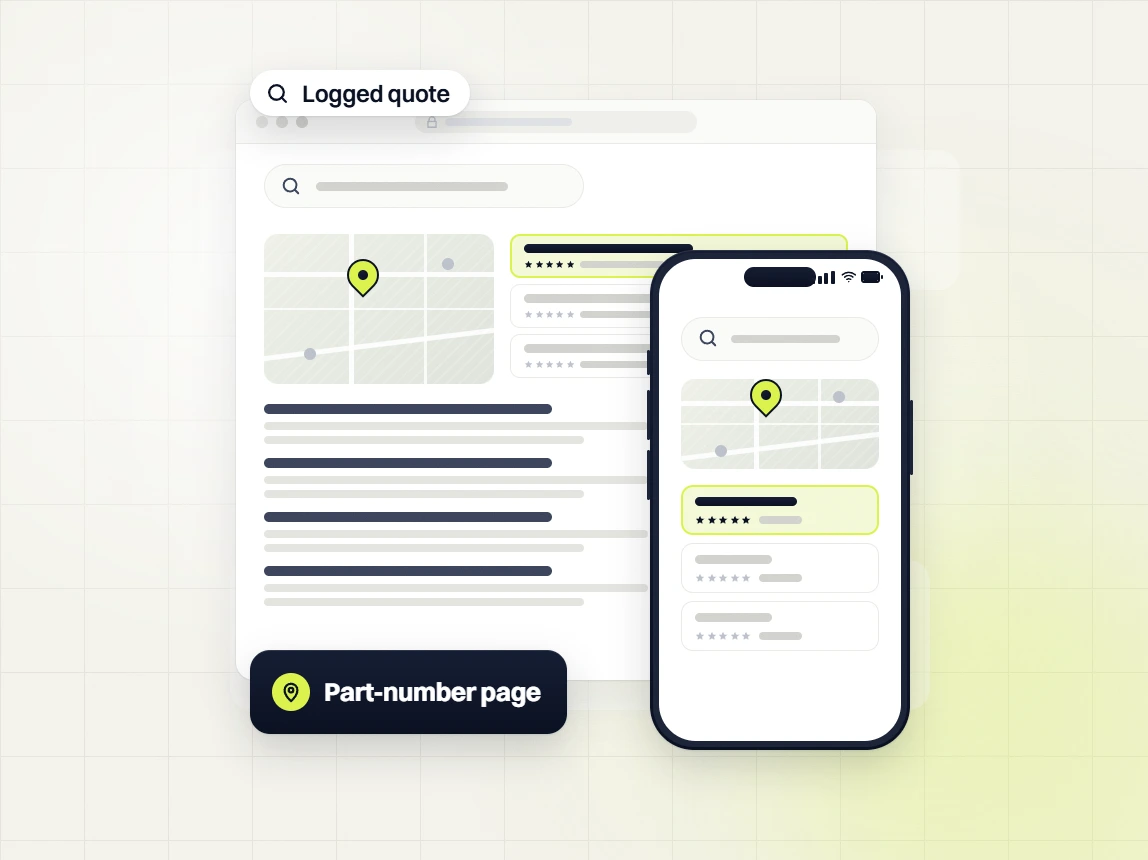
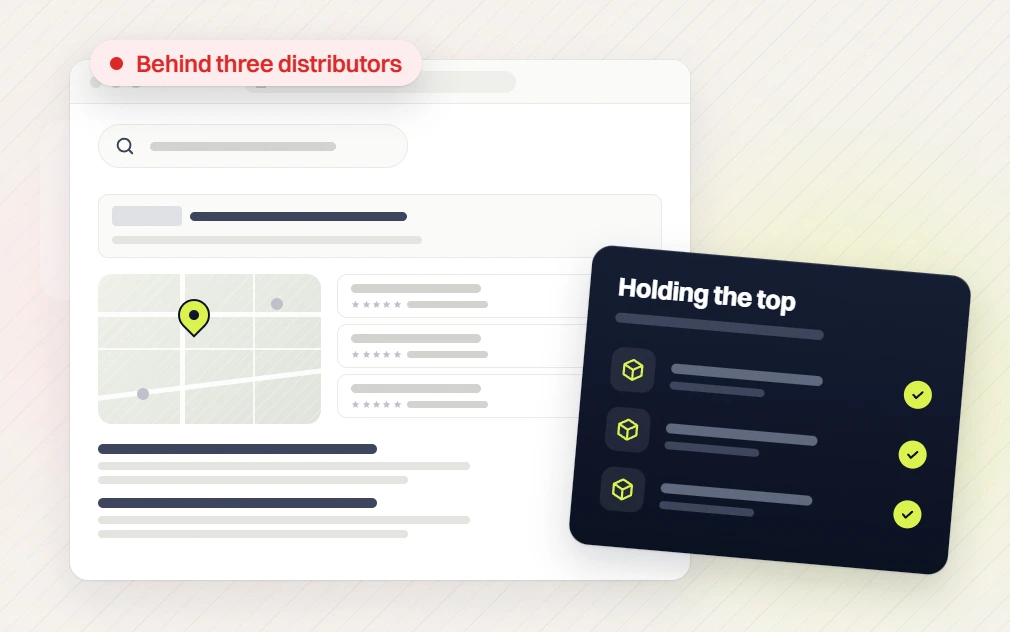
Engineers search a specific part number and land on ThomasNet, McMaster-Carr, or Grainger before your own PDP. Every RFQ that distributor page fires goes to a rival stocking your part or a competing spec. Your product page sits below the fold, so buyers never see the direct manufacturer they were trying to reach in the first place.
Spec sheets live in PDFs Google barely indexes
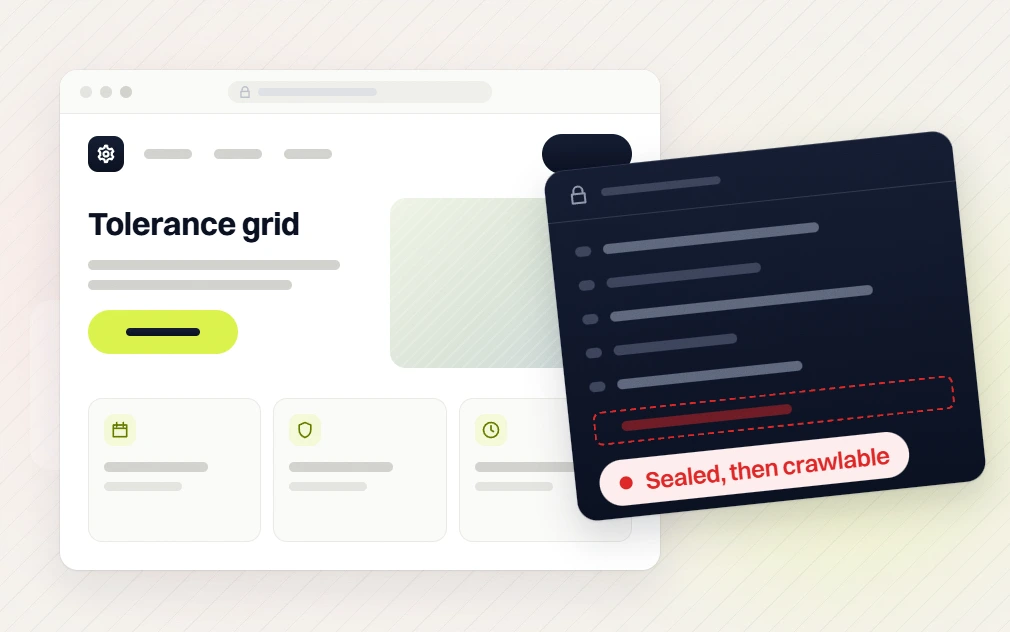
Every tolerance, material chart, and dimension buyers need sits inside a PDF Google indexes at 20 percent of the equity of an HTML page. Competitors with real HTML spec pages carrying Product schema beat you on material queries, tolerance ranges, and application searches. Your engineering data has zero organic index equity.
Category pages read like brochure blurbs, not engineer answers
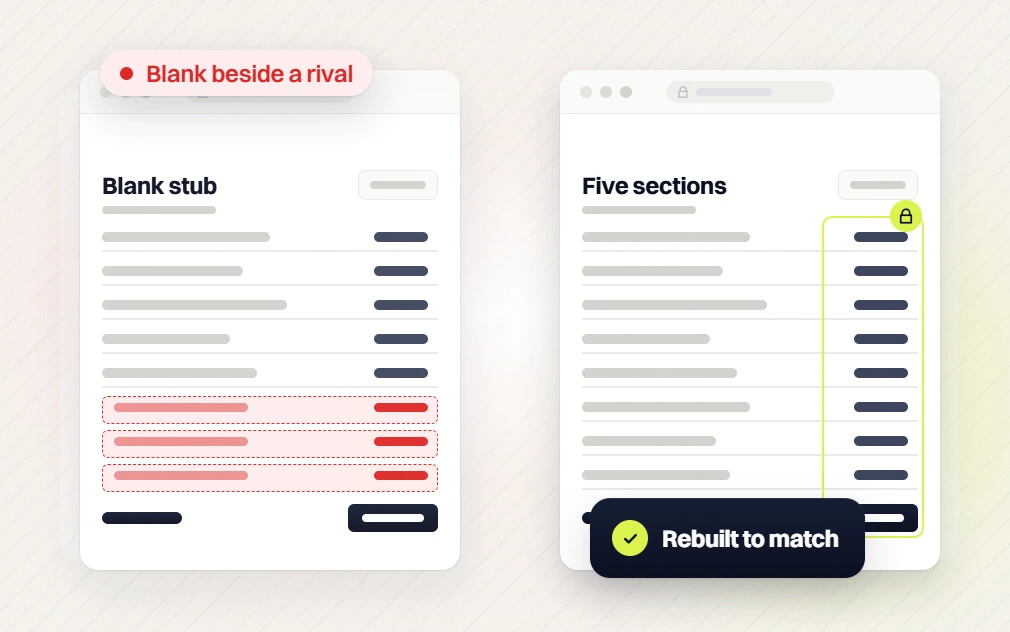
A 120-word CNC machining page cannot outrank an 1,800-word rival with alloys, tolerances, finishing options, and application detail. Google ranks the page that answers the engineer, not the one that reads like a sales brochure. Your capability pages lose every technical search to the competitor that wrote the depth.
Three outcomes every manufacturing SEO retainer produces
One HTML page per SKU family with Product schema, tolerance data, material specs, and STEP file links. Buyers land on you, not on ThomasNet listings.

One rewrite per process with alloys, tolerances, finishing options, MOQ, and lead times. Engineers land on your RFQ form with intent, not confusion.

A weekly ranking dashboard and a monthly written recap. Every gain traces to a real quote request logged in HubSpot, Salesforce, or Dynamics CRM.
Four stages from spec audit to booked RFQs
Fixed scope, written sign-offs, dates on the calendar. Nothing moves to the next stage until the deliverable is approved. Your launch date does not slip.
Part number and capability audit
Every SKU family, capability page, and spec PDF audited against real buyer searches. We pull your current rankings, Google Search Console impressions, and RFQ data. We map every distributor that outranks you and every PDF spec sheet Google is undervaluing. You get a written keyword-to-page map before any content work starts.
HTML spec pages and Product schema build
Every priority PDF spec sheet rebuilt as an HTML page with Product schema, Offer schema, and structured tolerance tables. We add CAD and STEP file downloads inline, not behind a form wall. Category pages get depth-first rewrites with alloys, tolerances, finishing, and application detail engineers actually search. Your part numbers become indexable content.
Technical resource content and internal linking
Technical resource pages built for engineer-intent keywords (material selection guides, tolerance calculators, application notes). Every page links to the capability and PDP it supports. Internal linking rebuilt so authority flows from the resource hub to the RFQ-ready pages. Your site reads like a technical reference, not a sales brochure.
RFQ attribution and CRM wiring
GA4, Search Console, and your CRM wired so every organic ranking traces to a real quote request. HubSpot, Salesforce, or Dynamics fields tagged with source SKU family and landing page. Your monthly report shows rankings, RFQs, and pipeline in one view. You know exactly which pages drove revenue and which need more depth.
Every deliverable inside a manufacturing SEO retainer
Five workstreams, every item listed. Nothing lives in a proposal appendix or a phase-two column.
Site architecture built to rank part numbers
Core Web Vitals, crawl budget, XML sitemap segmentation by SKU family, canonical rules for part-number variants, hreflang for international distributors, and Product schema on every PDP. Technical work runs first because no content ranks on a broken index.
Product, Offer, Organization, BreadcrumbList schema on every commercial page. Validated in Rich Results test before push live.
LCP under 2.5s, CLS under 0.1, INP under 200ms across every PDP and capability page. Image compression, lazy loading, critical CSS.
Faceted navigation cleaned, thin variant pages canonicalized, XML sitemap split by SKU family so Google indexes what you want ranked.
STEP, IGES, and DWG files linked inline on PDPs. Downloads tagged in GA4 as buyer-intent events feeding your CRM.
HTML spec pages and depth-first capability content
Every priority PDF rebuilt as an HTML page. Every capability page rewritten with alloys, tolerances, finishing, MOQ, and application detail. Engineer-intent keywords covered at the SKU, category, and resource level.
Every priority part number gets a 600 to 1,200 word HTML page with tolerance table, material chart, application notes, and CAD download link.
Capability pages rewritten to 1,500 to 2,200 words with alloys, tolerances, finishing options, industries served, and lead times.
Material selection guides, tolerance calculators, and application notes covering engineer-intent keywords buyers search at the research stage.
One case study per major industry served with real part numbers, tolerances, cycle times, and RFQ outcomes. Ranks for application-specific queries.
ThomasNet, Grainger, and industrial directory presence
Clean listings on ThomasNet, MSC Direct, GlobalSpec, IndustryNet, and your regional MEP or SME chapters. Google Business Profile for every plant location. Consistency is the ranking signal, so every directory maps to the same NAP.
Existing listings audited, categories corrected, part-number references reviewed. Your ThomasNet page carries the same authority as your own site.
Name, address, phone consistency across MSC Direct, GlobalSpec, IndustryNet, and regional industrial directories. Errors kill local rankings.
One Google Business Profile per plant location, optimized for capability keywords buyers search when they need a local supplier.
Structured review requests to post-project buyers. Reviews on GBP and industrial directories build the trust engineers look for on cold sourcing.
Editorial links from industry publications and associations
Real editorial placements on Modern Machine Shop, IndustryWeek, Manufacturing.net, and your trade association journal. Case study syndication to industry publications. No PBNs, no comment spam, no forum drops.

Pitches to Modern Machine Shop, IndustryWeek, Manufacturing.net, and vertical trade sites. Every placement earns a contextual link inside the article.
NAM, PMA, NTMA, SME, and regional MEP center member pages claimed, updated with capability copy, and linked back to your capability hubs.
One project case study per quarter pitched to trade publications with real numbers, tolerances, and application detail engineers care about.
Brand mentions on distributor and application sites converted to links. Every mention is a link opportunity a rival hopes you never claim.
Weekly rankings, monthly RFQ attribution report
A weekly ranking dashboard, a monthly written report, and a quarterly executive review. Every ranking gain traces to an RFQ logged in HubSpot, Salesforce, or your CRM. No vanity metrics, no keyword count reports nobody signs POs for.
Live Looker Studio dashboard tracking rankings, organic sessions, GSC impressions, and RFQ form submits. Filtered by SKU family and capability page.
A written recap on what shipped, what ranked, what RFQs were attributed, and what the next month prioritizes. Sent by day 5 every month.
Every RFQ tagged with source landing page, SKU family, and last-touch keyword. Pipeline value pulled from your CRM into the monthly report.
A 90-minute executive review each quarter. Pipeline attribution, priority SKU families for the next 90 days, and any capability page depth calls.
Four SEO tiers for every stage of growth
Pick the tier that matches your practice today. Move up or down with 30 days notice. Hover any feature name for a plain-English explanation of what it moves in your funnel.
Single-location testing local SEO, or recovering from a bad agency.
Growing brands owning the local pack. Organic tied to bookings.
Two to ten locations, organic across service areas and lines.
Enterprise or 11+ locations. Systematic SEO for new openings.
Every SEO feature, tier by tier
HOVER FOR DETAILPages + content +
SEO + local +
Reporting + analytics +
Support + onboarding +
Compliance + enterprise +
Team + service level +
Other +
Real manufacturers, real RFQs
Common manufacturing SEO questions
Straight answers on pricing, timelines, ThomasNet, part number ranking, and what actually gets done each month. If your question is not here, book the audit call.
How much do SEO services typically cost?
+
Manufacturing SEO services at Redefine Web run $499 to $3,500+ per month, priced against the size of your part number library and the number of capability pages that need rewrites. Foundation is $499/mo for a single-plant OEM targeting one metro or one capability. Growth is $999/mo and covers 5 to 8 capability pages plus 15 HTML spec pages replacing your priority PDFs. Authority is $1,999/mo for multi-plant operators or diversified contract manufacturers targeting national engineer-intent searches. Enterprise starts at $3,500/mo for fabricators running distributor SEO alongside OEM channels with a real Salesforce or HubSpot attribution build. Every tier includes a monthly report tied to RFQs in your CRM, weekly ranking dashboards, and quarterly executive reviews with your procurement and sales leads. Ad spend, third-party crawl tools, and premium directory listings sit outside the retainer and are billed at cost. See Google Search Central docs for the technical standards our team benchmarks against.
How long does manufacturing SEO take to show ranking gains?
+
Manufacturing SEO shows first ranking gains in 8 to 12 weeks once HTML spec pages replace the PDFs Google was undervaluing. Part-number searches usually hit page one by month 4 as Product schema, internal linking, and depth-first capability content compound. Steady quote volume and organic RFQs land between month 6 and month 9. Recovery projects on sites carrying prior thin-content pages or aggressive backlink work from a previous agency take an extra 60 to 90 days because month one goes to backlink cleanup and thin-page pruning before net-new capability pages go live. The 90-day launch plan is fixed. Week 1 is the part-number and capability audit. Weeks 2 to 4 build the first 20 HTML spec pages with schema validated in Google Rich Results Test. Weeks 5 to 8 build the resource hub and internal linking. Weeks 9 to 12 wire CRM attribution and deliver the first monthly report tying rankings to RFQs.
Do manufacturers still need SEO if we already list on ThomasNet and Grainger?
+
Yes, and the ThomasNet listing is why the SEO matters more, not less. ThomasNet, Grainger, McMaster-Carr, and MSC Direct all outrank your own PDP for your own part numbers when you leave the direct search to them. Every RFQ that lands on ThomasNet is a lead your distributor captures first, and the distributor decides which supplier gets the quote. Real manufacturing SEO gets your PDP above the distributor listing so buyers hit you first, download your CAD, and quote through your form. The directory listings still matter for reach, but they should not own your part number rankings. Every SKU family gets an indexable HTML page with tolerance tables, application copy, and schema so Google treats your PDP as the authoritative source for the part number. Distributor pages then become a second referral path, not the only path. Buyers who search a specific part number land on you, and the RFQ fires on your form with attribution tagged to the source SKU family in HubSpot or Salesforce.
How do you rank product pages for specific part numbers?
+
We rank product pages for part numbers with a three-layer build: real HTML content, Product schema, and internal link authority. Every priority SKU family gets a 600 to 1,200 word HTML page with the part number in the H1, tolerance and material data in a structured table, a CAD or STEP download link inline, and Product schema wrapping the entire page. Internal links from category and resource pages point to the PDP with the part number as anchor text. Google reads it as the authoritative page for that exact SKU query. Where a part number is a common industry standard, we cross-reference the ASTM International spec or the ISO reference so Google connects the page to a recognized standards body. Every page validates against the current schema requirements before it goes live, and re-validates monthly as prices, MOQ, or lead time updates flow from your ERP. Buyers who search the exact SKU or a close variant land on your PDP, download the CAD, and fire an RFQ.
What schema markup do you add to manufacturing product pages?
+
We add Product, Offer, Organization, and BreadcrumbList schema across every commercial page, plus Service schema on capability pages and MerchantReturnPolicy where applicable. Product schema carries the part number, brand, material, and tolerance where structured data supports it. Offer schema handles price on request or MOQ ranges. Organization schema surfaces your ISO, AS9100, or IATF certifications as trust signals engineers scan before requesting a quote. Every schema validates in Google Rich Results Test before push live and re-validates monthly as pages update. Schema is not optional on a manufacturing site because it is how engineers surface your part numbers in Google Shopping tabs, knowledge panels, and AI overviews. See the official schema definitions on Google Search Central. Our team also audits your existing schema before any rebuild and fixes duplicate, malformed, or missing markup pulled from legacy templates. Every published page carries a schema hash you can verify against the deployment log.
How is B2B manufacturing SEO different from consumer SEO?
+
B2B manufacturing SEO ranks for part numbers, tolerances, materials, and capabilities engineers type when they source. Consumer SEO chases brand and category queries with high volume and lower intent. A single manufacturing keyword may only get 30 monthly searches, but three of them close a $180K purchase order, so the numbers that measure success are RFQs, spec downloads, and pipeline value, not sessions or bounce rate. Content depth is technical, not lifestyle. Buyers read alloy grades, tolerance ranges, and finishing options before they fire a quote request. Attribution runs on CRM stages, not ecommerce revenue events. Every RFQ ties back to a source SKU family and last-touch keyword in HubSpot or Salesforce so procurement teams see which pages drove pipeline. The two disciplines share the same technical foundation (Core Web Vitals, crawl budget, schema, internal linking) but almost nothing above it. A consumer SEO agency running a manufacturing site treats every page like a category blog post, and the RFQ pipeline dies.
Do you rewrite our spec sheets or work with our engineering team?
+
We rewrite the HTML spec pages ourselves and route every technical detail through your engineering team for sign-off. Our content team drafts the page shell, tolerance table, material chart, and application copy from your existing PDF and part datasheet. Your engineer reviews the tolerance ranges, material grades, and any certification references before push live. Every published page carries a reviewed-by credit tying the content to a real engineer on your team, which Google reads as expertise on YMYL and technical topics alike. On sites carrying ISO 9001 or AS9100 certifications, we surface the standards on the About and capability pages as trust signals procurement teams scan before shortlisting. The engineering review takes 20 to 40 minutes per page, and we batch pages into weekly review queues so your team never gets buried. If you have a technical writer on staff, we hand the page shell and data table over for expansion instead of writing net-new copy. The workflow stays flexible.
How do you attribute organic rankings to actual RFQs and quote requests?
+
We wire GA4 to HubSpot, Salesforce, or your CRM so every RFQ form submit fires with the source landing page, last-touch keyword, and SKU family the buyer searched. Every quote request tags with pipeline stage and value as your sales team qualifies it. The monthly report pulls those tags into a written recap tying rankings to real RFQs, not sessions. You know which SKU families drove pipeline, which capability pages closed deals, and where the next 90 days of content depth should go. The attribution build takes 3 to 5 business days and covers form fires, CAD download events, spec sheet downloads, and phone number clicks. On the HubSpot CRM, we tag deals with source SKU family and content cluster so procurement teams see which content earned the pipeline. On Salesforce we mirror the same tag structure using custom fields. Dynamics 365 gets a matching schema wired through the Data Loader. Every attribution stays live after the retainer ends because the fields sit inside your CRM, not ours.
What is SEO in manufacturing?
+
Manufacturing SEO is the discipline of ranking part numbers, capability pages, spec sheets, and technical resources for the searches engineers, buyers, and procurement teams type when they source parts. It merges technical SEO (Core Web Vitals, schema, internal linking, XML sitemaps) with depth-first content built for engineer intent, plus RFQ attribution wired into HubSpot, Salesforce, or Dynamics so every ranking gain traces to a real quote request. Consumer SEO chases high-volume brand queries. Manufacturing SEO chases low-volume high-intent queries like an exact SKU, a tolerance range, or a material grade in a specific application. Every winning manufacturing SEO program ships three things: indexable HTML replacing PDF spec sheets, Product and Offer schema wrapping every PDP, and a CRM tag structure tying organic rankings to pipeline value. Distributor pages like ThomasNet, Grainger, and McMaster-Carr are handled inside the strategy so your PDP outranks them for your own part numbers, and the directory listings become a second referral path, not the only path.
What are the 4 types of SEO?
+
The four types of SEO are technical SEO, on-page SEO, off-page SEO, and local SEO. Technical SEO covers site architecture, Core Web Vitals, crawl budget, XML sitemaps, canonical rules, and schema markup, and it is what earns Google the right to rank your pages at all. On-page SEO covers the H1, subheadings, body copy, image alt text, internal links, and structured data on the page itself. Off-page SEO covers editorial links from trade publications, association pages, and unlinked brand mentions converted to links. Local SEO covers Google Business Profile per plant location, NAP consistency across industrial directories, and reviews from real buyers. Every manufacturing SEO retainer at Redefine Web runs all four in parallel because ranking part numbers demands technical foundations and content depth working together. The Foundation tier at $499/mo covers technical plus on-page for a single plant. Growth at $999/mo adds off-page. Authority and Enterprise cover all four across multi-plant operators and multi-vertical fabricators.
Which is better, SEO or SEM?
+
For manufacturers, SEO and SEM answer different problems and the honest answer is you run both. SEM (paid search on Google Ads and Bing Ads) captures immediate intent on queries you have not yet earned organic ranking for, which matters when a plant is booking cash-flow work in month one. SEO compounds free organic impressions on part numbers, capability pages, and spec sheet searches that would cost you $8 to $22 per click on Google Ads. A brand-new manufacturing site with zero domain authority and immediate quote-volume needs should start with SEM because it books RFQs in week one. An established plant with steady RFQ volume and 6 months of runway should lead with SEO because it drops blended cost per RFQ by 40 to 60 percent inside 9 months versus SEM alone. Run both, and the compounding effect drops cost per booked quote further because SEM catches searches SEO cannot rank for in the first 6 months, and SEO frees SEM budget for high-value engineer-intent keywords.
What is the contract length, and who owns the pages if we cancel?
+
Every manufacturing SEO retainer runs on a 6-month initial term, then rolls month to month with 30 days notice. Every page we build, every schema block we write, every CRM tag structure we wire, and every dashboard we hand you belongs to you the day it goes live. Cancel at any point after month 6, and your HTML spec pages, capability rewrites, resource hub content, Product schema, internal linking, and the full attribution build stay in your CMS and CRM. There is no lockout, no export fee, no template license. The only thing that ends on cancel is our monthly work, monthly reporting, and access to our internal keyword and ranking tools. Your Google Business Profiles, Search Console properties, and CRM stay under your account admins from day one because we work as delegated users, never as the account owners. The 6-month term exists because manufacturing SEO does not show ranking gains before month 4, and shorter contracts push both sides into vanity work.