
Ecommerce PPC Services That Grow Profitable DTC Orders
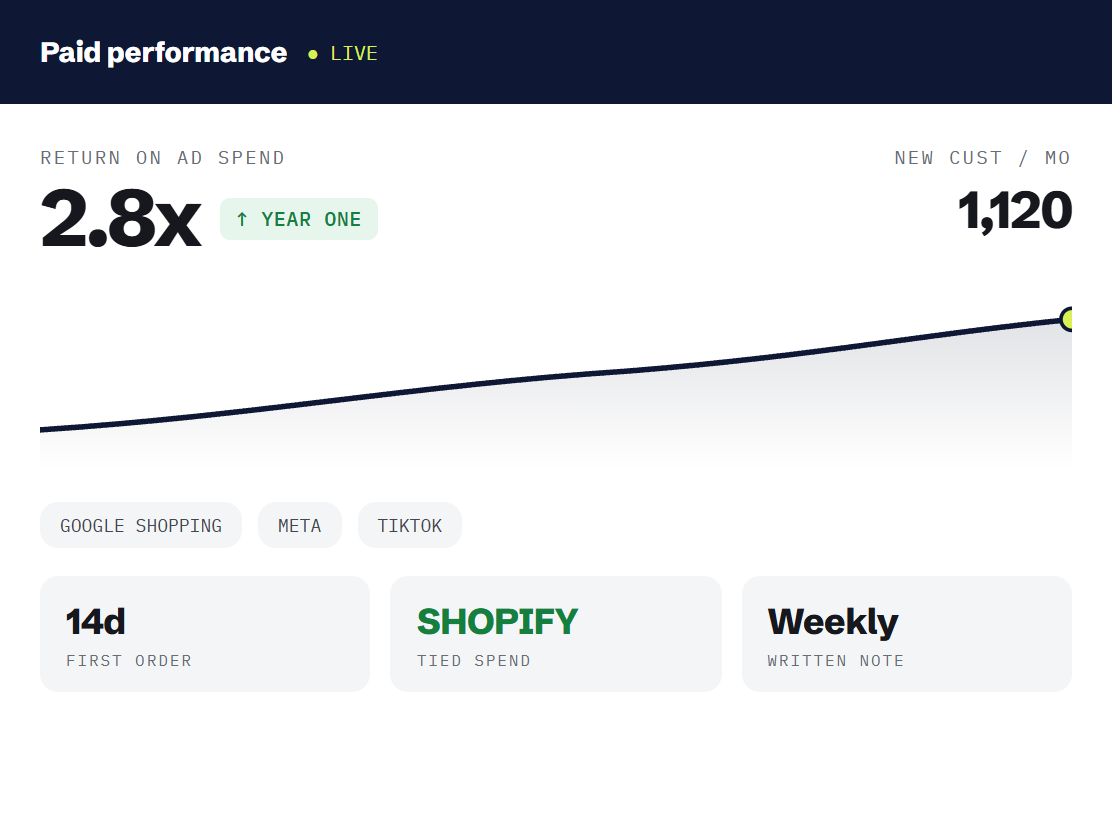
Ecommerce PPC for DTC brands, Shopify stores, and multi-SKU retailers. Google Shopping, Meta, TikTok, and Bing all report to contribution margin, not last-click. Flat monthly fee. Avg 2.8x return on ad spend in year one.
Three ways your ecommerce PPC is losing orders
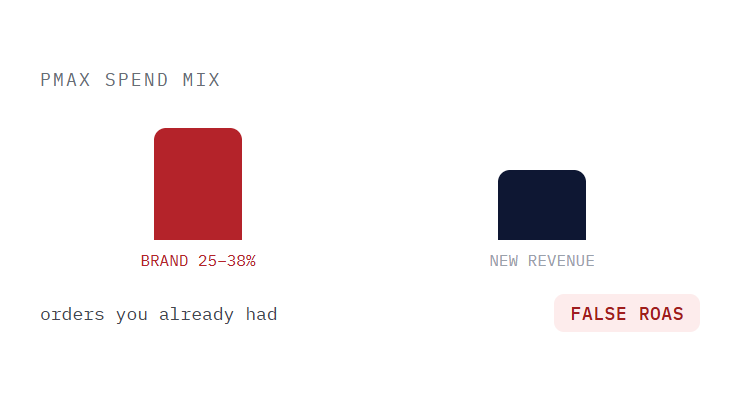
Performance Max eats your brand search and calls it new revenue
PMax auto-includes brand keywords by default, so 25 to 38% of the spend fires on orders you already had. The fix is brand exclusion lists plus separate asset groups per audience so PMax only bids on real prospecting queries.
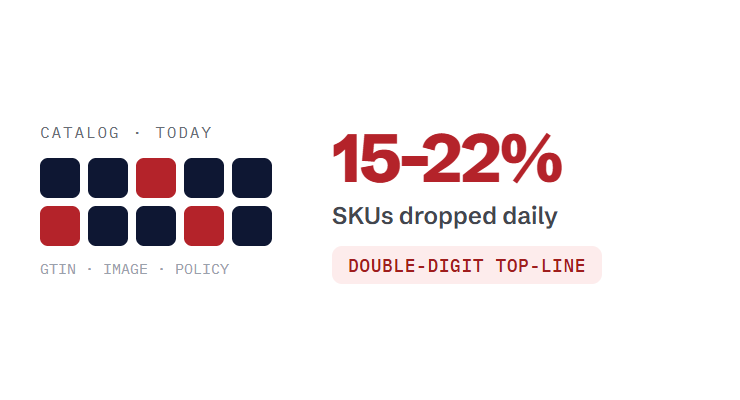
Merchant Center disapproves a fifth of your catalog on any given day
GTIN mismatches, image flags, and policy strikes drop 15 to 22% of SKUs from Shopping. Thirty days of drift ignored kills top-line by double digits. The fix is a weekly feed audit plus policy triage tied to Shopify inventory sync.
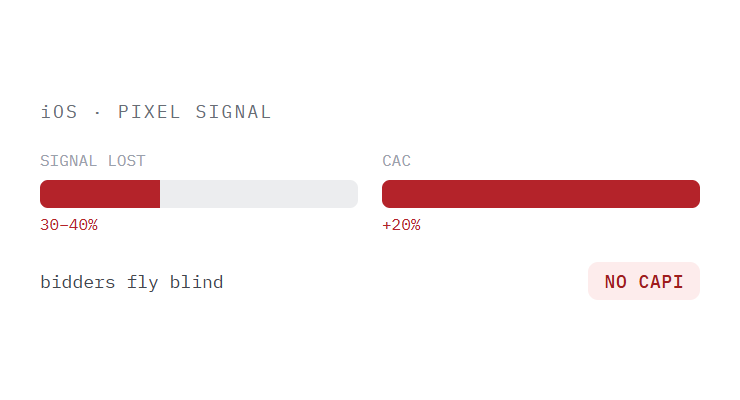
iOS 14.5 gutted pixel signal and your bidders are flying blind
Without CAPI or Enhanced Conversions, iOS erases 30 to 40% of conversion signal. CAC climbs 20% on the same order volume. The fix is Meta CAPI plus Google Enhanced Conversions plus server-side GTM wired to Shopify checkout events.
What every ecommerce PPC retainer delivers
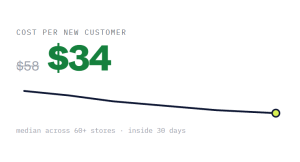
Tight campaign structure, aggressive negatives, and conversion-optimized product pages drop cost per new customer inside 30 days. Median CAC across 60+ DTC brands under our management sits at $14 per new customer after the first 60 days.
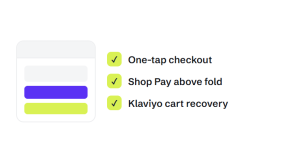
Every Google Shopping and Meta click lands on a product or category page wired for one-tap checkout, Shop Pay, and Klaviyo cart recovery. No dead-end contact forms, no drop-off between ad and add-to-cart.
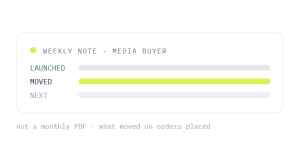
Not a monthly PDF. A weekly written note from your lead media buyer that says what launched, what moved on orders placed, and what is next. Owned by the person running your account.
Four stages, every step ends in a sign-off
Fixed scope, fixed timeline, fixed outcomes. Nothing moves to the next stage until your leadership signs off on the gate deliverable.
Audit that exposes wasted spend + broken tracking
Full campaign audit surfacing wasted spend, missing negatives, misconfigured conversions, and untracked order-placed events. Median finding on new ecommerce accounts: 42% wasted spend and 247 missing negatives. Written up in a 20-page report.
Campaigns rebuilt around ecommerce intent
Higher-margin SKUs get a higher target ROAS than commodity items. SKAG-lite structure with match-type discipline, Performance Max layered where your feed qualifies, and negative keyword sculpt to strip waste before it starts.
First paid order inside 14 days, guaranteed
Landing pages built per campaign with checkout flow, trust badges, and review proof. Every ad tracked through to a Shopify-verified order placed. If we do not hit a paid order inside 14 days, your first month is free.
Optimize weekly, scale against real revenue
Ad copy A/B tests, bid strategy tuning, and product page CVR iteration run weekly. Average account CPA drops 50% from launch to week eight. Meta and Display layered as retargeting once search demand is captured.
What you actually get from our ecommerce PPC services
Five workstreams, every item listed. Nothing lives in a proposal appendix.
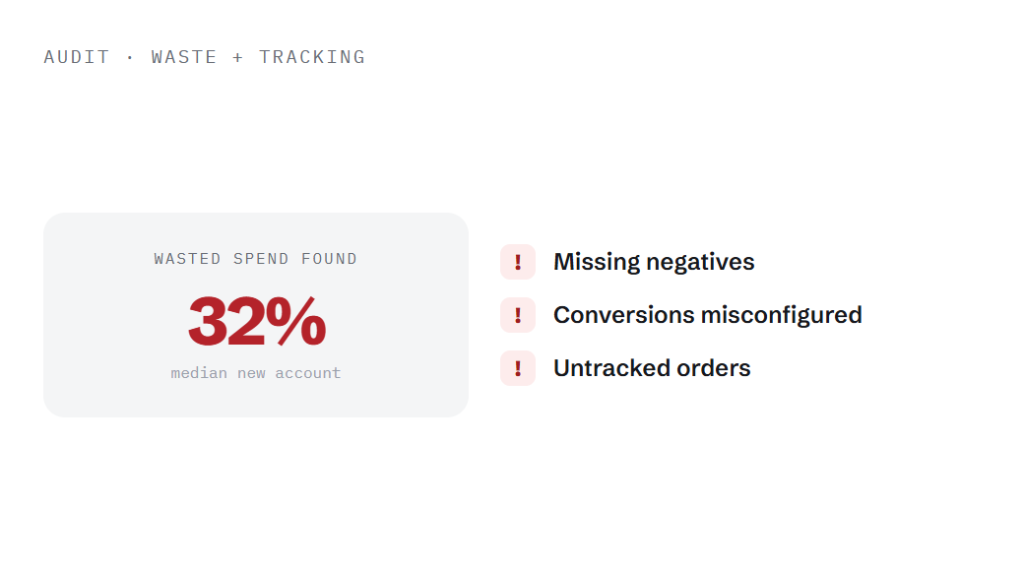
Audit that exposes wasted spend + broken tracking
Full campaign audit surfacing wasted spend, missing negatives, misconfigured conversions, and untracked order-placed events. Median finding on new ecommerce accounts is 42% wasted spend and 247 missing negatives. Signed off before we touch structure.
every search term with spend reviewed; off-category, brand-competitor, and irrelevant queries surfaced for negative-keyword sculpt.
are conversions counting clicks (wrong), add-to-cart (better), or order placed (right)? Fixed at the root before any bid change.
product page conversion rate benchmarked against ecommerce avg. Every ad group mapped to its landing page with a CVR score.
founder + ops lead review and sign off before we rebuild. No changes without a written go-ahead.
top DTC and category competitors in your niche pulled from Auction Insights and priced against your target ROAS ceiling.
last 90 days of orders mapped by source so the audit report starts with a real blended CAC and ROAS number.
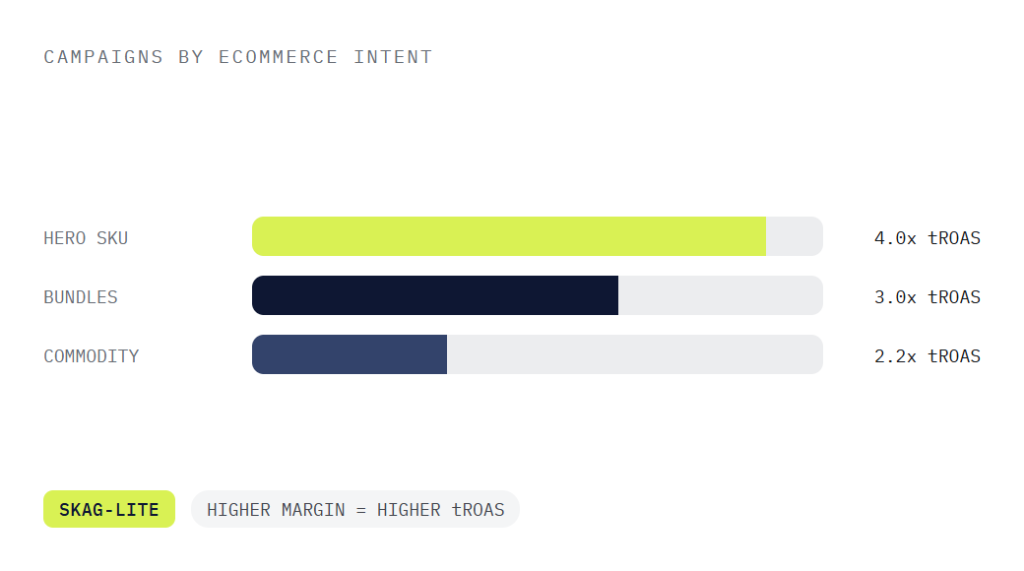
Campaigns rebuilt around ecommerce intent
Higher-margin SKUs get a higher target ROAS than commodity items. SKAG-lite structure with match-type discipline, Performance Max layered where your feed qualifies, and negative keyword sculpt to strip waste before it starts.
top-margin SKUs get their own campaign with a target ROAS floor based on contribution margin, not blended revenue.
247 negatives added on average in the first pass. Prevents budget drain from off-category, competitor, or irrelevant queries.
exact + phrase for high-intent, broad only on tightly scoped clusters. Every match type has a written rationale, not a default.
PMax layered only where your feed and creative library qualify. Asset groups segmented by audience and margin tier, not defaulted.
title, description, and custom labels rewritten for margin segmentation. GTIN and image compliance checked against every SKU.
target ROAS aligned to margin per SKU, seeded with Shopify offline conversions so bidding trains on gross profit, not top-line revenue.
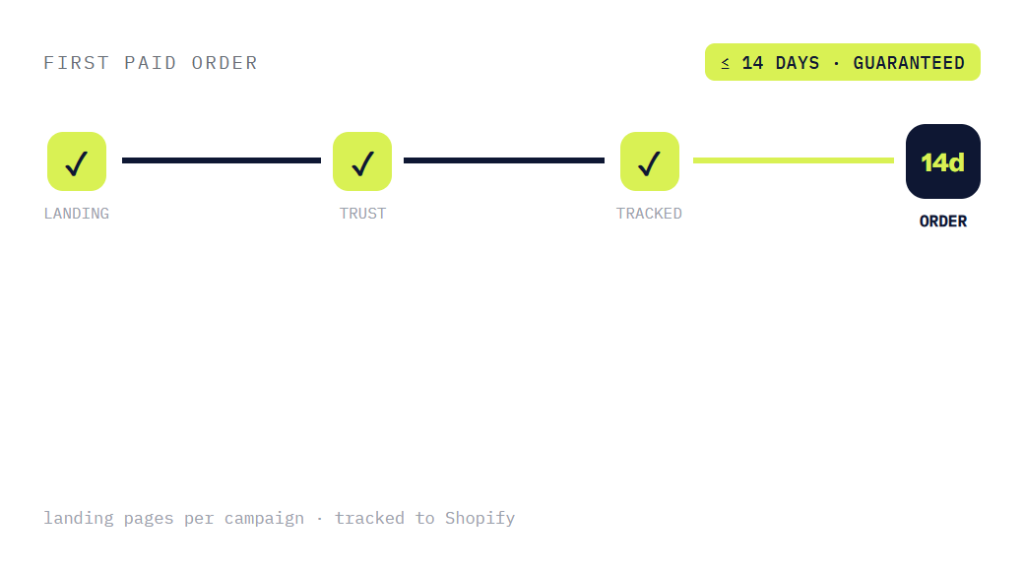
First paid order inside 14 days, guaranteed
Landing pages built per campaign with checkout flow, trust badges, and review proof. Every ad tracked through to a Shopify-verified order placed. Miss the 14-day first-paid-order mark, your first month is free.
every campaign gets its own landing page built around one hero SKU or category. No shared homepage traffic diluting purchase intent.
conversion is order placed, not add-to-cart. Tracked from ad through product page through Shopify checkout entry.
Meta CAPI and Google Ads pixels wired with server-side GTM backup. iOS-14-aware attribution across all channels.
miss the 14-day first-paid-order mark, your first month is free. Applied to 60+ DTC brands to date.
social proof, trust seals, and shipping guarantees baked into every landing page above the fold to grow add-to-cart rate.
landing pages under 2.1s on 4G mobile so Google Ads quality score cuts CPCs 20 to 40% out of the gate.
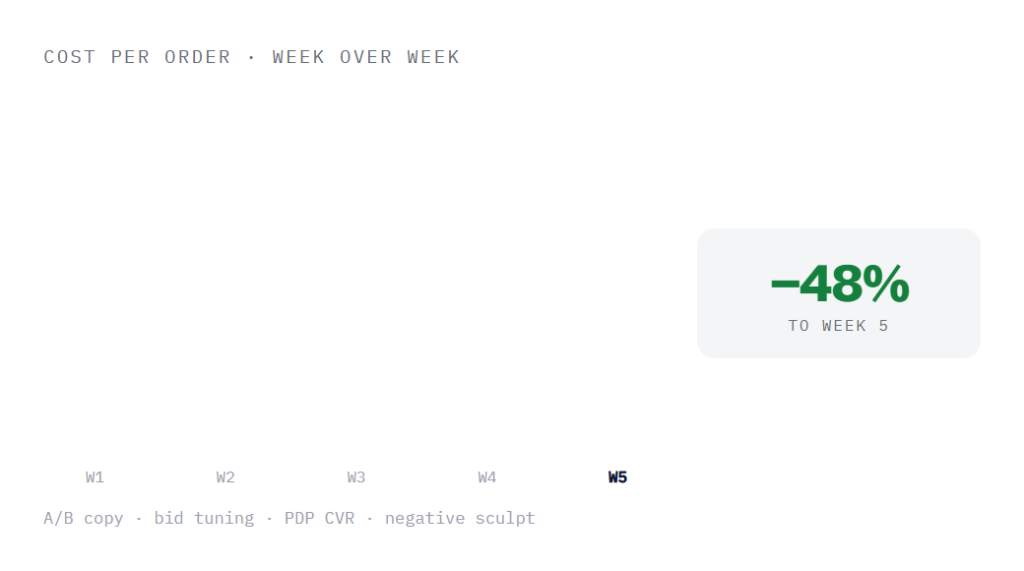
Cost per order drops week over week
Ad copy A/B tests, bid strategy tuning, product page conversion iteration, and negative keyword sculpt run weekly. Average account CPA drops 50% from launch to week eight. Every optimization is tied back to the Shopify-verified order-placed number.
every Monday: what changed last week, what impact it had on CPA and orders placed, what changes are being tested this week.
headline, description, and creative testing at ad-group level. Winners promoted, losers killed. No copy left running longer than 4 weeks without a test.
manual to target CPA to target ROAS progression as data compounds. Bid caps + budget shifts between SKU campaigns based on margin.
product page conversion rate benchmark tracked weekly. Copy, hero, and PDP layout test cycles run in-house without waiting on external design.
search-term report reviewed weekly; 15 to 30 new negatives added on average to protect budget from drift as auctions shift.
landing page + ad relevance + expected CTR monitored per keyword; poor scores fixed at the source, not papered over with higher bids.
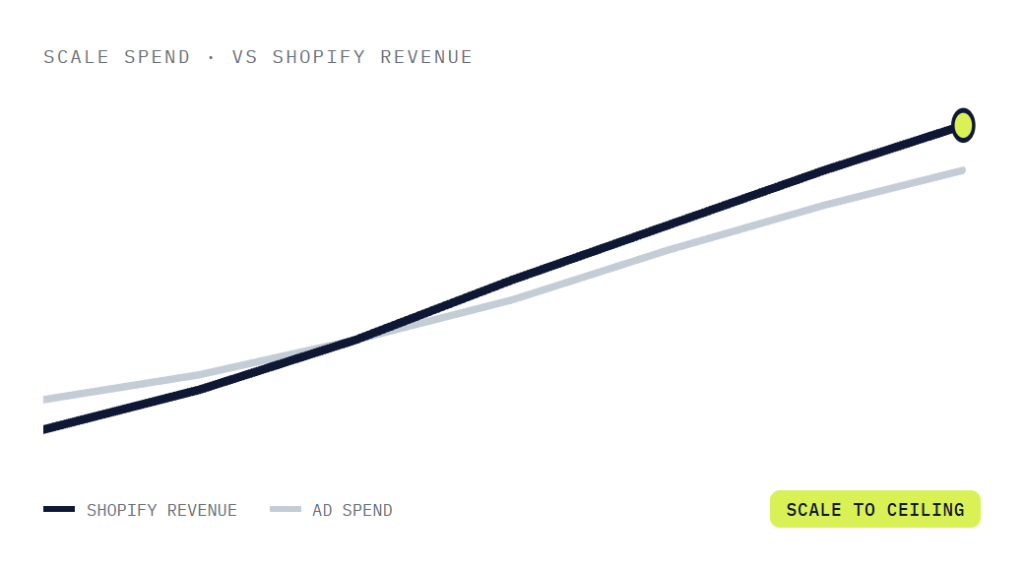
Scale spend against real Shopify-verified revenue
Once CPA is stable, we scale ad spend into the ceiling. Meta, TikTok, and Display layered as retargeting and awareness. Every scaling decision tied to gross profit and your inventory capacity, not vanity spend targets.
ad spend scaled against your inventory throughput and fulfilment capacity. No spending past what you can fulfil inside your promised window.
once search demand is captured, Meta and TikTok layers built as retargeting for site visitors plus lookalikes for repeat buyers.
every 30 days: ad spend, orders placed, cost per order, revenue from paid, blended ROAS, and next-month plan.
every 90 days we present ROI and book of tests to leadership. Budget shifts and strategy tweaks signed off in the meeting.
holding companies get one pool per brand with attribution per storefront, so leadership sees which brand each dollar bought.
high-margin SKUs scaled first since a $30 CPA still returns 3x on a $90 AOV; commodity items scaled to protect blended ROAS floor.
Four PPC tiers for every stage of growth
Pick the tier that matches your practice size. Move up or down anytime with 30 days notice, no setup fees. Hover any feature name for a plain-English explanation.
Single-location testing paid ads, or recovering from a bad agency.
Growing brands scaling beyond one campaign: PMax, search, Meta.
Two to ten locations, paid ads across service areas and lines.
Enterprise or 11+ locations. Systematic paid rollouts, multi-market.
Every PPC feature, tier by tier
HOVER FOR DETAILPlatforms and ad spend +
Campaigns + landing pages +
Reporting + analytics +
Ad channels + creative +
Compliance + enterprise +
Team + service level +
Real DTC brands, real order numbers



See what a $400/mo dental site could book back.
Slide in your practice numbers. Assumes a 32% relative conversion improvement, below the median gain on our dental rebuilds.
Common ecommerce PPC services questions, answered
From real quote calls. Anything else, ask on the call and get an answer in the first 5 minutes.
What is PPC in eCommerce?
+
PPC in ecommerce is a paid model where online stores bid on keywords and audiences and pay only when a shopper clicks the ad. Ads run on Google Search, Google Shopping, Meta, TikTok, Pinterest, and Bing, and route traffic to product or category pages inside a Shopify or BigCommerce storefront. Well-run ecommerce PPC services tie every click back to a checkout-verified order so bidders optimize for gross profit, not last-click revenue. The right structure segments campaigns by margin, uses Shopify order data for offline conversion imports, and rebuilds the Google Shopping feed inside Merchant Center every week to keep 15 to 22% of the catalog from dropping out of eligibility on any given day. The channels layer differently by funnel stage. Google Search and Shopping capture buy-now demand at the top of the funnel. Meta and TikTok warm up new audiences and retarget site visitors who abandoned cart. Bing quietly picks up mid-funnel shoppers most agencies ignore. Blended CAC across all channels should come in at 15 to 25 percent of average order value for a healthy DTC brand.
How much do ecommerce PPC services cost per month?
+
Ecommerce PPC services at Redefine Web start at $499 per month for the Launch tier and run to $999, $1,999, or from $3,500 per month for Enterprise DTC programs. Ad spend on Google, Meta, and TikTok is billed by the networks directly, not by us. Every tier includes campaign management, Google Shopping feed hygiene, weekly written notes from your lead media buyer, and the 14-day first-paid-order guarantee. Larger DTC brands spending $50K or more per month get dedicated day-to-day account support, quarterly ROI reviews with leadership, and a spend-to-inventory model that caps ad spend at what your fulfilment capacity can actually service. You own every ad account and every dollar of first-party data from day one. Contract length is 6 months, which lines up with the time it takes machine bidders to gather enough conversion signal to stabilize CAC. Cancellation returns full ad account access, your creative library, and all reporting inside 5 business days.
What does a PPC agency do?
+
A PPC agency runs paid-search and paid-social advertising for you across Google Ads, Meta, TikTok, and Bing so your team can focus on product, fulfilment, and customer service. Day to day the work covers keyword and audience research, ad copy and creative production, Google Shopping feed builds, bid strategy tuning, negative keyword sculpting, landing page conversion tests, and weekly performance reporting against orders placed. A good ecommerce PPC agency also owns the tracking stack. Google Enhanced Conversions, Meta CAPI, and server-side GTM tied to your Shopify checkout events keep bidders learning after iOS 14 stripped signal from browser pixels. The output is lower CAC per new customer, higher blended ROAS, and a written recap of what changed and why every single week. The wrong PPC agency touches campaigns once a month, reports last-click revenue in a PDF, and never opens Merchant Center. That agency will hold your CAC flat at best. Ask any agency you talk to what they did in your feed last week, and how many negatives they added to your search-term report. If the answer is vague, walk.
What is PPC management?
+
PPC management is the day-to-day work of planning, launching, and optimizing pay-per-click campaigns so ad spend produces profitable orders. It covers keyword and audience research, campaign structure, bid strategy selection, creative testing, negative keyword sculpting, feed hygiene inside Google Merchant Center, landing page conversion iteration, and weekly reporting on cost per order and blended ROAS. Ecommerce PPC management differs from lead-gen PPC because the conversion is a checkout-verified order, not a form fill. That means bidders need offline conversion imports from Shopify, margin-adjusted conversion values, and a feed that clears policy every day so shopping ads keep serving. Good ecommerce PPC management operates on a weekly cadence. Search-term reports get reviewed every Monday, negatives added, product page conversion rates checked, quality scores audited, and creative refreshed on a 4-week rotation. Monthly reports roll up ad spend, orders placed, cost per order, revenue from paid, blended ROAS, and next-month plan against your inventory throughput.
What is a good ROAS in PPC for ecommerce?
+
Target ROAS depends on contribution margin. If your CM3 per order is 30 percent, you need blended ROAS above 3.3 to break even on the first purchase. If margin is 60 percent, break-even is 1.7 and 3x ROAS is genuinely profitable. Bidders should be fed margin-adjusted conversion values so they optimize for gross profit, not top-line revenue. Most ecommerce PPC accounts we take over are chasing the wrong number: a 4x ROAS on a low-margin SKU can still lose money once returns, shipping, and payment processing are subtracted. We rewire bidding on day one against contribution margin per order using Shopify offline conversion imports, then set target ROAS floors per SKU cluster instead of one blended target for the whole account. Repeat-buyer LTV changes the math further. A brand with a 3-month repurchase cycle can afford break-even ROAS on first order because LTV pays back the acquisition cost inside 90 days. New-brand accounts without repeat data should target profitable ROAS from click one.
What is PPC vs SEO?
+
PPC buys ranked traffic today; SEO earns compound organic traffic over 6 to 18 months. Both feed the same funnel, but they solve different problems for a DTC brand. PPC gets you paid orders in the first 7 to 14 days, which is how new campaigns fund themselves. SEO builds a moat that keeps producing free traffic long after ad spend gets paused. Running only PPC caps your CAC once auction prices climb. Running only SEO leaves 12 to 18 months of revenue on the table during the ranking wait. The math favours running both as soon as a store clears $30K per month in blended revenue. Our ecommerce PPC services and SEO retainers share the same tracking stack so blended CAC stays honest across paid and organic. The best DTC brands treat PPC as a demand-capture engine and SEO as a demand-generation engine. PPC ads capture shoppers already searching for what you sell. SEO content, product schema, and category page optimization create demand from people who did not know your brand existed yet.
Which channels do ecommerce PPC management retainers cover?
+
Google Search, Google Shopping, Performance Max, YouTube, Meta prospecting and retargeting, TikTok, Pinterest, and Bing are all in scope for ecommerce PPC management retainers at Redefine Web. Amazon Advertising is handled through a co-managed specialist partner so blended CAC across DTC and marketplace stays honest. Every channel reports back to Shopify order data through offline conversion imports so target ROAS gets set against real gross profit, not last-click revenue. Klaviyo email and SMS flows are wired into the same first-party pixel stack via the Klaviyo API so retargeting audiences update in near real time based on shopper behavior on your storefront. Channel mix gets rebalanced quarterly against your margin, inventory throughput, and creative bandwidth. Brands with strong creative production go heavy on Meta and TikTok. Brands with a wide, feed-friendly catalog lean into Google Shopping and Performance Max. Every scaling decision is tied back to a written recap so leadership sees which channel each dollar bought.
How fast do ecommerce PPC services produce orders?
+
Ecommerce PPC services produce first orders in 7 to 14 days from campaign launch once tracking, feed hygiene, and creative are in place. Google Shopping usually delivers first orders inside a week. Meta prospecting warms up in week 2 as pixels gather signal. TikTok takes 3 to 4 weeks to hit stable CAC because the platform needs more creative iterations to learn. If the 14-day first-paid-order mark gets missed, your first month is free. We have applied that guarantee across 60+ DTC brands to date. The critical piece is having Google Enhanced Conversions and Meta CAPI wired before launch. Without that, iOS 14 strips 30 to 40 percent of the conversion signal and bidders spend 60 days training on noise. Beyond first orders, real scale kicks in around week 8. Median CPA drops about 50 percent from launch to week 8 as bidders finish their learning phase and negatives cut off the wasted-spend queries. From there, weekly optimization compounds.
Do ecommerce PPC services include Google Shopping feed work?
+
Yes. Google Shopping feed hygiene, GTIN attribution, custom labels for margin segmentation, feed rules for out-of-stock handling, and category attribution are all included in every ecommerce Google Ads engagement. Feed quality is the single biggest lever on Shopping performance and most brands under-invest in it. On any given day, 15 to 22 percent of a typical Shopify catalog is disapproved inside Merchant Center for image flags, GTIN mismatches, or policy strikes. Left ignored for 30 days that costs double-digit percentages of top-line revenue. Our team runs a weekly feed audit tied to Shopify inventory sync so out-of-stock SKUs get paused before spend fires and disapproved items get triaged inside 48 hours. Product titles, descriptions, and custom labels get rewritten for margin segmentation so high-margin SKUs bid into their own campaign at a higher target ROAS floor. That per-SKU control is how a 60+ DTC brand book keeps blended CAC in the $14 range while competitors flat-line at $40.
Is Google Ads good for ecommerce?
+
Yes. Google Ads is the highest-intent paid channel available to a DTC store because shoppers on Google Search and Google Shopping are actively trying to buy the thing you sell. Across our 60+ DTC brands, Google Shopping alone drives 40 to 60 percent of paid revenue, with Performance Max and branded Search filling most of the remainder. The channel works best when contribution margin per order is at least $30 and monthly ad spend clears $3,000 so machine-learning bidders have enough conversion data to optimize on. Below those thresholds, Google Ads is fine as a proof-of-demand test but should be paired with organic content and email flows for full-funnel economics. Where Google Ads underperforms is with pure impulse-purchase categories, where TikTok and Meta creative wins the click before the shopper ever searches. For considered purchases, planned replenishment, and category-defining products, Google Ads is almost always the first channel we build and the last we scale down.
What is the 80 20 rule in ecommerce?
+
The 80/20 rule (Pareto principle) in ecommerce is the observation that roughly 80 percent of revenue comes from 20 percent of your SKUs and 20 percent of your customers. On the ad side, the same rule holds: 80 percent of profitable paid orders typically come from 20 percent of campaigns, keywords, or audiences. Ecommerce PPC services should be structured around finding that 20 percent quickly, scaling spend into it aggressively, and stripping budget from the low-return long tail. In practice that means margin-first campaign structure with higher target ROAS on top-margin SKUs, negative keyword sculpts that kill off-category queries, and weekly search-term reports that promote winning terms and pause losers before they eat budget. Custom labels inside Google Merchant Center let you segment the top 20 percent of SKUs into their own Performance Max asset group so those items get bid protection when auction pressure climbs. Ignore the other 80 percent at your peril: they still need feed hygiene and disapproval triage, just not premium ad spend.
Is $20 a day good for Google Ads?
+
$20 a day (about $600 per month) is a real starting point for a Google Ads test if your average CPCs are under $2 and contribution margin per order is at least $30. At that spend, you get roughly 10 clicks a day, which is enough to prove demand on 1 or 2 tightly scoped Search campaigns or a small Google Shopping test. It is not enough to seriously feed Performance Max or Smart Bidding, both of which need 30 to 50 conversions per month to learn. For most DTC brands we take on, a serious Google Ads test starts at $3,000 per month across Search and Shopping. Below that, the platform under-optimizes and you pay a beginner-tax on every click while machine bidders wait for enough signal. If $20 a day is what your unit economics support today, use it for one clearly defined test with tight negatives and a single landing page. Scale the budget only after you see a repeatable ROAS above your margin break-even.
What is a PPC for Amazon sellers?
+
PPC for Amazon sellers is paid advertising inside Amazon Ads, primarily Sponsored Products, Sponsored Brands, and Sponsored Display. Ads are keyword-targeted or product-targeted and appear in search results, on product detail pages, and inside category browse pages. Amazon Ads is separate from Google Ads: it uses first-party purchase data from inside Amazon, so ROAS numbers reported there are checkout-verified but do not include off-Amazon behavior. Our ecommerce PPC agency co-manages Amazon Ads through a specialist partner so blended CAC across DTC and marketplace stays honest and inventory forecasts get built against the combined pipeline instead of two separate silos. The tactical stack differs from Google Ads: Amazon rewards catalog completeness, review count, and Buy Box ownership more than creative or landing page CVR. A tight Sponsored Products campaign structure with negative ASIN targeting and dayparted bids is usually the fastest path to profitable Amazon revenue for a DTC brand already running Shopify.
What is the difference between Google Shopping and Google Ads?
+
Google Ads is the whole platform. It runs Search, Shopping, Display, Video, Performance Max, and Demand Gen campaigns. Google Shopping is one campaign type inside Google Ads that pulls product data from a Merchant Center feed and shows product image, price, and store name in the ad slot. For most DTC brands Shopping is 40 to 60 percent of paid revenue. Setting up Shopping the right way starts with a clean product feed inside Merchant Center: accurate GTINs, high-resolution images at 1200 pixels or wider, and product titles that lead with the keyword shoppers actually search. The feed is the single biggest lever on Shopping performance, ahead of bid strategy or budget allocation. Standard Shopping and Performance Max both draw from the same feed but bid differently. Standard Shopping gives manual control over match types and negative keywords. Performance Max hands campaign optimization to Google Smart Bidding and layers in Display, YouTube, and Discover placements automatically.