Most advice about us page SEO is written as though the page were a landing page that has simply been neglected, and the fix were to put keywords in it. That is the wrong model, and following it produces an About page that reads like a brochure and still ranks for nothing. The page does real work. It just does not do the work people keep trying to make it do.
The honest version is narrower and more useful. Your About page will almost certainly never rank for a commercially valuable search. It is, however, the page Google names by name in its own guidance on whether content can be trusted, and it is read by a specific person at a specific moment for a specific reason. This walks through both, and what to actually put on the page as a result. Our SEO audit page covers the wider job.
What about us page SEO actually is, and what it is not
Two entirely different jobs get filed under this heading and conflating them is the whole problem. The first is making the page rank for searches. The second is making the page do something for the rest of the site. Only the second one works.
You can see the confusion in the search results themselves. Query this subject and the first organic result is a Reddit thread asking what the keyword on an About Us page should be, and a Quora question asking whether the page has any SEO value at all sits further down the same page. People are not asking how to optimize it. They are asking whether optimizing it means anything, which is a more sensible question and one almost nobody answers directly.
So here is the direct answer before the detail. An About page is not a ranking asset and should not be given a target keyword. It is a supporting page whose value is almost entirely in what it lets a reader and a search engine conclude about everything else you publish. Treat it as evidence rather than as inventory.
That reframing changes what success looks like. You stop asking whether the page ranks and start asking whether somebody who lands on it comes away able to say who you are, what you do, and why they should believe the rest of the site. Those are answerable questions and none of them appears in a rank tracker.
Why your about page will probably never rank, and why that is fine
Think about what an About page would have to compete for. The searches it could plausibly match are your own brand name, which your homepage already wins, and generic phrases like the words about us, which nobody searches with buying intent and which no business could own anyway.
There is no third category. An About page cannot rank for your services, because a services page answers that better and Google will prefer it. It cannot rank for your products, for the same reason. It cannot rank for informational questions in your field unless you have written an article inside it, at which point you have written an article and should have put it somewhere sensible.
This is why keyword-stuffing an About page is such a persistent waste. The page gets rewritten to include service terms, reads worse to the human who actually opened it, and still loses to your own service pages, which is the best possible outcome of that competition. You have made the page worse at its real job in order to lose a race you did not want to win.
The exception worth naming is brand-adjacent search. People do look up a company plus a word like reviews, founder, or team, and an About page can be the right answer to some of those. That is still not a keyword strategy. It is a reason to make sure the page states plainly who runs the business and where it operates from.
There is a second, quieter way the page gets seen, which is that search engines and the assistants built on them summarize sites as well as rank them. When something needs to describe what a business is, the About page is an obvious place to read it from. That is not a ranking argument and it should not be oversold as one, but it does mean a page that states plainly what you do and who you are is more useful than one written in the language of aspiration, because aspiration summarizes into nothing.
What Google’s own documentation says about it
Here is the part that settles the argument, and it is more specific than most people expect. Google’s guidance on creating helpful content includes a self-assessment list, and inside its expertise questions it names the page directly.
The question it asks you to put to your own content is this. “Does the content present information in a way that makes you want to trust it, such as clear sourcing, evidence of the expertise involved, background about the author or the site that publishes it, such as through links to an author page or a site’s About page?” (Google, Creating helpful, reliable, people-first content, read 16 September 2026).
Read what that sentence is actually doing. The About page is not being described as content that performs. It is being described as a place you link to in order to supply background, so that the content elsewhere on the site becomes more credible. The page is infrastructure for other pages.
The next question on the same list extends it past your own site, asking “If someone researched the site producing the content, would they come away with an impression that it is well-trusted or widely-recognized as an authority on its topic?” That is a question about what a person finds when they go looking, and your About page is usually the first thing they find.
The same guidance sets out a wider test it calls “Who, How, and Why”, and on the Who it asks two questions directly. “Is it self-evident to your visitors who authored your content?” and whether bylines “lead to further information about the author or authors involved, giving background about them and the areas they write about”. It then states its position rather than merely asking, saying “We strongly encourage adding accurate authorship information”. Those sentences are about author pages and About pages doing one job between them.
The trust job, and who is actually reading this page
Set search aside for a moment, because the human traffic to an About page is unusual and it explains what the page should contain. Almost nobody arrives here first. They arrive from somewhere else on your site, at a particular moment, with a particular doubt.
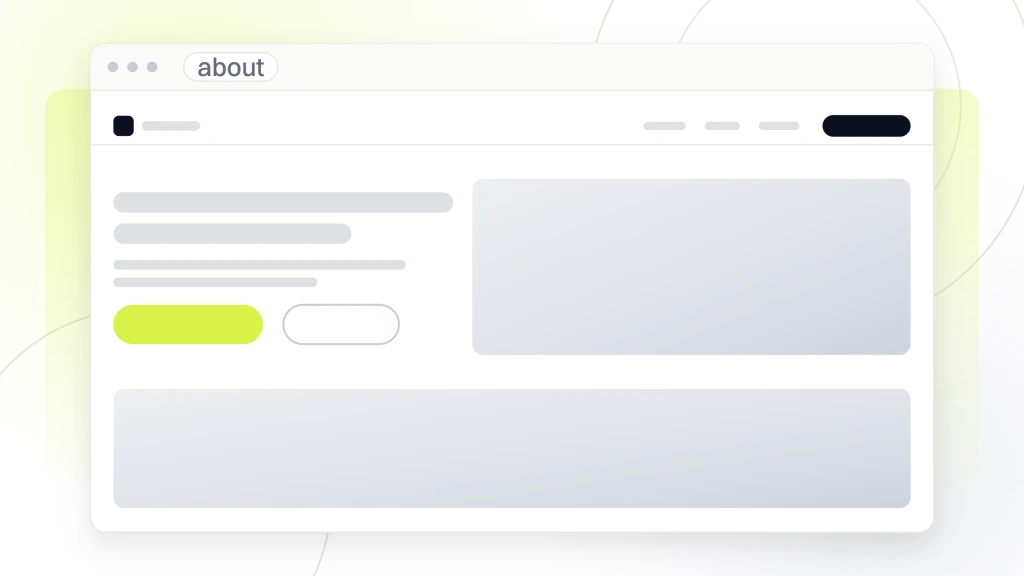
That moment is nearly always a check before a commitment. Somebody has read enough to be interested and is now deciding whether you are real, whether you are the right size, and whether there is a person behind this. They are not browsing. They are verifying, and they will leave the moment they either believe you or decide not to.
This is why the standard About page fails. It answers a question nobody asked, which is what the company believes about itself, in language chosen to sound established. Mission statements, founding-year narratives and words like passionate are all answers to a question the reader does not have. The reader wants evidence, and every sentence that is not evidence is delay.
It is also worth being clear that this matters more for some businesses than others. If you are asking for money, personal details, or trust in advice that affects somebody’s health or finances, the checking is harder and the page carries more weight. If you sell a low-risk product, a short and specific page is genuinely enough.
What belongs on the page, in order of what it changes
Given that the job is evidence rather than persuasion, the contents follow. This is roughly the order of usefulness rather than a layout.

- Who is actually behind it. Real names, real roles, real faces where you can. This is the single highest-value thing on the page and the most commonly missing.
- Where you are and how to reach a human. A verifiable location and a contact route that is not only a form. Absence of this is the most common reason a visitor decides against you silently.
- What you actually do, in plain words. Not the category, the specific work. Somebody should be able to tell from this page whether you do the thing they need.
- Evidence you have done it. Named work, numbers you can stand behind, credentials that are checkable. Anything a reader could verify beats anything they have to take on faith.
- Links out to author pages and to the work. This is the part Google’s guidance is pointing at, and it is what converts the page from a dead end into infrastructure.
Notice what is not on that list. A history of the company from its founding, unless the history is itself the evidence. Values. Anything phrased as a commitment to excellence. Those are not banned, they are just doing nothing, and on a page read by somebody in a hurry, doing nothing is a cost.
Length follows from that. The page should be as long as your evidence and no longer. A short About page full of specifics outperforms a long one full of positioning, and the instinct to pad this page to look substantial is the instinct to resist.
The keyword question, answered directly
Since the top result on this subject is somebody asking exactly this, it deserves a straight answer rather than a hedge. What keyword should you target on an About Us page? None.
Not every page on a site needs a target keyword, and pretending otherwise is a habit picked up from plugins that grade every page against one. A site has pages that are supposed to attract search traffic and pages that are supposed to do a job once somebody is already there. Assigning a keyword to the second kind produces worse pages and no traffic.
What to do instead is write the page for the reader described above, then make sure the basics are not actively broken. A title that says who you are rather than the word About alone. A description that would make sense in a result. Headings that match what is under them. That is not keyword targeting, it is just not being careless.
If your SEO plugin insists on a focus keyword and will not stop complaining, put your business name in it and move on. The score it gives you is measuring a thing this page is not for, and our comparison of website checkers covers how little those grades mean in general.
The author and contact pages beside it
The About page is one of three that do this job and it is usually the only one anybody thinks about. Treated as a set, they work considerably better, and Google’s own wording puts author pages and About pages in the same sentence.
Author pages are the piece most sites are missing entirely. If you publish anything with a byline, that byline should lead somewhere that says who the person is and why they can speak on the subject. A byline that links nowhere, or links to an empty archive of posts, is doing the opposite of what a byline is for.
Contact pages carry more weight than their content suggests, because their job is falsifiability. A real address and a real phone number can be checked, and the checking is the point. A contact page with only a form tells a cautious reader nothing, and on a site asking for money it tends to read as evasion whether or not it is.
Link the three to each other and from the content they support. That is the whole mechanism, and it is a half-hour of work on most sites. If you want the reasoning behind why these pages affect how a site is perceived overall rather than individually, our explanation of SEO visibility covers how sitewide impressions get built.
How to tell whether yours is doing anything
Because the page is not a ranking asset, the usual measurements tell you nothing, and people conclude from flat rankings that the page does not matter. Measure the things it is actually for instead.
Three numbers are available to anyone with analytics. How many sessions reach the page at all, which tells you whether it is part of the journey or an orphan. What people do immediately afterward, since an About page that sends people to contact or to services is working and one that ends sessions is not. And how far down it people get, which tells you whether the evidence is above or below the point where they stopped.
The qualitative test is faster and usually more damning. Hand the page to somebody who does not know your business and ask them to tell you, without scrolling back, who runs it, what it does and where it is. If they cannot, the page has failed at the only thing it was for, regardless of how it reads.
One caution about reading those numbers. Traffic to this page is small on most sites, so month-to-month movement is mostly noise and it is easy to talk yourself into a result that is not there. Look at direction across a longer window, and treat the step after the page as the more honest signal, since that one reflects a decision somebody made rather than an accident of how they arrived.
Set a baseline before you rewrite, because this is a change people make and then argue about. Record what those three numbers are now, and how you would know the rewrite worked. Our guide to benchmarking SEO covers doing that without fooling yourself.
Where this sits in an audit, and what it is not
This is a small, specific piece of on-page work and it should be kept in proportion. Three boundaries are worth drawing so it does not get oversold.
- It is not a search procedure. Whether pages can be crawled, whether the right page answers a query and whether anything changed after you acted is covered in SEO performance step by step, and this page is one line item inside it.
- It is not the delivered-product audit. Whether the site works, loads and can be operated belongs in how to conduct a website audit, and an excellent About page on a broken site changes nothing.
- It is not a fix for a trust problem that is real. If people doubt you because of something they found, a better About page does not answer it. The page presents evidence, it does not manufacture it.
That last one is worth sitting with, because this is the area where advice in this category quietly turns into something else. Writing a more convincing page about a business that cannot support the claims is not optimization. It is a different activity with a different name, and no amount of framing makes it an SEO tactic.
Where the page does earn attention is when it is genuinely absent or genuinely anonymous, which is more common than you would think, particularly on sites built quickly from a template. How that kind of finding gets written up so somebody acts on it is covered in our breakdown of an SEO report.
What we would do first, and what to ask us
Given a site and twenty minutes, we would open the About page and the contact page and try to answer three questions from them alone. Who runs this, where are they, and what have they actually done. If any of the three is unanswerable, that is the work, and it is usually writing rather than optimization.
Then we would check whether anything links to the page on purpose. An About page that appears only in the footer navigation is not doing the job Google’s guidance describes, because nothing is pointing at it from the content it is supposed to support.
Now point this at us, because an agency writing about trust pages has an obvious interest in you thinking they are complicated. They are not. This is an afternoon of writing that you are better placed to do than we are, because you know who is behind the business and what it has actually done, and nobody outside it can supply that. If somebody quotes you a project for it, ask what specifically they will find out that you already know, and ask whether the deliverable is words or evidence. If the answer is words, write them yourself.
The honest place this belongs is inside a wider review, where a thin About page is one finding among many and worth exactly the twenty minutes it takes to fix. If you would like that review done, our free website audit is where to start, and the wider search procedure is set out in SEO search.