
Beauty Influencer Marketing Agency That Actually Moves Product
- Beauty influencer marketing agency work covers sourcing, contracts, and TikTok Shop.
- Nano and micro creators produce most content volume at a fraction of paid spend.
- Gifting seeds the top of the funnel. Paid contracts lock the mid-funnel deliverables.
- Beauté Aesthetics grew qualified leads 166 percent through creator-led content.
- Program retainers run 6,000 to 40,000 dollars per month before creator fees.
- Monthly pricing bands for a beauty influencer marketing agency
- A beauty influencer marketing agency case study from a Manhattan clinic
- Content brief quality separates good beauty influencer marketing agency work from bad
- Paid social amplification of beauty influencer marketing agency content
- Reporting a beauty influencer marketing agency should send monthly
- Red flags in a beauty influencer marketing agency proposal
- Timeline to real results from a beauty influencer marketing agency
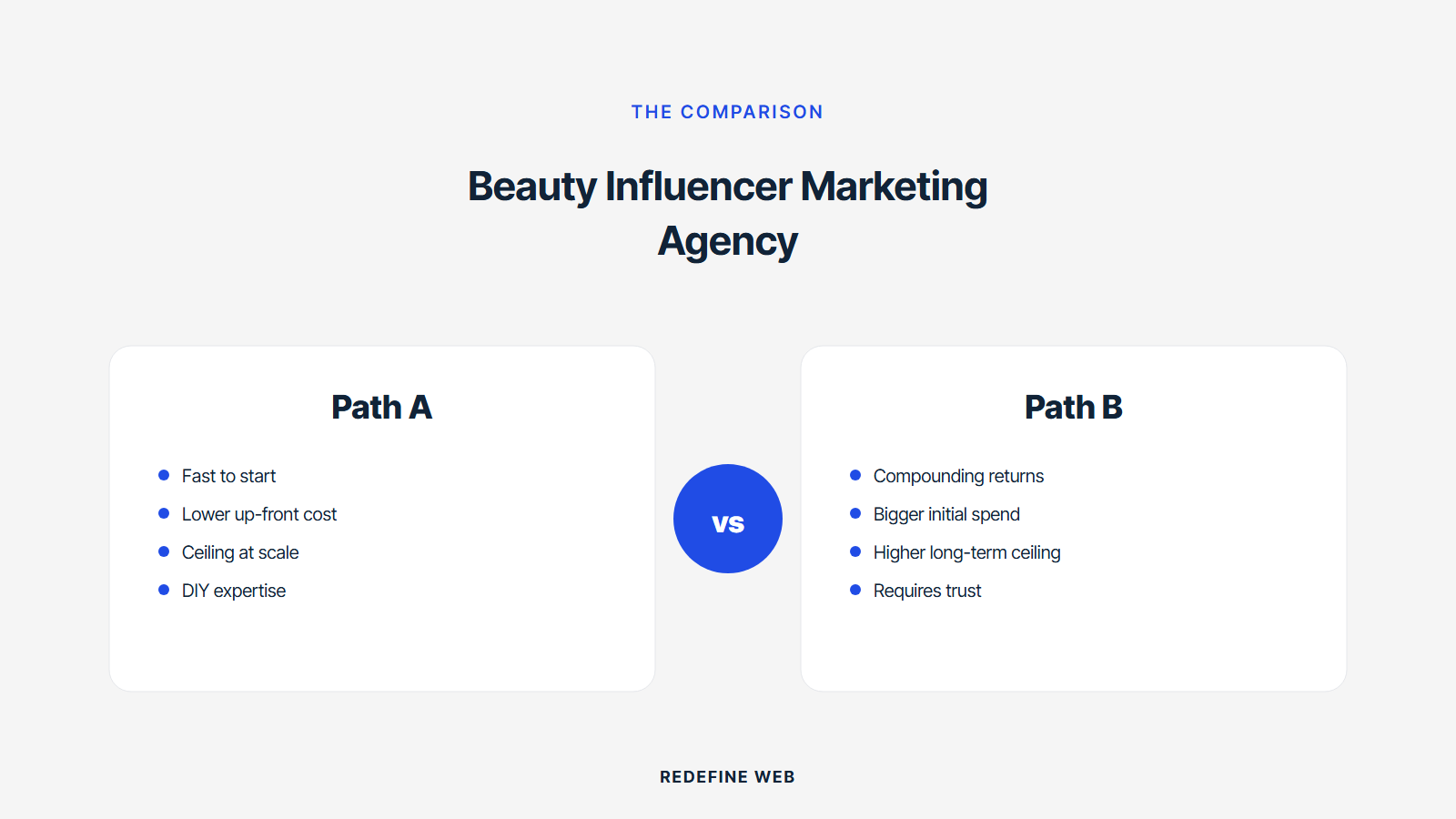
- In-house versus beauty influencer marketing agency partnership
- Wrapping up beauty influencer marketing agency selection
A beauty influencer marketing agency is the outside partner a skincare, color, or wellness brand hires to run creator seeding, paid partnerships, and TikTok Shop affiliate programs at a scale a solo founder cannot manage from a single laptop. In 2026 the category has split hard between real operators and PowerPoint agencies that resell a Notion database of creator handles. The math on which one you hired shows up inside 90 days, either as a repeatable content engine feeding paid ads and organic growth, or as a stack of gifting boxes sitting in a warehouse with no posts to show for it.
This guide walks the working scope for a beauty influencer marketing agency in 2026. Roster tiers from nano to celebrity, gifting versus paid contract math, TikTok Shop affiliate commission structures, FTC disclosure rules a real partner enforces, and the case study of Beauté Aesthetics New York growing qualified leads 166 percent through a creator-led content program across twelve months. If you are picking a partner in the next thirty days, this is the filter that separates a real beauty influencer marketing agency from a proposal deck.
Monthly pricing bands for a beauty influencer marketing agency
A beauty influencer marketing agency retainer runs 6,000 to 40,000 dollars per month depending on program scope. The floor is 6,000 for a nano-and-micro-only gifting program with 20 to 40 creators per month. The mid-range is 12,000 to 20,000 for a mixed gifting-plus-paid program with 60 to 120 creators per month. The upper range is 25,000 to 40,000 for a full-service program running TikTok Shop affiliates, paid partnerships, and macro launch pushes across 200 plus creators per month. Every tier excludes the media spend on paid amplification of the top-performing content.
Retainer tiers by program scope
| Program scope | Monthly retainer | Creators per month | Content pieces per month |
|---|---|---|---|
| Nano gifting only | $6,000 to $9,000 | 20 to 40 | 15 to 25 |
| Micro gifting plus paid | $9,000 to $14,000 | 40 to 80 | 30 to 55 |
| Mixed program with TikTok Shop | $14,000 to $22,000 | 80 to 140 | 60 to 110 |
| Full service with macro | $22,000 to $35,000 | 140 to 220 | 100 to 180 |
| Enterprise beauty portfolio | $35,000 plus | 220 plus | 180 plus |
What the paid partnership fees look like
Paid partnership fees inside a beauty influencer marketing agency program run 250 to 600 dollars per nano post, 500 to 2,500 dollars per micro post, 2,500 to 8,000 dollars per mid-tier post, 8,000 to 25,000 dollars per macro post, and 25,000 to 250,000 dollars per celebrity post. These fees are separate from the agency retainer and get paid directly to the creator or through the agency”s talent partnerships arm. A monthly program running 60 micro partnerships at an average 1,200 dollar fee adds 72,000 dollars in creator fees on top of a 14,000 dollar retainer.
A beauty influencer marketing agency case study from a Manhattan clinic
Beauté Aesthetics New York, a leading luxury beauty and aesthetics clinic in Manhattan, worked with Redefine Web on a twelve-month program that layered creator-led content on top of a full website redesign and SEO buildout. The clinic came in with strong clinical talent, a weak digital presence, and no creator marketing program at all. The site had poor SEO structure, missing metadata, and treatment landing pages that read like a clinical brochure. The creator program had never launched.
We paired the website rebuild with a targeted creator seeding program across 40 vetted local New York beauty and lifestyle creators in the nano-to-micro range. Every creator received a curated treatment consultation and the option to document a specific procedure on their channel with FTC disclosure. Over twelve months, the program produced 68 pieces of usable social content, 12 long-form YouTube reviews, and a steady stream of Instagram Story mentions during New York Fashion Week and Met Gala prep season.
The combined program grew qualified leads 166 percent, new users 88 percent, and website conversion rate 27 percent over twelve months. The creator content directly drove the top 20 percent of consultation bookings during peak season and became the primary asset library for paid social amplification. The same integrated buildout sits inside our beauty SEO service today, and Beauté Aesthetics New York now runs the same playbook on quarterly cohorts of creators with the internal marketing lead operating the ongoing program on top of the initial buildout.
Content brief quality separates good beauty influencer marketing agency work from bad
Content brief quality is the single largest determinant of whether creator content actually sells product versus filling a report. A working beauty brief covers the shade range or ingredient hook, the specific talking points, the visual composition guidance, the required product placement, the FTC disclosure language, and the do-not-say list of competitor mentions or medical claims. A three-page brief takes the agency two hours to write and saves ten hours of content approval cycles per campaign.
Do-not-say lists that keep the brand out of trouble
Beauty content triggers FDA scrutiny when creators drift into medical claims. Do-not-say lists cover any language implying the product treats, cures, or prevents a medical condition. A niacinamide serum reduces the appearance of pores. It does not treat rosacea. A retinol cream reduces the appearance of fine lines. It does not reverse aging. A vitamin C serum improves skin radiance. It does not cure hyperpigmentation. The distinction feels academic until the brand catches a warning letter from the FDA, at which point every historical post gets flagged for review.
Visual composition guidance the creator can execute
Visual composition guidance covers lighting angle, product-in-frame duration, application shot count, and the required brand logo visibility window. A working beauty content brief includes reference stills from three top-performing prior posts so the creator understands the visual language without needing a full creative direction call. Skip this step and the creator produces content in their default visual style, which usually clashes with the brand”s premium aesthetic and cannot get repurposed for paid social without a costly reshoot.
90 days in, count posts against gifted units. If your beauty agency shipped 300 boxes and got 40 posts, that's a Notion database rented at agency prices.
Paid social amplification of beauty influencer marketing agency content
Creator content becomes a revenue channel when the top-performing organic posts get amplified through Meta and TikTok paid ads with proper usage rights. The workflow: the agency tracks organic engagement on every creator post, identifies the top 15 to 25 percent by save rate and comment sentiment, negotiates paid rights extension where not already in contract, and hands the assets to the paid social team for whitelisting through Meta Brand Partnership Ads or TikTok Spark Ads. Whitelisted creator content typically outperforms brand-produced ad creative by 40 to 90 percent on click-through rate.
Meta Brand Partnership Ads workflow
Meta Brand Partnership Ads let a brand run a creator Instagram post as a paid ad from the creator handle instead of the brand handle. This preserves the authenticity signal that made the organic post work. Setup takes 15 minutes per creator: the creator accepts the partnership invitation, tags the brand in the original post, and the brand runs the ad through Ads Manager. According to the Meta Business Help Center on branded content and partnership ads, click-through rates on Brand Partnership Ads run 1.4 to 2.8 percent versus 0.8 to 1.5 percent for brand-native ads in the beauty vertical.
TikTok Spark Ads workflow
TikTok Spark Ads run a creator”s organic post as a paid ad with the original handle, comment thread, and video treatment preserved. The paid amplification typically pushes a 500,000-view organic post to 3 to 8 million views inside 14 days. Cost per thousand impressions on Spark Ads runs 40 to 60 percent lower than brand-produced TikTok ads in the beauty category, which makes creator-led paid social one of the most cost-efficient channels a beauty brand can run. Our beauty and skincare PPC service handles the paid amplification side alongside the creator program.
Reporting a beauty influencer marketing agency should send monthly
A monthly reporting deck from a working beauty influencer marketing agency covers program-level metrics, creator-level performance, content asset library growth, and sell-through numbers where affiliate tracking connects to revenue. The deck runs 12 to 20 slides and lands in the brand inbox on the first Tuesday of every month with a 30-minute review call. Reporting cadence tighter than monthly usually reflects an agency trying to look busy. Cadence looser than monthly usually reflects an agency avoiding accountability.
Program-level metrics that matter
Program-level metrics cover total creators activated, total content pieces produced, total impressions, total engagements, average engagement rate, share of voice inside the beauty category, and net sentiment analysis on comment threads. A working agency benchmarks these against the prior six months and against category peers where public data exists. Sudden drops in engagement rate usually indicate a shift in platform algorithm or a stale creator roster that needs a refresh cycle within the next 30 days.
Sell-through numbers where the tracking connects
Sell-through numbers come from TikTok Shop affiliate dashboards, ShopMy or LTK tracking links, and coupon code redemption inside the brand”s ecommerce backend. Not every creator post connects to a trackable sell-through event, which is why brand teams need to accept partial attribution on organic content. The 30 to 50 percent of creator revenue that is trackable through direct affiliate links typically represents the tip of a larger revenue impact including brand search gain, direct traffic growth, and retail sell-through in Sephora or Ulta.
Red flags in a beauty influencer marketing agency proposal
Every beauty brand founder reads at least one proposal a quarter promising a viral TikTok campaign for 3,000 dollars a month with 50 creators and a guaranteed ROAS number. The red flags below catch the majority of these proposals before the founder signs a contract that produces no working content. One agency pitched us a proprietary AI-driven creator matching algorithm that turned out to be a Google Sheets pivot table with a ChatGPT tab open next to it. The pivot table is not the algorithm.
- Retainer under 5,000 dollars per month with a promise of 40-plus creators. That budget covers 10 hours of coordinator time. Real programs need 60 to 120 hours per month of ops time.
- No mention of FTC disclosure review inside the workflow. Every paid post needs a disclosure check before publication. Skipping this catches the brand a warning letter.
- Guaranteed ROAS numbers on organic creator content. Nobody can guarantee ROAS on organic. The number moves week to week with platform algorithm changes.
- No named creator database size. A working agency has 40,000 plus vetted beauty creators in a searchable system. A pitch that dodges the number is running on manual DM outreach.
- No case study with named brand and specific outcome numbers. Real programs produce real numbers. Fake programs cite generic industry benchmarks.
- Vague description of the sample fulfillment workflow. Sample throughput is the operational bottleneck. If the pitch skips it, the ops are broken.
Green flags in a real beauty influencer marketing agency pitch
Green flags: a written scope naming the creator database size, sample fulfillment platform (GRIN, Aspire, or Modash), FTC disclosure review inside the workflow, monthly reporting cadence with specific slide categories, at least two beauty case studies with named brands and specific outcome numbers over six months, and a paid amplification handoff to a Meta and TikTok media team either in-house or through a stated partner. Any pitch hitting five of these six is worth a follow-up call within the week.
Timeline to real results from a beauty influencer marketing agency
Beauty brand founders arrive with wildly different expectations on timeline. Some expect a viral TikTok inside the first 30 days because a competitor caught one last quarter. Others expect nothing for six months because prior agencies never delivered. Real timelines sit in a narrow window shaped by category, price point, and how tightly the sample fulfillment ops run. The bands below reflect roughly 30 beauty and skincare programs we have run or audited across 2024 and 2025.
The creator seeding cold start
The creator seeding cold start takes 30 to 45 days from contract to first posts landing organically. Week one is sourcing and outreach. Week two is contract paperwork and sample fulfillment. Week three is content creation on the creator side. Week four is post approval and publication. Programs that promise posts in week two usually skip the paperwork or the approval step, which produces low-quality content and FTC risk.
The compounding curve after month three
Compounding kicks in around month three as the creator roster stabilizes, the content library grows past 40 usable pieces, and paid amplification of the top performers starts producing measurable revenue on Meta and TikTok. Between month three and month six, most beauty programs see engagement rates stabilize, cost per acquisition on paid social drop 20 to 40 percent versus brand-native creative, and organic Instagram followers grow 15 to 30 percent from creator tag exposure. Skip the paid amplification and the compounding curve stalls at organic reach only.
In-house versus beauty influencer marketing agency partnership
Every beauty founder eventually asks whether to run the creator program in-house or through an agency. The honest answer depends on program scope, monthly budget, and whether the brand has the operational bandwidth to fulfill 30 to 90 sample requests per week alongside contract paperwork, content approvals, and reporting. Below 200,000 dollars in annual revenue, an agency partnership wins on math because the operational tooling alone runs 800 to 1,600 dollars per month in licenses.
The tool license math for in-house
GRIN, Aspire, Modash, ShopMy, and Klaviyo integrations run 800 to 1,600 dollars per month in software licenses for a single-brand in-house program. An agency spreads those costs across 15 to 25 client programs, dropping the per-client license share to 40 to 80 dollars. On top of software, an in-house creator lead salary runs 65,000 to 95,000 dollars fully loaded, which pencils out at 5,400 to 7,900 dollars per month before tools. Below 200,000 in annual revenue, the agency retainer is materially cheaper on total cost of program.
When in-house wins on operations
In-house wins when the brand crosses 2 million dollars in annual revenue with a dedicated creator lead plus a creator ops coordinator, or when the brand”s creative direction sits so close to the founder that no agency can absorb the aesthetic language quickly enough. Even then, most brands keep a fractional agency relationship for macro launch pushes and TikTok Shop affiliate program setup because the platform-specific expertise takes 18 months of full-time work to build in-house. Our beauty marketing retainer plans support both fractional and full-service arrangements.
Wrapping up beauty influencer marketing agency selection
Picking a beauty influencer marketing agency in 2026 comes down to five things: creator database depth, sample fulfillment operations, FTC disclosure discipline, paid amplification handoff, and monthly reporting cadence with real numbers. Programs that run all five produce compounding content libraries, measurable sell-through on TikTok Shop, and paid social creative that outperforms brand-native ads by 40 to 90 percent on click-through rate. Programs that miss any two usually stall at gifting boxes in a warehouse with no measurable growth on the brand-search curve.
Real programs like the twelve-month Beauté Aesthetics New York engagement produce 166 percent qualified lead growth by pairing creator content with website rebuild and SEO buildout on the same team. If your beauty or skincare brand is picking a partner in the next 30 days, ask three agencies for line-item scopes with named tooling, named creator database size, named FTC disclosure workflow, and case studies with real brand names and real numbers. Book a call and we will walk through the last three beauty programs we ran end to end.
Frequently asked questions
What does a beauty influencer marketing agency actually do?
A beauty influencer marketing agency runs the full creator program lifecycle for a skincare, color, or wellness brand. That covers sourcing and vetting creators from a proprietary database of 40,000 to 90,000 vetted beauty handles, negotiating paid partnership contracts with usage rights and exclusivity windows, running gifting seeding programs alongside paid deals, handling TikTok Shop affiliate registrations and sample fulfillment, reviewing every post for FTC disclosure compliance, and reporting monthly on program-level metrics plus sell-through numbers where affiliate tracking connects to revenue. The scope is a repeatable content engine, not a spreadsheet of TikTok handles.
How much does a beauty influencer marketing agency cost per month?
A beauty influencer marketing agency retainer runs 6,000 to 40,000 dollars per month depending on program scope. The floor is 6,000 for a nano-and-micro-only gifting program with 20 to 40 creators per month. The mid-range is 12,000 to 20,000 for a mixed gifting-plus-paid program with 60 to 120 creators per month. The upper range is 25,000 to 40,000 for a full-service program running TikTok Shop affiliates, paid partnerships, and macro launch pushes across 200 plus creators per month. Every tier excludes creator fees and media spend on paid amplification of the top-performing content.
How long until a beauty influencer marketing agency shows real results?
The creator seeding cold start takes 30 to 45 days from contract signing to first organic posts landing. Week one is sourcing and outreach. Week two is contract paperwork and sample fulfillment. Week three is content creation. Week four is post approval and publication. Compounding kicks in around month three as the roster stabilizes past 40 usable content pieces and paid amplification of top performers starts producing measurable revenue. Between months three and six, most beauty programs see cost per acquisition on paid social drop 20 to 40 percent versus brand-native creative and organic Instagram followers grow 15 to 30 percent.
Should a beauty brand use TikTok Shop through an influencer agency?
TikTok Shop is the largest single beauty category on the platform by GMV and the affiliate structure lets brands scale creator content on pure performance without upfront flat fees. Commission rates run 15 to 20 percent on skincare, 12 to 18 percent on color, and 8 to 12 percent on fragrance based on category margin math. A working agency manages the affiliate registrations, the 30 to 90 sample requests per week, the content approvals inside the 14-day window most programs enforce, and the commission payouts through the platform built-in tools. This is not a channel a founder runs from a laptop.
What are the biggest red flags in a beauty influencer marketing agency pitch?
Red flags include a retainer under 5,000 dollars per month with a promise of 40-plus creators (budget covers 10 hours of coordinator time only), no FTC disclosure review inside the workflow (catches the brand a warning letter), guaranteed ROAS numbers on organic creator content (nobody can guarantee organic ROAS), no named creator database size (running on manual DM outreach), no case study with named brand and specific outcome numbers, and vague description of the sample fulfillment workflow. Any pitch skipping three of these six should not progress to a second meeting with the founder.
Should a beauty brand run creator marketing in-house or through an agency?
Below 200,000 dollars in annual revenue, an agency partnership wins on math because the operational tooling alone runs 800 to 1,600 dollars per month in software licenses and a creator lead salary runs 65,000 to 95,000 fully loaded. In-house wins when the brand crosses 2 million dollars in annual revenue with a dedicated creator lead plus an ops coordinator, or when the brand creative direction sits so close to the founder that no agency absorbs the aesthetic quickly enough. Most brands past 2 million still keep a fractional agency relationship for macro launch pushes and TikTok Shop affiliate program setup.
Book your free 30-minute strategy call.
No spam, no sales rep. We use your email to schedule your call with a senior strategist. That is it.
More from the blog
View all articles → Digital Marketing
 Dental Marketing Tips That Compound Into New Patients
Read article Digital Marketing
 Ecommerce Marketing Strategies That Drive Real DTC Revenue
Read article Digital Marketing