5.0 · verified April 2026
"They kept the process simple and focused. Understood our margin math and stayed focused on the changes that would actually move orders and repeat rate."

We run growth for DTC brands, Shopify stores, and multi-SKU online retailers. One team handles the storefront build, SEO, paid media, Klaviyo, and CRO. Every dollar reports back to contribution margin and repeat rate, not clicks or blended ROAS.


























These are the exact issues our first audit finds on most Shopify and WooCommerce stores. Any of them look familiar?
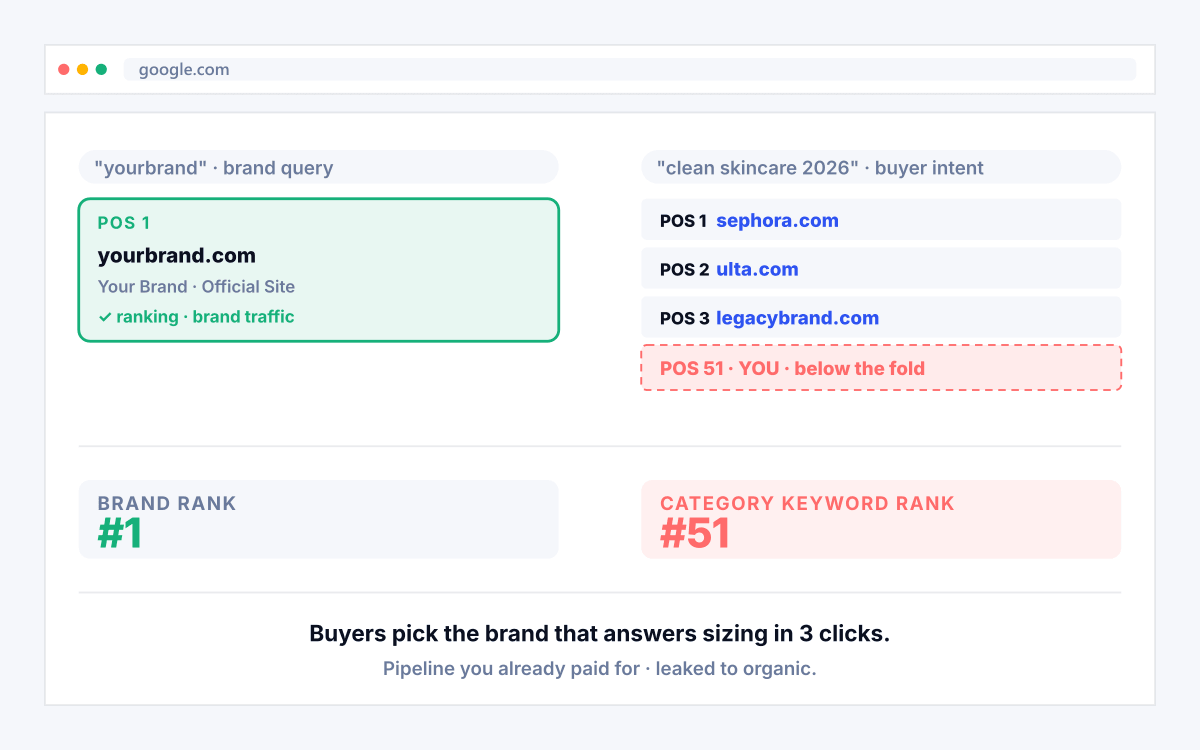
You rank for brand name only. Category queries and "best X 2026" buyer guides push traffic to competitors that ship 2-day and answer sizing in 3 clicks.
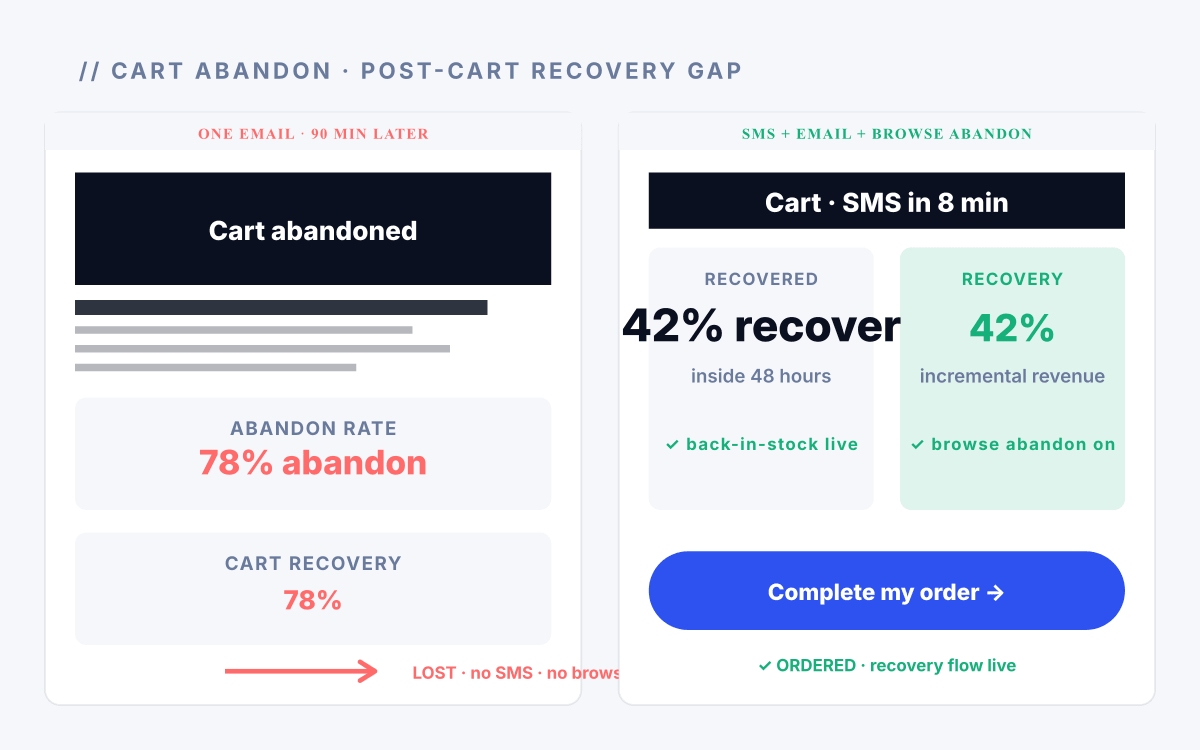
No SMS recovery, no browse-abandon, no back-in-stock. Shopify sends one generic email 90 minutes later. Meanwhile Klaviyo shows 42 percent recovery-flow potential unused.
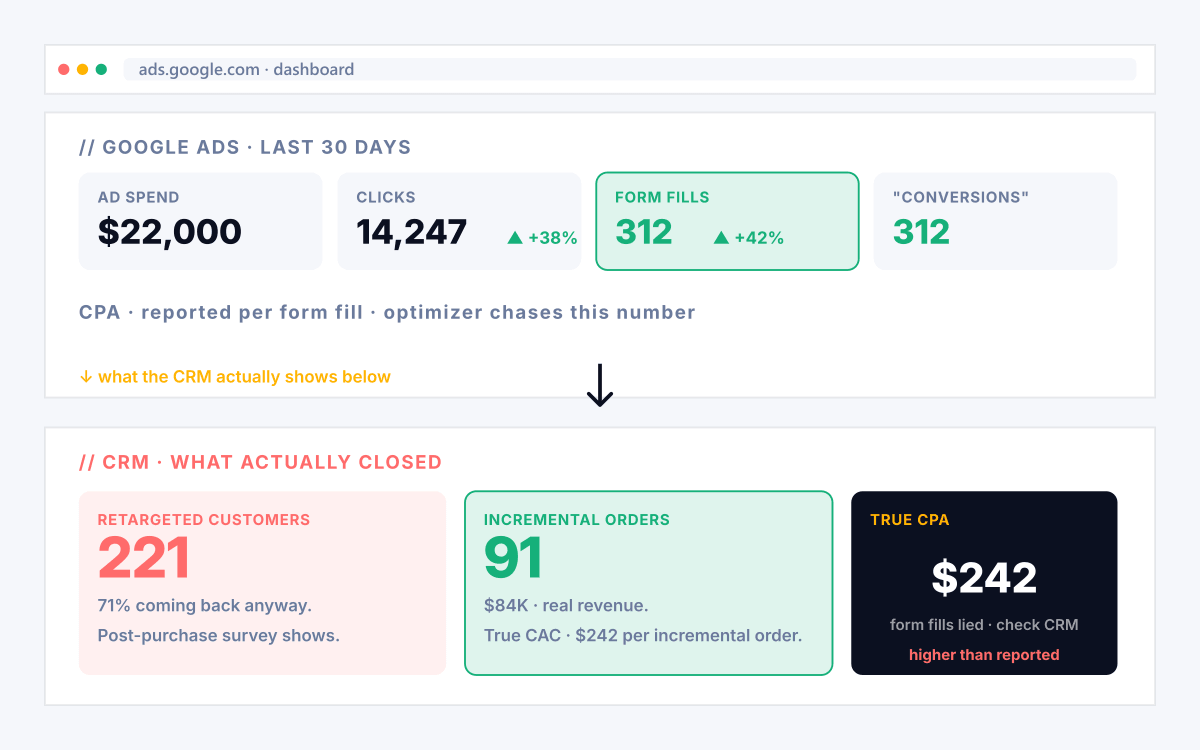
Meta reports 4.2x ROAS on retargeting. Post-purchase surveys show 71 percent of those buyers were coming back anyway. Ad spend goes up, incremental revenue does not.
Each pillar runs as a full program. Take one or bundle them under a single ecommerce strategist. All work reports to contribution margin and repeat rate.
Websites built to convert, engineered around your target buyer, hero products, and margin mix. Not a Dribbble entry, an order-taking machine. Owned by you at handoff.
Technical fixes, intent-mapped e-commerce content, and digital PR. Programs that pay back inside twelve months.
Explore e-commerce SEO →Google and Meta media buying by DTC operators. Every campaign tied to contribution margin and orders placed, never click-through rate.
Explore e-commerce PPC → Website MaintenanceLiteSpeed hosting, weekly security scans, monthly optimization, plus small content edits included. Zero worry about page-speed or broken plugins.
Explore maintenance plans → Marketing RetainerOne monthly retainer covers on-store SEO, Klaviyo, Meta and Google Shopping, TikTok Shop, and CRO under a single DTC strategist.
See tier pricing →Same rhythm on every brand. Audit before we spend a dollar. Position before we launch an asset. Build against the offer. Scale against orders placed and LTV, not blended ROAS.
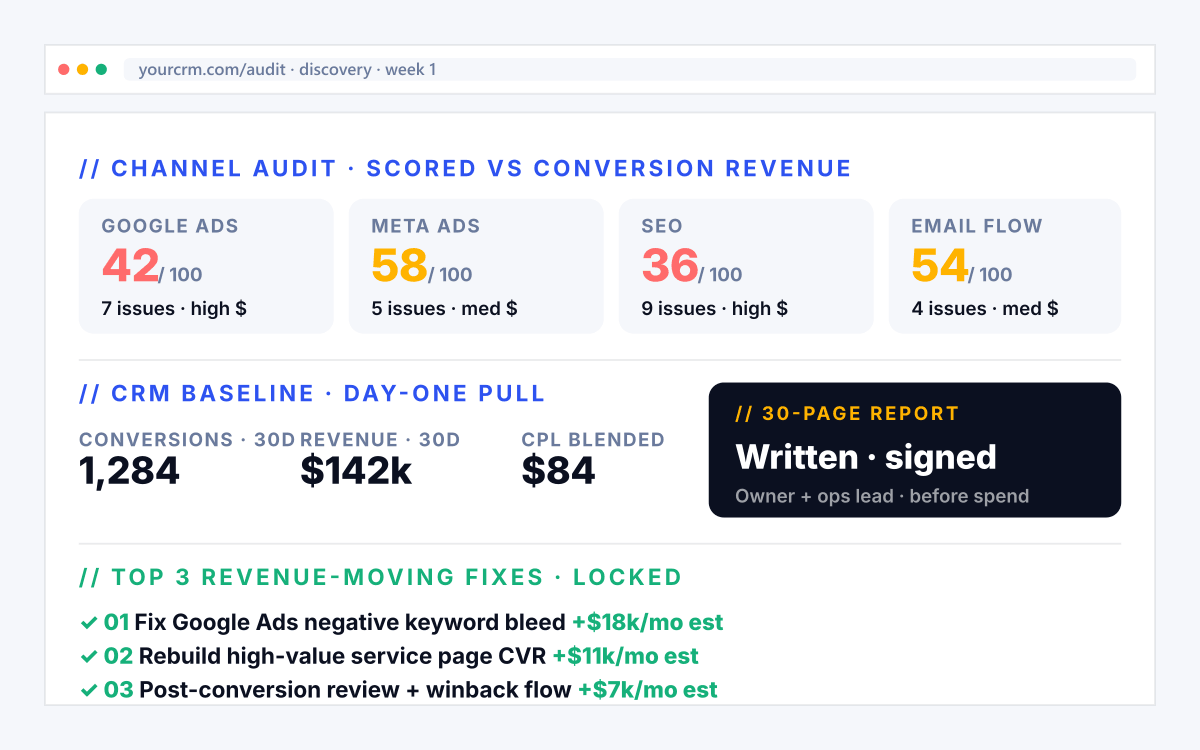
Site, Shopify, ad accounts, email flows, and post-purchase surveys. Channel-by-channel teardown against orders placed and LTV per cohort.
Nail the hero SKU mix, subscription posture, and target buyer. Every PDP, ad, and email built off one positioning brief.
Launch the storefront, PDPs, funnels, and Shopify-linked tracking. Weekly written notes, nothing stalled in draft.
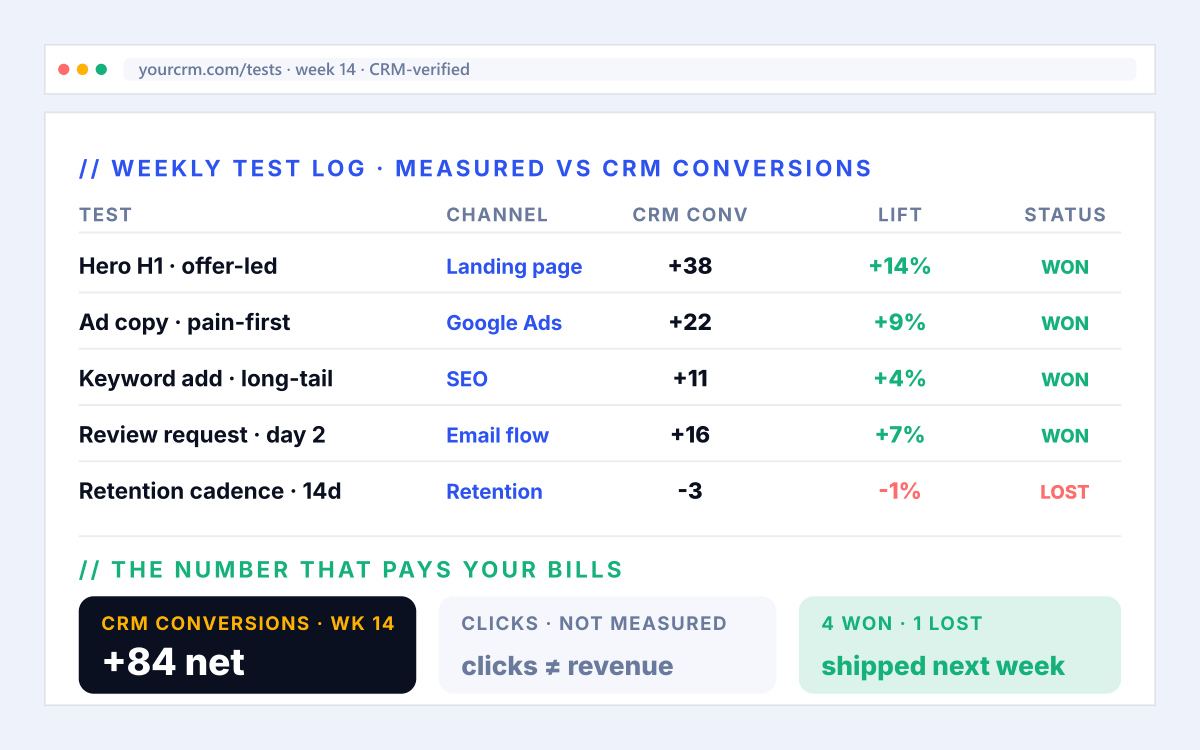
Compound paid, SEO, retention, and creator wins. Weekly review tied to orders placed and LTV per cohort, not clicks.
Every quote is verified by Clutch through a direct call with the client. Reviews shown span our verticals; full DTC references available on the strategy call.
Three engagements where we tied the work to store revenue and repeat orders. Numbers verified with the founder.
 E-commerce · SEO + PPC + Web
A Swedish brand offering sustainable, affordable furniture for businesses and individuals - buy, sell, or optimize spaces with quality pre-owned pieces.
 E-commerce · SEO + PPC + Web
Creator of the first reusable writing tablet in 2009 - pioneer of sustainable digital writing with liquid crystal technology.
Slide in your store numbers. Assumes a 20% relative conversion improvement, which is what our first audit typically finds on non-optimized DTC sites.
If your question is not here, book a 30-minute call. A DTC strategist answers on the call, not through a sales rep.
An ecommerce marketing agency runs the full acquisition and retention stack for a DTC brand under one roadmap. That means paid media on Google Shopping, Meta, and TikTok, plus SEO, storefront CRO, and lifecycle email or SMS. At Redefine Web the whole program ties to contribution margin, not clicks or last-click return on ad spend.
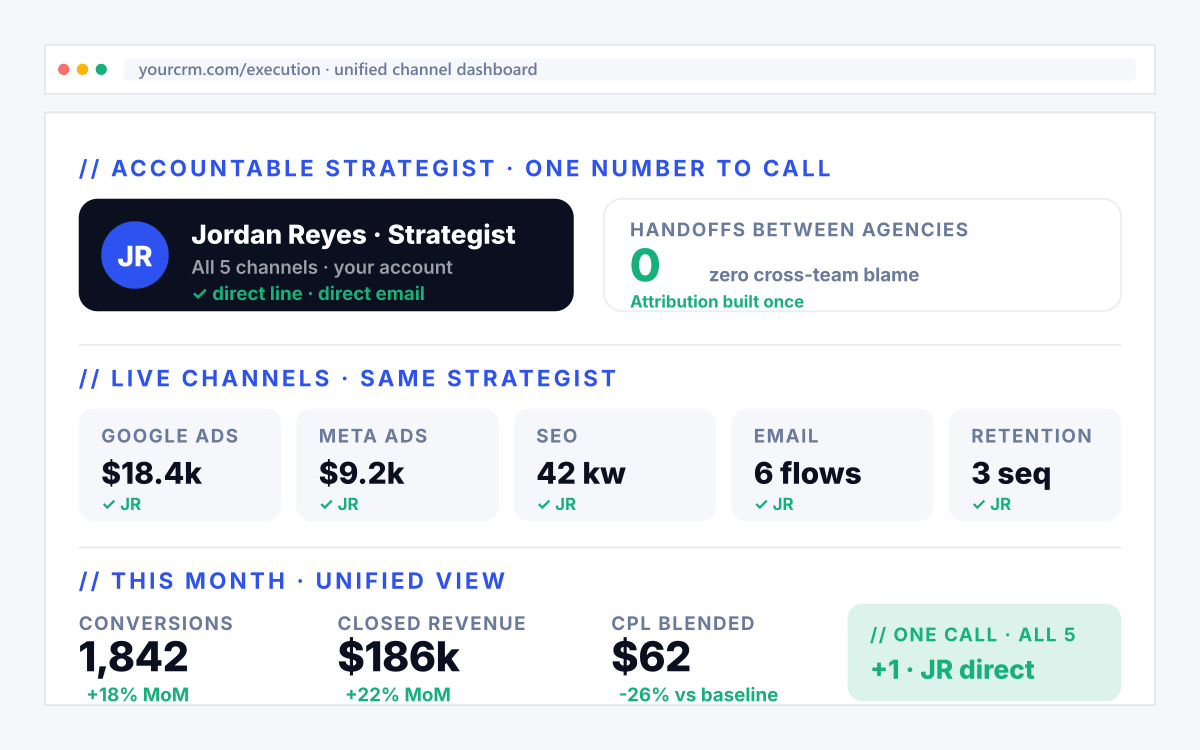
A typical week for a growth-stage brand covers four buckets. Media buying and bid work on Google and Meta, PDP and checkout CRO tests, ecommerce SEO on category and collection pages, and Klaviyo flow tuning. One lead operator owns the account. Nothing gets handed to a junior on your dime.
Ecommerce marketing services split into two lanes on the site. Retainer-based programs handle the ongoing acquisition and retention work at a flat monthly fee. Storefront builds are quoted as fixed-price projects. Both lanes report to the same contribution margin number so paid, organic, and lifecycle all pull in the same direction.
Managed retainers at this ecommerce marketing agency land between $999 and $6,500 per month depending on channel mix, ad spend under management, and whether SEO plus lifecycle are in scope. The $599/mo entry retainer covers one channel with a single lead operator. Full-stack DTC programs with paid, SEO, CRO, and lifecycle sit in the $3,500 to $6,500 band.
Three inputs move the number. Ad spend under management adds a scaled fee once monthly media crosses $30K. Channel count matters. Paid alone is cheaper than paid plus SEO plus lifecycle. Store platform complexity matters too. Shopify Plus with a subscription app stack or a headless Hydrogen build takes more operator time than a stock Shopify 2.0 theme.
Website builds are quoted separately as fixed-price projects starting at $1,500 and running to $85,000 for enterprise Shopify Plus or headless. Retainers do not include a rebuild. If you need both, we scope the build first and the retainer starts at launch.
Ecommerce PPC starts producing orders in 7 to 14 days once tracking, feed hygiene, and creative rotations are in place. SEO shows first ranking gains in 6 to 8 weeks with steady organic traffic gains by month 4. Storefront builds launch in 8 to 12 weeks and start converting from day one against the old benchmark.
Retention work moves on its own clock. Klaviyo welcome, abandoned cart, browse abandonment, and post-purchase flows show measurable repeat-purchase gains in 45 to 60 days after launch. Blended cost per customer usually improves by month 3 as lifecycle picks up revenue that paid used to carry alone.
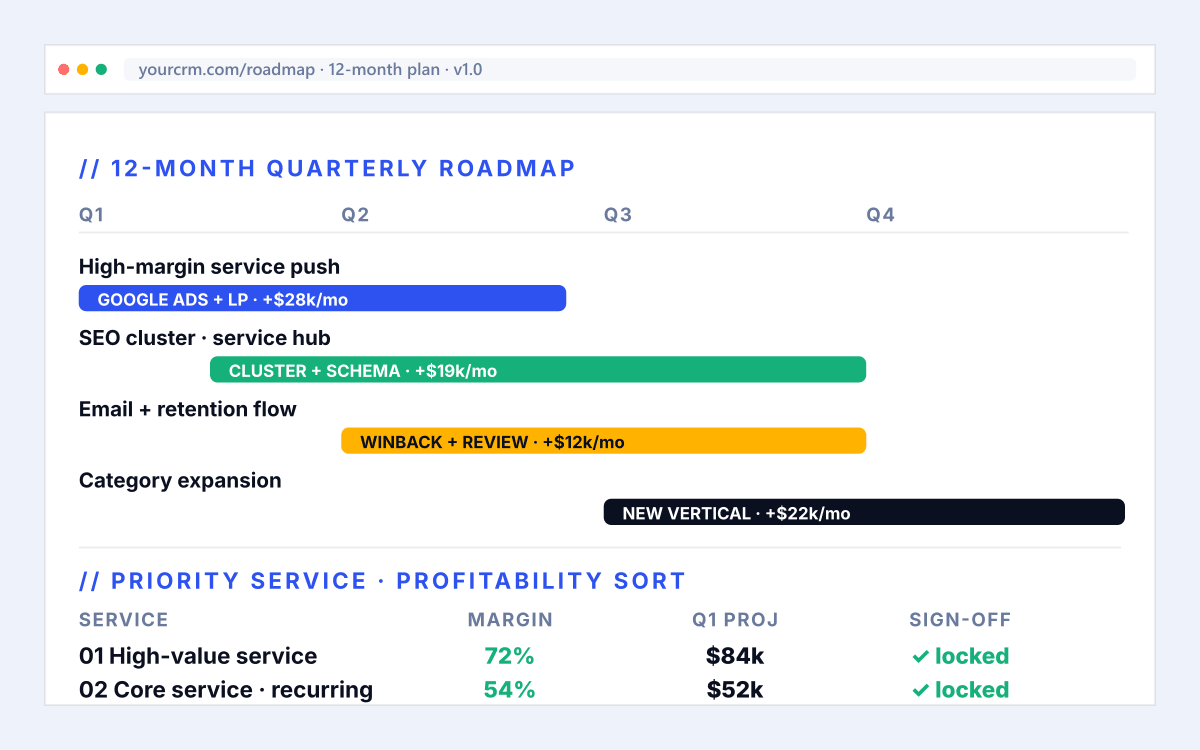
Every retainer opens with a written 30-60-90 plan tied to contribution margin, orders, and repeat-purchase rate. We report weekly and hold a monthly strategy call so no one is guessing what moved and why.
For brands under $10M in annual revenue we start with paid acquisition plus checkout CRO. Both move orders in the first quarter. Google Shopping and Meta usually carry the acquisition load. TikTok comes in when creative volume can support it. Lifecycle email and SMS layer on top so repeat revenue compounds.
Ecommerce SEO opens in month 1 but the payoff shows in month 4 and beyond. Category, collection, and PDP schema, technical fixes, and content on high-intent commercial queries compound into a defensible traffic source over 6 to 12 months. Most DTC brands under-invest here and stay dependent on paid.
The right mix is a function of margin, product category, and current channel maturity. A supplement brand with strong repeat behavior weights lifecycle and paid social. A furniture brand with long consideration cycles weights Google, SEO, and retargeting. We size the plan to the brand, not the template.
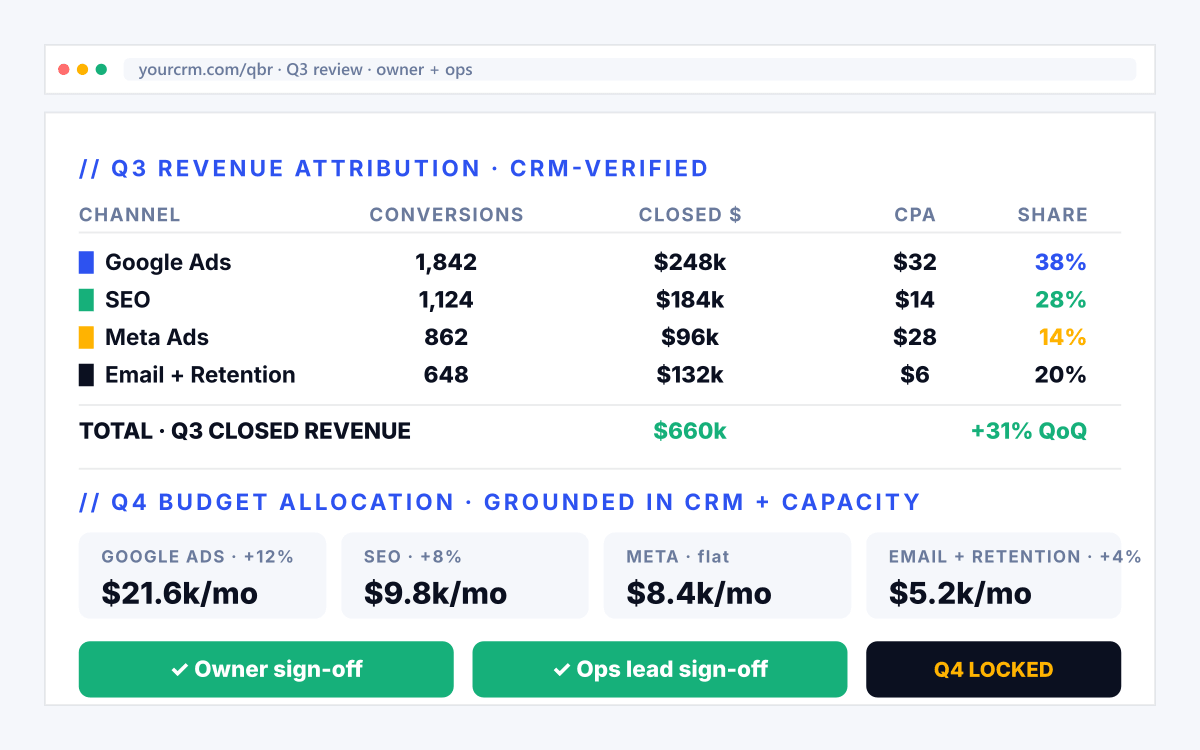
Contribution margin. Headline return on ad spend is a vanity number when shipping, returns, refunds, discounts, and blended CAC are excluded. Every reporting view for our online store marketing clients defaults to CM3, blended CAC, and repeat-purchase rate. Meta and Google get fed with margin-adjusted conversion values via CAPI and Enhanced Conversions so the algorithms bid to profit, not to revenue.
That single change usually moves acquisition efficiency 15 to 30 percent inside 60 days on accounts spending over $50K per month. The math is simple. Bidding to revenue drives orders that lose money after shipping and returns. Bidding to margin picks the orders that make money.
Yes. Shopify 2.0, Shopify Plus, Shopify Hydrogen, WooCommerce, BigCommerce, and Salesforce Commerce Cloud are all in scope for both storefront work and ongoing ecommerce marketing services. Headless builds on Next.js or Remix with Shopify or Sanity on the backend are handled by the engineering team.
Platform choice matters less than tracking, feed hygiene, and site speed. A well-run Shopify 2.0 theme with clean tracking usually outperforms a headless build with broken CAPI. We audit the stack in week 1 and flag anything that will block the acquisition or retention plan before we spend a dollar of your ad budget on it.
No. This ecommerce marketing agency serves U.S. based DTC brands only. Shipping economics, buyer search behavior, tax handling, and channel norms differ enough by country that we do not run acquisition programs for brands headquartered outside the U.S. right now.
U.S. brands selling internationally are fine. Multi-country Shopify Markets, cross-border shipping, and multi-currency checkout all fall inside scope as long as the brand is U.S. based and the primary market is the U.S.
One direct competitor per category slot. If we run acquisition for a clean skincare brand at a given price point, we will not take a second brand competing for the same buyer. This holds across paid, SEO, and lifecycle. Sharing operator knowledge across direct competitors is a conflict, not a service.
Adjacent brands are fine. A skincare brand and a supplement brand can both sit inside the roster. A skincare brand and a directly competing skincare brand cannot. Ask about your category on the intro call and we will tell you where the slot stands.
You do. Every Meta ad account, Google Ads account, Google Merchant Center, Shopify store, GA4 property, and tracking pixel is built in your name with your logins. If the engagement ends, you leave with everything intact, including the flow library and creative assets.
This is a hard rule for online store marketing at Redefine Web. Agencies that hold the accounts hold the client hostage. We do not. The engagement stands or falls on the numbers, not on account ownership.
Yes. Klaviyo, Postscript, Attentive, and Sendlane are all supported. Every retainer above the $599/mo entry tier includes welcome, abandoned cart, browse abandonment, post-purchase, replenishment, and win-back flows. Segmentation is built off first-party data plus platform events.
Lifecycle is the single fastest way to move repeat-purchase rate for a DTC brand under $10M in revenue. Most brands sit under 20 percent repeat rate. The flow library was set up once and never revisited. Rebuilding the flows and layering campaign calendar usually adds 10 to 25 percent to trailing 90-day revenue inside 60 days.
Managed retainers are monthly and billed on a 6-month initial term. That gives the DTC program at least one full ad and lifecycle cycle to prove out. Website builds are fixed-price projects with a 50 percent deposit and balance at launch. Four retainer tiers cover most brands. $599 entry, $1,500 growth, $3,500 scale, and $6,500 for full-stack programs above $100K monthly media spend.
After the initial term the retainer renews on a rolling monthly basis. Every tier includes one lead operator, weekly ops, and monthly strategy. Ad spend, subscription apps, and third-party tools are billed to the client directly and stay under client ownership.
Yes. Multi-brand holding companies and multi-storefront setups run under our Scale and Enterprise tiers. Shared attribution across brands, consolidated reporting for leadership, and per-brand operators are all supported. The Enterprise tier includes a dedicated pod for the account so hand-offs across brands stay clean.
Common setups look like a portfolio of 2 to 5 DTC brands under one holdco, or a single brand with U.S. and international storefronts. Both fit inside the ecommerce marketing agency model here. We scope the account structure, tracking, and reporting stack before we start work so the numbers stay comparable across brands.
An ecommerce strategist on the call. Three specific growth fixes you can apply with or without us. Written summary in your inbox the next business day.
Drop your email. A DTC strategist reviews your funnel and books the 30-minute audit within one business day.