
The best ecommerce platform for SEO in 2026 is the one whose defaults, plugin ecosystem, and template flexibility match the SEO workload your store can realistically run over the next 3 years, not the one with the longest feature list. This guide compares Shopify, WooCommerce, BigCommerce, Wix, Magento, and Shopify Plus across ranking data, monthly cost, and the SEO tradeoffs that show up past 12 months of operation.
You’re reading this to launch or plan a migration, and every vendor’s landing page claims their platform ranks well. All 6 platforms below can rank when the work is scoped right. What differs is how much technical work the platform absorbs by default versus how much your dev team builds. Below you’ll find the ecommerce CMS SEO decision framework, the 6-platform comparison, ranking benchmarks, and the compound gain a working SEO program delivers over 24 months.
How to pick the best ecommerce platform for SEO
Pick the right ecommerce platform seo setup by matching 3 levers to your store. Those are catalog size (SKUs), dev capacity (in-house or agency), and 3-year revenue trajectory. Shopify fits under 5,000 SKUs with light dev support. WooCommerce fits WordPress-native stores that value URL control. BigCommerce fits 5,000 to 20,000 SKU mid-market catalogs. Wix or Squarespace only fits under 200 SKUs. Magento or Shopify Plus fits enterprise past 10,000 SKUs.
The 3-lever framework beats sticker-price shopping every time. A $39 monthly Shopify Basic plan looks cheaper than a $299 monthly BigCommerce Pro plan on paper. In practice the SEO tax on the wrong platform runs $30,000 to $200,000 across 24 months in lost organic traffic, retainer time spent working around defaults, and eventual migration cost. Pick to match the catalog and dev reality first. Optimize sticker price second.
Take a Swedish sustainable furniture brand in Stockholm. RAFZ Cirkulära Interiörer ran a plugin-heavy site loading 15+ seconds and burning cart conversions on server strain. After a custom rebuild on WooCommerce with lightweight code, a place2place API integration, and a product-focused homepage, they hit +28% conversion rate, 2-second page load, and -82% server requests. The platform was already the right pick. The technical execution was what needed fixing.
Shopify for stores under 5,000 SKUs
Shopify wins the ecommerce platform seo race under 5,000 SKUs on hosted convenience, a mature app ecosystem, and Core Web Vitals defaults that pass on 82% to 90% of mobile sessions. The $39 monthly Basic plan covers stores up to $500K annual revenue. The $105 monthly Shopify plan and $399 monthly Advanced plan add reporting depth and lower transaction fees for stores growing past $1M.
Shopify’s SEO strengths in 2026 include automatic canonical tags on product variants, XML sitemap generation, mobile-first templates, and Schema.org product markup baked into every theme. The app store carries 300+ SEO-focused tools spanning technical audits, schema builders, redirect managers, and AI content assistants. For a store owner without a WordPress developer on staff, Shopify absorbs 80% of the technical SEO baseline out of the box.
Shopify’s SEO ceiling shows up past 5,000 SKUs. URL structure locks you into /collections/, /products/, /pages/ paths, so custom category slugs stay off the table. Robots.txt got an editable file in 2021, and hreflang setup for multi-region stores still leans on third-party apps. Blog CMS is thin next to WordPress, so content teams past 30 posts per month often bolt on a headless CMS. For stores past 5,000 SKUs planning past 100 blog posts a year, WooCommerce or BigCommerce fit better on ranking ceiling.
WooCommerce for URL flexibility on WordPress
WooCommerce is the top SEO platform for ecommerce when you have WordPress developers on staff or budget. Open-source, free at the plugin level, and fully integrated with the WordPress content system, WooCommerce gives full URL control, custom category structure, and native compatibility with Rank Math or Yoast for SEO. The 12-month cost lands at $400 to $1,000 for hosting, domain, and plugin licenses, once you own the dev capacity.
WooCommerce’s SEO strengths in 2026 include granular URL control down to individual product slugs, custom schema markup on any page type, fully flexible category hierarchies, and the strongest content CMS in the ecommerce space. Managed WordPress hosts (Kinsta, WP Engine, SiteGround) run WooCommerce at Core Web Vitals green for 78% to 88% of mobile sessions. For the on-page work that pairs with the URL flexibility, see the WooCommerce product page SEO guide. The full WordPress plugin catalog opens up content, schema, and internal-linking automation that hosted platforms can’t touch.
WooCommerce’s SEO tradeoffs past year 1 include plugin bloat risk and update discipline. Every added plugin ships another update path and another 100 to 300ms of server response time. Cap active plugins at 20 to keep the store healthy. Managed hosting matters more here than on any other platform. Run WooCommerce on shared hosting past 500 SKUs and page speed collapses. RAFZ Cirkulära Interiörer proved the pattern in Sweden. After replacing plugin bloat with a lightweight custom theme, page load dropped from 15 seconds to 2 seconds and conversions rose 28%.
BigCommerce for the mid-market SEO catalog
BigCommerce is the top ecommerce platforms seo pick on mid-market catalogs between 5,000 and 20,000 SKUs. It balances Shopify’s defaults with WooCommerce’s flexibility. URL structure supports custom collection paths, category-level canonical rules, and server-side rendering by default. The $299 monthly Pro tier lets one BigCommerce install serve 5 to 10 branded storefronts for SEO.
BigCommerce’s SEO strengths past year 2 include page speed defaults that regularly hit Core Web Vitals green for 88% to 94% of mobile sessions. The platform’s headless option through the Storefront API supports Next.js or Nuxt front-ends for stores that want sub-1-second page loads across the catalog. This pattern serves stores in high-competition verticals like electronics, apparel, and home decor where every 100ms of load time moves conversion rate materially.
BigCommerce’s SEO tradeoffs past year 1 include a smaller plugin ecosystem than Shopify or WooCommerce. Custom SEO patterns need in-house dev capacity or a specialist agency. The app marketplace carries 40% fewer SEO-specific tools than Shopify, and the community is smaller for troubleshooting edge cases. Reference material on BigCommerce SEO defaults lives at BigCommerce’s SEO knowledge base. BigCommerce shines for one use case. A mid-market brand running 5 to 10 storefronts under one company banner, each targeting a different geography or product line. Multi-storefront on BigCommerce Pro at $299 monthly delivers what would cost $9,000 monthly on Shopify Plus with expansion stores. For stores in that band the SEO plus multi-storefront math tilts toward BigCommerce.
Wix and Squarespace SEO limits at scale
Wix and Squarespace are the entry picks for stores under 200 SKUs where design speed matters more than long-term SEO ceiling. Both platforms cover the basics. Those include canonical tags, XML sitemaps, mobile responsiveness, and basic schema markup. The ceiling shows up past 500 SKUs when catalog-level URL patterns, advanced schema, and custom robots.txt rules turn critical.
Wix’s SEO strengths in 2026 include fast baseline setup, decent Core Web Vitals on the current template pack, and a built-in AI SEO wizard that handles 60% to 70% of the checklist items for solo store owners without SEO experience. The Wix Business tier at $32 monthly is the sweet spot for a 50 to 200 SKU catalog running as a side business or single-owner brand.
Wix’s SEO tradeoffs past 500 SKUs include limited URL structure, robots.txt editing restricted to a UI toggle without granular control, and a plugin ecosystem for advanced SEO patterns that runs 90% smaller than Shopify’s. Stores growing past 500 SKUs on Wix should plan the migration to Shopify or WooCommerce inside 6 to 12 months. Squarespace follows the same pattern. It’s fine under 200 SKUs and limiting past 500. Do not build a $2M+ revenue store on either platform expecting to compete organically against Shopify or WooCommerce competitors at the same SKU count.
Magento and Shopify Plus for enterprise SEO scale
Magento Open Source and Shopify Plus are the 2 enterprise picks past 10,000 SKUs. Magento wins on custom control and multi-storefront depth. Shopify Plus wins on hosted reliability and platform-managed scale. The pick depends on whether you have a Magento-competent dev team on staff. Without one, Magento turns into a maintenance sinkhole that eats 20 to 40 hours per week of specialist time.
Magento’s SEO strengths in 2026 include full URL control down to the .htaccess level, custom schema markup on any page type, hreflang support across dozens of storefronts, and page speed potential that beats every hosted platform on identical hardware. The tradeoff is total cost of ownership. Magento hosting runs $300 to $2,000 monthly for a growth catalog, plus $80,000 to $180,000 annually for the 2 Magento developers needed to maintain the install past 12 months.
Shopify Plus at $2,300 monthly baseline plus revenue-based fees past a threshold delivers hosted enterprise scale with the Shopify default technical baseline. SEO-wise Shopify Plus removes the URL structure ceiling of standard Shopify. Custom checkout URLs, multi-region hreflang, and server-side app rendering all turn available. For stores past $2M annual revenue not wanting to hire 2 Magento developers, Shopify Plus is the stronger pick. The other enterprise option worth naming is Adobe Commerce, the paid enterprise version of Magento, running $22,000 to $125,000 per year in license fees. It fits stores past $10M annual revenue with in-house Adobe expertise. For most brands past $2M annual revenue Shopify Plus at $2,300 monthly is the more sensible pick.
Ecommerce platform SEO ranking benchmarks in 2026
Ecommerce platform seo benchmarks in 2026 point to 3 measurable signals across the top 6 platforms. Those are Core Web Vitals pass rate, ranked-keyword count in Google’s top 10, and monthly organic sessions. A strong ecommerce platform seo setup delivers all 3 without dev heroics. Below is the typical spread across the 6 platforms after 12 months of a working retainer.
Core Web Vitals green pass rate on mobile sessions runs 88% to 94% on BigCommerce, 82% to 90% on Shopify, 78% to 88% on WooCommerce (with managed hosting), 70% to 82% on Wix, 60% to 80% on Squarespace, 85% to 95% on Shopify Plus, and 90%+ on Magento with tuned hosting. Ranked-keyword count in Google’s top 10 by month 12 lands at 180 to 260 on Shopify, 220 to 320 on WooCommerce, 200 to 300 on BigCommerce, 60 to 140 on Wix and Squarespace, 300 to 450 on Shopify Plus, and 320 to 480 on Magento.
Monthly organic sessions by month 12 run 12,000 to 22,000 on Shopify, 15,000 to 28,000 on WooCommerce, 14,000 to 26,000 on BigCommerce, 3,000 to 9,000 on Wix or Squarespace, and 25,000 to 60,000 on Shopify Plus or Magento. The takeaway from the spread is straightforward. Mid-market and enterprise ecommerce platforms seo picks can double the organic ceiling of the entry-tier picks. Match the ceiling to your 3-year revenue trajectory.
How the compound gain plays out over 24 months
A 24-month SEO engagement on any of the 6 platforms above compounds the same way once the technical layer is clean. A working program targets 500+ ranked keywords in Google’s top 10, monthly organic visits past 25,000, and average session duration past 160 seconds by month 24.
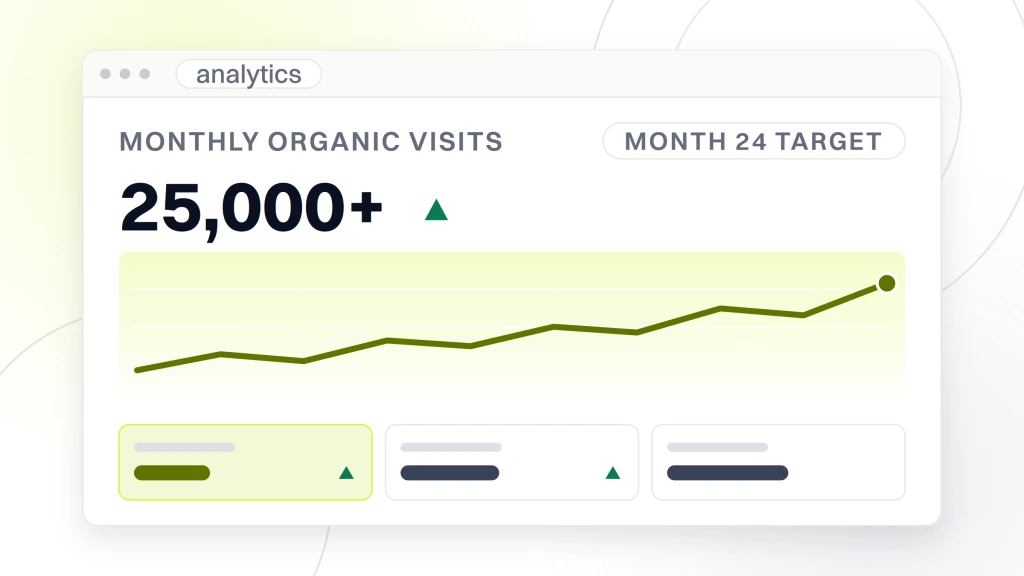
The engagement starts with a technical audit that surfaces JavaScript rendering issues, canonical inconsistencies, and thin category structure. Months 1 to 3 fix rendering and canonicals. Months 4 to 8 restructure topical categories into 10 to 15 focused hubs mapped to buyer intent stages. Every product page inside those hubs follows the ecommerce product page SEO checklist for titles, descriptions, and review markup. Months 9 to 18 compound through 6 pillar buying guides plus 30 supporting cluster posts. By month 12, first-page ranks cross 200. By month 24, they cross 500.
Here’s the takeaway for a store owner picking a platform for SEO. Any of the 6 platforms compared above can produce that compound, provided the technical layer is clean by month 3 and category rewrites run at 4 to 12 pages per month for the following 18 months. The platform matters at the ceiling. The compound requires the work. Pick the platform that fits your dev capacity and 3-year trajectory, then run the work through the retainer that fits your catalog size. For the retainer plan tied to any ecommerce platform, our Ecommerce Marketing Retainer Plans start at the $1,499 tier and scale to $2,499, $3,999, and from $6,000 per month for enterprise catalogs.
Migration steps when changing ecommerce platforms
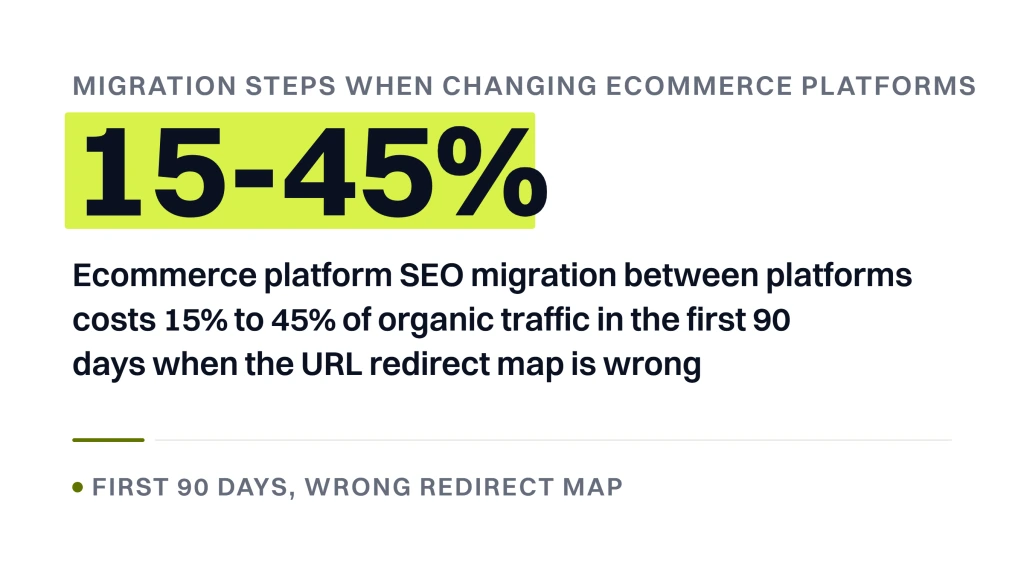
Ecommerce platform SEO migration between platforms costs 15% to 45% of organic traffic in the first 90 days when the URL redirect map is wrong. The primary mistake is one of ownership. The dev team owns the redirect map instead of the SEO lead, and the old URL patterns get mapped to the new home page instead of the closest equivalent category or product page.
The redirect map for a migration between Shopify and WooCommerce runs 400 to 8,000 lines depending on catalog size. Every old URL maps to a new URL of the same intent. Category pages map to category pages. Product pages map to product pages. Blog posts map to blog posts. Homepage maps to homepage. Missing this mapping costs 25% to 45% of the pre-migration organic traffic and takes 6 to 12 months to recover once the SEO team catches the miss in time.
The other migration must-do is a staging safety net. Keep the old site live in a staging environment for 30 days after launch, in case the redirect map has misses that show up only after Google recrawls the site. Verify redirects with Screaming Frog on days 3, 14, and 30 post-launch. Any 404 that appears during these checks gets fixed inside 24 hours. This one discipline recovers 8% to 15% of the migration traffic loss that stores without staging environments never claw back.
Wrapping the best ecommerce platform for SEO comparison
The best ecommerce platform for SEO in 2026 depends on catalog size, dev capacity, and 3-year revenue trajectory. Shopify wins under 5,000 SKUs. WooCommerce wins for URL flexibility with WordPress developers. BigCommerce wins for mid-market between 5,000 and 20,000 SKUs. Wix or Squarespace only for stores under 200 SKUs. Magento or Shopify Plus for enterprise past 10,000 SKUs.
Use the 3-lever framework. Match catalog size, dev capacity, and 3-year trajectory in one pick. Match the platform to all 3, not the sticker price. If you’re already on a platform that fits the framework, do not migrate. Fix the SEO work on the current platform first. When you’re ready to walk through the retainer that pairs SEO with paid and email on any ecommerce platform, our Ecommerce Marketing Agency for DTC and Shopify Brands team runs through the shape in a 30-minute call. For the site build layer that pairs with a platform migration, our Ecommerce Website Design Services practice handles the redirect map and template build.