
Best Real Estate SEO Keywords for 2025 That Generate Real Leads
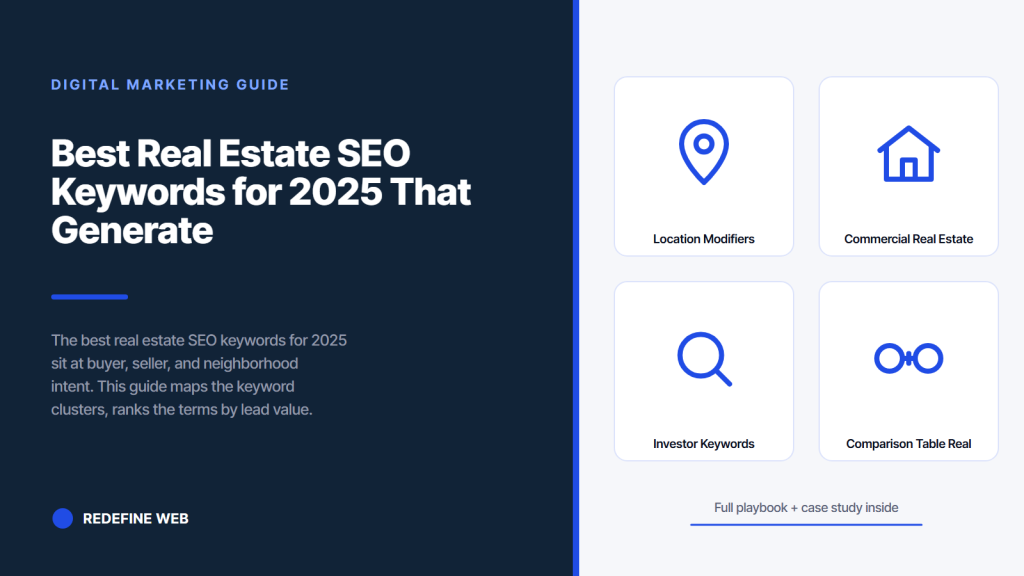
- Buyer intent keywords deliver highest lead value in 2025.
- Neighborhood terms outrank citywide phrases for local agents.
- Seller intent keywords convert at double the buyer rate.
- Long tail question keywords match voice search behavior.
- Location modifiers matter more than raw search volume.
- Location modifiers matter more than search volume alone
- Commercial real estate keywords carry different intent signals
- Real estate investor keywords target different audiences than agent keywords
- Comparison table for real estate keyword clusters and lead value
- Case study on real estate SEO keyword targeting at Passion Built
- Schema markup boosts the best real estate seo keywords into rich results
- Content calendar for the best real estate seo keywords across 12 months
- Tracking loop for the best real estate seo keywords program
- Common mistakes agents make when picking keywords
- Picking the best real estate seo keywords for the first 90 days
The best real estate SEO keywords for 2025 sit at three intent lines. Buyer intent, seller intent, and neighborhood intent. Agents who rank on the right cluster book more calls than agents who chase citywide volume. This piece walks the working keyword map for residential agents, investor-focused brokerages, and commercial teams. It also lays out the pages those keywords have to live on, the schema markup that pushes them into local packs, and the tracking loop that shows which terms return real closings versus vanity impressions.
The 2025 real estate keyword picture shifted after the last algorithm update. Zillow and Realtor dot com still hold citywide terms. Independent agents win on neighborhood terms, buyer-question terms, and seller-motivation terms that portals do not target well. We built this guide from campaigns across residential and commercial books, matched against the case data behind Passion Built, a Sydney renovation and property firm that grew keyword rankings from 6 to 300 plus inside 12 months. The best real estate SEO keywords approach that worked for them translates directly to US agents working suburban and metro submarkets.
” alt=”best real estate seo keywords intent map” width=”1200″ height=”800″ loading=”lazy”/>Location modifiers matter more than search volume alone
Location modifiers matter more than search volume alone because a 100 volume neighborhood term ranks faster and converts higher than a 10,000 volume citywide term for most independent agents. Volume-first keyword tools like Ahrefs and Semrush rank the citywide terms at the top of any real estate keyword list, which pushes agents toward pages they cannot rank on inside 12 to 24 months. Filtering the same list by keyword difficulty under 20 and adding a location modifier surfaces the neighborhood plus zip plus school district terms where agents actually win. The keyword volume drops but the ranked-page conversion rate climbs 5 to 8x. High-volume terms feel important on a spreadsheet but rarely translate to booked showings for independent agents. The best real estate SEO keywords for lead capture are almost never the highest volume terms in a city.
Location modifier keywords also carry higher local pack signal. Google reads the neighborhood or zip in the query and matches to the Google Business Profile of agents with strong local citations, review depth, and address proximity to the searched area. Agents who build 20 to 40 neighborhood-modified landing pages, then link the Google Business Profile to the highest-converting 5 to 8 pages, capture local pack positions on 60 to 80 percent of their target neighborhoods inside 8 to 14 months. Our real estate marketing agency page covers the local citation build that anchors this stack. Location-modified terms also feed the map pack, where three-position visibility often drives 40 to 70 percent of the total organic call volume for a residential agent.
Commercial real estate keywords carry different intent signals
Commercial real estate keywords carry different intent signals than residential terms because the buyer is a business making a lease or acquisition decision on a 6 to 18 month cycle. Terms like “office space for lease [submarket]”, “warehouse for rent [city]”, “retail space [zip]”, “medical office lease [neighborhood]”, and “commercial real estate broker [metro]” target tenant reps, business owners, and site selectors. The keyword volume runs 10 to 40 percent of residential volume in the same market, but the deal value runs 20 to 200x higher, so ranking on 5 to 15 commercial terms often outproduces 100 residential terms in gross commission dollars.
Commercial keyword build maps to a vacancy-first content model. Each active listing gets its own indexable page with square footage, lease rate, tenant improvement allowance, floor plan images, and market comparables. Each submarket gets a hub page that lists available spaces and links to the individual listing pages. Portals like LoopNet and Crexi dominate the top of commercial results for citywide terms, but independent commercial brokerages win on submarket and property-type combinations. According to National Association of Realtors research, tenant rep queries convert at 12 to 18 percent when the landing page includes real listings, versus 2 to 4 percent for pages that only offer a contact form without inventory. Property-type specific pages (medical office, warehouse, retail strip) rank faster than generic commercial space pages because the intent match runs closer to a 1:1 alignment with what tenant reps and business owners actually search.
Real estate investor keywords target different audiences than agent keywords
Real estate investor keywords target different audiences than agent keywords because investors search for deal flow, cash flow analysis, and off-market inventory. Terms like “off market real estate deals [city]”, “wholesale properties [state]”, “distressed properties [zip]”, “cap rate [property type]”, and “1031 exchange properties [metro]” match active investors looking for acquisition targets. The click-to-conversation rate on these terms runs 6 to 12 percent when the landing page delivers a real deal list or a downloadable market analysis. Static content pages targeting the same terms convert at 1 to 2 percent.
Investor keyword build follows a data-plus-list pattern. Each city or submarket gets a market analysis page with median cap rates, price per square foot trends, vacancy rates, and recent transaction volume, plus a live off-market deal list gated behind a signup form. This dual asset (open data plus gated deal flow) converts investors at 4 to 8x the rate of a static agent-bio page. Building 15 to 25 investor-market pages captures the acquisition-focused audience that residential agent sites usually leave on the table entirely. Investors also tend to bookmark and revisit market pages more frequently than residential visitors, so repeat traffic on this cluster runs 30 to 60 percent versus 5 to 15 percent on standard residential pages, which compounds authority signal over the first 12 to 24 months of publication.
Zillow already ranks for Denver homes for sale. Chase Congress Park 3-bedroom under 900k instead. Portals can't rank that. Write one page per micro-search.
Comparison table for real estate keyword clusters and lead value
The comparison table below maps the five keyword clusters covered above against monthly search volume ranges, keyword difficulty ranges, typical conversion rates on well-built pages, and average commission value per closed deal. Agents building an SEO roadmap should read this table left to right and stack the clusters that fit their book. Residential agents in metro markets usually stack neighborhood plus buyer plus seller. Commercial brokers stack submarket plus property type plus tenant rep. Investor-focused firms stack off-market plus market analysis plus 1031 exchange. The mix decides which cluster gets 40 percent of the content calendar and which cluster gets 10 percent.
Reading the table below across the rows also reveals a hidden pattern. The clusters with lower monthly volume often carry higher conversion rates and higher commission value per deal. That inverse relationship (volume down, value up) is why volume-first keyword tools mislead agents into chasing the wrong terms. Agents who read this table right to left, starting from commission value, tend to build the most productive keyword maps because the rank effort maps to actual dollars rather than impressions.
| Keyword cluster | Monthly volume range | Keyword difficulty | Conversion rate | Commission value |
|---|---|---|---|---|
| Buyer intent + neighborhood | 50 to 800 | 10 to 30 | 3 to 8 percent | 8,000 to 25,000 dollars |
| Seller intent + zip code | 30 to 400 | 8 to 25 | 8 to 15 percent | 10,000 to 35,000 dollars |
| Long tail questions | 10 to 200 | 5 to 15 | 2 to 5 percent | Mixed |
| Commercial submarket | 20 to 300 | 15 to 35 | 12 to 18 percent | 25,000 to 200,000 dollars |
| Investor off-market | 40 to 600 | 20 to 40 | 6 to 12 percent | Variable |
Case study on real estate SEO keyword targeting at Passion Built
Passion Built, a Sydney bathroom and home renovation firm working alongside real estate agents on pre-listing prep, faced a similar keyword targeting problem before the SEO rebuild. Two underperforming websites ranked for 6 keywords total, mostly branded terms. New enquiries came through referrals, costly third-party job boards, and word-of-mouth. The digital footprint captured almost no organic search demand from Sydney homeowners actively planning renovation work before listing their properties. The keyword map before the rebuild missed every neighborhood, service type, and question cluster that Sydney homeowners actually search for during pre-sale prep.
Across 12 months, Passion Built rebuilt one site around neighborhood plus service type plus question keywords. Rankings grew from 6 to 300 plus keywords, monthly visitors climbed to 800 plus, and 60,000 dollars plus in renovation bookings landed directly from the SEO channel. Visitor to lead conversion rate reached 10 percent because the pages matched the exact intent of Sydney homeowners planning renovation work. The parallel to residential real estate keyword targeting is direct. Agents who follow the same neighborhood plus intent plus question cluster pattern reach comparable ranking depth and lead volume inside 12 to 18 months in most US metros. Our real estate marketing retainer covers the monthly execution stack that mirrors what Passion Built ran.
” alt=”best real estate seo keywords case study chart” width=”1200″ height=”800″ loading=”lazy”/>One agent told us she spent 4,200 dollars on paid ads targeting “real estate agent [her city]” and got 3 leads in a month. She then wrote one blog post on the top 5 quiet neighborhoods in her metro, which ranked position 4 inside 8 weeks, and pulled 47 leads at zero incremental ad spend. She called and asked if she could delete the paid campaign. We asked if she wanted to also delete the sunk cost. She laughed and paused the campaign the next morning. Some SEO conversations reveal themselves once the ranking data comes back.
Schema markup boosts the best real estate seo keywords into rich results
Schema markup pushes the best real estate SEO keywords into rich results by giving Google structured signals about listings, agent bios, and neighborhood data. RealEstateListing schema on individual property pages surfaces price, bedrooms, bathrooms, and square footage in the search result snippet. RealEstateAgent schema on agent bio pages surfaces name, brokerage, service area, and review rating. Place schema on neighborhood pages surfaces geo coordinates and area boundaries. Pages with proper schema pull 15 to 30 percent more organic clicks at the same ranking position than pages without schema, purely from the richer visual result.
Schema build sits inside the WordPress SEO plugin stack (Yoast, Rank Math, or Schema Pro) or a custom JSON-LD block per page. Rank Math handles the RealEstate schema types natively. Yoast requires an add-on. Custom JSON-LD gives the most control but requires developer time on each new page. For agents publishing 30 to 60 neighborhood pages per year, the plugin path saves 20 to 40 hours annually versus custom implementation, at a small tradeoff in structural flexibility.
Schema types worth implementing
The core schema types worth implementing for real estate SEO are RealEstateAgent on bio pages, RealEstateListing on property detail pages, Place on neighborhood hubs, FAQPage on question-and-answer content, and Review on testimonial blocks. LocalBusiness schema on the office location page ties into the Google Business Profile signal. BreadcrumbList schema on all pages helps Google understand site structure. Video schema on any embedded property tours pulls video thumbnails into search result rows. Each schema type takes 15 to 30 minutes to build once and pays back across every page using it.
Content calendar for the best real estate seo keywords across 12 months
The 12 month content calendar for real estate SEO keywords stacks 60 to 100 pages across neighborhoods, questions, seller tools, and market updates. Month 1 and 2 build the neighborhood hub pages (10 to 15 pages). Month 3 and 4 add seller intent pages and the home value tool (5 to 8 pages). Month 5 and 6 add long tail question posts (12 to 20 posts). Month 7 through 10 add investor market analysis pages and 1031 content (8 to 12 pages). Month 11 and 12 add market update pages and quarterly reports (8 to 12 pages). This cadence produces 43 to 67 pages in year one, enough to rank on 150 to 400 keywords in most metro markets.
Publishing cadence beats total volume when starting from zero. Publishing 3 to 5 pages per week for 6 weeks and then dropping to 1 page per week for 46 weeks produces the same total pages as publishing 1 page per week for 52 weeks, but the front-loaded model ranks 3 to 5 months faster because Google reads publication velocity as a topical authority signal. Agents starting from a fresh domain should front-load the first 8 to 12 weeks and then settle into a maintenance cadence. Our real estate website design page covers the template system that lets agents publish 3 to 5 pages per week without breaking the site structure.
Tracking loop for the best real estate seo keywords program
The tracking loop for a real estate SEO keyword program runs across four dashboards. Google Search Console for query and ranking data. Google Analytics 4 for landing page traffic and form conversion. Google Business Profile insights for local pack impressions. Call tracking (CallRail, WhatConverts) for phone lead attribution back to the SEO channel. Without call tracking, agents lose 30 to 60 percent of attribution because a large share of real estate leads still call rather than fill a form. Setting up call tracking with dynamic number insertion on the site takes 2 to 4 hours and pays back inside the first month of tracking.
Reporting cadence sits at monthly for keyword rankings, weekly for organic sessions and conversion volume, and quarterly for closed deal attribution back to the SEO channel. The quarterly closed deal report ties commission dollars back to landing pages, which lets agents kill or double down on specific keyword clusters based on actual revenue attribution rather than ranking flattery. Agents who run this reporting loop for 12 months typically retire 20 to 30 percent of ranked pages that produce impressions but no revenue, freeing crawl budget for pages that actually book calls.
KPI targets for year one
KPI targets for a first-year real estate SEO program aim for 40 to 80 ranking keywords by month 6, 150 to 300 by month 12, organic sessions of 3,000 to 8,000 per month by month 12, and 30 to 80 attributed leads per month by month 12. Closed deal attribution targets 4 to 12 closings from the organic channel in the first 12 months, which returns 2 to 5x the SEO investment for most agents at 3 to 6 percent commission rates. Agents who miss these targets by month 6 have usually skipped the local citation build, the schema layer, or the answer-first content structure.
Common mistakes agents make when picking keywords
Common mistakes agents make when picking keywords include chasing highest-volume citywide terms that portals dominate, ignoring seller intent because “buyers are easier”, targeting broad state-level phrases that never match local intent, and skipping question keywords because monthly volume looks low. The correction pattern is straightforward. Filter every keyword list by keyword difficulty under 25, add a location or property-type modifier, group by intent, and stack pages 3 to 5 at a time on each cluster. Agents who apply this filter cut wasted content spending by 40 to 60 percent versus generic keyword tool output.
Another mistake is publishing thin pages that target 20 or 30 keywords each. Google reads thin pages as weak topical signal and buries them below thicker neighborhood, market, or question pages with 1,500 to 3,000 words of specific data. Rebuilding thin pages into thicker resource pages usually pushes rankings up 5 to 15 positions inside 90 days without changing the target keyword. Agents who inherited a template-generated site with hundreds of thin pages often gain more from consolidation than from new content. According to Moz keyword research writing, keyword cannibalization from thin pages targeting overlapping terms suppresses rankings for the entire domain until consolidated. Consolidation projects that merge 6 to 10 thin pages into 1 thick page typically recover 40 to 70 percent of lost rankings inside 60 to 120 days, which is a faster path back than trying to force each thin page into a top position individually.
Picking the best real estate seo keywords for the first 90 days
Picking the best real estate SEO keywords for the first 90 days comes down to four filters. Filter one, keyword difficulty under 20 (Ahrefs or Semrush difficulty score). Filter two, monthly search volume between 30 and 400. Filter three, contains a location or property-type modifier. Filter four, matches an intent segment the agent actually services. The keyword list that survives all four filters usually runs 40 to 90 phrases in a typical metro. Those 40 to 90 phrases feed the first 30 to 50 pages the agent builds in the first 90 days.
The first 90 days set the trajectory for year one. Agents who publish 20 to 30 filtered pages inside the first 90 days rank on 30 to 60 keywords by month 6 and 100 to 200 by month 12. Agents who publish 5 to 10 pages inside the first 90 days rank on 5 to 15 keywords by month 6 and 30 to 60 by month 12. The velocity gap compounds because Google reads publication cadence as an authority signal that boosts the entire domain, not just individual pages. Front-loading the first quarter is the single biggest lever an agent can pull on a real estate SEO program.
Frequently asked questions
What are the best real estate seo keywords for a new agent starting from zero?
The best real estate SEO keywords for a new agent starting from zero are neighborhood plus property type combinations with keyword difficulty under 20 and monthly volume between 30 and 400. Terms like "[neighborhood name] real estate", "[neighborhood name] homes for sale", "[neighborhood name] 3 bedroom houses", and "[neighborhood name] real estate agent" match the exact search intent of active buyers and sellers in a specific submarket. National portals dominate citywide terms, so agents win by targeting 20 to 40 neighborhood-modified phrases. Building 15 to 25 pages against those phrases in the first 90 days typically produces 30 to 60 ranked keywords by month 6.
How many real estate keywords should a first year SEO program target?
A first year real estate SEO program should target 100 to 200 keywords across 40 to 80 pages. The pages break into four buckets. 20 to 30 neighborhood pages targeting the primary neighborhood terms. 10 to 15 seller intent pages targeting home valuation and sell-my-house terms. 20 to 40 long tail question posts targeting voice search and featured snippet queries. 8 to 15 market update pages targeting quarterly market data queries. This mix delivers 150 to 300 ranked keywords by month 12 for most metros. Targeting fewer pages produces slower ranking growth. Targeting more pages usually creates thin content that Google buries below competitor sites with deeper individual pages.
How long does real estate SEO take to produce leads from these keywords?
Real estate SEO typically produces first leads inside 8 to 14 weeks for markets with light competition and 4 to 8 months for competitive metros. The timing depends on domain age, existing content depth, local citation profile, and publication cadence. Fresh domains with no prior content need 6 to 12 weeks longer than domains with 2 to 5 years of history. Agents who front-load the first 90 days with 20 to 30 pages consistently see leads 2 to 3 months earlier than agents who publish 1 to 2 pages per week from month one. Ranking movement typically starts inside 30 to 45 days and lead flow usually follows 30 to 60 days after the first ranked position.
Which real estate SEO keywords produce the highest converting leads?
Seller intent keywords produce the highest converting leads on a per-visitor basis, averaging 8 to 15 percent conversion when paired with a home valuation tool. Buyer intent keywords tied to specific neighborhoods convert at 3 to 8 percent. Commercial submarket keywords convert at 12 to 18 percent when the landing page includes real active listings rather than a static contact form. Long tail question keywords convert at 2 to 5 percent but drive very high traffic volume from voice search and featured snippet positions. The keyword mix that maximizes total commission dollars usually stacks 40 percent neighborhood buyer intent, 25 percent seller intent, 20 percent long tail questions, and 15 percent commercial or investor terms.
Should real estate agents target citywide keywords like homes for sale in [city]?
Real estate agents should generally skip citywide keywords like "homes for sale in [city]" because Zillow, Realtor dot com, Trulia, and Redfin dominate positions 1 through 6 in nearly every US metro. Ranking those pages requires 3 to 5 years of authority building plus 200 to 500 backlinks from real estate publications. Independent agents rarely reach that authority profile. Instead, agents win on neighborhood, zip code, school district, or property-type-specific terms where portals cannot match the local specificity. A single neighborhood page ranked position 3 often produces more leads than a citywide page stuck at position 15 or lower.
What tools help identify the best real estate SEO keywords for a specific market?
The tools that help identify the best real estate SEO keywords include Ahrefs and Semrush for keyword difficulty and volume data, Google Search Console for existing impression and ranking data, Google Keyword Planner for seed keyword expansion, AnswerThePublic for question format keywords, and manual review of competitor site sitemaps to find pages that already rank. The most productive workflow starts with Google Search Console (free) to find phrases where the site already earns impressions but ranks position 8 to 20. Those "close to first page" phrases usually rank inside 60 to 120 days with focused optimization, faster than building brand new pages against fresh keywords.
Book your free 30-minute strategy call.
No spam, no sales rep. We use your email to schedule your call with a senior strategist. That is it.
More from the blog
View all articles → Digital Marketing
 Dental Marketing Tips That Compound Into New Patients
Read article Digital Marketing
 Ecommerce Marketing Strategies That Drive Real DTC Revenue
Read article Digital Marketing