
Beverage Manufacturing Web Design That Converts B2B Buyers
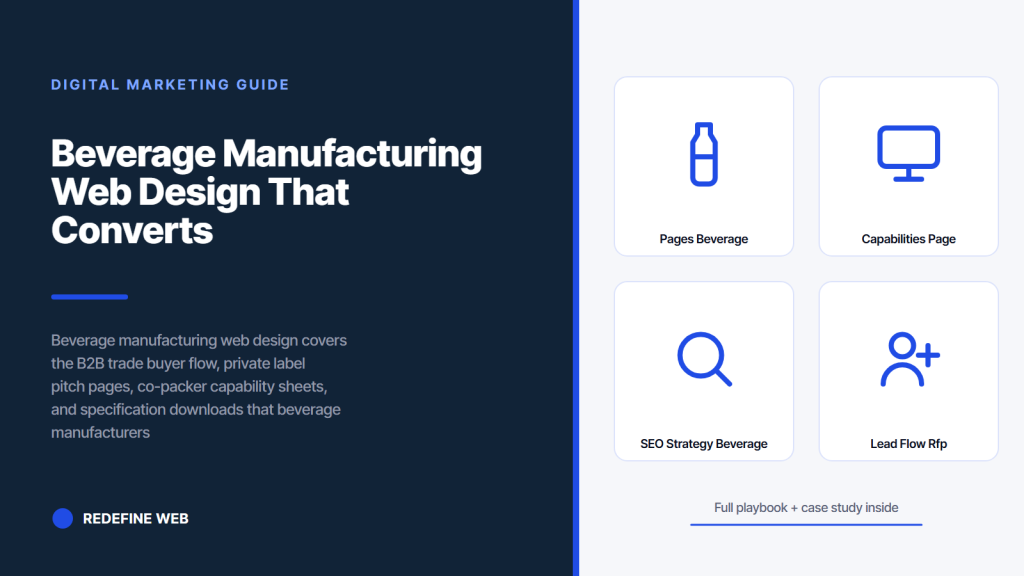
- Seven page types the trade buyer scans on every visit.
- Capability, capacity, and certification lead the homepage hero.
- Spec library gates the PDF without breaking SEO on the landing page.
- RFP form has five fields and hits sales inside 24 hours.
- WordPress fits 50 to 200 SKU manufacturers on the stack.
- Pages beverage manufacturing web design must include
- How beverage manufacturing web design serves the trade buyer
- Capabilities page structure and content depth
- Specification library and gated content strategy
- Sansa Interiors maps to a beverage manufacturing site build
- Comparison of beverage manufacturing web design stack options
- SEO strategy for beverage manufacturing web design
- Lead flow from RFP form to signed pilot batch
- Technical stack requirements for beverage manufacturing web design
- Trust signals that close beverage trade buyers
Beverage manufacturing web design is the site build a co-packer, a private-label bottler, a contract manufacturer, or a beverage industrial supplier ships to close the B2B trade buyer that walks in from a Google search on RFP intent. The category is not the DTC bottle site the founder scrolls past on Instagram every Sunday night. The buyer here is a beverage brand founder shopping for a co-packer, a private-label buyer at a retail chain, or an ingredient supplier working through a bid list, and every one of them needs a site that speaks capability, capacity, certification, and specification before the pitch call is ever booked on the calendar.
This guide walks the pages beverage manufacturing web design has to include, the content stack every trade buyer expects, the technical requirements the plant certifications call for, and the lead flow that closes the RFP into a signed pilot batch. It also names how Redefine Web scopes the build when a beverage manufacturer walks in with 50 SKUs live, three plant locations, and no site that catches the trade RFP flow.
Pages beverage manufacturing web design must include
Beverage manufacturing web design must include seven distinct page types the trade buyer expects to find inside two clicks of the homepage. A capabilities page listing production formats, batch sizes, and packaging options. A capacity page listing plant locations, line count, and monthly bottle output. A certifications page listing FDA, SQF, BRC, and organic certifications with certificate PDFs downloadable. A private-label pitch page with the process from first call to first pallet. A specification library with datasheets by SKU. A case study or existing client page with named brand references. And a real quote request form the trade buyer can fill in five minutes.
Each page has to carry the technical detail a beverage industry buyer scans for on the first read. The capabilities page should list every format, from 8 ounce cans to 32 ounce bottles, from single-serve pouches to bulk bag-in-box. The capacity page should list plant square footage, current line utilization, and available slot windows by quarter. The certifications page should include certificate expiration dates and audit history. Any page that hides the technical detail behind a contact form loses the buyer to the next co-packer on the list who published the detail on the site directly.
Redefine Web scopes the seven page types plus a blog on formulation, packaging, and industry news on the same build. The site has to run on a WordPress or headless stack that supports gated specification downloads without breaking the SEO on the underlying pages. Read the food and beverage web design page for the full DTC-plus-manufacturer web scope Redefine Web runs on the vertical.
How beverage manufacturing web design serves the trade buyer
Beverage manufacturing web design serves the trade buyer by leading with capability, capacity, and certification on the homepage above the fold. The buyer arrives from a Google search on a specific format or certification query and needs to confirm the manufacturer fits the RFP within the first ten seconds on the site.
The homepage hero should carry three data points inside a single scan. The format list carrying the top three production formats the plant runs. The certification badge row showing FDA, SQF or BRC, and any organic or kosher certifications. And the minimum order quantity band showing the smallest and largest run the plant accepts. The three data points let the trade buyer self-qualify on the site within seconds. Any buyer who does not fit the band bounces without wasting a sales cycle. Any buyer who does fit continues to the capabilities page with the qualification already made in their head.
The secondary navigation carries the seven page types with a fixed order that matches the trade buyer’s mental model. Capabilities, capacity, certifications, private label, specifications, case studies, contact. Any navigation that buries certifications three clicks deep or hides the case studies inside a resources dropdown fails the trade buyer’s scanning pattern on the first visit. Read the Beverage Daily coverage for the current trade-buyer signals every serious beverage manufacturing web design should account for on the homepage.
Capabilities page structure and content depth
Capabilities page structure on a beverage manufacturing site runs a modular block layout with one row per production format. Each row carries the format name, an image, the fill sizes available, the closure options, the labeling options, and the minimum order quantity for that format. A trade buyer scrolling the page finds the right format in seconds and moves to the specification download without the sales team involved on the first pass.
Content depth on the capabilities page separates a real beverage manufacturing web design from a brochure site. Every format needs the technical spec sheet linked from the row. Every format needs a real photo of the finished packaging, not a stock render from the closure supplier’s website. Every format needs the current lead time in weeks from PO to first pallet on the shipping dock. The lead time is the single most important number the trade buyer scans for after the certification badges on the homepage.
Certification callouts sit on every format row where the certification applies. A row showing an organic format needs the USDA Organic badge on that row. A row showing a kosher format needs the OU or Kof-K badge on that row. The badges do double duty as trust signals and as SEO anchors for the buyer searching on a specific certification-plus-format query on Google. Any capabilities page that shows a single certification row at the top and no per-format badges loses the specific-search-intent buyer to a competitor that mapped the badges to the formats correctly.
Trade buyers download SQF and BRC certs on the first visit. Put them one click from the homepage. A DTC-styled beverage site loses RFPs to a plain one with cert links.
Specification library and gated content strategy
Specification library on beverage manufacturing web design is the gated content section that converts an anonymous visitor into a named trade buyer with an email address and a company name on file. The library carries datasheets by SKU, technical spec sheets by production format, and a certifications packet by plant location that the buyer can download after a five field form fill.
The gating has to work without breaking the SEO on the specification pages. The right pattern indexes the specification landing pages on Google with a summary of the spec, gates the full PDF behind the form, and returns the PDF plus a follow-up email inside 30 seconds. Any gate that blocks the entire spec page from indexing loses the organic search traffic on the specification query, which is the highest-intent traffic source a beverage manufacturer will ever get on the site across the year.
The form fields should stop at five. Name, company, email, phone, and current volume band. Any form asking for more than five fields on the first fill drops the completion rate by 20 to 40 percent on the funnel. The follow-up email captures the additional context the sales team needs through a soft ask on the second touch after the buyer has already received the spec. Read the Food Manufacturing coverage for the trade-side context every serious beverage manufacturing web design should track on the operations calendar quarterly.
Sansa Interiors maps to a beverage manufacturing site build
Sansa Interiors Inc. is a Toronto interior design firm that specializes in modern residential spaces and hospitality venues including cafes and restaurants across the city. The engagement transfers to a beverage manufacturing site build because the shape of the digital work carried the same lead-generation-through-authority approach a B2B trade site needs on the same calendar.
Sansa Interiors Inc. hit 641 percent organic traffic growth, moved from 18 annual inquiries to 133, and landed top-3 Google rankings plus press features in DesignMilk, Casa Vogue, Elle, and Chic Haus inside a 12-month program. Every play in the engagement transfers to a beverage manufacturing web design. Real technical SEO on the certification and format queries. A conversion-focused site that turns the trade buyer visit into a spec download and a named lead. Digital PR that lands press coverage in beverage industry trades. A CRM that captures every inquiry and pushes it to a sales team on the same day.
The transfer point for a beverage manufacturer is the strategy-plus-execution split. Sansa Interiors Inc. did not just get a new site. Sansa hired a partner that built the KPI framework, redesigned the site, ran the paid channels, and secured the press features on the same 12-month arc. A beverage manufacturer that hires three separate shops for site design, SEO, and PR pays for three separate strategy loads and gets three separate reports. One partner running the four workstreams closes the RFP flow and gets the reporting into a single view every week on the sales side.
Comparison of beverage manufacturing web design stack options
The table below compares the common web design stack options a beverage manufacturer chooses on the site rebuild. The fit column names the manufacturer size the stack actually works for. The gap column names the workstream the stack typically drops in the first year. Use the table as a filter on the CMS decision before the design work starts to avoid a rebuild in year two.
| Stack | Best fit manufacturer size | Typical scope | Common gap | Initial build cost |
|---|---|---|---|---|
| WordPress + custom theme | 10 to 200 SKU manufacturer | Full seven-page structure | Enterprise CRM tie | 25K to 75K |
| Headless WordPress + Next.js | 200-plus SKU or multi-plant | Full structure plus API | Editor complexity | 60K to 150K |
| Shopify Plus for B2B | Manufacturer plus DTC brand | DTC catalog plus B2B portal | Deep spec content | 40K to 120K |
| Webflow with CMS collections | Under 50 SKU boutique | Marketing site only | Enterprise CMS gaps | 15K to 50K |
| Enterprise CMS like Adobe or Sitecore | 500-plus SKU global manufacturer | Multi-region, multi-language | Agility, cost, speed | 250K plus |
Two mistakes beverage manufacturers make on the stack decision. First, choosing Webflow at 300 SKUs because the initial cost looks low. The CMS runs out of steam past 100 pages with dynamic filtering, and the founder pays for a rebuild in 18 months on the enterprise stack instead. Second, choosing an enterprise CMS at 50 SKUs because the sales team wanted a familiar brand name on the stack. The build cost eats the marketing budget for two years and the site never ships because the enterprise CMS needs a dedicated engineering team the manufacturer does not have on staff.
The right stack for most 50 to 200 SKU beverage manufacturers is WordPress with a custom theme built specifically for the beverage manufacturing web design pattern. The stack ships fast, supports the seven page types, handles gated PDF downloads without SEO issues, and integrates with a Salesforce or HubSpot CRM through native connectors. See the food and beverage marketing retainer page for the ongoing scope Redefine Web runs on beverage manufacturer accounts every month.
SEO strategy for beverage manufacturing web design
SEO strategy for beverage manufacturing web design targets three query buckets the trade buyer runs on Google every week. Format-plus-service queries like functional beverage co-packer, sparkling water bottler, or cold-brew coffee contract manufacturer. Certification-plus-format queries like USDA organic beverage co-packer or SQF certified beverage manufacturer. And private-label queries like beverage private label bottler or turnkey beverage manufacturing partner.
Every bucket needs a landing page tuned to the query intent on the site structure. The format-plus-service pages sit inside the capabilities structure with dedicated URLs like slash capabilities slash functional-beverage-copacking. The certification-plus-format pages sit inside a certifications-plus-formats subtree that combines both filters on one landing page. The private-label pages sit inside a private-label subtree with a step-by-step process page, a case study set, and a specification library specifically for private label runs.
Backlink strategy on beverage manufacturing web design runs through the beverage industry trade press, the ingredient supplier partners, and the co-packer directories the buyer scans on Google. Beverage Industry, Beverage Daily, Food Manufacturing, and BevNet all take contributed content from co-packers with real technical depth. Ingredient suppliers link to co-packers they work with on their partner pages. Co-packer directories carry a listing for every certified plant in the region. All three sources compound into a domain authority strong enough to rank on the format-plus-service queries within 12 to 18 months on the plan. See the food and beverage SEO page for the organic scope Redefine Web runs on manufacturer accounts.
Lead flow from RFP form to signed pilot batch
Lead flow from RFP form to signed pilot batch on a beverage manufacturing web design runs through a four-step funnel every partner needs to model on the marketing plan. RFP form fill on the site captures the buyer. Sales qualification call inside 24 hours qualifies the fit against the manufacturer’s capabilities. Site tour or virtual walkthrough shows the plant. And a pilot batch quote closes the deal with a signed PO on the first run of 5,000 to 25,000 units depending on the format.
The RFP form has to capture the critical fields inside a five field structure. Company name, contact name, target format, target volume band, target launch date. Any form asking for more than five fields on the first fill drops the completion rate. The follow-up qualification call captures the technical detail on the ingredients, the packaging preferences, and the certification requirements the buyer needs on the pilot run.
Sales qualification cadence needs to hit the buyer inside 24 hours of the form fill. Any lead sitting more than 48 hours in the CRM without a sales touch closes at 30 to 50 percent lower rates than a lead touched inside 24 hours on the funnel. A real beverage manufacturing web design ships with a Zapier or native CRM integration that pushes every RFP form fill into a Slack channel plus a CRM record inside 30 seconds. The sales team gets a mobile ping and a full context view of the buyer inside a single tap. The number of beverage manufacturers with a real form on the site and a sales team that checks it once a week is roughly two thirds of every audit I have sat through.
Technical stack requirements for beverage manufacturing web design
Technical stack requirements for beverage manufacturing web design cover four core needs the build has to satisfy. Content management flexibility for the specification library and blog. Gated download support that does not break SEO on the underlying pages. CRM integration for lead routing and pipeline reporting. And a page speed floor at under 2.5 seconds on 4G mobile for the Core Web Vitals score that Google uses as a ranking factor.
The CMS choice affects every subsequent decision on the stack. WordPress with a custom Advanced Custom Fields structure handles the seven page types and the specification library out of the box. Headless setups pair a WordPress backend with a Next.js frontend for higher performance and more control but require a full engineering team to maintain. Enterprise CMS platforms carry more governance features and less agility across the year. The right choice depends on the manufacturer’s team size and the annual content velocity across the site.
Hosting sits on managed WordPress hosts like Kinsta or WP Engine for the WordPress stack. Object storage on S3 or R2 for the specification PDFs. CDN on Cloudflare for global delivery of the PDFs and images. Every asset served through a CDN cuts the page load time by 200 to 800 milliseconds on the international buyer visit. Read the food and beverage hosting and maintenance page for the ongoing infrastructure scope Redefine Web runs on beverage manufacturer accounts.
Trust signals that close beverage trade buyers
Trust signals close beverage trade buyers on the site build across three specific placements the manufacturer has to include on the design. Certification badges on the homepage hero, on every capabilities row, and in the footer sitewide. Named client logos on the case study page and in a smaller strip on the homepage below the hero. And plant photos with real people running the line, not stock photography from an industrial supply catalog.
Certification badges have to link to the current certificate PDF hosted on the site. Any badge that links nowhere or opens a broken PDF loses trust the moment the buyer clicks. The certificate PDFs need to show the current expiration date, the audit body, and the certificate number. Buyers on RFP procurement scans check the expiration and the audit body against the retailer’s approved audit list. A certificate that expired six months ago and never got refreshed on the site is a signal the plant is not audit-ready on the same calendar.
Named client logos need permission to use. Any brand shown on the case study page without a signed logo release is a legal risk the manufacturer carries silently. The design should include a small logo release process the sales team runs at contract signing so every new client goes on the wall by month three of the engagement. Read the Beverage Industry magazine coverage for the current trade calendar and the audit body updates every beverage manufacturer should track quarterly for the RFP conversations that follow.
Beverage manufacturing web design is a seven-page structure serving the B2B trade buyer with capability, capacity, certification, and specification depth on every page. Sansa Interiors Inc. hit 641 percent organic traffic on the same shape of strategy plus execution. A beverage manufacturer that runs the seven page types, the specification library, the CRM-tied lead flow, and the SEO strategy on the three query buckets closes the RFP funnel inside 12 months on the trade side of the account.

Frequently asked questions
What pages does beverage manufacturing web design need to include?
Beverage manufacturing web design must include seven page types the trade buyer expects. A capabilities page listing production formats, batch sizes, and packaging options. A capacity page listing plant locations, line count, and monthly output. A certifications page listing FDA, SQF, BRC, and organic certifications with certificate PDFs. A private-label pitch page with the process from first call to first pallet. A specification library with datasheets by SKU. A case study page with named brand references. And a real RFP form the trade buyer can fill inside five minutes on the site.
How does beverage manufacturing web design serve the trade buyer?
Beverage manufacturing web design serves the trade buyer by leading with capability, capacity, and certification on the homepage above the fold. The buyer arrives from a Google search on a specific format or certification query and needs to confirm the manufacturer fits the RFP inside ten seconds. The homepage hero carries three data points inside a single scan including the top three production formats, the certification badges, and the minimum order quantity band. The three data points let the trade buyer self-qualify on the site.
How should a beverage manufacturer gate specification downloads?
Gate the full PDF behind a five field form on the specification library while keeping the specification landing page fully indexed on Google with a summary of the spec. The pattern preserves the highest-intent organic search traffic on the specification query while capturing the buyer's name, company, email, phone, and current volume band. Any gate that blocks the entire page from indexing loses the organic search traffic. Any form asking for more than five fields on the first fill drops completion by 20 to 40 percent on the funnel.
Which CMS fits a mid-sized beverage manufacturer best?
WordPress with a custom Advanced Custom Fields structure and a purpose-built theme fits most 50 to 200 SKU beverage manufacturers on the stack. The stack ships fast, supports the seven page types, handles gated PDF downloads without SEO issues, and integrates with a Salesforce or HubSpot CRM through native connectors. Initial build cost runs 25,000 to 75,000 dollars depending on the specification library size. Headless setups on Next.js fit larger 200-plus SKU manufacturers at 60,000 to 150,000 dollars but require a dedicated engineering team.
How does SEO work on a beverage manufacturer site?
SEO strategy targets three query buckets. Format-plus-service queries like functional beverage co-packer or sparkling water bottler. Certification-plus-format queries like USDA organic beverage co-packer or SQF certified beverage manufacturer. And private-label queries like beverage private label bottler or turnkey beverage manufacturing partner. Every bucket needs a landing page tuned to the query intent on the site structure. Backlink strategy runs through beverage industry trade press, ingredient supplier partners, and co-packer directories the buyer scans on Google every week.
How fast should sales respond to an RFP form fill?
Sales should respond to an RFP form fill inside 24 hours on the funnel. Any lead sitting more than 48 hours in the CRM without a sales touch closes at 30 to 50 percent lower rates than a lead touched inside 24 hours. A real beverage manufacturing web design ships with a Zapier or native CRM integration that pushes every RFP form fill into a Slack channel plus a CRM record inside 30 seconds. The sales team gets a mobile ping and a full context view of the buyer inside a single tap.
Book your free 30-minute strategy call.
No spam, no sales rep. We use your email to schedule your call with a senior strategist. That is it.
More from the blog
View all articles → Digital Marketing
 Dental Marketing Tips That Compound Into New Patients
Read article Digital Marketing
 Ecommerce Marketing Strategies That Drive Real DTC Revenue
Read article Digital Marketing