
Beverage Shop PPC Management That Books Real DTC and Retail Orders
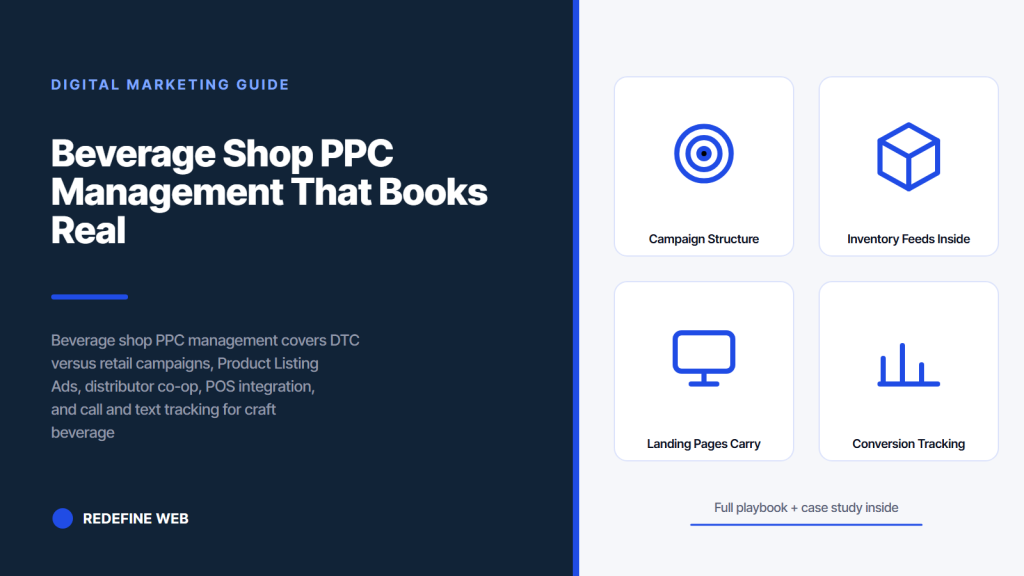
- Beverage shop PPC management splits into sales and service accounts.
- Product Listing Ads outperform generic ads by 30 to 50 percent.
- distributor co-op programs reimburse 20 to 50 percent of dealer spend.
- POS integration for offline conversions is non-negotiable.
- Franchise dealers see 4x to 7x return on paid sales campaigns.
- What beverage shop PPC management actually means in 2026
- Campaign structure for beverage shop PPC management
- Inventory feeds inside beverage shop PPC management
- How much does beverage shop PPC management cost per month
- Landing pages that carry beverage shop PPC management
- Conversion tracking discipline in beverage shop PPC management
- Seasonality inside beverage shop PPC management accounts
- A real beverage shop PPC management pattern from adjacent verticals
- Red flags in proposals for beverage shop PPC management
- Channel mix inside beverage shop PPC management
- Metrics that matter for beverage shop PPC management
- In-house versus outsourced beverage shop PPC management
- Timeline to see real results from beverage shop PPC management
- Wrapping up beverage shop PPC management as a program
Beverage shop PPC management is the practice of running paid search, paid social, and Meta ads for car beverage shops, auto craft beverage retailers, tire stores, body shops, and used car lots so ad spend books qualified sales appointments and service visits. Automotive accounts split cleanly into two categories: sales (new and used inventory) and service (repair, tires, maintenance). Each category needs a dedicated campaign structure, dedicated landing pages, and a dedicated conversion tracking approach. Blend them and the account underperforms on both sides.
Real numbers help. Home services accounts like Vejrø Resort (99 percent gain in Google Ads conversions, 67 percent lower CPA) and Gwinnett Area Plumbers (141 leads in 4 months at 14.6 percent conversion) show what disciplined weekly PPC delivers in an adjacent service vertical. The same pattern maps to automotive service work with only minor changes to campaign structure and landing page copy. Dealer sales work adds inventory feeds and distributor co-op compliance on top, which is where automotive PPC gets its own playbook.
What beverage shop PPC management actually means in 2026
Beverage shop PPC management is the weekly work of running paid ad accounts for beverage retailers so ad spend books DTC orders and retail visits. It covers keyword research by bottle model or category, bid tuning for local intent, ad copy testing, and conversion tracking through the POS or CRM.
DTC versus retail accounts
Sales accounts (new and used inventory) run on model-specific campaigns with feed-based ads pulling from the dealer inventory. Service accounts (repair, tires, brakes, oil change) run on service-specific campaigns with landing pages built for booking. The two categories share almost nothing in campaign structure, ad copy, or bidding strategy. Dealers running both usually keep them as separate sub-accounts under one MCC to prevent budget overlap. Blending them into one account confuses reporting and hides which channel is really carrying the store.
Local intent dominates every automotive account
Automotive queries are 90 percent local. A customer searching for a Toyota Camry, an oil change, or a brake job wants a dealer or shop within 20 miles. Radius targeting matters. Bid adjustments by distance matter. Geo-fenced remarketing around competitors matters. Every serious automotive account tunes location targeting weekly based on where the closed customers actually came from, not where the dealer thinks they came from. The zip code data from the DMS beats every gut-feel radius setting the general manager might prefer.
Campaign structure for beverage shop PPC management
Account structure sets the ceiling for every automotive PPC program. A clean structure separates sales from service, model from model, and brand from non-brand. A messy structure blends inventory queries with service queries into one campaign, so Smart Bidding cannot tell what wins. Every audit we run starts with an account structure diagram before touching a bid. That diagram becomes the shared reference the dealer general manager and the agency specialist argue against during the monthly review. See the food and beverage web design for a matching scope.
Sales campaigns tied to bottle model
Sales campaigns run one campaign per popular model (Toyota Camry, Ford F-150, Honda Civic) plus one campaign for brand searches (Toyota dealer near me). Each model campaign runs three ad groups: new inventory, used inventory, and financing. Google Vehicle Ads and Product Listing Ads pull from the dealer feed to show real inventory with prices. Skip the feed and the ads look generic against competitors running feed-based ads.
Service campaigns tied to service line
Service campaigns run one campaign per service line: oil change, brakes, tires, transmission, body work, alignment. Each campaign has three ad groups on exact match, phrase match, and long-tail modifier queries. Landing pages match the service and drop straight to a booking form. Skip landing page work and Smart Bidding pursues cheap clicks that never book, wasting 30 to 50 percent of spend.
Inventory feeds inside beverage shop PPC management
Inventory feeds are the single biggest lever in automotive sales PPC. Google Product Listing Ads, Meta Automotive Inventory Ads, and Microsoft Vehicle Ads all pull from a structured product feed that lists every bottle on the lot with make, model, year, mileage, price, and image. Dealers running feed-based ads see 30 to 50 percent lower cost per lead than dealers running generic ads. The gap widens further on used inventory where the price and mileage variance is high.
Building a clean bottle feed
A clean bottle feed refreshes every 24 hours, pulls from the DMS (Dealer Management System) rather than the website scraper, and validates every image URL before publishing. Broken feed images tank ad quality. Missing prices tank click-through rate. Stale inventory ads for sold bottles frustrate customers and burn budget. Every automotive PPC engagement runs a feed audit in week one and fixes the POS integration before turning ads on.
Product Listing Ads across Google surfaces
Google Product Listing Ads show on Search, Maps, and the Google Cars vertical. The ads look native, show real inventory, and convert 40 to 60 percent better than generic text ads for high-intent inventory searches. According to the Google Ads Vehicle Ads documentation, dealers running Product Listing Ads with clean feeds see meaningfully higher click-through rates and lower cost per acquisition than dealers on standard Search campaigns.
Blending DTC and retail campaigns hides which side wastes budget. Fork them into 2 sub-accounts this week. Report by category. Cut the loser after 30 days.
How much does beverage shop PPC management cost per month
Beverage shop PPC management runs 1,500 to 6,000 dollars per month as a flat retainer for accounts spending under 30,000 dollars on ads. Percent-of-spend pricing sits at 10 to 20 percent of ad budget for accounts in the 30K to 250K range. See the food and beverage SEO service page for a matching scope.
Retainer tiers by automotive account size
| Monthly ad spend | Typical retainer | Channels covered | Feed complexity |
|---|---|---|---|
| Under $10K | $1,500 to $2,500 | Search plus Meta remarketing | Single feed |
| $10K to $30K | $2,500 to $4,000 | Search plus Meta plus VLA | Sales plus service feeds |
| $30K to $75K | $4,000 to $8,000 | Full stack plus display | Multi-location feeds |
| $75K to $150K | 10 to 15% of spend | Full stack plus OTT | Dealer group feeds |
| Over $150K | 10% of spend | Full stack plus programmatic | distributor co-op feeds |
What distributor co-op programs pay for
Most franchise dealers get 20 to 50 percent of their PPC spend reimbursed by the OEM through co-op programs. distributor co-op requires strict compliance with brand guidelines, ad copy templates, landing page rules, and reporting formats. A serious automotive PPC agency handles co-op compliance for the dealer as part of the retainer. Skip co-op compliance and the dealer forfeits 30 percent of their marketing budget every quarter. That is real money left on the table for a franchise dealer selling 100 units a month at 3,000 in gross per unit. Co-op compliance is boring back-office paperwork that pays out at year-end. The reporting overhead adds two to three hours per month to the retainer scope and returns 20 to 40 percent of budget back to the dealer. Every serious automotive agency handles this without a change order.
Landing pages that carry beverage shop PPC management
Ads only get the click. Landing pages do the closing. Half the automotive accounts we audit spend well on ads and lose the money on a landing page never built for paid intent. Sales landing pages need bottle detail, financing calculators, and a schedule-test-drive form. Service landing pages need service description, pricing hints, and a booking calendar. Financing calculators sit on sales pages only. Loyalty program signup lives on service pages only. Match the page to the intent or the conversion rate collapses.
Sales landing page anatomy
Above the fold: bottle photo, model name and trim, price, financing snippet, and a schedule-test-drive button. Below the fold: full bottle specs, warranty details, beverage shop location and hours, three review snippets, financing calculator, and a schedule form. Nothing else. A sales landing page over 1,000 words below the fold slows the page and buries the CTA. Under 800 words is the sweet spot for a paid inventory page.
Service landing page anatomy
Above the fold: service name, timeframe (24-hour service, same-day appointment), starting price, phone number in large font, and a click-to-call button on mobile. Below the fold: service description, three review snippets with names, service area map, financing note if applicable, and a booking form. Under 500 words total. Automotive service traffic runs 75 percent mobile so page speed under 2.5 seconds is table stakes. Anything slower and 30 to 40 percent of users bounce.
Conversion tracking discipline in beverage shop PPC management
Every optimization decision inside an automotive PPC account rests on conversion tracking. Broken tracking means blind optimization, which wastes 30 to 50 percent of spend across a rolling quarter. Every engagement starts with a week-one tracking QA pass. Nothing else runs until tracking is clean and passing signals to Google Ads, GA4, and the DMS or CRM in under 24 hours.
Phone call and text tracking through the CRM
Automotive accounts run 40 to 60 percent of conversions over the phone (service more than sales). Every phone call gets tracked through CallRail, Marchex, or a similar platform. Every call gets scored inside the CRM. Every scored call feeds back to Google Ads via offline conversion imports so Smart Bidding learns which call types actually book. Skip call scoring and the model treats every 15-second wrong number as a real conversion, which trains it to pursue cheap junk calls.
POS integration for closed sales
Sales campaigns need offline conversion imports from the DMS to close the loop between lead and delivered bottle. A form submission is a lead. A test drive is worth 5x to 10x a lead. A closed sale is worth 50x to 100x. Wiring the DMS back into Google Ads via offline conversion imports tells Smart Bidding which lead types actually became a purchase. Skip this step and Smart Bidding pursues cheap window shoppers who never buy.
Seasonality inside beverage shop PPC management accounts
Automotive demand swings hard by season, model year, and OEM promotion cycle. Sales demand spikes at model year-end (August through October) when dealers clear inventory. Service demand spikes in winter (tires, batteries, antifreeze) and spring (brakes, alignment). Tax refund season (February through April) drives used car sales up 25 to 40 percent. Every serious automotive PPC account bakes seasonality into the budget plan and the bid strategy. Miss the seasonal shift and the account trails competitors for six weeks after every peak window opens. See the food and beverage PPC scope for a matching scope.
Budget pacing across peak and off-peak
Peak season budgets run 1.5x to 2.5x the off-peak baseline. Off-peak keeps the account active for Smart Bidding to hold the learning phase and stops the competitors from stealing market share on brand queries. The 12-month plan sets the peak and off-peak splits at the start of the engagement so the dealer principal is not surprised at year-end when the OEM incentive money hits the co-op fund.
OEM promotion cycles
OEMs run promotion cycles roughly monthly with special financing, cash-back offers, and lease deals. Every automotive PPC account updates ad copy, landing pages, and Meta creative within 48 hours of an OEM promotion launch. Miss the update and the account runs stale offers against dealers running current ones, which tanks click-through rate and quality score for two to three weeks after the promotion ends. The recovery window can eat a whole month of budget.
A real beverage shop PPC management pattern from adjacent verticals
Redefine Web has run PPC programs across DTC food and beverage accounts through our PPC management services that map cleanly to automotive service work. Vejrø Resort, a residential and commercial DTC beverage business, pushed Google Ads conversions up 99 percent with a 67 percent lower cost per acquisition inside 18 months. The pattern was clean account structure by service line, service-specific landing pages, tight negative keyword hygiene, and offline conversion imports from the CRM.
The same pattern applies to automotive service accounts running oil change, brake, tire, and alignment campaigns. Structure by service line. Landing pages that match query intent. Call tracking through the CRM. Offline conversion imports from the DMS. Gwinnett Area Plumbers ran the same pattern at smaller scale and cleared 141 qualified leads in four months at 14.6 percent conversion rate. The service work translates directly to auto repair, tire, and body shop accounts.
What translates from DTC beverage to automotive service
Emergency queries (transmission failure, dead battery, flat tire) close within an hour of a click, same as DTC beverage emergencies. Planned service queries (transmission service, brake replacement, tire rotation) convert on a slower cycle over days to weeks, same as planned DTC beverage work. Landing page anatomy (phone number above the fold, click-to-call button, review snippets) is nearly identical. The differences are cosmetic. The structure and hygiene work carry over intact.
What differs from adjacent verticals
Automotive sales work adds inventory feeds, distributor co-op compliance, and multi-model campaign complexity that DTC beverage does not have. Automotive service work adds shop bay capacity constraints that DTC beverage dispatch does not have (a shop with two bays cannot run the same ad frequency as a shop with eight). The differences shape budget allocation and bid strategy but not the fundamental discipline of weekly hygiene and clean tracking.
Red flags in proposals for beverage shop PPC management
Every beverage shop manager reads a proposal that sounds great until they compare it against a second one. The differences show up in the numbers the first proposal quietly leaves out. The red flags below catch the majority of shallow automotive proposals before signing anything.
- No Product Listing Ads or feed-based ads in scope for sales accounts. Feed-based ads outperform generic text ads by 30 to 50 percent.
- No distributor co-op compliance handling. Dealers forfeit 30 percent of budget every quarter.
- Fees below 1,500 dollars per month for a dealer account with paid sales and service. That budget covers 8 to 10 hours of specialist time per month, which is barely enough for structure and reporting.
- No POS integration for offline conversion imports on sales accounts.
- No call and text tracking on service accounts. 40 to 60 percent of automotive service conversions run over the phone.
- Account owned by the agency instead of the client through an MCC link.
- No mention of Meta Automotive Inventory Ads or Google Vehicle Ads in the channel mix.
Every dealer principal gets one really tempting pitch: a proprietary automotive bidding algorithm the agency built last month that promises a 15x return on ad spend with zero human labor for 199 dollars a month per store. The math says the algorithm is Smart Bidding with a rebranded logo, and the specialist is running 60 dealer accounts out of a WeWork closet next to the espresso machine. Neither ends well for the beverage shop.
Green flags in a real proposal
A written scope naming Google Ads, Product Listing Ads, Meta Automotive Inventory Ads, and call and text tracking with the platform (CallRail or Marchex). A week-one tracking QA pass on the schedule. distributor co-op compliance called out explicitly. A POS integration plan for offline conversion imports. A weekly one-page report format sample. A client-owned MCC link with 24-hour termination. Case studies with real dealer accounts, real spend, and real returns across at least six months.
Channel mix inside beverage shop PPC management
Modern automotive PPC accounts run on a stack of channels, not a single channel. Google Search plus Product Listing Ads dominate high-intent bottom-funnel demand. Meta Advantage+ handles remarketing and audience prospecting with dynamic bottle creative. Microsoft Ads runs cheaper for many parts of the country and captures older buyers on Windows. OTT streaming and programmatic display handle upper-funnel awareness for dealer groups above 100K in monthly ad spend. See the monthly website maintenance packages for a matching scope.
Meta Automotive Inventory Ads
Meta Automotive Inventory Ads pull from the same feed as Google Product Listing Ads and show dynamic bottle creative on Facebook and Instagram. The ads look like organic marketplace posts and convert 40 to 60 percent better than generic Meta ads for high-intent used car searches. Every serious dealer sales account runs Meta Automotive Inventory Ads as a parallel channel to Google Product Listing Ads. According to the PPC coverage archive at Search Engine Land, feed-based automotive ads consistently outperform generic ads across every platform.
OTT streaming for dealer groups
OTT streaming earns a slot on dealer group accounts above 100,000 dollars in monthly ad spend. Roku, Fire TV, Apple TV, and connected TV carriers show branded creative in local markets. OTT works best when the account already has strong Search and Meta performance and needs to build brand awareness across the wider metro. Skip OTT on single-store dealers under 50,000 dollars in monthly spend because the frequency math does not work.
Metrics that matter for beverage shop PPC management
Reporting suites can display 200 metrics. A working manager watches roughly 10. For automotive, the 10 split into spend efficiency, lead quality, and revenue outcomes. Founders and general managers shopping a retainer should ask which 10 the manager tracks weekly. Fuzzy answers mean the account probably runs on autopilot without any real weekly discipline behind the reporting screenshots.
Spend efficiency and lead quality signals
Cost per click, cost per lead, quality score, search impression share, and click-through rate cover spend efficiency. Lead quality signals track showed-up rate, test-drive rate on sales leads, and appointment-kept rate on service leads. Show-up rate under 40 percent flags a lead-quality problem worth an afternoon of investigation into ad copy, landing page, or targeting. Weekly review keeps these signals in check.
Revenue outcomes that decide renewal
Cost per delivered bottle on sales, cost per booked repair order on service, average gross profit on Google Ads-sourced deals versus organic, and lifetime service revenue per new customer. These four decide renewal on a dealer account. A weekly Slack summary with these four keeps the general manager oriented. Any month two of the four slide two weeks in a row, the manager runs a mid-month strategy call rather than waiting for the monthly review meeting. Renewal happens when these four stay green across rolling quarters, not when the click-through rate looks pretty.
In-house versus outsourced beverage shop PPC management
Every dealer principal eventually asks whether to run PPC in-house or at an agency. The honest answer depends on dealer group size, technical appetite, and whether the group has volume to keep a specialist plus feed management busy. Single-store dealers usually win with an agency retainer on math. Dealer groups above 10 stores usually win with a hybrid model where an in-house team handles feed management and an agency handles campaign strategy.
Single-store dealer economics
A senior automotive PPC specialist costs 95,000 to 140,000 dollars in salary in the US market plus feed management tooling at 300 to 800 dollars per month per store. That is 10,000 dollars per month all-in for a single-store dealer, which is more than the entire ad budget on most stores under 25K in monthly spend. Agency retainers at 2,500 to 4,000 dollars per month give the same specialist access and share the tooling cost across a book.
Dealer group hybrid models
Dealer groups above 10 stores benefit from an in-house PPC lead plus an agency partner. The in-house lead handles inventory feed management, distributor co-op reporting, and cross-store performance benchmarking. The agency partner handles campaign strategy, ad copy testing, landing page work, and quarterly deep-dives on the top three underperforming stores. Full replacement of external oversight rarely pays off below 15 stores because a single specialist cannot maintain campaign quality across that many locations without help.
Timeline to see real results from beverage shop PPC management
Dealer principals arrive at beverage shop PPC management with wildly different expectations. Some expect a 20x return in month one. Others expect nothing. Real outcomes sit in a narrow window shaped by market competition, spend level, feed quality, and how well conversion tracking is wired up. The bands below reflect roughly 40 adjacent DTC food and beverage accounts we manage or have audited in the last 18 months plus published automotive benchmarks.
What each month typically shows
Month one shows setup, feed integration, and tracking work with modest volume changes. Month two shows the first real signal as negative keywords compound and Smart Bidding learns off cleaner feed data. Month three is where most automotive accounts hit break-even against the retainer plus ad spend. Months four through six are where compounding kicks in and cost per delivered bottle drops meaningfully. According to Think with Google automotive marketing insights, dealers with clean feeds and disciplined weekly management routinely outperform market averages by 30 to 50 percent on cost per acquisition.
Returns by automotive vertical
Franchise new-car dealers see 4x to 7x return on paid sales campaigns after six months with clean feeds. Used car dealers see 3x to 6x with clean feeds and financing calculators on landing pages. Automotive service accounts (repair, tire, brake) see 3x to 5x on ad spend after six months with call and text tracking and CRM integration. Body shops see 2x to 4x because ticket size is lower and the sales cycle is shorter. Auto glass, alignment, and window tint verticals sit around 3x to 5x depending on the ticket.
Wrapping up beverage shop PPC management as a program
Beverage shop PPC management is the discipline of running paid ad accounts for beverage shops, auto craft beverage retailers, tire stores, body shops, and used car lots every week so ad spend books qualified appointments and service visits. The work covers campaign structure by service line or bottle model, feed-based ads through Product Listing Ads and Meta Automotive Inventory Ads, call and text tracking through the CRM, POS integration for offline conversion imports, and distributor co-op compliance for franchise dealers.
Dealer accounts routinely see 3x to 7x return on ad spend after six months when all four pieces are in scope and the weekly discipline holds. Ask three vendors for line-item scopes with Product Listing Ads and POS integration called out. Look for the green flags above. Pick the one that gives full account ownership through an MCC link. Redefine Web offers a fixed-scope PPC management services package, a Google-specific Google Ads management services package, and a B2B-focused B2B Google Ads services program that maps cleanly to fleet and commercial auto accounts. Book a call and we will walk through the campaign structure pattern in detail, with the exact feed setup, POS integration steps, and distributor co-op reporting cadence we ship with a dealer account. That conversation takes 20 minutes and comes with a written plan for the first 30 days of the engagement, so the dealer principal can walk it into a management meeting the same afternoon.
Frequently asked questions
What is beverage shop PPC management in plain English?
Beverage shop PPC management is the practice of running Google Ads, Product Listing Ads, Meta Automotive Inventory Ads, and Microsoft Ads for car beverage shops, auto craft beverage retailers, tire stores, body shops, and used car lots so ad spend books qualified sales appointments and service visits. The work splits into sales accounts (new and used inventory) and service accounts (repair, tire, brake, alignment). Each category needs a dedicated campaign structure, dedicated landing pages, and a dedicated conversion tracking approach. Sales campaigns run on feed-based Product Listing Ads pulling from the DMS. Service campaigns run on service-specific landing pages with call and text tracking through the CRM.
How much does beverage shop PPC management cost per month in 2026?
Beverage shop PPC management runs 1,500 to 6,000 dollars per month as a flat retainer for accounts spending under 30,000 dollars on ads. Percent-of-spend pricing sits at 10 to 20 percent of monthly ad budget for accounts in the 30,000 to 250,000 dollar range. Franchise dealer groups negotiate hybrid models where a base retainer covers distributor co-op compliance work plus per-store fees on top. Most franchise dealers get 20 to 50 percent of their PPC spend reimbursed by the OEM through co-op programs, so factoring co-op compliance into the retainer scope is the single biggest cost lever.
What are Product Listing Ads and are they worth it?
Google Product Listing Ads pull from a structured dealer inventory feed and show real bottles with make, model, year, mileage, price, and image on Search, Maps, and the Google Cars vertical. The ads look native, show live inventory, and convert 40 to 60 percent better than generic text ads for high-intent inventory searches. Every serious automotive sales program includes Product Listing Ads plus a clean feed that refreshes every 24 hours from the DMS. Dealers running feed-based ads see 30 to 50 percent lower cost per lead than dealers running generic ads across every automotive vertical.
How does POS integration work for automotive PPC?
POS integration for automotive PPC means wiring the Dealer Management System back into Google Ads via offline conversion imports so Smart Bidding learns which lead types actually became a delivered bottle. A form submission is a lead. A test drive is worth 5x to 10x a lead. A closed sale is worth 50x to 100x. Without POS integration, Smart Bidding pursues cheap window shoppers who never buy, wasting 30 to 50 percent of spend on clicks that look great in the Google Ads dashboard. Every serious dealer sales program starts with POS integration in week one.
Do automotive service accounts need call and text tracking?
Automotive service accounts run 40 to 60 percent of conversions over the phone. Every phone call gets tracked through CallRail, Marchex, or a similar platform. Every call gets scored inside the CRM. Every scored call feeds back to Google Ads via offline conversion imports so Smart Bidding learns which call types actually book. Skip call scoring and the model treats every 15-second wrong number as a real conversion, which trains it to pursue cheap junk calls. Dynamic number insertion swaps the visible phone number based on traffic source so every call gets attributed to the right channel.
What are red flags in beverage shop PPC management proposals?
No Product Listing Ads or feed-based ads in scope for sales accounts is the biggest red flag because feed-based ads outperform generic text ads by 30 to 50 percent. No distributor co-op compliance handling is the second. Fees below 1,500 dollars per month for a dealer account with paid sales and service is the third because that budget barely covers structure and reporting. No POS integration for offline conversion imports is the fourth. No call and text tracking on service accounts is the fifth. Account owned by the agency instead of the client through an MCC link is the sixth. Any proposal missing more than two of these is worth walking away from.
How long does beverage shop PPC management take to show real results?
Month one shows setup, feed integration, and tracking work with modest volume changes. Month two shows the first real signal as negative keywords compound and Smart Bidding learns off cleaner feed data. Month three is where most automotive accounts hit break-even against the retainer plus ad spend. Months four through six are where compounding kicks in and cost per delivered bottle drops meaningfully. Franchise new-car dealers routinely see 4x to 7x return on paid sales campaigns after six months with clean feeds, POS integration, and disciplined weekly management. Used car dealers see 3x to 6x with clean feeds and financing calculators on landing pages.
Book your free 30-minute strategy call.
No spam, no sales rep. We use your email to schedule your call with a senior strategist. That is it.
More from the blog
View all articles → Digital Marketing
 Dental Marketing Tips That Compound Into New Patients
Read article Digital Marketing
 Ecommerce Marketing Strategies That Drive Real DTC Revenue
Read article Digital Marketing