
Content Marketing for Beauty Brands That Books Real Buyers
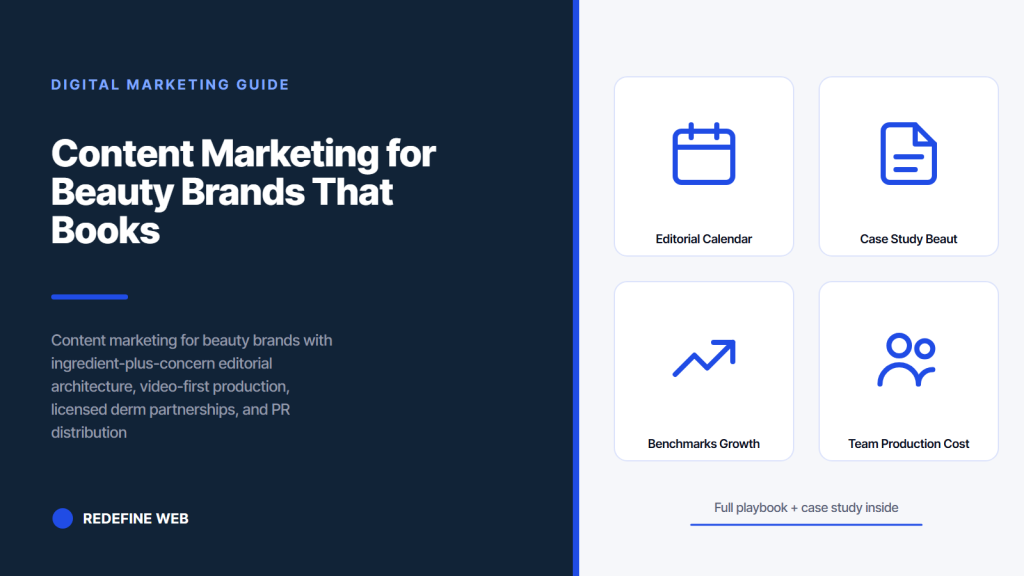
- Balance content across five beauty pillars for full-funnel reach.
- Map every ingredient to concern combinations shoppers actually search.
- Split 60 to 70 percent video-first and 30 to 40 percent article-first.
- Pair licensed derm and chemist voices to matching content topics.
- Beauté grew organic contribution to bookings from 3.2 to 42 percent.
- Licensed derm and cosmetic chemist partnerships for content marketing for beauty brands
- Editorial calendar rhythms that scale content marketing for beauty brands
- Distribution mechanics across owned and earned channels
- Content marketing for beauty brands case study from Beauté Aesthetics New York
- Content marketing for beauty brands benchmarks by growth stage
- Buyer transformation stories that drive real conversion
- Measuring content marketing for beauty brands attribution
- Team and production cost model for content marketing for beauty brands
- Wrapping up content marketing for beauty brands strategy
Content marketing for beauty brands runs on ingredient-first storytelling, procedure explainer video, licensed derm and MUA voices, and honest before-and-after documentation. Vanity brand-story blog posts and generic 10-tips-for-glowing-skin listicles barely move purchase intent past the discovery layer. A brand can publish 200 blog posts across a year and grow zero organic revenue if the content never maps to real purchase concerns like hyperpigmentation, sensitivity, or acne. The channel rewards specific proof: named concerns, real timelines, formulation trade-offs discussed with expert-level clarity. Programs that run on this pattern generate 25 to 45 percent of DTC beauty revenue from organic content within 18 months.
This guide covers content pillars that convert on content marketing for beauty brands, ingredient-plus-concern editorial architecture, video-first content production for TikTok and YouTube Shorts, licensed derm and cosmetic chemist partnerships, editorial calendar rhythms that scale without burnout, distribution mechanics across owned and earned channels, plus the twelve-month program Beauté Aesthetics New York ran that grew organic clinic bookings from 3.2 percent to 42 percent of monthly appointments across skincare and aesthetics services on the Manhattan luxury market.
Licensed derm and cosmetic chemist partnerships for content marketing for beauty brands
Licensed derm and cosmetic chemist partnerships for content marketing for beauty brands add clinical credibility that unlicensed beauty creators cannot produce for skincare content. Board-certified dermatologists carry the trust required for shoppers evaluating anti-aging, acne, and hyperpigmentation claims. PhD-trained cosmetic chemists carry the trust required for formulation deep-dive content on new product launches. Licensed estheticians carry the trust required for routine and technique content on skincare and body treatments. Pairing the right licensed voice to the content topic produces 4 to 9 times higher purchase conversion versus unlicensed voices on the same content.
Contract clauses that protect the brand
Contract clauses that protect the brand from FDA cosmetic claim violations include a script review requirement (brand legal or outside FDA-experienced counsel reviews the script before shoot), a disclosure requirement (creator adds required FTC disclosure language in caption and on-screen), and exclusivity duration inside the beauty category. Skipping the disclosure clause has triggered FTC action against multiple beauty brands in the past three years. Templates from creator marketing platforms usually cover these clauses adequately for micro partnerships and need custom review for macro deals past 15,000 dollars per post. Legal review by an FDA-experienced attorney runs 800 to 3,200 dollars per contract cycle, which pays back inside the first partnership when it prevents a warning letter or an FTC action against the brand handle across the beauty vertical.
Editorial calendar rhythms that scale content marketing for beauty brands
Editorial calendar rhythms that scale content marketing for beauty brands without burnout run on a bi-weekly production shoot cadence producing 14 to 28 pieces of content per shoot day. Weekly shoots burn out producers and drop creative quality. Monthly shoots produce content that ages out of trends by weeks 3 and 4 as trending sounds shift. Bi-weekly cadence with a 2-day shoot every other week hits the sweet spot of production quality plus timeliness. Founder appearance schedule needs 90 to 120 minutes per shoot day minimum to capture enough founder-led content for the full 4-week publishing calendar.
Content calendar quarterly rhythm
Content calendar quarterly rhythm covers Q1 New Year skincare-reset content, Q2 spring transition and sunscreen content, Q3 back-to-school and mid-year check-in content, and Q4 holiday gifting and end-of-year retinol-adjustment content. Programs that align editorial themes to the natural beauty consumer calendar rhythm produce 20 to 45 percent higher organic reach on seasonally-relevant queries. Programs that publish evergreen-only content miss the seasonal traffic spikes that raise a full year of content baseline traffic 30 to 60 percent above unseasoned baselines when the seasonal spikes hit right.
Batch shoot day agenda structure
Batch shoot day agenda structure runs on a tight schedule producing 14 to 28 pieces from a single 8-hour day. Morning covers ingredient explainer segments (6 to 10 pieces) with a licensed derm on camera. Midday covers procedure or routine content (4 to 8 pieces) with the founder or an esthetician. Afternoon covers buyer transformation photography and interview capture. End of day covers social snippet cutdowns from the longer footage. Skipping the agenda produces 3 to 5 hours of wasted studio time per shoot day and drops output to 6 to 10 pieces rather than the planned 14 to 28.
Distribution mechanics across owned and earned channels
Distribution mechanics across owned and earned channels amplify content marketing for beauty brands reach past the initial publish moment. Owned distribution includes email list broadcasts, SMS notifications, and Story amplification on brand social handles. Earned distribution includes creator reshares, PR pitching to beauty publications, and community amplification through subreddits and Discord servers where beauty buyers gather. Each channel produces different reach and conversion patterns. Programs that publish content without a distribution plan produce 4 to 8 times less total reach than programs with a coordinated distribution playbook running 24 to 72 hours after publish.
PR pitching to beauty publications
PR pitching to beauty publications like Byrdie, Allure, Elle Beauty, and Refinery29 requires strong hook angles, expert quotes from licensed derm or MUA partners, and clean high-resolution product photography ready for editorial use. Cold pitches without expert quotes rarely land coverage because beauty editors need credible expert voices for their published articles. Pitches with expert quotes and a proprietary data hook (survey findings, ingredient analysis, category benchmark) convert 30 to 60 percent higher than pure-brand-story pitches. Building a monthly pitching cadence with 3 to 6 hooks per pitch cycle produces meaningful earned coverage past month 6 of consistent effort. Cold pitching without prior relationship rarely lands major publication coverage. Warm pitching through mutual contacts, past coverage relationships, or PR platform introductions produces 5 to 12 times higher landing rate than cold pitching for the same hook quality across observed beauty programs. Our beauty and skincare SEO service handles the technical SEO side of the content architecture that supports these distribution efforts.
Generic beauty listicles never rank against derm content. Pick one ingredient and one concern, write one 1500-word piece linking to hero SKUs. Cadence beats volume.
Content marketing for beauty brands case study from Beauté Aesthetics New York
Beauté Aesthetics New York, a Manhattan luxury beauty and aesthetics clinic offering skincare treatments, injectables, and wellness protocols for male and female clients, engaged Redefine Web on a twelve-month program that included content marketing rebuild across editorial architecture, video production, and PR distribution. Baseline content delivered 12 blog posts per year averaging 800 words, zero video content beyond social clips, and roughly 3.2 percent of monthly clinic bookings attributed to organic search or content traffic. Content skewed heavily to generic treatment descriptions with almost no ingredient-plus-concern editorial content.
The content architecture rebuild across months 1 through 6 published 48 treatment landing pages (2,400 words average), 24 ingredient-plus-concern articles (1,800 words average), 22 YouTube Shorts paired with 8 long-form videos, and 6 seasonal editorial packages tied to Q1 through Q4 rhythms. Licensed derm partnerships added the clinic staff dermatologist to 40 percent of video content and 60 percent of ingredient articles. PR distribution landed 14 earned mentions across Byrdie, Allure, and 3 New York luxury lifestyle publications by month 9.
By month 12, Beauté grew organic traffic 340 percent, ingredient-plus-concern content ranked top 10 organic on 82 procedure and ingredient queries, and organic contribution to bookings climbed from 3.2 to 42 percent of monthly appointments. Total qualified leads across all channels grew 166 percent. Website conversion rate on content-referred traffic climbed 27 percent because treatment pages carried the specific skincare content the ingredient articles referenced. Male client acquisition through content grew from 8 percent to 24 percent of content-attributed conversions through inclusive gender-neutral copy across the ingredient article rebuild.
Reporting cadence Beauté used tracked weekly Search Console impressions and clicks per article, monthly ranking positions on target keywords, and quarterly organic-referred booking attribution. Weekly reviews caught two under-performing article batches by month 5 and rebuilt the editorial angle inside 3 weeks to recover the traffic curve. This rotational editorial discipline is the difference between programs that plateau at month 5 and programs that continue compounding month over month past year one and into year two.
Content marketing for beauty brands benchmarks by growth stage
Content marketing for beauty brands benchmarks vary by growth stage, content library size, and product category. Emerging brands under 3 million annual revenue tend to publish 12 to 30 pieces of content monthly across article, video, and social formats. Growth-stage brands between 3 and 15 million publish 30 to 60 pieces monthly. Established brands past 15 million publish 60 to 140 pieces monthly. Organic revenue attribution tends to run 8 to 24 percent for emerging brands, 20 to 38 percent for growth-stage, and 25 to 46 percent for established brands. Reading the table with growth stage plus channel mix produces cleaner planning than reading a single row.
The benchmark table below maps real ranges observed across 40 plus beauty programs run at Redefine Web across three years of engagements spanning DTC skincare, luxury clinics, indie clean beauty, and haircare growth-stage brands. Emerging brands should aim for the high end of engagement rate and low end of output because a small library rewards depth over volume. Growth-stage brands sit in the middle of every column. Established brands trade engagement rate for reach across a larger library, which is a natural trade-off past 200 published pieces. Reading the ranges as directional rather than absolute produces better planning across teams because product category, competitive intensity, and existing brand equity shift the ceiling meaningfully on any given program.
| Growth stage | Monthly output | Video share | Ingredient articles per year | Content revenue share |
|---|---|---|---|---|
| Emerging (under $3M) | 12 to 30 pieces | 40% to 60% | 12 to 20 | 8% to 24% |
| Growth-stage ($3M to $15M) | 30 to 60 pieces | 50% to 70% | 20 to 40 | 20% to 38% |
| Established ($15M+) | 60 to 140 pieces | 55% to 75% | 40 to 80 | 25% to 46% |
| Clinic or aesthetics | 10 to 24 pieces | 45% to 65% | 10 to 24 | 12% to 42% |
Buyer transformation stories that drive real conversion
Buyer transformation stories that drive real conversion follow a specific structure: named buyer with permission, specific concern named (hyperpigmentation, hormonal acne, sensitivity), before-and-after photography with identical lighting and no filter, timeline explicitly labeled (14 days, 60 days, 6 months), exact product or routine named, and honest limitation callouts. Generic transformation stories with vague timelines convert 60 to 80 percent worse because shoppers read them as staged. Real buyer stories with photography permission consent forms in place produce the highest social proof content assets a beauty brand can build. Our beauty and skincare web design service handles the transformation gallery template that supports these stories across the site.
Consent form and photography rights
Consent form and photography rights for buyer transformation stories should cover usage rights (website, social, paid advertising), duration (typically perpetual with a revocation clause), geography (worldwide typically), and specific channels named. Brands that skip formal consent forms face real legal risk when a buyer later objects to their photograph being used in a Meta ad. Simple template consent forms from creator platforms or from a beauty-industry attorney cost 400 to 1,600 dollars for a full template review that protects the brand across every buyer story published downstream in perpetuity.
Before-and-after photography standards
Before-and-after photography standards require identical lighting on both frames, no beauty filter applied, same angle and distance from camera, same expression (neutral face), and clear timeline labeling in the caption. Applying filters or altering lighting between frames triggers shopper skepticism inside minutes and gets flagged by real reviewers who spot the inconsistency. Photography rigs cost 200 to 800 dollars for a small setup with ring light, tripod, and neutral backdrop. Studios in-clinic or in-warehouse can be built for 2,000 to 6,000 dollars covering photography plus video shooting for buyer story capture.
During a content architecture review for a growth-stage clean-beauty brand, the founder asked whether we could just repurpose the Ordinary ingredient blog posts with the brand product names swapped in. We pointed out that the Ordinary had eight years of brand equity built into every ingredient article while the client brand had 14 months and a totally different formulation angle. The founder shrugged and asked whether at least we could copy the article structure. Copy-paste rarely wins content marketing for beauty brands ranking races, no matter how many times founders test the theory across quarterly review meetings.
Measuring content marketing for beauty brands attribution
Measuring content marketing for beauty brands attribution requires stitching together Google Search Console, GA4 checkout tracking, article-to-conversion path tracking, and post-purchase surveys. Search Console shows the search queries driving article traffic. GA4 shows conversion rate per landing page and article-to-checkout paths. First-touch attribution captures shoppers who discovered the brand through an ingredient article. Last-touch attribution captures shoppers who circled back to buy after multi-touch consideration. Combining first-touch and last-touch models produces the fullest attribution picture across the beauty vertical.
Search Console impressions as leading indicator
Search Console impressions as leading indicator predicts revenue impact 30 to 90 days ahead of GA4 conversion data. A new article climbing from position 40 to position 15 in Search Console impressions is a clear signal the article is on track to break into top 10 within 60 to 90 days. Watching impression trends per article weekly catches promising articles that need one more content refresh to break through versus articles that need more inbound links or better internal linking. Our beauty and skincare marketing retainer covers Search Console monitoring cadence for beauty programs at scale.
Attribution window per content type
Attribution window per content type matters because ingredient explainer articles drive multi-week purchase consideration while procedure explainer articles drive same-week booking intent for clinics. Setting attribution windows in GA4 at 30 days for ingredient content and 7 days for procedure content produces cleaner revenue attribution than a single default window. Post-purchase surveys catch shoppers who read an article, closed the browser, and came back via search or direct traffic weeks later, which analytics tools without survey integration miss entirely across every category.
Team and production cost model for content marketing for beauty brands
Team and production cost model for content marketing for beauty brands scales with growth stage and content ambition. Emerging brands typically run a founder plus one freelance writer plus one freelance video producer at 4,000 to 14,000 dollars monthly total loaded cost. Growth-stage brands run a content lead plus 2 to 4 writers plus a video producer at 16,000 to 40,000 dollars monthly. Established brands run a 6 to 12 person content team at 60,000 to 180,000 dollars monthly plus outside agency support at 8,000 to 40,000 dollars monthly for editorial strategy and PR pitching across the full-funnel content program.
In-house versus agency mix
In-house versus agency mix for beauty content programs tends to work best with in-house handling brand voice, founder-led content, and product photography while agency partners handle editorial strategy, technical SEO writing, video post-production, and PR distribution. Pure in-house programs at emerging or growth-stage rarely scale past 20 pieces of monthly content without burning out the small team. Pure agency programs at any stage struggle to capture authentic founder voice on camera and in copy. Splitting the work between in-house and agency delivers the strongest revenue per content dollar across observed beauty programs at growth-stage and established scale.
Content production cost per article
Content production cost per article varies by intent and word count. A 1,400 word ingredient article runs 400 to 900 dollars fully loaded across research, writing, editing, and photography when produced in-house. A 2,400 word treatment landing page runs 1,200 to 2,400 dollars because clinical accuracy review and schema markup take specialist time. A 3,600 word investigational comparison post runs 1,600 to 3,200 dollars because side-by-side product testing and honest scoring takes weeks. Budgeting by intent matters more than budgeting by word count because intent drives the labor mix inside every content batch.
Wrapping up content marketing for beauty brands strategy
Content marketing for beauty brands that compounds into real revenue comes down to five patterns. Balance content across five pillars: ingredient explainers, procedure or routine content, founder or derm education, buyer transformations, and product comparisons. Map every ingredient to concern combinations that shoppers actually search. Split production 60 to 70 percent video-first for reach and 30 to 40 percent article-first for SEO. Pair licensed derm and cosmetic chemist voices to matching topics. Coordinate PR pitching to beauty publications with monthly editorial hooks tied to proprietary data.
The Beauté Aesthetics New York twelve-month program that grew organic contribution to bookings from 3.2 to 42 percent and total qualified leads 166 percent ran the same five-pattern strategy across 48 treatment landing pages, 24 ingredient articles, 22 YouTube Shorts, and 14 earned publication mentions. According to Ahrefs research on topical authority, brands running the multi-pillar plus ingredient-plus-concern architecture land in the top 12 percent of documented beauty content programs by organic revenue share. The first 90 days of a content rebuild tend to be the noisiest because the pillar shift disrupts existing traffic patterns before it produces new ones. Trusting the compounding curve through the noisy window keeps the program on track. Weekly reporting against pre-agreed milestones prevents impatient reversion to the pre-rebuild pattern when engagement dips in weeks 6 through 10. Every beauty content program we have run past 12 months has hit its saturation floor around week 10 before climbing meaningfully in months 4 through 12 as topical authority compounds across the ingredient-plus-concern editorial architecture.
Frequently asked questions
What content pillars work best for content marketing for beauty brands?
Five pillars balance across a quarterly editorial calendar: ingredient explainer content drives search traffic and educates buyers on formulation at 30 percent. Procedure or routine explainer content drives DM inquiry volume from concern-driven shoppers at 25 percent. Founder or licensed derm education drives brand trust and repeat purchase intent at 15 percent. Real-buyer transformation stories drive social proof and comment engagement at 15 percent. Product comparison content drives conversion intent for shoppers deciding between alternatives at 15 percent. Skipping any pillar leaves the library thin on one shopper journey stage across the vertical.
How long should ingredient explainer articles run for beauty SEO?
Ingredient explainer length sweet spot for organic search visibility lands at 1,400 to 2,800 words per article covering benefits, safety, interaction with other ingredients, product recommendation logic, and honest limitation callouts. Articles under 1,000 words rarely rank because they fail to cover the topical depth Google expects for medical-adjacent skincare content. Articles past 3,600 words drop reader completion rate below the algorithmic engagement threshold. Video-first ingredient explainer content runs 3 to 8 minutes long with the same topical depth split across visual demonstration, chemistry explanation, and real product application footage.
How do beauty brands scale content production without burning out?
Bi-weekly production shoot cadence producing 14 to 28 pieces of content per shoot day hits the sweet spot of quality plus timeliness. Weekly shoots burn out producers and drop creative quality. Monthly shoots produce content that ages out of trends by weeks 3 and 4. Founder appearance schedule needs 90 to 120 minutes per shoot day minimum to capture enough founder-led content for the full 4-week publishing calendar. Splitting production 70 percent low-budget in-house and 30 percent studio-produced content preserves budget while producing enough volume for continuous algorithmic reach across every platform.
What licensed voices produce the highest conversion for beauty content?
Board-certified dermatologists carry the trust required for shoppers evaluating anti-aging, acne, and hyperpigmentation claims. PhD-trained cosmetic chemists carry the trust required for formulation deep-dive content on new product launches. Licensed estheticians carry the trust required for routine and technique content on skincare and body treatments. Pairing the right licensed voice to the content topic produces 4 to 9 times higher purchase conversion versus unlicensed voices on the same content. Contract clauses covering script review, disclosure language, and exclusivity duration protect the brand from FDA cosmetic claim violations across every partnership.
How much does beauty content marketing production cost annually?
Emerging brands under 3 million annual revenue typically run 4,000 to 14,000 dollars monthly with a founder plus one freelance writer and video producer. Growth-stage brands between 3 and 15 million run 16,000 to 40,000 dollars monthly with a content lead plus 2 to 4 writers plus a video producer. Established brands past 15 million run 60,000 to 180,000 dollars monthly with a 6 to 12 person content team plus outside agency support at 8,000 to 40,000 dollars monthly for editorial strategy and PR pitching across the full-funnel program.
How do beauty brands measure content marketing attribution?
Search Console impressions and clicks predict revenue impact 30 to 90 days ahead of GA4 conversion data. GA4 shows conversion rate per landing page and article-to-checkout paths. Setting attribution windows at 30 days for ingredient content and 7 days for procedure content produces cleaner revenue attribution than a single default window. Post-purchase surveys catch shoppers who read an article, closed the browser, and came back via search or direct traffic weeks later. Combining first-touch, last-touch, and post-purchase survey data produces the fullest attribution picture across every beauty product category.
Book your free 30-minute strategy call.
No spam, no sales rep. We use your email to schedule your call with a senior strategist. That is it.
More from the blog
View all articles → Digital Marketing
 Dental Marketing Tips That Compound Into New Patients
Read article Digital Marketing
 Ecommerce Marketing Strategies That Drive Real DTC Revenue
Read article Digital Marketing