
Content Marketing for Ecommerce Pillars and Distribution
- Content marketing for ecommerce compounds where paid channels rent.
- Four pillars beat scattered posts across every category.
- Editorial cadence lands at 4 to 12 assets monthly by stage.
- Distribution across 5 channels multiplies reach 4 to 12 times.
- Retainers run $599 to $18,000 monthly on 6-month contracts.
- SEO and Topical Authority for Ecommerce Content
- Measuring Content Marketing for Ecommerce
- Ecommerce Content Marketing Services and Agency Scope
- How Abigail Ahern Scaled With Content Marketing for Ecommerce
- Content Marketing Ecommerce Mistakes That Cost Revenue
- Where Content Marketing for Ecommerce Fits Your Stack
You run a DTC brand and content marketing for ecommerce keeps landing on the calendar as a low-priority chore that never quite gets done right, while your Meta acquisition cost climbs 40 to 90 percent every fiscal year against the same auction that everyone else is bidding into. The compounding organic revenue you keep hoping content will pay back is real, and the brands winning it in 2026 do not treat content as a blog post factory. They treat content as a topical authority engine with three or four locked pillars, a monthly editorial calendar tied to product launches, a distribution playbook that pushes every asset across five channels, and a measurement rhythm that reads back category rankings, non-branded organic sessions, and assisted conversions weekly. This read is the full content operating system our team runs for Shopify and BigCommerce clients doing $500,000 to $30M yearly revenue across beauty, supplements, apparel, coffee, and home decor. Every number, playbook, and cadence line inside comes off live client dashboards our team reads monthly, not off a generic marketing blog. Read straight through and finish with a written 90-day priority order for your content program.
SEO and Topical Authority for Ecommerce Content
SEO discipline inside content marketing for ecommerce closes the gap between publishing content and earning organic revenue. Every published asset needs on-page fundamentals in place before it goes live, and every pillar cluster needs the internal linking pattern that teaches Google which pages carry the topical weight. Brands that skip either layer usually publish for 12 months before the founder asks why the blog is not producing traffic.
On-Page SEO Fundamentals
On-page work covers the primary keyword in the title, meta description, first 100 words, and at least two H2 headings. The URL slug matches the primary keyword in kebab case. Every image carries descriptive alt text with cluster keyword variants. Every asset earns Article schema markup that Google reads when serving featured snippets and AI Overview results. Skip these and the asset ranks position 40 instead of position 8 for the same underlying content quality. The Ahrefs guide to ecommerce SEO covers the technical stack most brands need running before publishing volume goes up.
Topical Authority Signals
Topical authority builds through cluster architecture and consistent publishing inside a defined subject area over 6 to 18 months. Google’s helpful content system rewards sites that own topics deeply, and it demotes sites that publish scattered content without a clear specialty. A supplement brand focused on adaptogens for six quarters straight earns rankings for hundreds of adaptogen-adjacent queries far faster than a brand publishing across ten unrelated categories in the same window. Topical narrowness at the cluster level plus internal linking depth is the pattern that produces top-3 rankings without the backlink volume most agencies claim you need to compete.
Measuring Content Marketing for Ecommerce
Measurement discipline inside content marketing for ecommerce sits on six numbers most brands never track together in a single dashboard. Organic sessions per pillar cluster. Non-branded keyword rankings by cluster. Blog-attributed revenue from GA4 with a 30-day assist window. Email captures per content asset. Time on page and scroll depth. Backlinks earned per pillar page. A brand tracking those six together spots cluster fatigue, ranking drift, and category shifts weeks before the revenue side actually moves.
Sessions and Rankings by Cluster
Sessions by cluster tells you which pillars are earning organic reach and which pillars need a rebuild or a fresh publishing push. Rankings by cluster tells you the leading indicator behind the session number, because rankings move 4 to 8 weeks before the traffic curve does. A brand tracking cluster-level rankings weekly through Ahrefs, Semrush, or Google Search Console spots when a competitor updates their pillar page and starts to overtake yours, and can respond with a targeted refresh before the traffic drops. That leading-indicator discipline is what separates a real content operation from a monthly blog publishing calendar.
Revenue Attribution and Email Capture
Revenue attribution runs through GA4 with a 30 or 60-day assist window, tagged to the pillar cluster the buyer first landed inside. Email captures per asset tells you which content pulls its weight against the retention side of the account, feeding the flow set with high-intent subscribers. The HubSpot content strategy guide covers the wider content measurement stack most brands adapt for their own reporting rhythm. Brands that read all six numbers together every month iterate content honestly. Brands that read only sessions cherry-pick the wins and stay stuck.
Ecommerce Content Marketing Services and Agency Scope
Ecommerce content marketing services from a real agency cover strategy, editorial calendar management, writing, SEO optimization, distribution, and monthly measurement together, which is what turns a stack of blog posts into a compounding revenue channel. A serious ecommerce content marketing agency operates against a written strategy document that lists the pillar map, the cluster inventory, the publishing cadence, and the measurement dashboard, then runs monthly reviews against the same document to close the gap between plan and outcome.
What an Ecommerce Content Marketing Company Delivers
An ecommerce content marketing company at the growth stage produces 6 to 12 assets monthly across blog posts, pillar rebuilds, product education content, and occasional video scripts or podcast episodes. The retainer covers keyword research, editorial calendar management, on-page SEO, internal linking maintenance, distribution across the primary channels, and monthly reporting with cluster-level insights. Growth retainers price at $2,500 to $6,000 monthly for that scope on 6-month contracts. Starter retainers at $599 to $1,500 monthly cover 3 to 5 assets monthly for pre-$500,000 brands still building the pillar map. Full deliverables per tier live inside our ecommerce digital marketing services retainer read.
Enterprise Content Ops
Enterprise ecommerce content marketing services at $6,000 to $18,000 monthly cover 15 to 30 assets across formats, dedicated video production, thought leadership from founder or CMO voices, and paired PR outreach that earns editorial coverage in category publications. Enterprise scope usually includes quarterly content audits where the team retires underperforming assets, refreshes cluster pillar pages, and reallocates writer capacity toward the topics ranking hardest. Every tier runs on 6-month contracts with monthly plan reviews and a shared reporting dashboard the whole team reads together.
Every DTC founder eventually reaches the Monday morning where the analytics dashboard shows the blog carried 34 percent of the previous month’s revenue, the founder emails the head of marketing asking why nobody told them, and the answer is that they were told, in the monthly report, in the last three quarterly reviews, and in the strategy doc from the launch call two years back. Content marketing wins are almost always announced in advance and celebrated in retrospect, usually while reading a Search Console graph on the couch at 11 pm.
Most content programs die from topic sprawl. Write your 3 category pillars on a sticky note. Anything outside those doesn't make the calendar for 90 days.
How Abigail Ahern Scaled With Content Marketing for Ecommerce
Abigail Ahern, a London-based luxury home decor brand on Shopify, engaged Redefine Web in August 2020 with a content program leaning on discount-anchored promotional posts. The paid side carried most of the growth story while the content side quietly under-performed against a design-conscious audience that wanted mood-led interiors storytelling.
The rebuild started with a locked pillar map covering dark interiors design, mood lighting, room-by-room styling, and seasonal interior refresh cadences. Every pillar got a 3,800 to 4,600-word deep read authored by editorial voices that matched the brand’s high-end position. Each pillar seeded 8 to 14 supporting cluster posts across the first 6 months of publishing. Category and product page copy moved off promotional messaging onto premium editorial storytelling that matched the pillar voice. Internal linking connected pillar to cluster to product page in the pattern Google reads as topical depth. Distribution pushed every asset across email, organic social, Pinterest, and paid social amplification for the top three performers monthly.
The results across a 12-month window on the rebuilt content plus paid rhythm. Ecommerce revenue climbed 179 percent year over year. Paid search return on ad spend reached 1,588 percent driven by non-branded query capture that the content pillars fed with quality landing pages. Paid social return on ad spend reached 3,000 percent through disciplined retargeting supported by the content ecosystem catching every buyer signal. Ecommerce conversion rate roughly doubled from baseline. Contribution margin per order recovered as the discount reliance dropped across content and paid together. Content became the compounding layer under the paid layer, and the whole account moved forward together for the trailing three years of the partnership.
Content Marketing Ecommerce Mistakes That Cost Revenue
Content marketing ecommerce work goes wrong in the same 6 or 7 patterns across almost every DTC account our team audits. Publishing without pillars. Publishing on the wrong keywords. Skipping the internal linking layer. Never distributing beyond a Facebook share. Refusing to update or retire older content. Chasing thin AI-generated posts that Google’s helpful content system quietly demotes across the whole domain. Every mistake below drains capacity and slows the compounding curve by 6 to 18 months.
Publishing Without a Pillar Map
The single biggest mistake DTC brands make with content marketing for ecommerce is publishing individual posts without a pillar map that groups the assets into topical clusters. Each post ranks on its own instead of borrowing authority from the pillar around it. Google reads the site as a scattered blog rather than a category specialist. A skincare brand publishing 24 disconnected posts across a year earns roughly one-fifth the organic sessions a brand publishing 6 pillars plus 18 tied supporting posts does inside the same window. Pillars are the multiplier that turns a blog into a compounding channel.
Thin AI Content and Refusal to Refresh
Thin AI-generated content that reads like a generic listicle no longer ranks in most categories through 2026, and it drags the topical authority score down for the whole domain when Google’s helpful content signals classify the site as low quality. Refresh and retirement discipline matters just as much. A brand refreshing pillar pages every 4 to 6 months with new stats, current buyer questions, and cleaned-up internal links usually holds top-3 rankings through core updates that hit stale competitor content. Brands that never touch a page after publish watch rankings decay 2 to 5 positions per quarter as the SERP moves on without them.
Where Content Marketing for Ecommerce Fits Your Stack
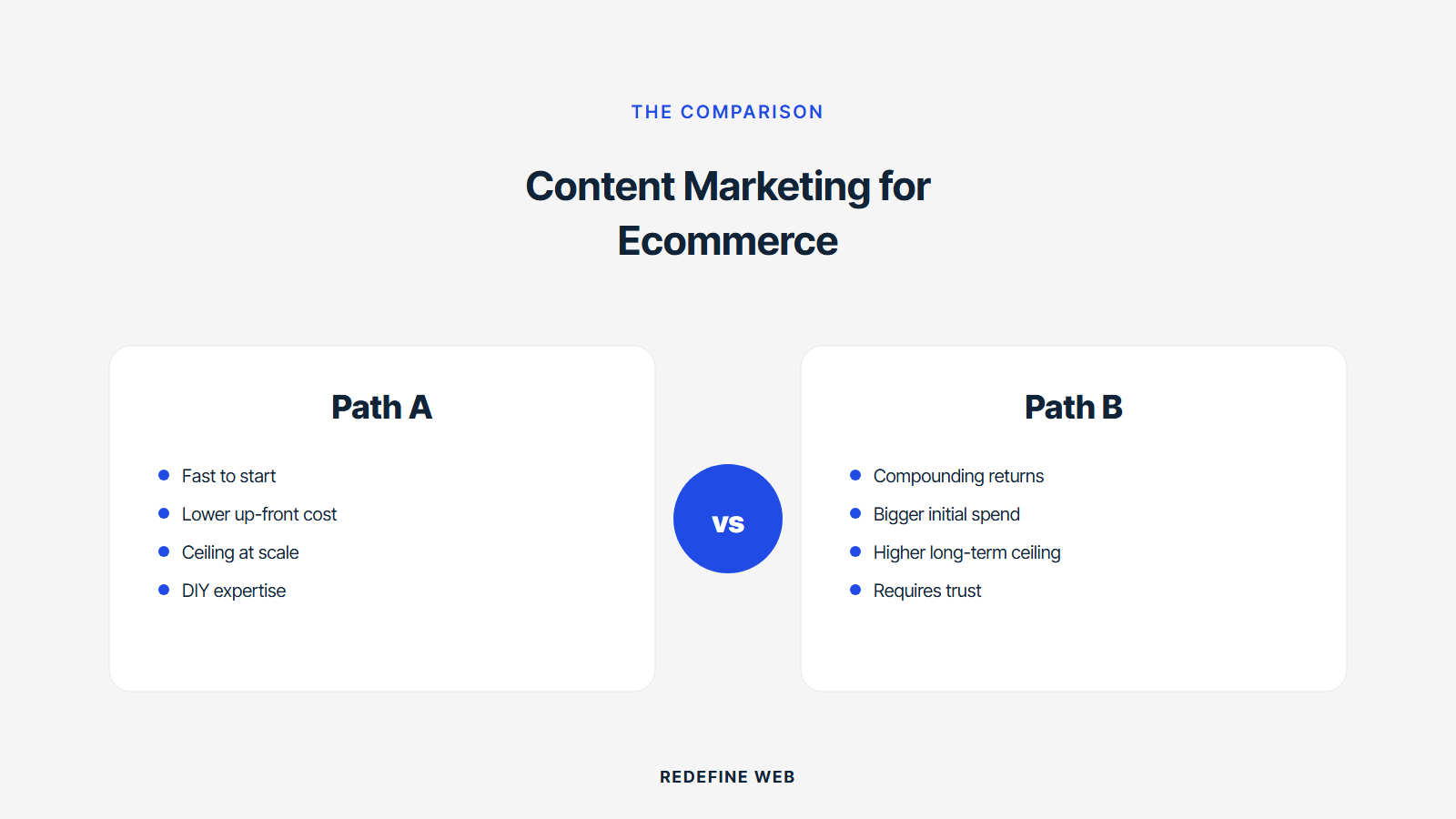
Content marketing for ecommerce sits at the top of the organic side of your marketing stack, feeding search, social, email, and paid layers with the storytelling and authority that keep every other channel working harder. Paid media rides on content quality because landing page depth raises quality scores and conversion rates. Email rides on content quality because subscribers open newsletters that deliver a genuine read rather than another promo push. Retention rides on content quality because engaged buyers stay engaged when the brand consistently teaches them something useful about the category they buy in.
Founders ready to rebuild the content side against real category benchmarks can start with a free audit of the current pillar map, publishing cadence, cluster depth, and measurement stack. That audit produces a written 90-day priority order before any retainer conversation opens. Whether your brand runs a starter Shopify store at $300,000 yearly revenue or a scale account past $15M, anchoring on the four-pillar architecture plus a locked editorial calendar plus disciplined distribution beats chasing the next content template every quarter of 2026. Read the wider cross-channel rhythm inside our ecommerce marketing agency hub for the full picture.
Every retainer scope inside our team runs against a written 6-month plan with monthly reviews, a shared editorial calendar, cluster-level ranking reports, and a measurement dashboard the whole team reads together each month. Starter tiers begin at $599 monthly and enterprise tiers cap at $18,000 monthly across formats, distribution, and paired PR. The right tier depends on brand stage, category depth, and the number of pillars the topic map calls for. Book a free audit call and see the written priority list before any retainer conversation opens.
Content pillars fuel the paid amplification layer, and the creator program is the operational layer that turns pillar content into usable ad creative at volume. Our sibling read on influencer marketing ecommerce programs and attribution covers the sourcing, briefs, and whitelisting side of that plumbing.
Frequently asked questions
What is content marketing for ecommerce and why does it matter for DTC brands?
Content marketing for ecommerce is the organic channel that builds topical authority across search, social, and email through pillar pages, supporting cluster posts, video, and long-form guides tied to buyer intent. It matters because organic content compounds against a flat platform cost while paid channels rent every impression against auction inflation that climbs 12 to 22 percent yearly. A skincare brand publishing 8 pillars and 24 supporting posts across a year usually earns 40,000 to 220,000 monthly organic sessions by month 14. Paid never delivers that curve because sessions stop the second spend stops. Content is the compounding layer under the paid layer that keeps blended acquisition cost tolerable through 2026 and 2027.
How does content marketing ecommerce work across pillars and clusters?
Content marketing ecommerce work runs on 4 pillar topics minimum for a category-serious DTC brand. Each pillar covers a deep topical territory the brand chooses to own. Pillar pages run 3,200 to 4,800 words covering every subtopic in the cluster and link out to every supporting post. Supporting cluster posts run 1,400 to 2,600 words each, cover a single sub-question, and link back to the pillar plus 2 or 3 sibling posts. That reciprocal linking pushes Google's topical authority score up across the whole cluster together rather than one asset at a time. Pillars are chosen by intersecting buyer search volume, product line depth, and remaining SERP room.
What do ecommerce content marketing services cost for a DTC brand?
Ecommerce content marketing services cost $599 to $18,000 monthly depending on scope, list of pillars, and content volume across formats. Starter retainers at $599 to $1,500 monthly cover 3 to 5 assets monthly for pre-$500,000 brands still building the pillar map. Full deliverables per tier live inside our <a href="https://redefineweb.com/blog/ecommerce-digital-marketing-services-what-you-get-per-retainer/">ecommerce digital marketing services</a> retainer read. Growth retainers at $2,500 to $6,000 monthly cover 6 to 12 assets monthly including pillar rebuilds, distribution, and monthly measurement. Enterprise retainers at $6,000 to $18,000 monthly cover 15 to 30 assets across blog, video, thought leadership, and PR outreach. Every retainer runs on a 6-month contract with monthly plan reviews and a shared reporting dashboard the whole team reads together.
How do I measure content marketing for ecommerce against real revenue outcomes?
Measuring content marketing for ecommerce work runs on 6 numbers together. Organic sessions per pillar cluster from GA4. Non-branded keyword rankings by cluster from Ahrefs, Semrush, or Search Console. Blog-attributed revenue from GA4 with a 30 or 60-day assist window. Email captures per asset from the marketing automation platform. Time on page and scroll depth from GA4. Backlinks earned per pillar page from Ahrefs or Majestic. Brands tracking all six together spot ranking drift, cluster fatigue, and category shifts weeks before the revenue side actually moves. Brands tracking only sessions cherry-pick the wins that support the content they wanted to write anyway.
What is the best ecommerce content marketing company for a DTC brand past $1M yearly revenue?
The best ecommerce content marketing company for a DTC brand past $1M yearly revenue runs an integrated program across strategy, writing, SEO, distribution, and measurement rather than treating content as isolated blog production. A serious ecommerce content marketing agency operates against a written pillar map, a locked editorial calendar, an internal linking maintenance plan, and a monthly measurement dashboard the whole team reads together. Look for agencies that publish real client numbers, run 6-month minimum contracts at $2,500 to $18,000 monthly, and produce quarterly content audits where underperforming assets get retired and refreshed. Beware agencies that quote a per-post rate without a pillar strategy.
Book your free 30-minute strategy call.
No spam, no sales rep. We use your email to schedule your call with a senior strategist. That is it.
More from the blog
View all articles → Digital Marketing
 Dental Marketing Tips That Compound Into New Patients
Read article Digital Marketing
 Ecommerce Marketing Strategies That Drive Real DTC Revenue
Read article Digital Marketing