
Ecommerce Sales Funnel That Turns Traffic Into Customers
- Six stages, five drop-offs. Fix the widest gap first.
- Cart recovery emails plus SMS recover 15 to 20 percent.
- Guest checkout raises completion by 20 to 35 percent.
- Post-purchase flow drives 30 to 60 percent of lifetime value.
- Discounts hide the real conversion problem.
- Ecommerce sales funnel optimization moves that pay back fast
- Shopify sales funnel setup that ships fast
- An ecommerce sales funnel template you can copy
- Ecommerce sales funnel examples from real accounts
- Sales funnel web design versus single-page funnels
- Repeat purchase and post-purchase flow
- Driving traffic into a healthy ecommerce sales funnel
- Common ecommerce sales funnel mistakes
- Hiring help on your ecommerce sales funnel
- Wrapping up ecommerce sales funnels
An ecommerce sales funnel is the flow a shopper walks from first ad click to paid order to repeat customer. Six stages, five drop-off points, and about a dozen numbers that decide whether the store makes money at scale. You are here because your traffic is fine and your revenue is not, or because your Shopify store hit a plateau you cannot explain from the dashboard alone.
This guide is the playbook we run on Redefine Web ecommerce accounts. Stage-by-stage benchmarks, the cart abandonment fixes that recover the most revenue, the Shopify sales funnel setup we recommend, and the mistakes we watch DTC brands make every quarter. Read straight through in about eleven minutes and you get a diagnosis pattern you can put to work this week on your own store. You also get real numbers from the Abigail Ahern account and the Topps Tiles paid media rebuild, both walked through with the moves that produced the outcome.
Ecommerce sales funnel optimization moves that pay back fast
Ecommerce sales funnel optimization pays back fastest at three stages. Product page conversion. Cart abandonment recovery. Checkout completion. Fix all three and most stores see 15 to 30 percent revenue growth inside 90 days without adding traffic or spend.
The five moves below are the ones we run first on almost every DTC engagement. They are stage-specific, they are measurable in two to four weeks, and they do not require a redesign. Every one of them has a floor and a ceiling. Cart abandonment recovery has a ceiling around 12 to 15 percent of abandoned revenue. Product page copy has a ceiling around a 30 to 50 percent add-to-cart gain. Know the ceiling before you start so you know when the stage is done.
- Cart abandonment recovery email plus SMS sequence
- Product page copy rewrite to lead with benefit and social proof
- Checkout field reduction and guest checkout enablement
- Post-purchase upsell and repeat-purchase email flow
- Site speed pass to drop mobile load time under 2.5 seconds
Cart abandonment recovery that recovers real revenue
Cart abandonment recovery emails at 1 hour, 24 hours, and 72 hours recover 8 to 12 percent of abandoned revenue on average. Adding SMS as a fourth touch adds another 3 to 5 percent recovery. On-site exit-intent overlays with a small first-purchase discount recover another 2 to 4 percent. Stack all three and you can add 15 to 20 percent to closed revenue without changing a thing on the store itself.
Product page copy that raises add-to-cart
Lead with the benefit, not the feature. Show the price plus shipping cost together, above the fold, so nobody feels tricked at checkout. Add at least three real photos beyond the studio hero shot. Add customer reviews above the fold, not buried at the bottom of the page. Rewrite the product name to include the primary search phrase without keyword stuffing. These five changes together usually raise add-to-cart by 20 to 40 percent.
Shopify sales funnel setup that ships fast
A Shopify sales funnel does not need a third-party sales funnel builder for most brands. Shopify Plus and even the standard plan handle collection pages, product pages, cart, and checkout natively. Layer in a review app, a cart abandonment tool, and an upsell app and you have 80 percent of the stack most brands need.
Where a dedicated Shopify sales funnel builder helps is on high-ticket funnels with long copy pages, quiz-based product recommendation flows, and subscription-plus-upsell combinations. For a standard DTC store selling 20 to 200 SKUs, the native Shopify sales funnel handles the flow cleanly. Where most stores go wrong is layering 8 to 12 apps that fight each other and slow the checkout. Cut the app count first, add carefully.
The native Shopify stack for most stores
Shopify’s native product page, cart, and checkout cover the core funnel. Add a review app like Judge.me or Loox for social proof. Add Klaviyo or Omnisend for email and SMS flows. Add a cart abandonment tool if Klaviyo does not cover it. Add ReCharge if subscription is core. Add a bundle-builder if multi-item AOV is a lever. That is six apps and covers the sales funnel Shopify supports natively for most DTC brands.
When to add a dedicated sales funnel builder
Add a dedicated Shopify sales funnel builder when your product needs a long-form sales page instead of a standard product page. Add one when a quiz-based recommendation flow drives 30 percent-plus of revenue. Add one for high-ticket products above $500 where the buyer needs a long value narrative. Do not add one to boost the sales funnel Shopify already handles well for standard product pages. Extra apps slow the store and confuse the buyer.
An ecommerce sales funnel template you can copy
Every ecommerce sales funnel template is a variation on the same six stages. Awareness ad or organic content, product page, add to cart, checkout, payment, post-purchase nurture. What changes is the offer, the messaging, and the sequence of touches. The template below is the one we hand off to new DTC clients on day one.
Copy this ecommerce sales funnel template into a Notion doc, fill in your own numbers, and run it through your team on a Monday morning. Print it and pin it in the ops room. This is not a proprietary framework, it is the pattern every serious DTC brand runs on. Your version will diverge in a few places based on your product and price point, but the stages hold.
- Awareness: Meta or TikTok prospecting ad, blog content, organic search landing page
- Consideration: retargeting ad, email newsletter signup, quiz or product finder
- Product page: hero, price with shipping, reviews, three-plus real photos, sticky add-to-cart
- Cart: free shipping threshold shown, upsell offer, single primary CTA
- Checkout: guest checkout enabled, Apple Pay and Google Pay, address autofill
- Post-purchase: thank-you upsell, delivery notification, review request at day 14
- Repeat: replenishment email, referral offer, loyalty tier progress email
Customizing the template for your product
High-ticket items above $300 need a longer consideration stage with two or three retargeting touches before the buyer commits. Impulse buys under $50 can collapse the consideration stage entirely and run straight from ad click to product page to checkout. Subscription products need a stronger day-30 and day-60 email flow because the first repeat purchase is where subscription retention lives or dies.

Ecommerce funnels rebuild traffic acquisition when the product page loses 78 percent of clicks. Load your top PDP on 4G and time the tap-to-buy. Fix that first.
Ecommerce sales funnel examples from real accounts
Ecommerce sales funnel examples that actually teach something have three parts. The starting numbers, the moves, and the outcome. Anything less is a case-study puff piece. The two ecommerce sales funnel examples below are Redefine Web accounts with the full numbers included.
Both accounts started with different funnel problems and both solved them without a discount banner. That is the discipline we push clients toward. Anyone can grow with 30 percent off. Growing with brand intact means fixing the funnel, not paying customers to overlook it.
Abigail Ahern, luxury home decor
Abigail Ahern is a luxury home decor DTC brand that wanted to grow revenue without leaning on discounts. Their starting conversion rate was around 1.4 percent, discount mix was heavy, and paid social was under-invested. We restructured SEO around intent-driven queries, rebuilt paid media around premium creative and buyer-intent audiences, and left the pricing intact. Revenue grew 179 percent, paid search return on ad spend hit 1,588 percent, and paid social return on ad spend reached 3,000 percent. Full breakdown of the Abigail Ahern account and the paid media restructuring lives in our case studies archive.
Topps Tiles, UK tile retailer
Topps Tiles is the largest tile retailer in the UK. They came to us with a paid media program that had gone flat, unknown search cannibalization, and dynamic search ads switched off. We ran a structured test-and-learn program with clear stage instrumentation. The result was 5,465 new visitors, 1.3 million additional impressions between June and September, a 7 percent gain in click-through rate, and 33 percent unique-visitor share of the market. Sales funnel discipline at scale, not clever creative.
Every quarter a new DTC founder tells us they cannot compete with Amazon on price. We agree. Then we ask if they have set up a cart abandonment sequence. The answer is almost always no. Amazon spent 20 years and $60 billion in tech infrastructure to win on price. You can beat them at cart recovery with a three-email sequence and a Klaviyo subscription. Pick your battles.
Sales funnel web design versus single-page funnels
A sales funnel website is a full store with a homepage, collection pages, product pages, and a global cart. A single-page sales funnel collapses the whole flow into one long-scroll landing page ending in a checkout. Both work for different products. Most DTC brands need the full sales funnel website. Single-page funnels only pay off for one-SKU-focused offers.
The instinct to build a single sales funnel page for every product is usually a mistake. It loads a wall of copy on someone who wants to see photos and reviews, and it hides the alternatives that could have kept them shopping if the first pick did not fit. Single-page funnels work for tightly scoped offers with one hero product, one price point, and one clear buyer profile. For a multi-SKU catalog, the ecommerce sales funnel needs the full website structure to convert.
When single-page sales funnels work
Single-page sales funnels work for one-SKU brands with a hero product above $80. They work for challenger brands running a direct-response ad strategy where the ad promises a specific transformation and the page delivers on it in long-form. They work for kickstarter-style pre-orders where the story matters as much as the specs. Outside those cases, a proper ecommerce sales funnel website converts better.
Multi-SKU store setup
Multi-SKU stores need collection pages that group products by use case, not by category name. “Gifts under $50” converts higher than “Category A.” Product filtering matters, but keep the filter list short so buyers can scan the choices without page reload. Search bar quality matters more than most brands realize because 30 to 45 percent of engaged buyers use the search. If your search returns nothing on brand-name typos, you are losing sales.
Repeat purchase and post-purchase flow
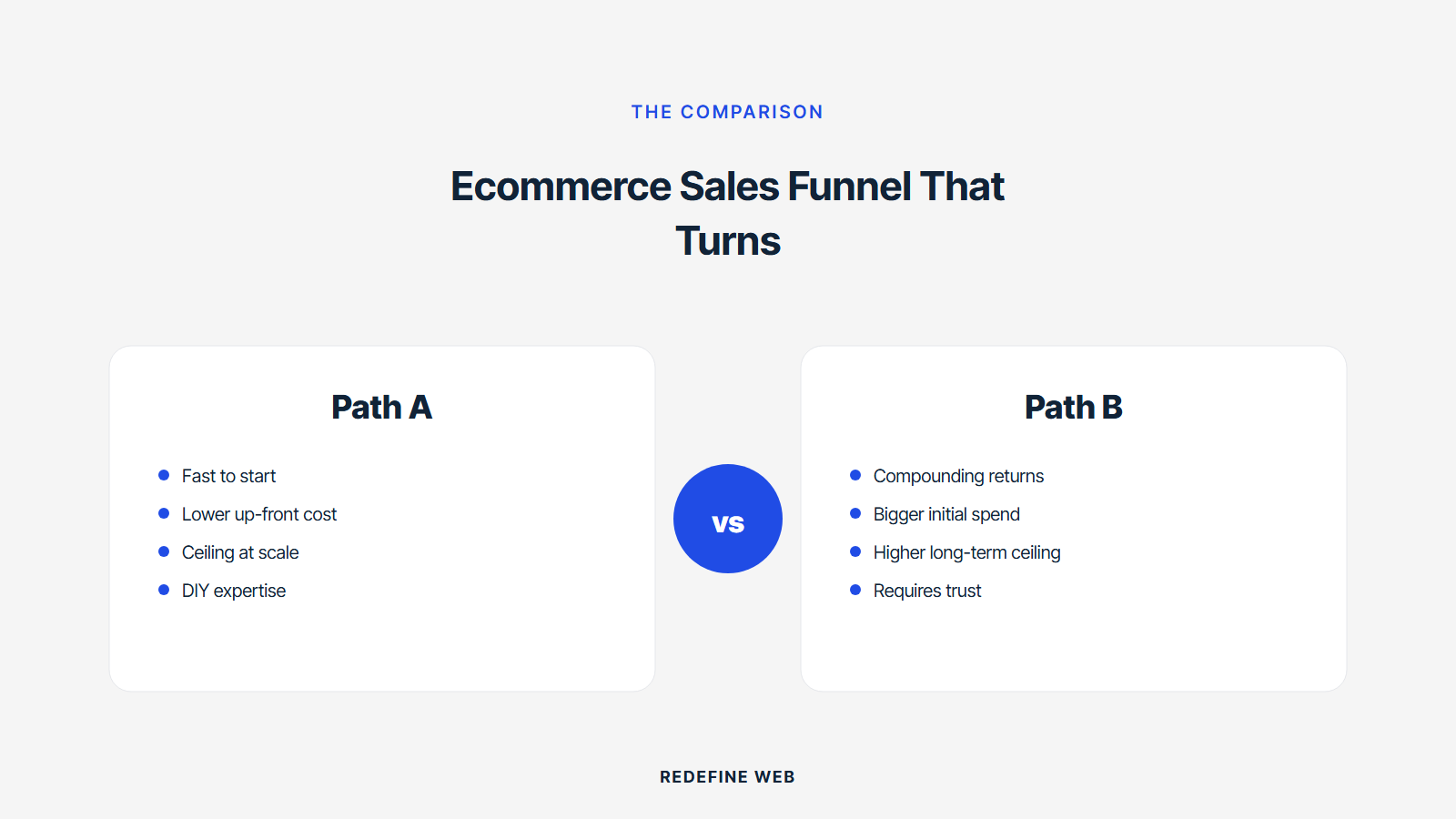
The post-purchase stage of the ecommerce sales funnel decides whether a customer is a one-time buyer or a lifetime one. Most brands under-invest here because the sale already closed. That underinvestment is worth 30 to 60 percent of lifetime revenue on average, and the fix is a three-touch email flow plus a smart replenishment reminder timed to product usage.
The post-purchase flow has three jobs. Confirm the order and the timeline so the buyer does not open a support ticket. Ask for a review at the right moment so the review is real and specific. Prompt the next purchase when the timing makes sense based on the product. Skip any of those and you leave 15 to 40 percent of possible revenue on the table.
Review request timing
Review request emails sent 14 days after delivery convert 3 to 5 times higher than requests sent day one. The reason is simple. The buyer has actually used the product by day 14. Requests sent day one just annoy the buyer because they have not opened the box. Time the review request to actual product usage, not the checkout event. Apparel review requests can go earlier because trial happens fast. Skincare should wait 21 to 30 days.
Replenishment and repeat purchase flow
Replenishment emails work when the product has a predictable usage cycle. Beauty products, supplements, coffee, pet food, and household consumables all fit. Send the replenishment reminder about 5 to 10 days before the average buyer runs out. Include a one-click reorder button. Optional discount, though repeat customers convert at 3 to 5 times the rate of new prospects even without a discount because loyalty is the biggest driver. Our Ecommerce Marketing Agency for DTC and Shopify Brands runs this playbook across most active DTC accounts.
Driving traffic into a healthy ecommerce sales funnel
Traffic into a healthy ecommerce sales funnel comes from four channels for most DTC brands. Paid social, paid search, organic search, and email. Any brand generating more than a quarter of revenue from a single channel is one algorithm change away from a bad quarter. Diversify channels before the change forces you to.
The right channel mix depends on your price point, category, and margin. High-ticket considered purchases lean on paid search and email. Impulse and lifestyle brands lean on paid social and organic content. Subscription brands lean on paid social prospecting plus email retention. Match the channel investment to the buyer behavior, not to what the founder finds interesting. The channel that grew you to $1 million is rarely the channel that grows you to $10 million.
Paid social feeding the top of funnel
Paid social on Meta and TikTok feeds the top of the funnel for lifestyle, apparel, beauty, and low-consideration ecommerce. Creative is 70 percent of the outcome. Static images and lifestyle videos beat product photography most quarters. Test 8 to 15 creative variations per month against 3 to 5 audiences. Cut anything under 1.5 return on ad spend at day 14 unless the creative is early in its cycle. Our PPC Management Services handle this workflow across DTC accounts.
Organic search and content
Organic search is the compounding channel. Every product page, category page, and blog post you rank earns traffic month after month with no ongoing spend. Ecommerce SEO focuses on category page optimization first, then product page optimization, then editorial content around buyer-intent queries. Six months is the realistic timeline for a fresh site to see organic revenue at scale, and Google Search Central’s SEO starter guide lays out the technical foundations before you write a single product page. If a partner promises faster, they are running low-quality tactics that will backfire inside a year.
Common ecommerce sales funnel mistakes
Three mistakes wreck most ecommerce funnels. Discount reliance that hides the real conversion problem. App bloat that slows the store. No post-purchase flow at all. Any one of them costs 10 to 25 percent of revenue. All three together can cost half.
A fourth mistake, quieter but expensive, is optimizing for average order value at the expense of conversion rate. Bundle offers and upsells look great on a spreadsheet, but they add friction to the buying decision. Test them, keep the ones that raise both AOV and conversion, cut the ones that raise AOV while dragging conversion down. The bigger long-term win is almost always the funnel that closes more buyers, not the one that squeezes an extra $8 out of each order.
The discount trap
Every brand that leans on 20 to 30 percent-off promotions to hit revenue targets is training their audience to wait for the next promotion. Full-price conversion drops. Margin drops. The brand ceiling drops. If you cannot hit the number without a discount banner, the funnel is broken, not the pricing. Fix the funnel first. Discounts should be tactical, not structural, and reserved for actual liquidation events.
App bloat and page speed
Twelve installed Shopify apps loading scripts on every page will drop your mobile page speed under 40. That drop costs about 20 to 30 percent of conversion. Audit the app list every quarter. Remove any app you cannot name the specific KPI it moves. Consolidate overlapping tools. Move heavy widgets from every page to only the pages that need them. Store speed is a funnel stage, not a nice-to-have.
Hiring help on your ecommerce sales funnel
Hire outside help when your internal team has run three optimization cycles without moving the number, when you need results inside 60 days, or when the diagnosis crosses paid media, site, and email in a way your internal team is not staffed for.
A good ecommerce sales funnel partner does five things in the first 30 days. Audit the current stage instrumentation. Capture 90 days of baseline transition rates by channel. Identify the two stages farthest from benchmark. Propose one change per stage with predicted delta. Set up measurement to read the delta cleanly at 2, 4, and 8 weeks. Any partner who skips the audit and jumps to a redesign is selling a template, not a diagnosis. Our Sales Funnel and Automation service runs this exact pattern.
Pricing tiers for ecommerce optimization
Full-service ecommerce sales funnel optimization runs $3,500 to $10,000 per month for DTC brands doing $500,000 to $5 million in annual revenue. Above $5 million, expect $8,000 to $25,000 per month depending on channel complexity and app stack. Standalone consultants run $250 to $500 per hour or $6,000 to $18,000 for a defined audit project. Anything under $2,000 per month is usually a monthly reporting service, not real optimization work.
Reference checks that catch bad partners
Ask for two references from clients whose engagement ended in the last 12 months, not just current clients. A good ecommerce optimization partner will have both wins and finished engagements. Talk to at least one of each. The finished-engagement reference tells the truer story because the client is no longer being managed. If a partner cannot produce that reference, keep interviewing.
Wrapping up ecommerce sales funnels
An ecommerce sales funnel is six stages, five drop-offs, and a dozen numbers that decide whether the store scales. Fix the biggest gap first, one stage at a time, and re-measure over two to four weeks. The compound effect across stages is what turns a plateaued store into a growing one.
If you want a second set of eyes on your ecommerce sales funnel, we run a 90-minute audit that identifies the two biggest gaps and predicts the delta of fixing each. Same audit we run on the first day of every DTC engagement. Whether you keep the work internal or bring us in, the audit output is yours to run with.
Frequently asked questions
What is an ecommerce sales funnel?
An ecommerce sales funnel is the sequence a shopper walks from first ad click or organic visit to paid order to repeat customer. Six visible stages, with five drop-off points between them. Ad or organic click, product page view, add to cart, checkout start, payment complete, and post-purchase flow. Every transition has a healthy conversion rate benchmark, and the gap between your rate and the benchmark tells you where the revenue goes to die. Fixing the biggest gap first compounds through every stage below it, which is why measurement before design is the whole discipline. Skip that measurement pass and you are guessing about your own store.
How do I optimize a Shopify sales funnel?
Most Shopify stores do not need a third-party sales funnel builder. Shopify Plus and even the standard plan handle collection pages, product pages, cart, and checkout natively. Layer in a review app like Judge.me or Loox, Klaviyo or Omnisend for email and SMS flows, and a cart abandonment tool if Klaviyo does not cover that piece. Enable guest checkout, cut checkout fields down to eight or fewer, and enable Apple Pay plus Google Pay. Audit your app stack every quarter and remove any app you cannot name the specific KPI it moves. App bloat kills mobile speed, and speed is a funnel stage.
What are healthy ecommerce sales funnel benchmarks?
Ad or organic click to product view runs 60 to 80 percent for well-targeted traffic. Product view to add to cart runs 5 to 12 percent depending on category. Add to cart to checkout start runs 40 to 60 percent. Checkout start to payment complete runs 50 to 75 percent, with cart abandonment sitting at roughly 70 percent on the industry average. Payment complete to repeat purchase inside 90 days runs 15 to 30 percent. Overall visit to revenue is 1 to 2.5 percent for most DTC brands. Read your category and channel benchmarks separately because averages hide too much detail.
How does cart abandonment recovery work?
Cart abandonment recovery uses email and SMS to bring back shoppers who added items but did not complete checkout. A three-email sequence sent at 1 hour, 24 hours, and 72 hours after abandonment recovers 8 to 12 percent of abandoned revenue on average. Adding SMS as a fourth touch adds another 3 to 5 percent recovery. On-site exit-intent overlays with a small first-purchase discount recover another 2 to 4 percent. Stack all three together and you can add 15 to 20 percent to closed revenue without changing anything else on the store. Tools like Klaviyo, Omnisend, and Attentive handle the flows natively.
Should I build a single sales funnel page or a full store?
Most multi-SKU DTC brands need the full ecommerce store, not a single sales funnel page. Single-page sales funnels work for one-SKU brands with a hero product above $80, for challenger brands running a direct-response strategy where the ad promises a specific transformation and the page delivers in long-form, and for pre-order or kickstarter-style launches where the story matters as much as the specs. Outside those cases, a proper multi-page ecommerce sales funnel with collection pages, product pages, and a global cart converts better because it lets buyers browse alternatives when the first pick does not fit.
What is the best ecommerce sales funnel template to follow?
Every good ecommerce sales funnel template covers six stages. Awareness through paid social or organic content, consideration through retargeting and email signup, product page with hero and reviews above the fold, cart with free shipping threshold and one primary CTA, checkout with guest option and Apple Pay plus Google Pay, and post-purchase with thank-you upsell plus delivery notification plus review request at day 14. Add a repeat purchase flow with replenishment reminders and referral offers. Customize the template for your product price point and category, but keep the six stages intact. The stages are not proprietary framework, they are how ecommerce works.
How much does ecommerce sales funnel optimization cost?
Full-service ecommerce sales funnel optimization runs $3,500 to $10,000 per month for DTC brands doing $500,000 to $5 million in annual revenue. Above $5 million in revenue, expect $8,000 to $25,000 per month depending on channel complexity and app stack. Standalone consultants run $250 to $500 per hour or $6,000 to $18,000 for a defined audit and recommendations project. Anything under $2,000 per month is usually a monthly reporting service, not real optimization work. Match the pricing tier to the actual scope of execution work included, not just the size of the retainer or the frequency of the report.
Book your free 30-minute strategy call.
No spam, no sales rep. We use your email to schedule your call with a senior strategist. That is it.
More from the blog
View all articles → Digital Marketing
 Dental Marketing Tips That Compound Into New Patients
Read article Digital Marketing
 Ecommerce Marketing Strategies That Drive Real DTC Revenue
Read article Digital Marketing