
Fashion Marketing Campaigns Drop and Seasonal Playbook
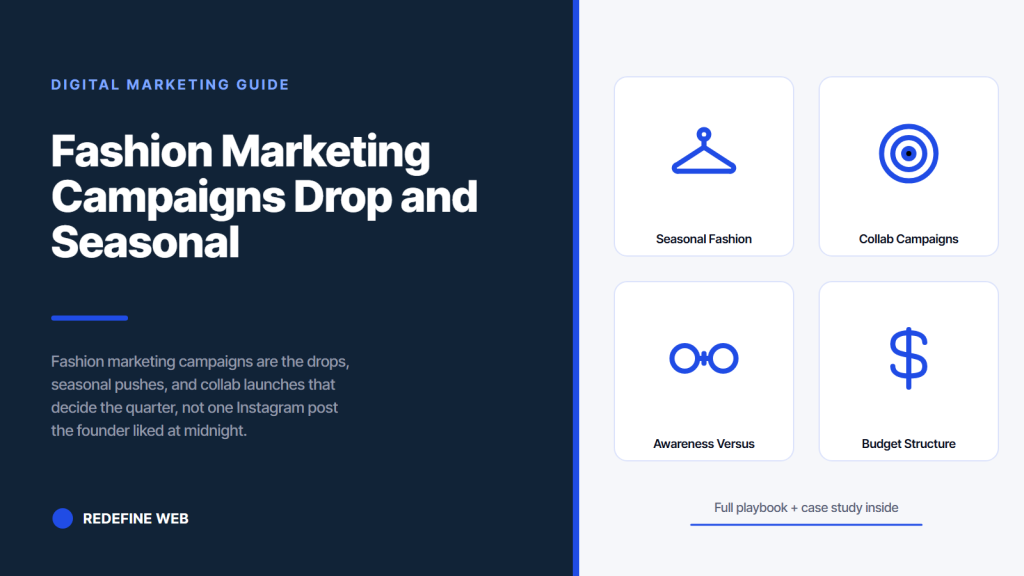
- Four archetypes drive every quarter drop, seasonal, collab, awareness.
- Drops carry 45 to 60 percent of first order revenue on apparel.
- Budget splits shift by archetype, not by founder mood.
- Pre launch checklist beats launch day heroics every quarter.
- Attribution needs Shopify, GA4, ads platform, and survey together.
- Kill flat campaigns at week two, not at end of month.
- Seasonal fashion marketing campaigns and the calendar
- Collab campaigns inside fashion marketing campaigns
- Awareness versus conversion in fashion marketing campaigns
- Budget structure inside fashion marketing campaigns
- Pre launch checklist for fashion marketing campaigns
- Paid social inside fashion marketing campaigns
- How do fashion marketing campaigns report honestly
- Fashion marketing campaigns in production
- Weekly review inside fashion marketing campaigns
- Where fashion marketing campaigns fit the wider stack
Every DTC apparel founder has watched a competitor drop a capsule on a Tuesday, sell out by Friday, and wondered which line item in their retainer was supposed to catch that. Fashion marketing campaigns are the repeatable answer to that question. They are the drops, seasonal pushes, collab launches, and awareness plays that decide the quarter, not the single Instagram Reel that pulled 900 orders in a weekend and nobody could replicate. A working campaign calendar runs on a documented archetype (drop, seasonal, collab, awareness), a budget split across paid social, creator seeding, email, and site merchandising, a KPI stack that separates first order revenue from repeat, and a Monday review meeting where the founder can kill a campaign at week two.
This guide covers the version of fashion marketing campaigns our team runs for apparel and accessories brands between $80,000 and $2 million monthly. You will see the four archetypes, the pre launch checklist, the paid budget split, the creator brief that pairs with each archetype, the attribution model that reconciles direct to consumer against wholesale, and the Monday meeting agenda that stops a bad campaign from eating a whole month.
Seasonal fashion marketing campaigns and the calendar
Seasonal pushes are the second archetype and carry 20 to 30 percent of first order revenue across an apparel year. The calendar is fixed. Fall winter kickoff in mid August. Holiday build starting the second week of October. Resort in late December through mid January. Spring summer in mid February. Back to school in mid July. Mother’s Day, Father’s Day, and Valentine’s Day for accessories brands. The founder does not get to invent new seasons.
Each seasonal push runs 3 to 6 weeks and blends a creative story arc with existing SKU inventory rather than a new drop. The story angle is what earns the campaign its own budget line. A fall winter push labeled Layering Season with a curated 12 SKU capsule sold from existing stock outperforms a generic fall sale by 40 to 80 percent because the story gives the audience a reason to buy today, not a discount. Discount led seasonal campaigns train the audience to wait for the next markdown, which caps annual revenue growth at 12 to 18 percent even when volume goes up.
The seasonal calendar sheet
Every fashion program keeps a rolling 12 month seasonal calendar sheet with 8 columns. Campaign name, archetype, start date, end date, primary SKU set, offer type, paid budget, and post campaign owner. The sheet is the single source of truth for the pod. Meetings that argue about which campaign runs which week are the sign the sheet is not being maintained, and every founder eventually learns the lesson the same way, which is by missing the holiday paid social spike window because the creative was still in edits on November 8.
Collab campaigns inside fashion marketing campaigns
Collab campaigns pair the brand with an outside partner to borrow audience and creative angle. The partner is a creator, an adjacent apparel or accessories label, a retailer, or a cultural property (band, film, artist). Collabs are the third archetype and carry 10 to 18 percent of first order revenue on a typical mid market apparel year.
The economics of a collab break in a specific place if the split is wrong. A 50 50 revenue split with a creator who brings only a warm audience of 30,000 followers leaves the brand paying the manufacturing risk while sharing half the upside. A 30 percent creator split with a licensing fee floor of $8,000 to $20,000 protects the brand from the downside while giving the creator real skin in the game. Larger brand to brand collabs run on a wholesale plus retail split that a lawyer models against the manufacturing run size before either side commits inventory. The fashion influencer marketing playbook covers the creator side of that math in more depth.
Assets and paperwork
Collab campaigns need double the paperwork of a drop. A signed collab agreement with revenue split, IP ownership on shared creative, exclusivity window, cancellation clause, and post campaign asset ownership. A creative brief that both sides sign before shoot day. A launch calendar that both marketing teams commit to. A joint email plan that avoids double sending to the overlap audience. Founders who skip the paperwork end up in a licensing dispute at day 45 that eats 6 to 12 weeks of legal fees and quietly kills the next planned collab.
Awareness versus conversion in fashion marketing campaigns
Every campaign carries a primary objective, and the objective decides the media mix, the creative rules, and the KPI stack. Awareness campaigns build audience for a future push. Conversion campaigns turn existing audience into revenue. Mixing the two on the same reporting line is the single most common way founders miscalibrate the retainer.
Awareness campaigns are measured on assisted revenue over 30 to 90 days, brand search growth on Google Trends, unaided recall on a post campaign survey, and email list gain. The paid social creative runs longer form, softer product placement, higher production value. The KPI is not day one revenue. Founders who apply a 3 day click return on ad spend target to an awareness push kill the campaign at week one and never see the 90 day compounding effect on the direct traffic line. That mistake costs a mid market apparel brand roughly $80,000 to $220,000 of forgone revenue in a bad year.
Conversion campaigns are measured on day 3 and day 7 return on ad spend, first order revenue, cost per order, and add to cart rate. The creative runs shorter, harder on price and product, with clearer social proof stacked on the ad frame. Both archetypes deserve budget, and both deserve their own KPI board. The ecommerce digital marketing strategy guide covers the wider channel allocation math the two archetypes plug into.
Fashion campaigns run 2-6 weeks. Set a Monday kill-line at week 2. If it's under target, cut it. Everyone extends losers hoping for a Hail Mary.
Budget structure inside fashion marketing campaigns
Every campaign gets a documented budget split across five buckets. Paid social. Paid search and Shopping. Creator seeding and paid collaborations. Email and SMS operations. Site merchandising and creative production. The split shifts by archetype and by season, but the buckets stay constant so the founder can compare campaign to campaign on Monday without rebuilding the spreadsheet.
| Archetype | Paid social | Paid search | Creator | Email and SMS | Site and creative |
|---|---|---|---|---|---|
| Drop | 45% | 10% | 25% | 5% | 15% |
| Seasonal | 40% | 20% | 15% | 10% | 15% |
| Collab | 35% | 10% | 30% | 10% | 15% |
| Awareness | 55% | 5% | 20% | 5% | 15% |
| Always on baseline | 50% | 25% | 10% | 10% | 5% |
The split above is the starting point for a mid market apparel brand between $80,000 and $600,000 monthly. Smaller brands under $80,000 usually run heavier on creator and email because paid social under $10,000 monthly rarely produces stable creative testing volume. Brands above $600,000 monthly tighten paid search up to 25 percent because the branded search volume can absorb it. Founders who lock a single split and never revise it leave 10 to 20 percent efficiency on the table by the end of the year, which shows up on the annual review as a soft margin quarter without an obvious cause. The pod that runs the campaign work reviews the split every 4 weeks against the last two campaign results and shifts 5 to 10 percentage points at a time between buckets. Bigger shifts than that inside a single cycle confuse the paid social algorithm and reset the learning phase on Meta campaigns, which costs 7 to 12 days of stable delivery on the next drop. That review discipline is what turns the budget split from a spreadsheet cell into a real growth lever the founder can point at on Monday morning.
Pre launch checklist for fashion marketing campaigns
Every campaign runs against the same pre launch checklist. Skipping items on the list produces the same three failures every quarter. A missed Meta ad approval on launch day. A broken landing page discount code. A creator posting one day early or one day late. The checklist is 14 items long and takes one afternoon to work through per campaign.
- Campaign name, archetype, dates, and primary KPI in the calendar sheet.
- Product feed sync tested on Meta and Google Shopping 72 hours before launch.
- Landing page live in staging with QA on desktop, mobile, and iOS Safari.
- Discount codes provisioned in Shopify with usage caps set per creator.
- Paid social creative approved and scheduled in Meta Ads Manager.
- TikTok Spark Ads codes collected from every creator on the roster.
- Email flows triggered off drop day tag with 48 hour delay branches.
- Post purchase survey line item added to Fairing or KNO with campaign source.
- Klaviyo segments refreshed for teaser, launch day, and post launch sends.
- Creator briefs signed, deliverables logged, expiry dates on the whitelist rider.
- PR embargo drops at the same hour the site page and the paid ads go live.
- Customer service macros written for the top three expected questions.
- Rollback plan documented if inventory sells out inside the first 6 hours.
- Monday review meeting booked for 8 days after launch with the founder invited.
The checklist above is where the difference between a solid campaign and a soft campaign gets baked in during the week before launch, not on launch day itself. Founders new to structured programs assume the launch day tempo is what decides the outcome, and every one of them learns inside two quarters that the calm of the pre launch checklist is what makes launch day boring, and boring is the point.
Paid social inside fashion marketing campaigns
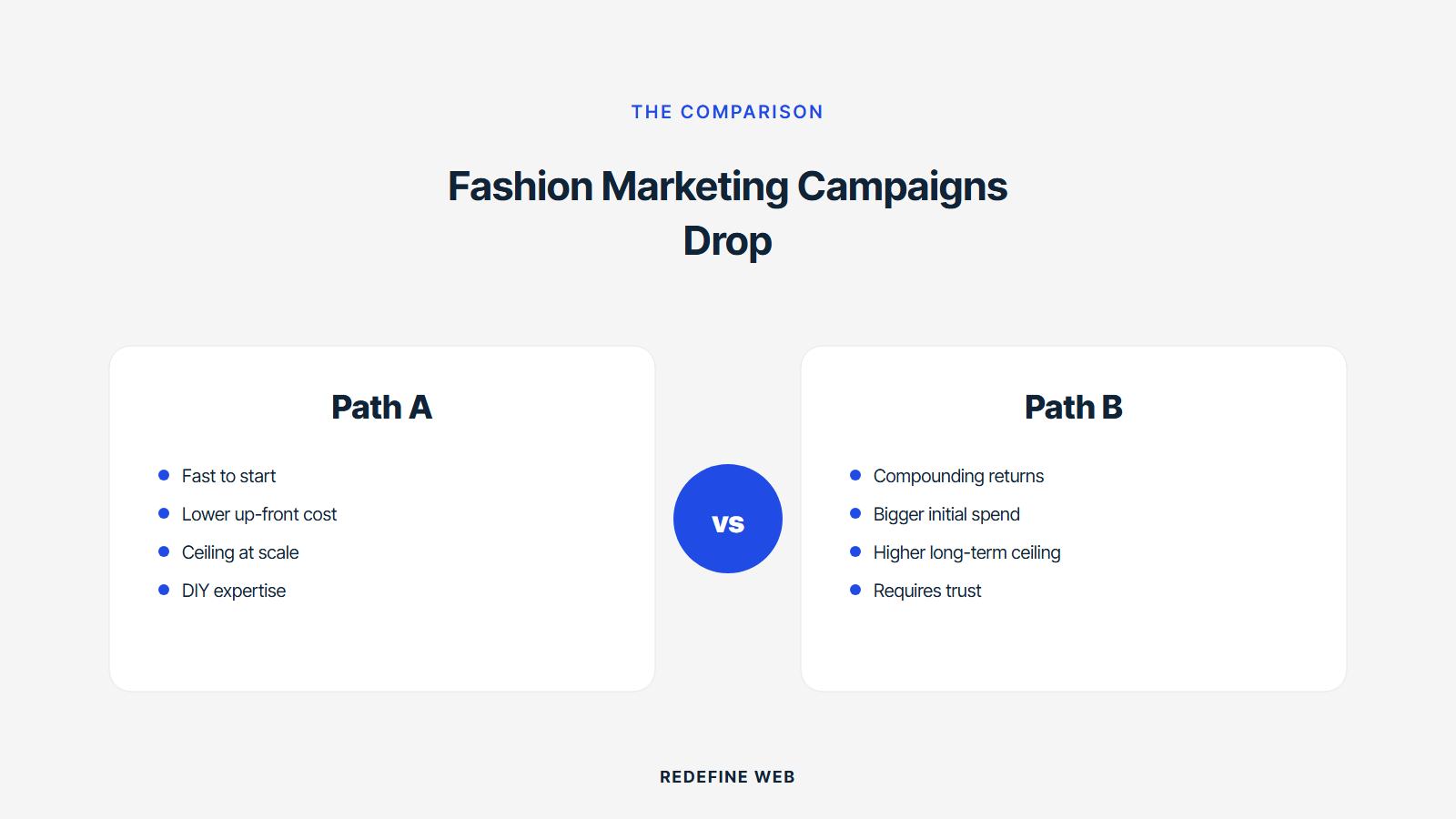
Paid social carries 35 to 55 percent of the campaign budget on most archetypes and is the single lever most brands over rotate around. Meta remains the primary channel for fashion, TikTok has grown to 25 to 40 percent of paid social spend, and Pinterest earns a real slot for accessories, home style, and adjacent categories where the audience saves before they buy.
Creative velocity is the constraint that limits paid social performance more than budget. A campaign that ships 6 to 12 new creative variants weekly across static, Reel, and TikTok formats outperforms the same budget on 2 to 3 variants by 30 to 60 percent on cost per order. Fashion audiences fatigue creative inside 5 to 9 days on the same face and product angle, and the retainer has to be structured to feed that fatigue rate rather than fight it. Meta’s own creative best practices reference is the source founders should read before they scope the shoot volume for a quarter.
The bidding structure matters as much as the creative. Cost cap on Meta with a conservative cap 15 to 25 percent below the target cost per order gives the algorithm room to hunt profitable audiences without spending into unprofitable ones. Lowest cost bidding with no cap eats budget on drop day when the algorithm senses conversion volume and inflates cost per order 20 to 40 percent inside 48 hours. Founders who inherit a Meta account bidding on lowest cost with no cap are looking at the top single lever available to improve campaign efficiency inside two weeks.
How do fashion marketing campaigns report honestly
Honest reporting on fashion marketing campaigns runs on four data streams reconciled inside one weekly Looker Studio dashboard. Shopify revenue by UTM and code. GA4 sessions and assisted conversion. Meta plus TikTok ads platform attribution. A post purchase survey on every order. Each stream lies on its own, and only the four together tell the truth.
The single biggest reporting mistake is trusting Meta’s own return on ad spend number as the campaign result. Meta over reports by 30 to 90 percent on fashion accounts because the pixel double counts view through and click through revenue that would have converted anyway. GA4 under reports because the model discounts paid social influence on longer consideration windows. Shopify tells the truth on first order revenue but nothing on assisted revenue. Post purchase surveys catch the audience that saw the campaign on TikTok, searched a week later, and bought through direct traffic. The four together reconcile inside a 5 to 8 percent margin on a well tagged account. The GA4 attribution model documentation is the source every founder should read before they argue about which number is correct.
The dashboard reports campaign level revenue against the campaign level budget with a 7 day and 30 day view. Anything shorter than 7 days is noise on a fashion buying cycle. Anything longer than 30 days is too late to change the current campaign trajectory. The founder reads the dashboard once a week on Monday morning before the review meeting, not once at the end of the campaign.
Fashion marketing campaigns in production
Boogie Board came to us with a DTC apparel adjacent site that ran a monthly drop cadence without a documented campaign structure. Drops shipped without a pre launch checklist, creative ran on 2 variants a week, paid social was bidding lowest cost with no cap, and the founder reviewed results at end of month when the quarter was already committed.
Our team rebuilt the program around the four archetype model. Drops moved to a 14 day pre launch window with the 14 item checklist. Seasonal pushes got their own budget line and a story led creative brief. Meta bidding switched to cost cap 20 percent below target cost per order. Weekly Monday review meetings replaced the end of month post mortem. Creative velocity climbed from 2 variants weekly to 9 variants weekly across static, Reel, and TikTok formats. Post purchase survey went live on every order inside the third week.
Over the following two quarters, first order revenue on drop archetypes grew 62 percent on the same paid budget. Seasonal push revenue grew 41 percent. Cost per order dropped 28 percent. Assisted revenue caught on the survey grew from an untracked line to 18 percent of measured revenue. The apparel fashion marketing hub covers how the wider retainer stack plugs into a campaign program like the one Boogie Board runs now.
Weekly review inside fashion marketing campaigns
The Monday review meeting is where a program earns the right to keep spending. 45 minutes, three agenda items, one decision. Read the dashboard. Review the top and bottom three ad creatives by cost per order. Decide whether the campaign continues into week two, gets a creative pivot, or gets killed. The founder is invited and expected to make the kill decision when the numbers warrant it.
Every Monday review meeting eventually reaches the moment where somebody points at the flat performing creative and asks if the founder wants to give it one more week. The founder always says yes. The creative always underperforms for a second week. Nobody remembers who first suggested the one more week. Somewhere in the archive of every apparel brand’s Slack, a flat creative is quietly generating more Monday meetings about itself than actual orders about anything.
The kill rule is simple. If the day 3 return on ad spend is below 40 percent of target and the day 7 return is below 60 percent of target, the campaign gets a 24 hour creative pivot or a full kill. Programs that hold underperforming campaigns for the full run out of hope produce the flat quarters that founders learn to fear. Programs that kill fast and reallocate to the winners produce the compounding quarters that make the retainer worth its rate. That single discipline is the top performance separator between the fashion accounts our team scales past $500,000 monthly and the ones that plateau at $180,000.
Where fashion marketing campaigns fit the wider stack
Fashion marketing campaigns sit above the always on retargeting layer and below the annual brand strategy inside the growth stack. Every retainer allocation, every creative brief, and every founder decision on inventory rolls up to the campaign calendar the pod is running against. Programs that budget for tactics without a campaign structure produce busy months with soft revenue. Programs that build the campaign structure first produce quarters where every published post, every ad, and every email adds up to a single growth arc.
The retainer that runs a campaign program starts at $599 monthly on a 6 month contract and scales with revenue. The retainer includes campaign calendar management, creative direction, paid social buying, creator liaison, and the Monday review meeting. Founders scoping the wider agency side should also read our fashion marketing agency guide for how the campaign work slots into the broader deliverable list. Two outside reads worth an hour before the first campaign kicks off. Meta’s creative best practices reference above for paid social. Google’s Google Shopping updates blog for the merchant feed side of the drop stack.
Frequently asked questions
What are the main types of fashion marketing campaigns for DTC brands?
Fashion marketing campaigns for DTC brands run in four working archetypes. Drop campaigns launch limited SKUs on a defined ship window with a scarcity mechanic and carry 45 to 60 percent of first order revenue. Seasonal pushes align to the fashion calendar (fall winter, spring summer, holiday, resort) and carry 20 to 30 percent. Collab campaigns pair the brand with a creator, retailer, or adjacent label to borrow audience and carry 10 to 18 percent. Awareness plays build audience for the next quarter and are measured on assisted revenue over 30 to 90 days instead of day one revenue. A working annual calendar rotates the four in a rough 3 drop, 2 seasonal, 1 collab, 1 awareness ratio.
How much do fashion marketing campaigns cost per month for a DTC apparel brand?
Fashion marketing campaigns cost $8,000 to $22,000 monthly for a brand under $80,000 in revenue, $22,000 to $80,000 monthly for a mid market brand between $80,000 and $250,000, and $80,000 to $250,000 monthly for a scaled brand above $250,000. The number covers paid social, paid search, creator seeding and paid collaborations, email and SMS operations, and site plus creative production. The retainer fee for the pod running the program starts at $599 monthly on a 6 month contract and scales with revenue band. Founders should track ad spend and pod retainer on separate lines so they can compare campaign to campaign without rebuilding the spreadsheet.
How do you plan a drop campaign inside fashion marketing campaigns?
A drop campaign runs a 14 day pre launch window. Ten days out, a hero Reel warms the interest audience without the price. Seven days out, an email teaser goes to the top 20 percent of the list. Four days out, a creator seeding pack ships to 30 to 60 hand picked micro creators. One day out, the countdown Story lands with a swipe up to a waitlist. Drop day, paid conversion campaigns switch on across Meta, TikTok, and Google Shopping in the same hour the site page goes live. Real scarcity mechanics (a capped run of 400 units labeled as such, a live inventory ticker on the product page) beat fake countdown timers that reset when a visitor returns and eat a Meta ad review warning inside a week.
Which KPIs should fashion marketing campaigns actually report against?
Fashion marketing campaigns report against a KPI stack that varies by archetype. Drop and seasonal campaigns report day 3 return on ad spend, day 7 return, first order revenue, cost per order, and add to cart rate. Awareness campaigns report assisted revenue over 30 to 90 days, brand search growth on Google Trends, unaided recall on a post purchase survey, and email list gain. Collabs add joint audience overlap and creator code redemption rate. All archetypes reconcile Shopify revenue, GA4 sessions, ads platform attribution, and post purchase survey answers inside one weekly Looker Studio dashboard. Reading only Meta's own return on ad spend number overstates campaign performance by 30 to 90 percent on typical fashion accounts.
How do fashion marketing campaigns split budget across channels?
A drop campaign splits budget 45 percent paid social, 10 percent paid search, 25 percent creator, 5 percent email and SMS, 15 percent site and creative. Seasonal pushes rotate to 40 percent paid social, 20 percent paid search, 15 percent creator, 10 percent email, 15 percent site. Collabs run heavier on creator at 30 percent and pull paid social down to 35 percent. Awareness plays lean 55 percent paid social with only 5 percent paid search. The always on baseline runs 50 percent paid social, 25 percent paid search, 10 percent creator, 10 percent email, 5 percent site. Splits shift by revenue band and season, and founders who lock a single split for a year leave 10 to 20 percent efficiency on the table.
Book your free 30-minute strategy call.
No spam, no sales rep. We use your email to schedule your call with a senior strategist. That is it.
More from the blog
View all articles → Digital Marketing
 Dental Marketing Tips That Compound Into New Patients
Read article Digital Marketing
 Ecommerce Marketing Strategies That Drive Real DTC Revenue
Read article Digital Marketing