
Food and Beverage Manufacturing SEO That Books B2B Buyers
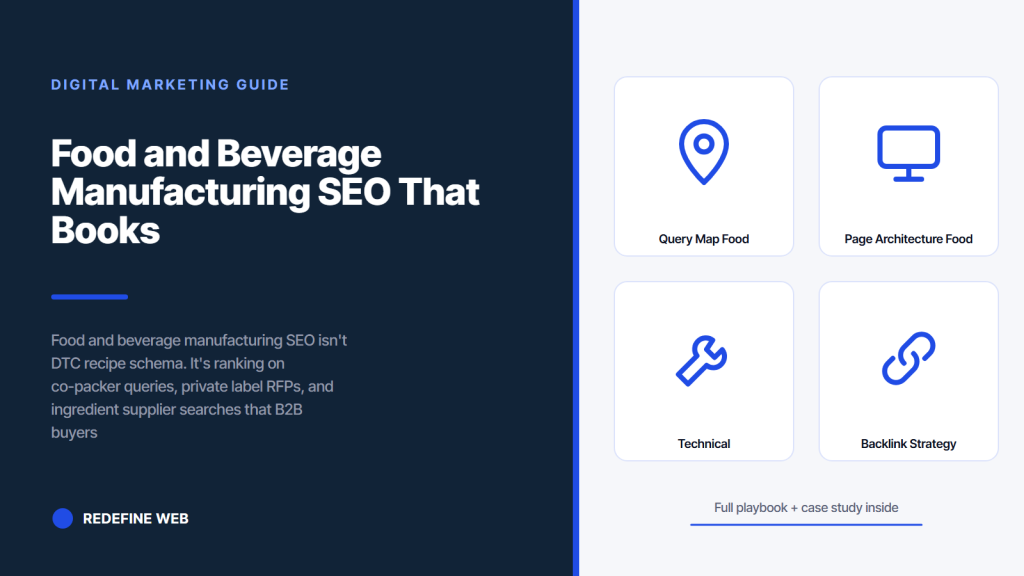
- Food and beverage manufacturing SEO targets B2B queries, not DTC recipe queries.
- Query map covers co-packer, private label, ingredient supplier, and certification.
- Retainer bands: $2.4k technical, $4.8k content, $9.6k full, $18k enterprise.
- Sales cycle 90-180 days extends SEO payback windows to month 9-12.
- One ranking can be worth $180k-$840k in annual contract revenue.
- Query map for food and beverage manufacturing SEO
- Page architecture for food and beverage manufacturing SEO
- Technical requirements for food and beverage manufacturing SEO
- Backlink strategy for manufacturing SEO
- Case study on Sansa Interiors Inc.
- Retainer bands for food and beverage manufacturing SEO
- Screening food and beverage manufacturing SEO shops
- Content cadence for food and beverage manufacturing SEO
- Analytics for food and beverage manufacturing SEO
- Making the pick for your manufacturing brand
Food and beverage manufacturing SEO is a different animal than DTC food SEO. The buyer isn’t a shopper looking for a $28 six-pack of cold brew at 10 pm. It’s a procurement lead at a mid-market CPG brand searching for “organic cold brew co-packer with California kitchen” or “private label hot sauce manufacturer minimum 5000 units.” The queries are longer, the intent is transactional, and the conversion path runs through an RFP form, not an add-to-cart button. Food and beverage manufacturing SEO ranks for these specific queries and converts B2B buyers who arrive with budget and timeline already defined.
You get the query map for food and beverage manufacturing SEO across co-packer, private label, and ingredient supplier categories, page architecture for a B2B manufacturer site, technical requirements, retainer bands, a Sansa Interiors case teardown, and a FAQ that answers what plant operations leaders ask on a first call. Read straight through in twelve minutes and you’ll know how to brief the SEO scope for a food manufacturing engagement.
Query map for food and beverage manufacturing SEO
Query map for food and beverage manufacturing SEO breaks into six intent categories. Co-packer searches (“organic cold brew co-packer California”, “gluten-free snack co-packer with SQF certification”). Private label RFPs (“private label hot sauce manufacturer minimum 5000 units”, “private label coffee roaster small batch”). Ingredient supplier searches (“organic cocoa nibs bulk supplier”, “gluten-free oat flour wholesale California”). Contract manufacturing (“contract beverage manufacturer with FDA facility”, “contract snack packaging with retail-ready trays”). Facility and certification (“SQF certified beverage co-packer”, “organic certified snack manufacturer NY”). And equipment and process (“HTST pasteurization co-packer”, “kettle cooking beverage co-packer”). Each category needs dedicated pages, structured differently than a DTC brand’s site.
Query volume per category runs lower than DTC queries but conversion rate runs 8 to 20 times higher because B2B buyers arrive with real intent and real budget. A single ranking on “organic cold brew co-packer California” can be worth $180k to $840k in annual contract revenue if the manufacturer converts one buyer per year off the query. Food and beverage manufacturing SEO ranks for these narrow high-intent queries specifically, and the ROI calculation runs on contract value per ranking, not on session count. See the Ahrefs guide to manufacturing SEO for the methodology adapted to the food category.
Co-packer queries and dedicated pages
Co-packer queries need dedicated pages segmented by product category and by facility feature. A manufacturer covering coffee, tea, and cold-pressed juice needs three separate co-packer pages: one for coffee, one for tea, one for cold-pressed juice. Each page ranks for its own category-specific query set. Adding facility features (organic-certified, kosher-certified, SQF-level-2, HTST pasteurization) as additional page dimensions creates more ranking surface area. Food and beverage manufacturing SEO builds this page matrix at kickoff. Generalists build a single “co-packer services” page and under-rank against manufacturers with dedicated per-category pages.
Private label pages for RFP capture
Private label pages capture RFPs from brands looking to launch new SKUs without their own manufacturing. Each private label page needs minimum order quantity (MOQ) stated clearly, lead time from concept to first production run, formulation flexibility (existing formulas versus custom), and packaging options (bottles, cans, pouches). MOQ transparency filters buyers before the RFP form and saves the manufacturing team from RFPs they can’t fulfill. Manufacturers that hide MOQ on private label pages waste sales time on unqualified inbound. Food and beverage manufacturing SEO puts MOQ above the fold on every private label page.
Page architecture for food and beverage manufacturing SEO
Page architecture for food and beverage manufacturing SEO differs from DTC brand architecture. Homepage that names capabilities and certifications above the fold. Capability pages segmented by product category (coffee, snack, beverage, condiment). Facility pages with photos, certifications, and equipment lists. Case study pages with client outcomes (under NDA where required). Ingredient sourcing pages if the manufacturer offers vertical integration. RFP or contact page with a form structured for procurement leads, not DTC shoppers. And a certification hub linking to all certifications with expiration dates visible. The whole site is B2B-shaped, not DTC-shaped.
The RFP form is where most manufacturing SEO projects lose conversions if the form is designed like a DTC contact form. A B2B RFP form needs product category, target launch date, expected annual volume, packaging format, existing formulation status (new versus reformulation), and certification requirements as required fields. Long forms scare off tire-kickers and capture serious buyers. Short forms capture volume that wastes sales cycles. Food and beverage manufacturing SEO tunes the form for real procurement flow, not for maximum form starts.
| Page type | Query intent | Conversion rate | Content depth |
|---|---|---|---|
| Category capability | Co-packer search | 4 to 8 percent | 1,800 to 2,600 words |
| Facility page | Certification search | 3 to 6 percent | 1,200 to 1,800 words |
| Private label | RFP intent | 6 to 12 percent | 2,200 to 3,200 words |
| Ingredient sourcing | Bulk supplier search | 2 to 5 percent | 1,400 to 2,000 words |
| Case study | Trust building | Assist role | 800 to 1,200 words |
Facility pages that rank on certification queries
Facility pages that rank on certification queries need certification badges visible in the first fold, expiration dates listed transparently, and audit history summarized. Buyers searching for “SQF Level 2 co-packer California” are qualifying manufacturers before any sales call. Facility pages that show expired certifications or hide audit history lose qualified inbound. Food and beverage manufacturing SEO structures facility pages with schema markup for LocalBusiness and Organization, plus custom schema for certifications where applicable. See the FDA FSMA guidance for the regulatory framework that shapes what buyers verify.
Case study pages for trust and social proof
Case study pages build trust and rank for brand-plus-capability queries (“organic cold brew co-packer used by [brand]”). Case studies under NDA can share vertical, volume band, and outcome without naming the client. Case studies with client permission share full name, quote, and metrics. Both formats work if the manufacturer runs enough case study pages to cover the capability matrix. Food and beverage manufacturing SEO builds three to eight case study pages in the first 90 days and adds two to four per quarter after. Manufacturers with under five case study pages under-rank against competitors publishing consistently.
Technical requirements for food and beverage manufacturing SEO
Technical requirements for food and beverage manufacturing SEO cover the standard SEO base plus a few B2B-specific items. Structured data across LocalBusiness, Organization, and Product schema (yes, capabilities count as products for schema purposes). XML sitemap segmented by page type. Core Web Vitals mobile LCP under 2.5 seconds. Image alt text describing capability and certification. Robots.txt allowing crawlers on facility and case study pages. And canonical tags on capability pages that share URL patterns. Manufacturing sites often have legacy technical issues (Flash animations, outdated CMS, slow servers) that need cleanup before rankings shift. Food and beverage manufacturing SEO delivers the audit first, fixes the base, and then publishes the content.
Server response time on manufacturing sites often runs 800ms-plus because sites live on outdated shared hosting. Moving to a modern host (Kinsta, WP Engine, or comparable) cuts TTFB to under 200ms and drives ranking gain that content alone can’t produce. Hosting migration runs one to two weeks depending on plugin complexity and pays back inside 90 days on mid-market manufacturing accounts. Food and beverage manufacturing SEO surfaces the hosting issue in the audit and recommends migration when TTFB is the ranking blocker.
Schema for manufacturing capability pages
Schema for manufacturing capability pages uses Product schema with the capability as the product name and the certification as the brand or manufacturer field. Aggregate ratings from client testimonials count if properly attributed. Offers schema with MOQ as the price base captures private label RFP intent. FAQPage schema on capability FAQ blocks opens up people-also-ask boxes on Google. Food and beverage manufacturing SEO deploys the full schema stack in the first 60 days of a retainer. Manufacturers running without capability schema stay invisible in rich results and lose click-share to competitors that deployed correctly.
Crawl budget on legacy manufacturing sites
Crawl budget on legacy manufacturing sites often runs poorly because sites accumulate orphaned URLs from redesigns, product page changes, and blog experiments abandoned mid-campaign. Google’s crawler wastes budget on 404s and thin content pages, missing the capability and case study pages that need indexing. Food and beverage manufacturing SEO runs a crawl budget audit in the first 30 days and cleans up 20 to 200 orphaned URLs typically. Post-cleanup, indexation rate on new content pages moves from 8 to 12 days down to 3 to 5 days. Faster indexation compounds ranking gain. See our food and beverage web design guide for how site architecture pairs with crawl budget cleanup.
Buyers search 'SQF-certified cold brew co-packer California'. If your page just says beverage manufacturer, procurement never finds you. Add certs to the H1.
Backlink strategy for manufacturing SEO
Backlink strategy for food and beverage manufacturing SEO differs from DTC brand strategy. Trade publications (Food Business News, BevNet, Food Dive, Snack Food & Wholesale Bakery) drive category-specific authority. Certification body pages (SQF, USDA Organic, Non-GMO Project) sometimes list certified manufacturers with backlinks. Association memberships (Specialty Food Association, IFT, ASBC) pass authority through member directories. Regional manufacturing directories link to local co-packers. And case studies published on client brand sites include backlinks to the manufacturer. Food and beverage manufacturing SEO targets all five sources across a quarterly outreach cadence.
Guest posts on trade publications carry less weight for manufacturers than editorial coverage because trade editors write about manufacturers directly when the news is category-relevant. A capacity expansion, a new certification, a partnership with a notable brand: all three earn editorial coverage without a guest-post pitch. Food and beverage manufacturing SEO pitches these newsworthy items to trade editors quarterly. Manufacturers without newsworthy activity fall back to guest posts and rely on the outreach volume compounding over a year.
Trade publication outreach patterns
Trade publication outreach patterns for food and beverage manufacturers use news-tied hooks. Capacity announcements (new production line, new facility opening). Certification earn-outs (SQF Level 3 achievement, USDA Organic renewal). Client partnership stories (with permission). Category trend commentary from the founder or plant manager. Each hook targets 5 to 12 trade publications with rolling pitches. Food and beverage manufacturing SEO runs the outreach as a monthly cadence, not a quarterly burst. Editors remember consistent pitchers over one-off outreach campaigns.
Certification directory backlinks
Certification directory backlinks from SQF, USDA Organic, Non-GMO Project, and other certification bodies pass authority to certified manufacturers listed in their directories. Ensuring the manufacturer’s listing includes a link back to the site (not just a name mention) requires occasional outreach to the certification body’s web team. Food and beverage manufacturing SEO checks each certification body’s directory quarterly and requests link additions where the listing exists without a hyperlink. Small effort, meaningful authority gain over 12 months.
Case study on Sansa Interiors Inc.
Sansa Interiors Inc. is a Toronto interior design firm specializing in modern residential spaces and hospitality venues, particularly cafes and restaurants. The parallels to food and beverage manufacturing SEO are direct. Traffic was flat, inbound relied on referral, press recognition was thin, and inquiries came in sporadically without a CRM to catch them. A general marketing shop would have suggested a paid boost. We rebuilt the site with SEO-first architecture, targeted vertical-specific pages for hospitality clients (cafes and restaurants), digital PR outreach into design and hospitality publications, and Google Ads capturing immediate high-intent inquiries.
The Sansa Interiors program delivered 641 percent organic traffic growth, moved annual inquiries from 18 to 133, and locked top-3 Google rankings for “interior designer in Toronto” and related national queries across 24 months. Press features landed in DesignMilk, Casa Vogue, Elle, and Chic Haus. The same operational pattern applies to a food and beverage manufacturer. Vertical-specific pages (co-packer capabilities per product category, private label RFP pages per format, facility pages per certification) qualify inbound before the sales call, the same way Sansa’s hospitality-specific pages qualified restaurant and cafe project inquiries.
| Sansa Interiors metric | Baseline | After 24 months |
|---|---|---|
| Organic traffic | Flat month over month | +641 percent |
| Annual inquiries | 18 in 2021 | 133 in 2023 |
| Google rankings | No first-page presence | Top 3 for target queries |
| Press features | None | DesignMilk, Casa Vogue, Elle |
Vertical-specific pages that qualify inbound
The 641 percent organic gain wasn’t a volume trick. Vertical-specific landing pages qualified inbound inquiries by educating on process, timeline, and budget bands before the discovery call. Inquiry-to-project conversion climbed alongside raw inquiry count because leads arriving already knew what they wanted. Food and beverage manufacturing SEO adapts the pattern with capability pages that educate on MOQ, lead time, certification, and formulation flexibility. Buyers arriving at the RFP form already qualify themselves. Sales cycle shortens by 30 to 45 percent inside 12 months on manufacturers running the pattern correctly.
Press features as domain authority anchors
Press features from DesignMilk, Casa Vogue, and Elle anchored Sansa’s domain authority. Editorial links from high-authority sites compound faster than any other backlink source. Food and beverage manufacturing SEO pursues editorial coverage in Food Business News, BevNet, Snack Food & Wholesale Bakery, and Food Dive as the equivalent set. One placement per quarter across the four publications delivers Domain Authority gain that content alone can’t produce. Manufacturers ignoring editorial outreach cap organic authority at whatever content plus low-quality directory links deliver.
Retainer bands for food and beverage manufacturing SEO
Retainer bands for food and beverage manufacturing SEO depend on scope, not on facility size. Technical-only retainer covering audit, schema, and Core Web Vitals runs $2,400 to $4,800 monthly. Content-plus-technical retainer adding four to eight capability, facility, or case study pages per month runs $4,800 to $9,600. Full-service retainer adding trade publication outreach and quarterly digital PR runs $9,600 to $18,000. Enterprise retainer with dedicated account lead and monthly content depth runs $18,000 to $32,000. Our own food and beverage retainer starts at $599 per month for smaller manufacturers on a maintenance-plus-organic package. Larger manufacturers land in the higher band because the operational depth is real work.
Payback math on manufacturing SEO retainers runs faster than DTC brand payback because each ranking is worth $180k to $840k in annual contract revenue. A single co-packer contract from an organic ranking recoups a full year of full-service retainer inside the first client. Manufacturing SEO retainers show tangible revenue by month five to seven and compounding gain from month twelve onward. Founders who cancel at month six lose the compounding entirely. Food and beverage manufacturing SEO retainers pay back through contract wins, not through session volume. See our food and beverage SEO services page for the retainer breakdown at the industry level.
Contract value math per ranking
Contract value math per ranking on food and beverage manufacturing SEO runs on annual contract value times expected close rate. A ranking on “organic cold brew co-packer California” pulls maybe 40 to 80 monthly qualified visits. Of those, maybe 4 to 12 fill out the RFP form. Of those, maybe 1 to 3 close as contracts. Contract value ranges $180k to $840k depending on volume and product. That’s $180k to $2.5M in annualized contract revenue from one keyword ranking. Food and beverage manufacturing SEO retainers pay back at those rates inside the first year.
Sales cycle length and retainer patience
Sales cycle length in food and beverage manufacturing runs 90 to 180 days from first inquiry to signed contract. This means SEO retainer payback windows have to include the sales cycle in the math. A ranking that starts driving inquiries in month six delivers signed contracts in month nine or later. Founders who evaluate SEO retainers on month-six revenue miss the compounding that shows up in month nine to twelve. Food and beverage manufacturing SEO sets expectations correctly at kickoff to prevent premature cancellation.
Our favorite pitch from a generalist SEO shop chasing a co-packer account promised “we’ll rank you for co-packer.” The plant operations lead asked which product category. The consultant said “just co-packer.” The lead asked if they’d checked the search volume for the generic term and the fact that the top ranking results are all category-specific pages. Ten seconds of silence. He signed with a food and beverage manufacturing SEO team that mapped his six product capabilities into a matrix of 47 category-plus-certification queries the following Wednesday. Turns out ranking for “co-packer” is not a plan.
Screening food and beverage manufacturing SEO shops
Screening food and beverage manufacturing SEO shops takes six specific questions in the first call. Manufacturing account count over 18 months (three-plus indicates category muscle). RFP form design for procurement leads (they should show a live example). Trade publication outreach placements in the last six months (name the publications). Capability page architecture for a multi-category manufacturer (they should draw the matrix). Schema deployment across capability, facility, and case study pages (live Rich Results Test demo). And Search Console screenshot showing manufacturer-specific commercial queries. Category specialists answer all six inside the first call.
Generalists chasing manufacturing SEO accounts deflect these questions or promise to circle back. The circle-back is the tell that the shop doesn’t run manufacturing accounts often enough to have the muscle memory built. Food and beverage manufacturing SEO shops with three-plus category accounts pull screenshots and RFP form examples live in the call. Watch response speed and specificity. Manufacturing SEO is a niche within a niche, and the specialists who run it well are rare enough that the answer speed reveals expertise quickly.
- Show me three food or beverage manufacturer SEO retainers run over 18 months and the specific contract wins delivered.
- Walk me through an RFP form design for a procurement lead versus a DTC contact form.
- Which trade publications have you earned editorial backlinks from in the last six months and how did the pitches read?
- Draw the capability page matrix for a manufacturer covering coffee, beverage, and snack co-packing.
- Deploy Product schema on a manufacturing capability page live in Google’s Rich Results Test right now.
- Show me a Search Console screenshot from a manufacturing account with names redacted but numbers intact.
The Search Console screenshot tells the truth
The Search Console screenshot tells the truth about a shop’s manufacturing category work. If the query list shows brand-name queries and generic “co-packer” terms, the shop is running a generalist template. If the query list shows category-plus-certification queries (“organic cold brew co-packer California”, “SQF Level 2 snack manufacturer”), the shop is running a food-manufacturing-native cluster strategy. If the screenshot doesn’t exist, the shop hasn’t run a food manufacturing account long enough to accumulate the data. Ask for the screenshot on the first call. Category specialists share it immediately.
Shop tenure on manufacturing accounts
Shop tenure on manufacturing accounts matters more than agency size. Ask how long the shop has run food and beverage manufacturing SEO retainers specifically. Under 18 months on food manufacturing and the muscle memory isn’t built. Under 36 months and complex work like capability page matrices plus trade publication outreach plus RFP form tuning is still learning-on-your-budget territory. Manufacturing SEO specialists retain their category muscle because the work is narrow and rewards repetition. Generalist shops rotate junior consultants onto manufacturing accounts and eat the ramp cost on your retainer.
Content cadence for food and beverage manufacturing SEO
Content cadence for food and beverage manufacturing SEO runs slower than DTC brand content but with higher revenue per page. Two to four capability, facility, or case study pages per month sustained across twelve months builds the ranking surface area needed to capture category queries. Faster cadences (six-plus pages monthly) usually trade quality for quantity and trigger thin-content signals on B2B queries. Slower cadences (one page monthly) delay compounding by twelve months and cost real contract revenue. Food and beverage manufacturing SEO sets the cadence at kickoff and holds the pace across quarters.
Content depth matters more than volume on manufacturing SEO. A 2,600-word capability page with detailed process description, equipment list, certification badges, MOQ, and lead time beats three 800-word capability pages every time on ranking and conversion. B2B buyers reading capability pages want depth and specificity. Thin capability pages signal to buyers that the manufacturer doesn’t have the depth to support their program. Food and beverage manufacturing SEO writes deep, not wide, and the retainer scope reflects that.
Capability page depth signals expertise
Capability page depth signals expertise to procurement buyers reading the page before a sales call. A 2,600-word capability page covers process description, ingredient sourcing options, equipment used, throughput capacity, MOQ, lead time, packaging formats, certification requirements met, quality control process, and case study links. Depth at this level filters unqualified buyers before the RFP form and captures qualified buyers with real intent. Food and beverage manufacturing SEO writes to this depth on every capability page. Manufacturers with thin capability pages lose to competitors publishing depth as standard practice.
Case study publication frequency
Case study publication frequency at one to two per quarter builds the trust content library that closes RFPs in the sales cycle. Each case study covers the client’s original challenge, the manufacturer’s solution (formulation, packaging, production), timeline from RFP to first production run, and outcome metrics if the client permits sharing. Case studies under NDA share vertical, volume band, and outcome without naming the client. Food and beverage manufacturing SEO delivers case studies as a repeating cadence and closes the loop between sales and marketing. See our food and beverage PPC breakdown for how paid channels support case study distribution.
Analytics for food and beverage manufacturing SEO
Analytics for food and beverage manufacturing SEO focuses on RFP-quality metrics, not session volume. Sessions and pageviews matter as leading indicators, but the real metric is qualified RFP submissions per month. A capability page ranking for a category-plus-certification query with high commercial intent might generate 60 monthly sessions and 6 RFP submissions. That’s the kind of ratio manufacturing SEO retainers report on. Reports focused on volume (“organic sessions up 40 percent”) without RFP quality reporting miss the actual business outcome.
The specific metrics that matter run five categories. RFP submissions per capability page per month. RFP-to-contract close rate over 90 to 180 days. Contract value distribution by SEO-driven inquiry versus other channels. Capability page ranking position for target queries. And backlink authority growth from trade publications quarter over quarter. Food and beverage manufacturing SEO reports on all five categories monthly. Shops that report on sessions and rankings only skip the outcome layer that justifies the retainer.
RFP tracking through CRM integration
RFP tracking through CRM integration closes the loop between SEO inquiries and closed contracts. Every RFP submission needs a source attribution field (organic search, direct, referral, paid) and a first-page attribution field (which capability page did they land on). The CRM tracks progression from RFP through discovery call, formulation development, first production run, and long-term partnership. Food and beverage manufacturing SEO reports read the CRM to attribute closed contract revenue back to the SEO-driven capability pages that first captured the inquiry. Without CRM integration, attribution is guesswork.
Leading indicators for manufacturing SEO health
Leading indicators for manufacturing SEO health predict lagging indicators 30 to 90 days out. Capability page ranking position changes predict RFP volume 30 days out. Ranking position drops of 3-plus positions predict RFP volume drops 20 to 40 percent inside 60 days. Backlink acquisition rate predicts Domain Authority movement 90 days out. Technical health regressions (Core Web Vitals slipping, indexation rate slowing) predict ranking drops 30 to 60 days out. Food and beverage manufacturing SEO reports include leading indicators alongside lagging ones so the account team catches drift before it hits contract revenue.
Making the pick for your manufacturing brand
Pick the specialist food and beverage manufacturing SEO shop if you need capability page architecture, RFP form tuning, trade publication outreach, or case study publication cadence. Pick a general B2B SEO shop if the site is a single-page brochure with no capability differentiation. Run both on scope split if you’re above $50M in revenue and can divide technical work from category-specific content work. Skip SEO entirely and focus on trade show outreach if you’re under $5M in revenue and product-market fit for co-packing services is still open. The retainer math doesn’t pay back at that stage on manufacturing SEO.
The last piece of advice is simpler than the whole guide. Have the sales call, ask the six screening questions, watch for live schema demos, review the Search Console screenshot, and trust the answers. Category specialists demonstrate. Generalists circle back. The circle-back is the tell. See our food and beverage marketing services page for the retainer scopes we run today. See the USDA per-capita food availability data for the category context that shapes capability page priorities at a food manufacturer.
Frequently asked questions
What makes food and beverage manufacturing SEO different from DTC food SEO?
Food and beverage manufacturing SEO targets B2B procurement buyers searching for co-packers, private label manufacturers, ingredient suppliers, and contract manufacturing capacity. Queries are longer, more specific, and lower in volume than DTC food queries. The conversion path runs through an RFP form, not a checkout button. Content depth on capability pages runs 1,800 to 2,600 words per page because procurement buyers read for specificity. Backlink strategy targets trade publications like Food Business News, BevNet, and Snack Food & Wholesale Bakery rather than editorial food media. And schema markup uses Product, LocalBusiness, and Organization to describe capabilities rather than Recipe schema to describe consumer content. The whole site is B2B-shaped, not DTC-shaped.
How much does food and beverage manufacturing SEO cost per month?
Technical-only retainer covering audit, schema, and Core Web Vitals runs $2,400 to $4,800 monthly. Content-plus-technical retainer adding four to eight capability, facility, or case study pages per month runs $4,800 to $9,600. Full-service retainer adding trade publication outreach and quarterly digital PR runs $9,600 to $18,000. Enterprise retainer with dedicated account lead and deeper monthly content runs $18,000 to $32,000. Our own food and beverage retainer starts at $599 per month for smaller manufacturers on a maintenance-plus-organic package. Larger manufacturers land in the higher retainer band because the operational depth is real work. Payback runs faster than DTC SEO because each ranking is worth $180k to $840k in annual contract revenue.
What kind of pages does a food and beverage manufacturer site actually need?
Seven page types carry the load on a food and beverage manufacturer site. Homepage naming capabilities and certifications above the fold. Capability pages segmented by product category (coffee, snack, beverage, condiment) each 1,800 to 2,600 words deep. Facility pages with photos, certifications, and equipment lists. Case study pages with client outcomes under NDA where required. Ingredient sourcing pages if the manufacturer offers vertical integration. Private label pages with MOQ, lead time, and packaging options stated clearly. And an RFP or contact page with a form structured for procurement leads. The whole site targets category-plus-certification queries specifically, not generic co-packer terms with zero conversion intent.
How long does food and beverage manufacturing SEO take to pay back?
Tangible ranking gains show up between month three and six on technical fixes and initial content. Compounding revenue from contracts closed off SEO-driven inquiries shows up between month nine and twelve because the manufacturing sales cycle runs 90 to 180 days from first inquiry to signed contract. A ranking that starts driving inquiries in month six delivers signed contracts in month nine or later. Founders evaluating retainers on month-six revenue miss the compounding gain. One signed co-packer contract typically pays back a full year of full-service retainer, so payback math runs faster than DTC SEO once the first contract closes. Sales cycle patience is required, but the math works when the retainer runs at least twelve months.
Which trade publications should a food manufacturer target for backlinks?
Four trade publication categories drive the highest-authority backlinks for food and beverage manufacturers. Food Business News covers ingredient sourcing, capacity expansions, and category trends. BevNet covers beverage industry news and product launches. Food Dive covers policy, regulation, and industry moves. Snack Food & Wholesale Bakery covers snack category news specifically. Each publication accepts news-tied pitches on capacity announcements, certification earn-outs, client partnership stories, and category trend commentary. Guest posts carry less weight than editorial coverage because trade editors write about manufacturers when the news is category-relevant. Pitching newsworthy items quarterly to all four publications delivers Domain Authority gain that content alone can't produce.
How do I screen a food and beverage manufacturing SEO shop in one call?
Ask six specific questions and watch how fast the answers land. Show me three food or beverage manufacturer SEO retainers run over 18 months and the specific contract wins delivered. Walk through an RFP form design for a procurement lead versus a DTC contact form. Which trade publications have you earned editorial backlinks from in the last six months. Draw the capability page matrix for a manufacturer covering coffee, beverage, and snack co-packing. Deploy Product schema on a manufacturing capability page live in Google's Rich Results Test right now. Show a Search Console screenshot from a manufacturing account with names redacted but numbers intact. Category specialists demonstrate. Generalists circle back after the call. The circle-back is the tell that the shop doesn't run manufacturing accounts often enough to have the muscle memory built.
Book your free 30-minute strategy call.
No spam, no sales rep. We use your email to schedule your call with a senior strategist. That is it.
More from the blog
View all articles → Digital Marketing
 Dental Marketing Tips That Compound Into New Patients
Read article Digital Marketing
 Ecommerce Marketing Strategies That Drive Real DTC Revenue
Read article Digital Marketing