
Food and Beverage PPC That Turns Grocery-Priced SKUs into Orders
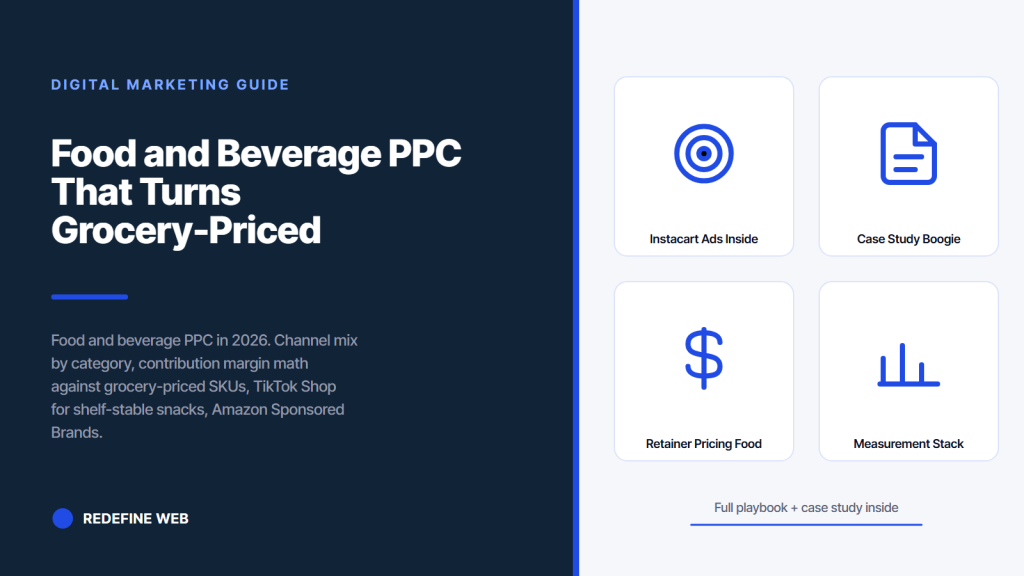
- Food and beverage PPC starts with feed hygiene and contribution margin math.
- Channel mix shifts by category from TikTok Shop to Amazon and Instacart.
- Amazon Sponsored Brands video outperforms static by 30 to 60 percent ROAS.
- Boogie Board program drove revenue at 31 dollars cost per conversion at scale.
- Retainers run 3,200 to 22,000 dollars per month excluding ad spend.
- Meta Advantage Plus Shopping inside food and beverage PPC
- Instacart Ads inside food and beverage PPC
- A food and beverage PPC case study on Boogie Board
- Retainer pricing for food and beverage PPC
- Measurement stack inside food and beverage PPC
- Red flags in a food and beverage PPC agency proposal
- Wrapping up food and beverage PPC selection
Food and beverage PPC is the paid media discipline of turning DTC snack, functional beverage, alcohol, and grocery ecommerce budgets into orders on Meta, TikTok, Google, Amazon, and Instacart. Every category inside food and beverage carries different regulatory rules, different platform ad policy restrictions, and different unit economics that a general apparel PPC agency will miss. In 2026, the food and beverage PPC winners are running clean product feeds, category-specific creative that names ingredients, and Amazon Sponsored Brands campaigns tuned to the shelf placement math inside Whole Foods, Sprouts, and specialty grocery.
This guide walks the working scope for food and beverage PPC in 2026. Channel mix by category, target CPA math against contribution margin, Meta Advantage Plus Shopping structure, TikTok Shop for shelf-stable DTC snacks, Amazon Sponsored Brands versus DTC feed math, alcohol platform ad policy compliance, and the Boogie Board case study on 31 dollar cost per conversion at scale. If a founder is picking a paid media partner in the next 30 days, this is the filter that separates a real food and beverage PPC operator from an apparel agency stretching into a new vertical.
Meta Advantage Plus Shopping inside food and beverage PPC
Meta Advantage Plus Shopping runs catalog-based creative that Meta generates dynamically from the product feed, pulls in creator assets through Brand Partnership Ads, and optimizes bidding on value-based lookalikes tied to first-party purchase data. The setup takes two to four hours per campaign the first time and drives 45 to 65 percent of typical food and beverage Meta revenue by month three. Food and beverage brands running Advantage Plus need feed titles that include SKU size, flavor variant, and dietary certifications (organic, gluten-free, vegan) to catch the specific search intent.
Feed hygiene before any Meta spend
Feed hygiene before any Meta spend covers clean SKU titles (brand plus flavor plus size), a lifestyle plus product-only image pair, GTIN completeness on every variant, dietary certification tags in the custom label fields, and category taxonomy accurate to Google Merchant Center and Meta Commerce Manager. Skip the feed audit and the first 30 days of paid social burns 20 to 40 percent of budget on broken variants and low-quality-scored listings. A working partner audits and remediates the feed inside week one.
Creative volume the Meta algorithm expects
Meta Advantage Plus in the food and beverage vertical needs 8 to 15 fresh creatives uploaded every two weeks to prevent creative fatigue on high-frequency retargeting audiences. The creative mix is roughly 40 percent creator-produced content, 30 percent brand-produced lifestyle featuring the product in a real-use scene, 20 percent product-only stills with ingredient callouts, and 10 percent user-generated content pulled from tagged posts. Skip the creative refresh cadence and CTR drops 20 to 40 percent in month two.
Instacart Ads inside food and beverage PPC
Instacart Ads inside food and beverage PPC covers featured product placement inside grocery search results, category takeovers on grocery-adjacent search terms, and shoppable video units targeting recipe search intent. The platform runs on pay-per-click at 0.40 to 1.80 dollar CPC depending on category. Instacart drives 15 to 25 percent of digital grocery revenue for brands with distribution at Kroger, Sprouts, Publix, or Wegmans. Skip Instacart and the brand leaves 15 to 25 percent of trackable digital grocery attribution on the table.
Featured product placement on grocery search
Featured product placement on Instacart grocery search places the brand SKU at the top of category search results (coffee, protein bar, sparkling water) inside the Instacart app. The click-through rate on featured placement runs 3 to 6 percent versus 1 to 2 percent on organic Instacart search results, and the conversion rate to add-to-cart runs 15 to 30 percent. Instacart Ads reporting closes the loop on paid attribution better than most food and beverage brands realize because the platform reports the actual grocery basket the SKU landed in.
Category takeover budgets and duration
Category takeover budgets on Instacart run 4,500 to 22,000 dollars per week per category takeover depending on category size and time of year. Peak categories (protein bars, sparkling water, coffee) during peak periods (January new year, summer, holiday gifting) command the top of the range. Off-peak categories in shoulder seasons run at the floor. A working food and beverage PPC partner books category takeovers 8 to 12 weeks in advance for peak periods, following the calendar our food and beverage web design team maps against retailer promotional windows because Instacart sells out top slots for major categories in tight timeframes.
A food and beverage PPC case study on Boogie Board
Boogie Board, the creator of the first reusable writing tablet in 2009 and a pioneer of sustainable digital writing with liquid crystal technology, worked with Redefine Web on a scaled PPC program targeting DTC ecommerce and Amazon marketplace revenue. The brand came in with strong product-market fit, an educated customer base, and a paid media program that had plateaued at unsustainable cost per conversion. The prior agency had run generic Meta prospecting without a clear feed hygiene pass or catalog structure.
We rebuilt the paid structure around Meta Advantage Plus Shopping with a cleaned product feed, layered Amazon Sponsored Brands with dedicated video creative on the top three SKU families, and added Google Search branded protection plus non-branded category keywords targeting sustainable-writing and educational-tablet search intent. The program layered creator whitelisting through Meta Brand Partnership Ads on the top-performing organic creator content. Every campaign fed a treatment-specific landing page with schema markup and one-second load times.
The combined program drove Boogie Board revenue at 31 dollars cost per conversion at scale, with return on ad spend consistently above the target margin threshold across Meta, Amazon, and Google channels. The same integrated buildout sits inside our food and beverage marketing hub today. Boogie Board now runs the same paid playbook with the internal marketing lead operating monthly optimization on top of the initial buildout, and the model translates cleanly to food and beverage brands with similar sustainable and functional positioning.
Skip Meta ROAS benchmarks. Take per-unit contribution margin. Divide by payback period. That's your target CPA, not what an apparel deck said.
Retainer pricing for food and beverage PPC
A working food and beverage PPC retainer runs 3,200 to 22,000 dollars per month depending on channel count, monthly ad spend, and creative production scope. The floor is 3,200 for a single-channel Meta engagement with 20,000 to 40,000 monthly ad spend. The mid-range is 6,500 to 12,000 for a Meta plus Google plus Amazon engagement with 50,000 to 150,000 monthly spend. The upper range is 12,000 to 22,000 for a multi-channel program with TikTok Shop, Amazon Brands video, Instacart Ads, and creator whitelisting management.
Contribution margin tiers by food category
| Category | Typical gross margin | Contribution margin per unit | Target CPA range |
|---|---|---|---|
| Shelf-stable snacks | 55 to 65 percent | 3 to 6 dollars | 2 to 5 dollars single unit or 12 to 22 bundle |
| Functional beverages | 40 to 55 percent | 2 to 4 dollars | bundle only, 14 to 26 for 12-pack |
| Coffee and tea | 60 to 70 percent | 8 to 18 dollars per bag | 5 to 12 dollars single unit |
| Alcohol | 45 to 55 percent | 12 to 28 dollars per unit | 8 to 20 dollars with age-gate |
| Baby food and formula | 35 to 50 percent | 2 to 5 dollars per unit | subscription capture only, 18 to 32 |
What the retainer excludes
Every serious food and beverage PPC retainer excludes ad spend, creator flat fees, tool licenses (Triple Whale, Northbeam, Perpetua for Amazon), and creative production fees for shoots that go beyond the included 8 to 15 static ads per month. Founders reading a proposal that folds ad spend into the retainer number are looking at an agency that will overspend on paid to justify the retainer, which structurally misaligns incentives on tight food and beverage margins.
Measurement stack inside food and beverage PPC
Measurement is the layer that separates a serious food and beverage PPC partner from a proposal deck. The stack that actually works in 2026 combines platform-native attribution (Meta pixel with Conversions API, TikTok pixel with Events API, Google Ads with GA4, Amazon Attribution), server-side event forwarding through a CDP or a GTM server container, and post-purchase survey data through Fairing or KnoCommerce. Each layer catches purchases the other two miss because food and beverage buyers often complete purchase 3 to 7 days after first ad exposure across multiple devices.
Amazon Attribution for retail-adjacent tracking
Amazon Attribution measures the impact of off-Amazon paid channels (Meta, TikTok, Google) on Amazon sales, which matters heavily for food and beverage brands with 40 to 65 percent of revenue coming through Amazon retail versus DTC. Setup takes 4 to 6 hours and needs a fresh Amazon Attribution account plus tag placement on every off-Amazon ad campaign. Skip Amazon Attribution and the brand undercounts paid channel contribution to Amazon revenue by 25 to 45 percent.
Conversions API and events API setup
Meta Conversions API and TikTok Events API forward server-side conversion data to the platforms directly, catching 20 to 35 percent of purchases the browser-side pixel misses because of iOS App Tracking Transparency and cookie decay. The setup runs through Shopify native integration for Shopify stores or through Stape, Elevar, or a custom GTM server container. According to the Meta developer documentation on Conversions API, event match quality above 8.0 is the minimum for reliable optimization on Advantage Plus campaigns in the food and beverage vertical.
Red flags in a food and beverage PPC agency proposal
Every food and beverage founder reads at least one PPC proposal a quarter promising guaranteed 4x ROAS across channels for 1,800 dollars a month. The red flags below catch the majority of these pitches before the founder signs a contract that produces spend without profit. One agency once proposed a proprietary AI-powered performance engine that turned out to be Google Sheets with conditional formatting and a cookie-cutter Meta ads template. The template was consistent. The AI was not present.
- Guaranteed ROAS numbers across channels. Nobody can guarantee ROAS on paid social with algorithm changes week to week and iOS attribution decay running 20 to 35 percent.
- Ad spend folded inside the retainer number. This misaligns incentives and produces overspend that justifies the retainer on tight food and beverage margins.
- No mention of contribution margin per SKU in the discovery call. If the pitch skips the margin math, the target CPA is guesswork.
- No named measurement stack. Meta Conversions API plus TikTok Events API plus Amazon Attribution plus post-purchase survey is the minimum in 2026.
- No regulatory review workflow on alcohol or claims-heavy categories. Missing this catches the brand a warning letter within 60 days.
- No Amazon Sponsored Products setup where the brand has retail presence. Alone that leaves 30 to 45 percent of trackable revenue on the table.
Green flags in a real food and beverage PPC pitch
Green flags: contribution margin math done during the discovery call, named measurement stack with Conversions API and Events API and Amazon Attribution setup covered, regulatory review workflow on alcohol and claims-heavy categories, Amazon Sponsored Products and Brands setup where the brand has retail presence, Instacart Ads coverage where the brand has grocery distribution, and case studies with named brands plus specific CPA numbers over six months. Any proposal hitting five of these six is worth a second meeting inside the week.
Wrapping up food and beverage PPC selection
Food and beverage PPC in 2026 comes down to six operational disciplines: feed hygiene, contribution margin math against tight grocery-priced SKU economics, lifecycle-mapped channel mix that includes Amazon and Instacart where distribution supports it, TikTok Shop for shelf-stable snacks, regulatory compliance on claims and age-gated categories, and a measurement stack with Amazon Attribution layered on top of platform-native pixels. Programs running all six produce compounding paid revenue growth with clean unit economics visible every month.
Real programs like the Boogie Board engagement produce 31 dollar cost per conversion at scale by pairing paid media with product feed rebuild and platform-specific creative on the same team. If a food and beverage brand is picking a paid media partner in the next 30 days, ask three agencies for line-item scopes with named tooling, contribution margin math, regulatory review coverage, and case studies with real brand names and real CPA numbers. Book a call with our food and beverage marketing retainer team and we will walk through the last three food and beverage PPC programs we ran end to end.
Frequently asked questions
What does food and beverage PPC actually cover?
Food and beverage PPC covers Meta Advantage Plus Shopping, TikTok Ads Manager including Shop Ads for shelf-stable snacks, Google Search plus Performance Max, Amazon Sponsored Products and Brands, Instacart Ads for grocery-adjacent brands, and Pinterest Idea Ads for recipe-driven audience segments. The scope is a portfolio that runs cold prospecting on TikTok and Meta, retargeting on Meta, branded search protection on Google, Amazon Sponsored campaigns where the brand has shelf presence, and Instacart Ads where the brand distributes through grocery.
How much does food and beverage PPC cost per month?
A working food and beverage PPC retainer runs 3,200 to 22,000 dollars per month depending on channel count, monthly ad spend, and creative production scope. The floor is 3,200 for a single-channel Meta engagement with 20,000 to 40,000 monthly ad spend. The mid-range is 6,500 to 12,000 for a Meta plus Google plus Amazon engagement with 50,000 to 150,000 monthly spend. The upper range is 12,000 to 22,000 for a multi-channel program with TikTok Shop, Amazon Brands video, Instacart Ads, and creator whitelisting management layered in.
What target CPA should a food and beverage brand set?
Target CPA on food and beverage paid social depends heavily on category margin. Shelf-stable snacks at 55 to 65 percent gross margin support 2 to 5 dollar target CPA on single-unit purchase and 12 to 22 on bundle purchase. Functional beverages at 40 to 55 percent margin need bundle-only targeting at 14 to 26 dollars for a 12-pack. Coffee and tea at 60 to 70 percent margin support 5 to 12 dollar target CPA. Alcohol at 45 to 55 percent margin runs 8 to 20 dollars with age-gate compliance. Baby food runs subscription-capture only at 18 to 32 dollars per acquisition.
Should a food brand run Amazon Sponsored Brands or Sponsored Products first?
Both Amazon Sponsored Brands and Sponsored Products should run together with roughly 60 to 75 percent budget on Sponsored Products for keyword-plus-SKU intent and 20 to 30 percent on Sponsored Brands for brand video and store-front takeovers on category search results. Click-through on Sponsored Brands runs 0.6 to 1.4 percent versus 0.3 to 0.7 percent on Sponsored Products, and the Amazon Store conversion rate runs 8 to 15 percent versus 4 to 8 percent on individual product detail pages. Video Sponsored Brands convert at 2 to 4 times the rate of static.
How does Instacart Ads fit into food and beverage PPC?
Instacart Ads covers featured product placement inside grocery search results, category takeovers on grocery-adjacent search terms, and shoppable video units targeting recipe search intent at a 0.40 to 1.80 dollar CPC. Instacart drives 15 to 25 percent of digital grocery revenue for brands with distribution at Kroger, Sprouts, Publix, or Wegmans. Category takeover budgets run 4,500 to 22,000 dollars per week and need booking 8 to 12 weeks in advance for peak periods like January new year, summer, and holiday gifting when top slots sell out quickly.
What measurement stack does food and beverage PPC need?
The stack that actually works in 2026 combines platform-native attribution (Meta pixel with Conversions API, TikTok pixel with Events API, Google Ads with GA4, Amazon Attribution), server-side event forwarding through a CDP or a GTM server container, and post-purchase survey data through Fairing or KnoCommerce. Amazon Attribution measures off-Amazon paid channel impact on Amazon sales, catching 25 to 45 percent of paid contribution the platform pixels miss. Conversions API and Events API catch another 20 to 35 percent of purchases browser-side pixels miss from iOS attribution decay.
Book your free 30-minute strategy call.
No spam, no sales rep. We use your email to schedule your call with a senior strategist. That is it.
More from the blog
View all articles → Digital Marketing
 Dental Marketing Tips That Compound Into New Patients
Read article Digital Marketing
 Ecommerce Marketing Strategies That Drive Real DTC Revenue
Read article Digital Marketing