Knowing how to choose a web design and development company is the difference between a site that books leads and a build that runs 8 weeks late, burns $22,000, and gets rebuilt inside 18 months. The pattern behind every horror story is the same. The founder picked on price or a slick sales deck instead of portfolio depth, ownership clauses, and retainer scope.
This guide walks through 7 signals we use to separate a real web design and development company from a template shop. Portfolio depth. Discovery call quality. Proposal completeness. Ownership discipline. Retainer clarity. Timeline honesty. Red flags in the first 2 conversations. Read straight through in 9 minutes.
Portfolio pattern matching before you shortlist any web design and development company
The portfolio is the first filter and the fastest. A serious web design and development company shows 8 to 15 recent projects with named clients, live URLs, and one or two lines on outcome. A template shop shows 40 sites with the same hero pattern and no outcome data. The gap is visible in 5 minutes of scrolling.
Match the portfolio to your scope band, not to your taste. A team that builds small business sites will not stretch to a 60-page mid-market site without dropping half the integrations. A team at $50K+ will overserve a $12K single-owner site and price you out of the retainer. Ask for 2 to 3 case studies at your scope band before the discovery call.
Portfolio signals that separate real work from stock work
Look for revenue attribution on at least 2 case studies. Rankings gained (see the framework in our SEO web design and development guide). Leads booked. Bookings closed. Any portfolio that shows launches without post-launch numbers is a design gallery, not proof of work. The best web design and development company treats every case study as evidence, and every piece of evidence gets a number.
Vertical depth beats vertical breadth
An agency with 4 sites in your industry beats an agency with 40 sites across 40 industries. Vertical depth means the team already knows your customer’s search behavior, your compliance rules, and the integrations your platform needs. That saves 2 to 4 weeks of discovery. Ask for past projects in your vertical before you book a call. The answer decides whether the call is a fit review or a sales pitch.
Discovery call quality tells you if the web design and development company can run your build
A real discovery call runs 45 to 75 minutes and covers business goals, revenue targets, current traffic and conversion numbers, CMS preference, integration list, timeline, and budget band. A weak call runs 20 minutes, asks about page count, and lands a proposal the next day. The first tells you the agency plans to scope your project. The second tells you they plan to template it.
The single most useful signal on the discovery call is how many questions the agency asks about revenue. An agency that skips revenue targets is going to build a portfolio piece for its own gallery. One that anchors the call in booked leads and closed revenue is going to build for your business. Count the revenue questions. If it’s under 3, keep looking.
Discovery questions worth hearing on the first call
What are the top 3 pages that book leads today. What is your current cost per lead. Which integrations are non-negotiable. What is the CMS ownership plan. Who signs off on design and copy internally. What does year two look like from your side. Any agency that runs a first call without hitting at least 4 of these is walking through a script. Real teams follow the answers.
Proposal completeness separates a real web design and development company from a template shop
A real proposal covers scope, timeline, team roles, pricing, payment schedule, revision limits, out-of-scope handling, retainer scope, and ownership clauses. Any proposal that skips one of these leaves 20 to 40 percent of the contract undefined. That gap is where 3-month delays, midpoint invoices, and post-launch surprise bills live. Read every proposal end to end. Ask about missing sections. Any team that gets defensive about a proposal question is not the team to hire.
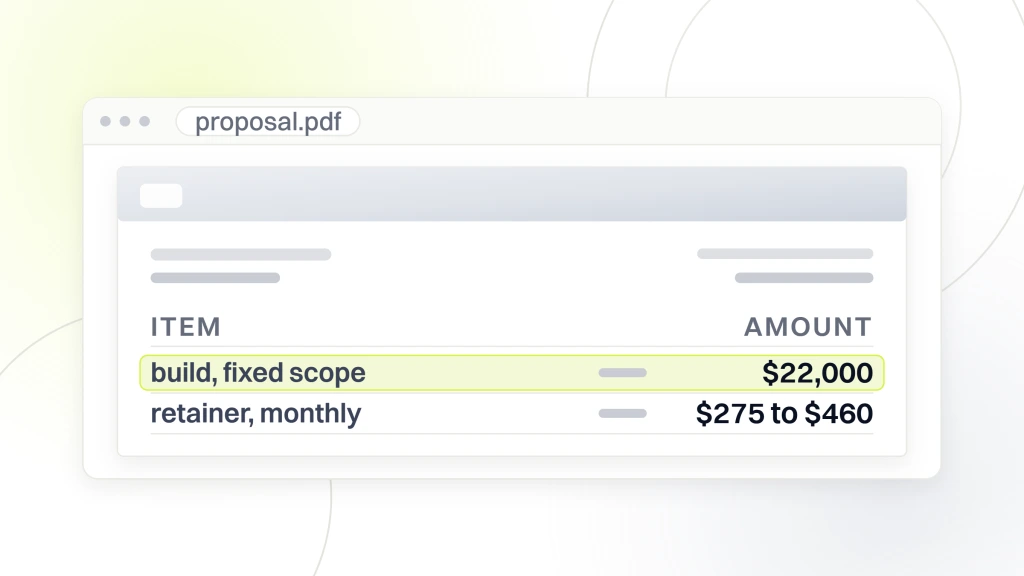
The best web design and development company hands you a proposal that reads like a contract, not a brochure. Clean scope. Weekly milestones with named owners. Fixed price or hourly cap with a stated escalation policy. 25/50/25 payment schedule. Two revision rounds per page. Documented rate for out-of-scope work. Retainer scope on the same PDF. Ownership of code, CMS credentials, analytics, and domain in writing.
| Proposal section | Template shop version | Real agency version |
|---|---|---|
| Scope | Vague page count | Line-item page list |
| Timeline | Total weeks only | Weekly milestones with owners |
| Revisions | “Endless” or “as many as you need” | 2 rounds per page, documented |
| Retainer | Discussed post-launch | Priced on same PDF |
| Ownership | Not mentioned | Code, CMS, analytics, domain |
| Out-of-scope | Not mentioned | Documented hourly rate |
Scope clarity down to the page list
Real scope lists every page. Home. About. Services (with sub-pages named). Locations (with count). Blog index. Contact. Legal. Any page marked “TBD” will end up as a change order at midpoint. The best web design and development company writes the full page list into the scope before signing. Any team that hedges on page count is going to bill you for pages 25 to 40 in month three.
Retainer scope on the same PDF as the build quote
Part of knowing how to choose a web design and development company is reading the retainer section before signing. A retainer that shows up in the proposal is one you can price against. A retainer discussed post-launch is one you cannot compare. Every real agency prices the retainer on the same document. Monthly rate, response times, included hours, escalation cost. Retainer typically runs 15 to 25 percent of the build annually. A $22,000 build points to a $275 to $460 monthly retainer for standard scope. Any agency that will not commit to retainer scope before signing is either padding it for later or has never actually run one at your scale.
Ownership clauses that a real web design and development company writes into every contract
Ownership is the single line in a proposal that decides whether you have a website or a rental. Ownership of code. Ownership of CMS credentials. Ownership of analytics accounts. Ownership of domain registration. Ownership of every third-party account tied to the site (call tracking, email platform, chat, CRM). Any web design and development company that hedges on any one of these ownership lines is not the company to hire. Ownership discipline is the cleanest signal of a team that plans to earn year two on merit, not on lock-in.
Watch for the CMS trap. Some agencies build on their own proprietary CMS, keep the credentials on their side, and structure the contract so the site cannot migrate without them. That is vendor lock-in dressed up as a service model. Every real web design and development company builds on an open-standard CMS (WordPress, Webflow, Contentful, Sanity, headless React with a documented backend, using the web design and development tools real agencies standardize on) and hands over full admin credentials at launch. See MDN on web platform standards for the open-standard baseline every real agency assumes.
Code ownership in writing
The proposal states that you own the code repository, that the code lives in your GitHub or GitLab organization, and that the agency has commit access as a paid contractor. Not the other way around. Every rule on how to choose a web design and development company includes this one. Any agency that keeps the repository on their side is one CTO departure away from you losing the site. Code ownership is the boring clause that saves the founder from an ugly conversation two years in.
Analytics ownership from day one
You own the GA4 property. You own the Search Console verification. You own the call tracking account. You own the tag manager container. The agency gets user-level access as a contractor. Any agency that installs analytics on their account with your site as a property is going to make your data hostage to the retainer. Own the analytics from day one. Force the conversation now, before the proposal gets signed.
Retainer scope tells you what year two with the web design and development company looks like
Every real build ends with a retainer offer, not as an upsell. A site that loses attention post-launch degrades inside 90 days. Plugin updates lag. Broken links accumulate. Content gets stale. Conversion drifts. The retainer scope inside the proposal tells you what year two costs and delivers.
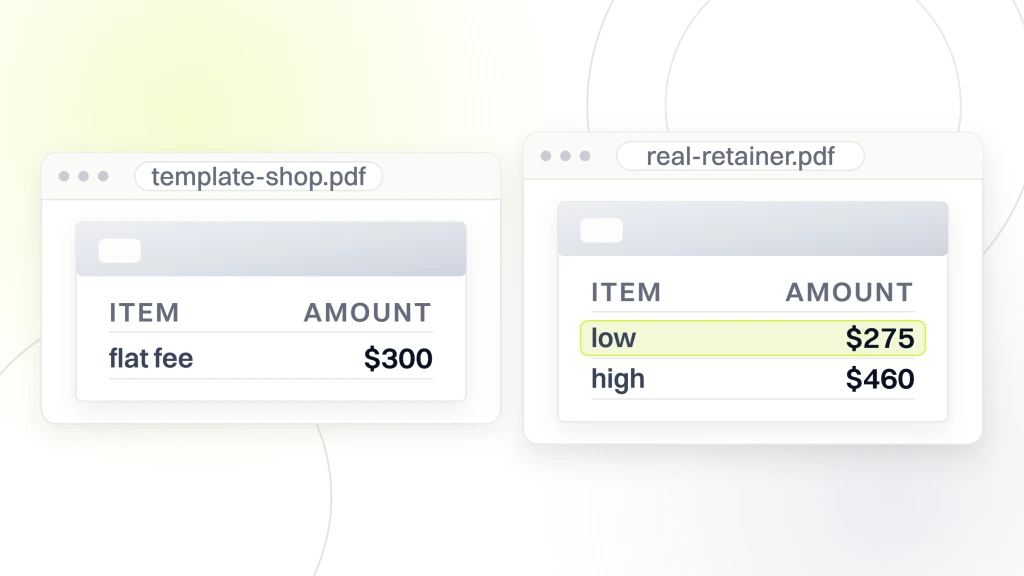
A real retainer covers monthly plugin and framework updates, a monthly conversion-rate audit, quarterly content refresh on 4 to 8 pages, ongoing accessibility fixes, monthly reporting on rankings and lead flow, and a response SLA on outages. Retainer under 10 percent of build annually is reactive only. Retainer above 30 percent is padding scope you do not need. 15 to 25 percent is where the best web design and development services price it.
Retainer inclusions worth asking for
Monthly plugin and framework updates. Monthly uptime and performance monitoring. Monthly Core Web Vitals report. Quarterly content refresh on 4 to 8 pages. Quarterly conversion-rate testing (A/B or heatmap-driven). Ongoing accessibility scans and fixes. Monthly ranking and lead flow reporting. A defined response SLA. Any retainer that lists fewer than 6 of these inclusions is thin. Any retainer that lists 12+ inclusions at $300 per month is overpromising and will underdeliver on half.
Retainer exit clause worth reading
Ask what happens if you leave the retainer. Do you keep the code, the CMS credentials, the analytics accounts, the domain, and the third-party service accounts. If any one of those goes with the agency, the retainer is not a service, it is a hostage situation. Any real team will answer the exit question in one paragraph. Anyone who dodges it is telling you what the working relationship really looks like.
Timeline honesty separates the best web design and development company from a sales team
Real timelines are boring. A small business site takes 4 to 6 weeks. A local business site with 15 to 25 pages takes 6 to 12 weeks. A mid-market site with 30 to 60 pages takes 10 to 20 weeks. A custom web application takes 12 to 24 weeks. Any agency that promises a mid-market build in 4 weeks is either quoting a template or setting you up for a slipped deadline. Any agency that quotes 20 weeks on a single-owner service site is understaffed for your project.
Timeline honesty shows up in the weekly milestone breakdown. Week 1 discovery and architecture. Weeks 2 to 3 design system and template design. Weeks 4 to 6 template development. Weeks 7 to 9 page production and integrations. Week 10 QA and accessibility. Week 11 launch prep and content migration. Week 12 launch. Any team that will not commit to a weekly breakdown before signing has not run enough builds. Keep looking.
Ask five agencies to quote the same project and you will get five timelines. 3 weeks, 6 weeks, 10 weeks, 14 weeks, and one team who asks for a discovery call before quoting. Book the fifth. The other four are quoting a fantasy, and fantasies do not launch clean websites.
Weekly cadence during the build
Real agencies run a weekly status call with a written recap sent within 24 hours. Loom videos on Friday for anything visual. A shared project board with tickets in flight visible to the client. Any team that will not commit to a weekly cadence is going to disappear for 2-week stretches during production and reappear at midpoint asking for a scope-change payment. Weekly cadence decides whether a build launches on week 12 or slips to week 18.
Slippage handling that respects both sides
Sometimes a build slips. A key integration surfaces new complexity. Content review takes longer than expected. The best web design and development agency handles slippage with a clear message inside 48 hours, a revised schedule, and a shared decision about what to cut or extend. Bad agencies hide the slippage until launch week and hand over a broken site. Ask about slippage handling on the discovery call.
Web design and development company near me versus a remote agency
Location matters less than delivery discipline in 2026. A local team can meet you for coffee. A remote team can staff a paired designer and developer inside a week. Both models work. Process beats proximity. Ask any web design and development company near you about their weekly cadence, revision loop, and handoff documentation. The team with tight answers wins regardless of zip code.
Our own delivery covers clients across the US, Australia, and Europe fully remotely. One representative rebuild replaced two underperforming Sydney sites (6 ranking keywords, conversion under 1 percent) with a single SEO-driven build. A $22,000 scope, paired designer and developer team, launched in 12 weeks. Inside the first year the site generated $60K+ in bookings, grew to 800+ monthly visitors, and ranked for 300+ keywords. The best web design and development agency for your project is the one whose process fits, not the one closest to your office.
Remote process discipline
Remote agencies win on process discipline. Loom videos replace hallway conversations. Notion or Basecamp replaces the whiteboard. Weekly recorded calls with written recaps replace the drop-in. A tight remote agency runs a cleaner project than a loose local agency most of the time. Ask for a Loom walkthrough of the agency’s own project management setup on the discovery call. Any team that can show their tools in 5 minutes can be trusted to run your build in 12 weeks.
Timezone match on the paired team
The one place location still matters. Timezone overlap on the paired designer plus developer team. A team that spans 12 hours across time zones will have days where a design decision waits 18 hours before development picks it up. Ask which time zones your paired team lives in. Ask what the overlap window is. Any web design and development company that runs a paired team in adjacent time zones (or with a full 4-hour daily overlap) delivers faster than a team split across the globe. Timezone match beats geographic proximity.
Red flags on how to choose a web design and development company inside two conversations
Some signals show up inside the first 2 conversations if you know where to look. A quote inside 24 hours of first contact. A portfolio with no vertical depth. A discovery call under 30 minutes. A refusal to name the project manager. A retainer described as “we can talk about that after launch.” A CMS on the agency’s platform with no export path. A pricing chat that skips revenue targets. Any 2 of these together mean walk. Any 3 mean run.
The biggest red flag is a proposal that lands inside 48 hours of first contact. Real proposals take 3 to 7 business days for small business scope, 7 to 14 days for mid-market or custom scope. Anything faster is a template with your logo pasted onto page one. See Smashing Magazine on agency pricing transparency for the broader industry pattern. The template proposal underquotes to win the deal, then reprices at midpoint through scope changes.
- Red flag 1: Quote inside 24 hours of first contact.
- Red flag 2: Portfolio with zero revenue attribution.
- Red flag 3: Discovery call under 30 minutes.
- Red flag 4: No named project manager.
- Red flag 5: Retainer scope deferred to “after launch.”
- Red flag 6: Proprietary CMS with no export path.
- Red flag 7: Ownership clauses missing from proposal.
Portfolio red flag worth catching early
A portfolio that shows 40 sites, all in different verticals, all with the same layout patterns, is a template shop. A portfolio that shows 12 sites, 4 of which look genuinely custom and 4 of which sit in your vertical, is a real agency. Template shops can build a fine small business site. They cannot build a mid-market site without dropping half the integrations. Match your scope to the shop honestly.
Pricing red flag inside the first quote
A $3,500 quote on a mid-market scope is a red flag. A $75,000 quote on a small business scope is a red flag. Any quote that comes in more than 40 percent below the market spread on your scope band is underquoting to win the deal, and the midpoint invoice will surface every gap. Fair pricing tracks the tier ranges. $6K to $14K single-owner. $14K to $32K local business. $32K to $80K mid-market. Match your scope to the range. Any quote that lands wildly outside the range is a warning, not a bargain.
Reference checks and past-client conversations before signing
Ask for two past-client references at your scope band. Not testimonials on the website. Phone numbers of founders who signed proposals in the last 18 months. A 20-minute call with a past client tells you more about the working relationship than any sales deck. Past clients will name the project manager, describe the revision loop, and explain what happened when the timeline slipped.
Real web design and development pros share references without hesitation. They know their past clients will vouch for them. Any team that hedges, or offers only clients from 3+ years ago, is telling you what the recent working relationship looks like. Ask what worked and what did not. Ask if they would hire the team again. The answers are the cleanest E-E-A-T signal on the shortlist.
Reference questions worth asking
Did the project launch on the original deadline. Did the retainer scope match what was promised. Did the ownership handoff go clean at launch. Were there surprise invoices during production. Did the retainer response times match the SLA. Would you hire the team again. 6 questions. 20 minutes on the phone. The best info you will get on any agency’s real delivery pattern comes from a founder who has lived it.
Reference red flag worth catching
Any team that offers only glowing references from clients still on the retainer is protecting current revenue. Ask for one reference on active retainer and one who has since moved off. The founder who moved off will tell you what the wind-down looked like, and that is often the most useful signal on the whole shortlist. Real agencies handle both types of request without pushback.
Pick your web design and development company and start the shortlist this week
The final step in learning how to choose a web design and development company is running a shortlist. Start with three shortlisted agencies. Any more and you are running discovery calls all week. Any fewer and you cannot compare apples to apples. Get a portfolio walkthrough from each. Get a proposal from each. Compare the proposals side by side on the six sections that matter. Scope, timeline, revisions, retainer, ownership, out-of-scope handling. The winner is usually visible inside 20 minutes of side-by-side reading.
Ready to run the process. For a full-stack conversation, see our web design and development services. If the scope is small business, our web design services for small business covers the fixed-price entry point. For a WordPress-specific build, see WordPress website development services. For post-launch scope, our monthly website maintenance packages map the retainer scope. And for cost math on all of this, our web design and development cost guide walks through the tier pricing in full.