
Real estate website design templates cost $30 to $300 up front and go live in 3 to 10 business days. A custom brokerage site starts at $18,000 and takes 10 to 14 weeks. That price gap and that timeline gap decide 95% of the pick. What most agents miss is the third variable. The SEO ceiling on a template caps at about 40 to 60 first-page ranking keywords for local queries. A custom build clears 200 to 500 inside 12 months. If you’re a solo agent closing 12 deals a year, the template pays for itself in a week. If you’re a 20-agent team writing $80 million in gross commission, the template ceiling costs you 40 to 80 buyer inquiries a month that a custom build would catch.
This guide walks the tradeoff. You’ll get the cost bands on both sides, the SEO gap in real ranking numbers, the IDX vendor depth math, the segment-fit framework that tells you which side you belong on, and the pattern we run for teams that outgrow their template. Two named client cases anchor the tradeoffs. McCarthy Court sold all 7 luxury units in 3 months off a fully custom site. Abels Residential ranks for 280 keywords and books 20 qualified leads monthly off a custom SEO rebuild. Neither would have hit those numbers on a template. Read the guide, run your own math against the 4 segment-fit questions in section 5, and pick right the first time so you don’t waste 12 months on a tier that caps your pipeline growth.
Cost bands for real estate website design templates in 2026
Templates split into four price tiers, and each tier ships a different depth of feature. Free templates run $0 and cover about 30% of what a working agent needs. Basic paid templates cover $30 to $70, semi-custom themes cover $100 to $300, and premium real estate CMS themes with IDX integration cover $300 to $1,200 with an annual renewal.
Free templates on WordPress.org, Wix, and Squarespace look fine at first click but skip the workflow depth that closes buyers. No IDX integration. No lead-capture-to-CRM flow. No property-page schema markup for Google’s rich results. Basic paid themes at $30 to $70 add property listing layouts and search filters, but the theme author usually ships one style variation and no ongoing updates past year one. Semi-custom themes at $100 to $300 cover most agent needs and include 6 to 12 months of vendor support. Premium themes at $300 to $1,200 come with IDX plugin bundles, agent profile pages, neighborhood templates, and CRM hooks. A working solo-agent stack with a premium theme, IDX add-on, and hosting lands at $1,500 to $3,500 in year one.
Custom real estate website design starts at $18,000 for a boutique brokerage build and climbs to $95,000 for a developer or estate-office scope. The middle band, $25,000 to $45,000, covers most 5-to-20-agent teams. This is where the template vs custom math gets real. A 10-agent team on a $200 premium theme spends about $3,500 in year one on the site stack. The same team on a $28,000 custom build spends $28,000 up front plus a $1,499 monthly retainer past launch. Year one custom cost lands at $45,988. That’s a 13x delta. The question is whether the delta pays back inside 24 months on closed transactions the template wouldn’t have captured. For most teams above 8 agents, it does. For solo agents and 2-person duos, it usually doesn’t. Google Search Central’s how search works documentation covers the technical patterns that separate a $200 theme from a $30,000 build in loading speed and Core Web Vitals results, and the same signals feed into our real estate marketing retainer scope.
Where these templates actually win the pick
Templates win on 4 fronts. Speed to launch, low up-front cost, proven baseline patterns, and vendor-maintained code. Any of those four wins carry enough weight to justify a template for the right agent profile.
Speed to launch matters most for a new agent under 24 months into their license. A template goes live in 5 to 10 business days with IDX integration active on day one. A custom build takes 10 to 14 weeks minimum. Losing 3 months of lead capture at a new agent’s ramp stage is worth more than the visual polish gap between the two options. The Nashville agent who joined Compass in January and needs a working site by March picks a template every time, and it’s the right call.
Low up-front cost matters when the agent’s marketing budget hasn’t cleared $500 monthly yet. A $200 theme plus $50 monthly hosting plus $59 IDX plugin subscription totals about $900 in year one after setup labor. That’s inside the reach of an agent closing 6 to 12 deals annually. A $28,000 custom build wipes out an entire year’s marketing budget for the same agent and starves the paid ad and CRM stack that actually generates the pipeline. Rank the spend by conversion impact, not by ambition.
- New agent under 24 months. Template wins on speed and cost. Custom is overkill.
- Solo agent closing 6 to 12 deals a year. Template wins on ROI math. Custom pays back in year 4 at best.
- Buyer’s agent on a team of 5+ where the brokerage owns the main site. Template on the agent’s personal page is fine. The brokerage carries the SEO weight.
- Investor or wholesaler running Facebook ads to a landing page. Template with a Carrot or InvestorFuse foundation covers 95% of the workflow.
- Rental agent covering one submarket. Template with an IDX rental feed covers the search needs. Custom SEO is unnecessary.
Custom real estate website design is where the math flips
Custom real estate website design flips the math above a certain team size and transaction volume, and this is where the real estate template vs custom design gap starts to matter. The tipping point is usually 8 to 12 agents on a team, $30 million to $50 million in annual gross commission, or a specialty niche the template market doesn’t serve (luxury, off-market portfolios, commercial leasing, real estate investment).
The SEO ceiling gap is the single biggest driver. A template ranks well for 40 to 60 local keywords in year one after solid on-page work. A custom build with proper site architecture, dedicated neighborhood pages, and structured schema clears 200 to 500 keywords in the same window. The 4x to 8x ranking difference translates to 40 to 80 extra buyer inquiries a month for a mid-market brokerage. At a $12,000 average commission on a $400,000 median home price, even one extra closed transaction a month from that inquiry stream pays the custom build back inside 30 months.
McCarthy Court is the pattern in action. A 7-unit luxury Sidcup development that sold 100% pre-completion in 3 months off a fully custom site we built. The site pulled 60 qualified buyer leads and 10,000 targeted campaign visits during the pre-launch window. Full occupancy at pre-completion pricing on a $2.4 million average unit price. Try that off a $200 real estate template and the buyer sees the same visual language as every 3-agent brokerage in town. The template signals commodity. The custom build signals category leadership. In luxury, developer, and commercial verticals, the signal decides the pipeline. Reference reading on the design-to-brand-signal pattern lives at the National Association of Realtors technology survey at the NAR reports library, which tracks the working technology stacks agents run.
Real estate website templates vs custom on IDX depth
IDX integration is the make-or-break workflow feature for any working agent site. IDX (internet data exchange) is the feed protocol that pulls live MLS listings into your site so buyers can search and save properties. The template market covers IDX at 3 depth tiers, and the custom market covers a fourth tier the template market can’t touch.
Tier one is the plugin-based IDX at $59 to $99 monthly. iHomefinder, IDX Broker, and Showcase IDX all offer plugin integration that drops into most WordPress real estate templates. The buyer searches, the results load inside a plugin-controlled iframe, and the SEO value on those search pages is close to zero since the content isn’t indexable. This tier covers most solo-agent and small-team needs at a low monthly cost.
Tier two is the API-integrated IDX at $149 to $299 monthly. Placester, Real Geeks, and BoomTown ship IDX inside their proprietary CMS with better search UX and lead-capture flows. The tradeoff is you’re locked into the vendor’s platform. If Placester raises prices or drops a feature you rely on, you migrate the whole site.
Tier three is the semi-custom IDX build at $2,500 to $8,000 one-time, running on top of a WordPress or Webflow template. A developer writes indexable property pages that inherit the template’s design but render property data server-side for SEO. This tier bridges the template and custom worlds and works well for teams that outgrow the plugin tier.
Tier four is the fully custom IDX integration inside a custom build at $8,000 to $22,000 as part of the site scope. Server-rendered property pages, custom search UX, deep CRM integration, and a full lead-scoring flow. The SEO ceiling on custom IDX pages clears 500 to 2,000 indexable property URLs, each earning small amounts of long-tail search traffic that compounds into 20 to 40% of the site’s total organic leads inside 18 months. Templates can’t match this tier because the plugin architecture can’t ship server-rendered property pages at scale.
The real estate template vs custom design segment-fit framework
The segment-fit framework runs on 4 questions. Answer them honestly and the template vs custom call becomes obvious. Answer them with wishful thinking and you buy the wrong tier and regret it inside 12 months.
Question one. How many transactions do you close annually across the team? Under 24 transactions, template wins on cost math. 24 to 100 transactions, semi-custom is the sweet spot. Above 100, custom pays back inside 18 to 24 months. Question two. What’s your total marketing budget per month after payroll? Under $2,000 monthly, template. $2,000 to $8,000 monthly, semi-custom. Above $8,000 monthly, custom. The site is a channel, not a stand-alone spend, so it competes for budget with paid ads, CRM software, listing photography, and lead nurture.
Question three. What’s your niche and does the template market serve it well? Residential in a competitive metro is well-served by templates. Luxury, developer, commercial leasing, off-market portfolios, and real estate investment are not. If you’re one of the last four, custom is a near-mandatory pick since the template market’s aesthetic and workflow patterns don’t match your buyer’s expectations. Question four. How long do you plan to hold the site before the next rebuild? Under 3 years, template. 3 to 5 years, semi-custom. Above 5 years, custom, since the amortized annual cost on a $30,000 custom build over 6 years is $5,000, which lands close to the annual cost of a premium template stack anyway. our real estate website design retainer scope covers the industry benchmarks on rebuild cycles by segment.
The SEO ceiling on templates and why it caps at 120 keywords
The SEO ceiling on the template side is real, measurable, and roughly the same across every major theme in the market. A well-optimized template on a competent hosting stack ranks for 40 to 60 first-page keywords in year one and plateaus at 80 to 120 keywords by year two. Beyond that plateau, the template’s architecture becomes the bottleneck.
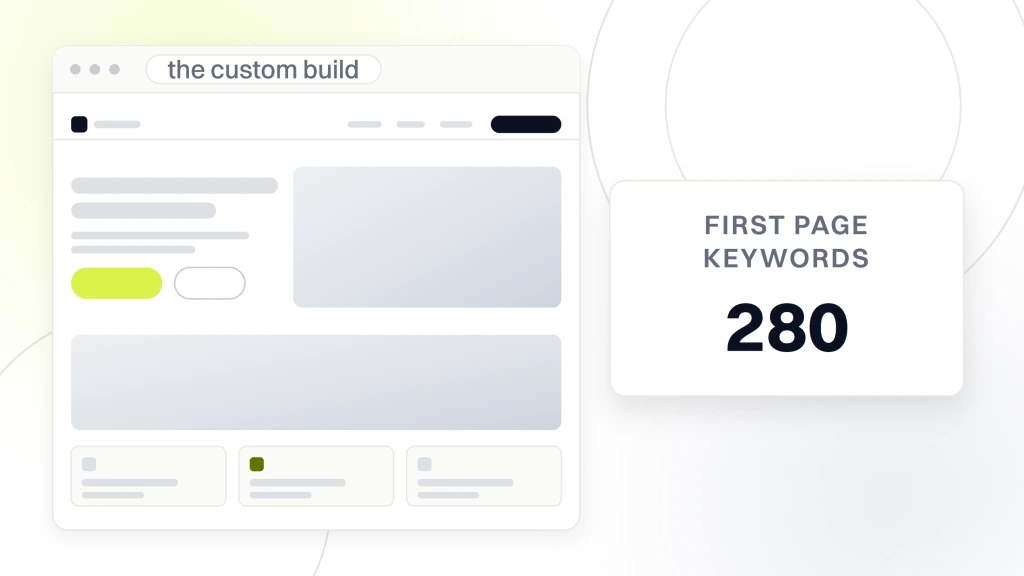
Three architectural limits drive the ceiling. First, the property search pages render inside a plugin iframe that Google can’t index deeply. So the long-tail buyer searches like “3-bedroom colonial Nashville 37209” don’t produce indexable landing pages. A custom build ships each property URL as a server-rendered page with a full open graph, schema markup, and internal linking depth. Second, the neighborhood and area pages on templates are usually 3 to 8 pages of thin content generated by an area-page module. A custom build ships 30 to 150 neighborhood pages with 400 to 1,200 words of unique content each, plus embedded market data. Third, the blog and content architecture on templates locks into the theme’s default category and tag structure, which usually can’t support a topic-cluster site plan.
Abels Residential is the SEO-side proof point. A London letting agency that entered the market with a fully custom site plus on-page and off-page SEO targeting London rental keywords. Today the site ranks for 280 keywords, produces 20 qualified leads per month, and holds a sub-2-second page load. On a template, the same agency would have plateaued at 60 to 100 keywords and captured maybe 6 to 8 leads monthly. The 14-lead monthly gap, at a $2,400 lifetime rental commission per lead, is $33,600 in monthly revenue the template ceiling would have cost. That’s how the SEO gap compounds. Reference reading on template-vs-custom SEO patterns lives in Google Search Central’s real estate listing structured data documentation.
Templates vs custom side by side across 8 dimensions
The comparison table below covers the 8 dimensions that decide the pick. Print it, sit with your business partner, and rate your team on each row before you commit to either side.
| Dimension | Template | Custom build |
|---|---|---|
| Up-front cost | $30 to $1,200 | $18,000 to $95,000 |
| Year-one total (stack) | $900 to $3,500 | $25,000 to $110,000 |
| Time to launch | 5 to 10 days | 10 to 14 weeks |
| SEO ceiling (year 2) | 80 to 120 keywords | 200 to 500 keywords |
| IDX depth | Plugin iframe | Server-rendered pages |
| Brand differentiation | Low. Reads as familiar. | High. Reads as distinctive. |
| Vendor lock-in | Low if WordPress, high on SaaS | None if properly scoped |
| Payback window (mid-team) | Weeks | 18 to 30 months |
The right pick maps to where you sit on those 8 rows. If 6 or more of your answers favor the template column, buy the template. If 6 or more favor the custom column, budget the custom build. If it’s a 4-4 split, run the semi-custom tier as the middle path. This is how the pick gets made without wishful thinking distorting the math.
Upgrading from a real estate template to custom design
The upgrade path from a template to a custom real estate website design runs cleanly if you plan for it. Skip the planning and the migration wipes out 6 months of SEO progress. Do the planning right and the custom build inherits the template’s traffic and keeps the ranking momentum.
Three planning moves matter most. First, keep the URL structure identical across the migration. If the template runs property pages at /properties/{address}/, the custom build ships the same URL pattern. Any URL that changes needs a 301 redirect mapped and tested before launch. Second, export the template’s content library (blog posts, neighborhood pages, agent bios) and rewrite each piece into the custom site’s content architecture before the DNS switch. Third, run a full technical audit on the custom build in staging for 2 weeks before launch, focusing on schema markup, page speed, mobile responsiveness, and internal linking depth. Reference reading on migration best practices lives at our monthly website maintenance packages, which cover the technical checks needed before DNS switch.
Budget the retainer past launch honestly. A custom real estate website design ships as launch-ready but needs monthly working attention to compound the value. Redefine Web ships production sites at 3 fixed tiers. SMB Starter at $2,500, SMB Growth at $4,500, and SMB Pro at $7,500. Full custom builds start at $12,000. The retainer past launch runs $1,499 monthly for the working designer engagement. Skip the retainer and the site goes stale inside 90 days as new listings sit in a WordPress default template instead of the branded editorial pattern. Vendors who let clients skip the retainer produce sites that plateau at 6 months. Vendors who insist on the retainer produce sites that compound past year 3.
Template mistakes agents keep making
Agent template mistakes cluster around six patterns we see on almost every audit. Fix all six inside 60 days and the template stack starts producing 30 to 50% more qualified inquiries without adding a dollar to the ad budget.
- Buying the theme with the prettiest demo. Demo photos disguise weak IDX integration. Test the search flow first.
- Skipping the SSL and hosting audit. Cheap $3 hosting drops Core Web Vitals scores and kills mobile rankings. Budget $25 to $50 monthly.
- Ignoring the property page schema. No RealEstateListing schema markup means no rich results in Google. Fix the theme’s schema output.
- Not connecting IDX to a proper CRM. Leads that land in a WordPress inbox get lost. Wire IDX to Follow Up Boss or Sierra Interactive.
- Leaving neighborhood pages as auto-generated thin content. Google demotes thin pages. Rewrite each neighborhood page to 400 to 800 unique words.
- Skipping the mobile page-speed check. 70% of real estate searches happen on mobile. Test on 4G, not fiber.
Order to fix them. Fix the schema markup first since it delivers the fastest ranking payback. Add the CRM connection second so the leads you already generate don’t get lost. Rewrite neighborhood pages third since each page compounds into ongoing traffic. Upgrade hosting fourth if Core Web Vitals scores fall below 75 on mobile. Test the IDX search flow at week 5 and swap plugins if the UX is friction-heavy. Audit page speed at week 8 and rework the theme’s image sizes if pages load past 3 seconds on mobile. Batch the six fixes over 60 days rather than trying them all at once, so you get clean analytics on what actually moved the numbers.
The right pick for your real estate website design templates call
The right pick for the templates vs custom call comes down to matching the tier to your business stage and your marketing budget. Solo agents and duos pick templates. Teams of 5 to 12 pick semi-custom or upgraded templates with a serious IDX integration. Teams above 12 agents pick custom. Luxury, developer, commercial leasing, and investor brands pick custom regardless of team size, since the template market’s aesthetic patterns undermine the brand signal buyers filter on.
Run the segment-fit questions honestly. Run the SEO ceiling math against your keyword targets. Run the IDX depth analysis against your buyer’s search behavior. Run the year-one total cost math with the retainer past launch included. Those four checks give you a defensible pick you can present to a business partner or a brokerage principal without hand-waving. If the math points to a template, buy the template and skip the aspiration overspend. If the math points to custom, budget the full year-one investment plus the retainer and stop second-guessing the number. The engaged retainer past launch is where the returns compound. Skip it and you own an expensive site that ages badly. Commit to it and you own a compounding asset. Our full custom web design and development retainer covers the full working scope, including the template-to-custom migration pattern above and the SEO handoff that keeps the numbers compounding past the launch window.
Real estate template vs custom design. Pick the tier that fits your stage
Templates are the right pick for solo agents, new agents inside their first 24 months, small duos, and residential brokerages under 8 agents in year one. Custom real estate website design is the right pick for teams above 8 agents, luxury brokerages, developers, commercial leasing brands, and investor-focused brokers where the brand signal decides pipeline. The middle band, 5 to 12 agents, works with a semi-custom build that hybrids the two approaches. Whatever tier you pick, budget the ongoing working retainer past launch. The launch is the starting line, not the win. The 12 months past launch is where the numbers compound and the site pays back the investment.
Are website templates worth it?+
Website templates are worth it when your business stage matches the template’s ceiling. For a solo real estate agent closing 6 to 12 deals a year, a premium theme at $200 plus a $59 IDX plugin plus $50 monthly hosting delivers everything the workflow needs at about $900 in year one. That spend pays back inside a single closed transaction. For a 20-agent team writing $80 million in gross commission, the template’s SEO ceiling and IDX depth caps cost 40 to 80 buyer inquiries a month a custom build would catch. At that scale the template stops being worth it and a $30,000 custom build pays back inside 18 to 24 months.
Is selling website templates profitable?+
Selling website templates is profitable at scale but tough at small volume. The math runs on volume. A $79 template selling 500 copies a year on ThemeForest grosses $39,500 minus the 30 to 50% marketplace cut, netting about $22,000 annually per successful template. Top-selling real estate templates like Houzez and RealHomes clear 15,000+ lifetime sales on ThemeForest, netting hundreds of thousands over the product life. Small template shops that ship one theme rarely clear $10,000 annually. The profitable path is either shipping 20+ themes across categories or building one dominant theme with strong ongoing support and premium add-ons that grow the annual revenue per customer.
How to do real estate website design templates free+
Free template options run through 3 main channels. WordPress.org’s free theme directory carries about 40 real estate themes with basic property listing layouts. Wix and Squarespace both ship free tiers with real estate templates you can activate without any up-front payment, though both add branded footer badges until you upgrade. Elementor Cloud offers a free real estate template pack that runs inside its page builder. All 3 free routes work for a new agent’s first 90 days but cap out fast on IDX integration, custom domain flexibility, and SEO ceiling. Budget $200 to $500 within the first year to upgrade to a premium theme once the free tier’s limits become obvious.
How to do real estate website design templates free download+
Free download options for these templates come from a few reliable sources. WordPress.org’s official theme directory hosts free real estate themes like Realtorz, Real Homes Lite, and WP Estate Basic, all downloadable with no signup. Colorlib and Free-CSS.com host free HTML real estate templates for developers who want to build on a static site. GitHub carries 200+ open-source real estate templates across React, Vue, and vanilla HTML. The tradeoff on any free download is the missing IDX integration and CRM hooks that paid themes bundle. You’ll spend the money you saved on the theme in developer time wiring the missing pieces, so calculate the total setup cost, not the download price, before committing.
What is real estate website design templates word+
The word variant usually refers to Microsoft Word document templates for real estate marketing materials rather than website builds. Word templates cover listing flyers, buyer’s guide packets, comparative market analysis reports, and open house sign-in sheets. Sites like Canva, HubSpot, and Template.net offer free Word real estate template packs. If you meant real estate website templates that work with WordPress content editing, the WordPress ecosystem hosts thousands of themes designed for point-and-click editing without any code knowledge required. Most premium real estate WordPress themes ship with visual page builders like Elementor or WPBakery that make site edits as easy as editing a Word document.
What is real estate website design templates free+
The free tier covers any theme, layout, or design asset you can use without paying an up-front license fee. WordPress.org’s directory, Wix’s template library, and Squarespace’s template gallery all ship free real estate options. Free templates cap out on IDX integration, custom domain support without branded footers, and access to premium support. They work for a solo agent’s first site or a landing page test but rarely support a mature working agent site past 12 months. Budget for a paid theme by year two, since the free tier’s ceiling on IDX depth and SEO features starts limiting the pipeline you can build off the site.
What is real estate website design templates html+
The html variant refers to static HTML real estate templates coded in raw HTML, CSS, and JavaScript rather than built on a CMS like WordPress. HTML templates work well for developers or agents who want a fast landing page without a database backend. Sites like Colorlib, TemplateMonster, and ThemeForest sell HTML real estate templates from $12 to $79. The tradeoff is you’ll manually edit every listing, since there’s no CMS to add properties through a dashboard. HTML templates fit best for one-page property showcases, single-agent bio sites, or a lead-capture landing page attached to a paid ad campaign. Most working agents outgrow HTML templates inside 6 months and migrate to a WordPress-based real estate theme.
What is real estate website design templates free download+
The free download variant combines the two prior categories into a single search. The download sources cluster on WordPress.org (WordPress themes), Colorlib and Free-CSS.com (HTML templates), Canva and Template.net (design assets and flyers), and GitHub (open-source themes across frameworks). Every free download source ships with limits on IDX integration, premium support, or advanced SEO features. A free download works for testing an idea, launching a personal agent bio site, or building a single-property showcase for a specific listing campaign. For a mature real estate operation, budget $200 to $1,200 for a premium theme with proper IDX integration, ongoing vendor support, and the SEO features that turn a site into a real pipeline generator.