Dental landing page AB testing sounds glamorous. In practice, most of what runs under that name is a hero swap, a 2-week wait, and a guess dressed up as a decision on 40 form fills. That is not a test. That is a story. This guide walks you through what a real dental landing page AB testing program looks like, which ideas actually move the booking rate, how big your sample has to be before you can trust the winner, and where practices quietly waste PPC budget every month thinking they are optimizing.
The short version. You need a testable hypothesis tied to a real booking blocker, enough clicks to reach statistical confidence, one variable per variant, and the discipline to call a loser without emotion. Do that and dental landing page AB testing raises booked patients 8 to 22 percent inside a quarter on a well-scoped PPC lander. Skip any one of those pieces and you are polishing a dashboard as the ad account bleeds.
What Dental Landing Page AB Testing Actually Is
Dental landing page AB testing is a controlled comparison between 2 versions of the same page where you change 1 element, split live PPC traffic evenly, and measure which version books more patients. It is not a redesign, a preference vote, or a story about which page looks nicer. A real dental practice AB testing program sets a numeric winner rule before the test starts, and it declares the winner only when the sample-size math says the number is real.
Where dental landing page testing fits inside a PPC program
Testing lives downstream of a working ad account. If your quality scores are 3 or lower, your keywords are broad-match sludge, or your ad copy has zero call to action, do not run tests yet. Fix the account first. Testing multiplies whatever conversion rate you already have. A page that books at 4 percent tested to 5 percent is a meaningful win. A page that books at 0.6 percent tested to 0.7 percent is noise. See our dental ppc landing pages guide for the account fundamentals to fix first.
What dental AB testing is not
It is not multivariate testing across 5 headline and image combinations at once on 900 monthly clicks. It is not swapping to a brand-new page and calling it a test. And it is not comparing this month booking rate to last month when the keyword mix, ad copy, and seasonality all shifted. Those are stories. Real tests have a control, a variant, isolated variables, and a stopping rule. Anything else is a redesign in a test costume.
Why the definition matters
9 out of 10 dental practices that say they tested something on a landing page did not actually test anything. They swapped a hero image, watched the number tick up for a week, and moved on. That habit kills compounding. The definition matters, so only a real dental landing page AB testing cycle produces a learning you can carry to the next lander, the next channel, and the next campaign.
Why Most Dental Landing Page Testing Fails
Most dental practices fail at testing for 4 reasons that stack on each other. Small sample size makes results unreliable. Loose hypotheses mean nobody learns from the outcome. Multiple simultaneous variables cloud the cause. And office politics push decisions before the math has settled. Fix these 4 and you are already ahead of every dental competitor testing in your market. That is the whole edge.
The sample size problem
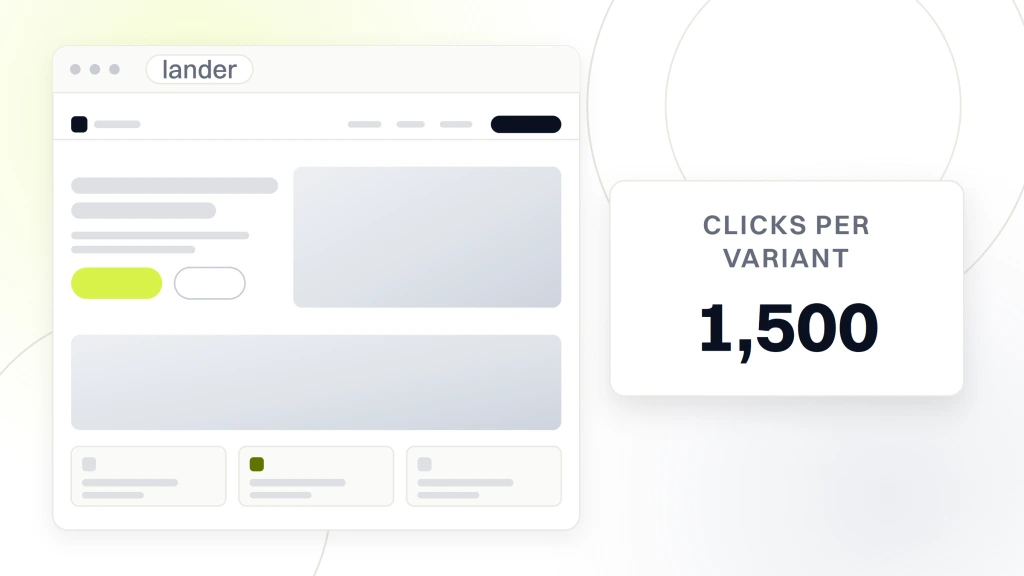
A dental PPC lander that converts at 4 percent needs roughly 1,500 clicks per variant to detect a 20 percent relative gain at 95 percent confidence. Most practices run tests on 300 clicks per variant and declare victory. That is a coin flip. If your account drives 800 clicks a month to one lander, plan for a 5 to 8 week test window per hypothesis and stack your priorities so you are learning the whole time. Small accounts still get to learn, they just have to pick bigger swings.
The hypothesis problem
Change the hero image out of boredom. That is not a hypothesis. That is a mood. A hypothesis reads like this. Patients drop off since the hero copy focuses on the practice, not the patient outcome. Rewriting to lead with the outcome should raise booking rate by 15 percent, and heatmaps show scroll depth ends before the outcome copy loads today. You cannot learn from a mood. You can learn from a claim that could be wrong.
The single-variable rule
Practices routinely change 3 things at once and call the winning combination a learning. It is not. If the variant swapped the hero, the form, and the button, and it beat control by 12 percent, nobody knows which change earned the gain. You cannot port that learning to the next lander. Every serious dental landing page AB testing program isolates 1 variable per test, even when 3 ideas look ready to go live at once.
The office politics problem
Someone at the practice sees a mid-test result trending against their preferred variant and asks to call it early. Someone else likes the old hero photo and wants to keep it regardless of numbers. That is politics, not statistics. Assign 1 person to own test decisions and let the sample-size math settle every argument. Your dental AB testing decisions get faster and cleaner the moment 1 person owns them, and the whole team stops treating outcomes as personal wins or losses.
Dental Landing Page AB Testing Hypotheses That Move Bookings
Here is the hypothesis stack that has produced the most consistent gains across the dental PPC landers we run. Sort by expected gain against effort to run. The first 3 usually move numbers on any dental PPC lander. The rest depend on the service and the traffic mix. Every one has a documented winner condition and a rollback plan before it ever hits live traffic.
- Outcome-first hero copy versus practice-first hero copy on service-specific landers.
- Sticky book-now button versus scroll-only book-now button on mobile.
- 3-field form versus 7-field form on the primary lead capture.
- Star rating and review count above the fold versus hidden below the fold.
- Insurance list visible above the fold versus buried in the FAQ.
- Real doctor photo versus stock smile photo in the hero.
- Same-day appointment badge versus generic call today language.
- Price transparency block versus no price mention on service landers.
The outcome-first headline test
Most dental landers open with the practice name and years in business. That copy answers a question nobody clicked to ask. The patient wants to know if the practice can fix their specific problem, fast, near them, at a price they can plan around. Rewriting the hero to lead with the patient outcome, followed by proof, followed by the booking action, tends to move booking rate 10 to 25 percent on high-intent paid search traffic like emergency dentist near me searches.
The form field count test
Every extra required form field cuts submission rate by about 4 to 8 percent on mobile. A 7-field form asking for insurance, condition, preferred date, preferred time, address, phone, and email loses about a third of the intent that reached the form. A 3-field form asking for name, phone, and preferred time captures more submissions and lets the office qualify by phone. Test the trim, measure booked appointments not just form fills, and confirm the office can handle the phone qualification workload before rolling out.
The proof placement test
Star rating, review count, and 1 real patient quote above the fold beats the same proof buried in a mid-page carousel most of the time. Patients scan for social proof in the first 3 seconds. If they cannot find it, they bounce back to the SERP and click the next dentist. Test proof placement early in your dental landing page testing queue, since it is cheap to build and moves numbers on most implant and cosmetic landers.
Dental Landing Page AB Testing Sample Size Math
Sample size is where dental landing page AB testing stops being marketing theater and starts being math. The formula is boring. The consequences of ignoring it are expensive. You need enough clicks per variant to detect the size of the change you expect at a confidence level you trust. If you cannot reach that number in a reasonable window, you run fewer variants, pick bigger swings, or accept that your account cannot support high-frequency testing yet.
| Baseline conversion rate | Minimum detectable effect | Clicks per variant | Weeks at 400 clicks per month |
|---|---|---|---|
| 2 percent | 20 percent relative | 3,100 | 15 to 16 |
| 4 percent | 20 percent relative | 1,500 | 7 to 8 |
| 4 percent | 30 percent relative | 700 | 3 to 4 |
| 8 percent | 20 percent relative | 700 | 3 to 4 |
Why you cannot cheat this
The math is not a suggestion. Stopping a test early since it looks like the variant is winning creates a bias called peeking. Peeking flips the false positive rate from 5 percent to closer to 25 percent, and that means 1 in 4 winners you declare are actually noise. Peeking is why dental practices adopt a variant, watch bookings quietly slide over the next quarter, and blame seasonality. Use a proper sequential-testing tool or wait until you hit the sample-size floor. There is no third option that keeps the math honest.
What to do when the account is too small to test
If your account drives 400 clicks a month to a single lander, you cannot run a 1,500-click-per-variant test in a reasonable window. That is fine. Pivot to bigger swings. Test outcome-first hero copy against practice-first, or trim the form from 7 fields to 3. Bigger changes take less traffic to detect. Or consolidate lower-volume landers into a single high-quality page and test there. See Evan Miller’s sample size calculator for the math behind these numbers.
How to Prioritize Dental Landing Page AB Testing Ideas
You have more test ideas than traffic to run them. That is the normal state of every dental PPC account. Prioritization separates practices that compound gains from practices that run 7 inconclusive tests a year. Use a 3-factor score. Rate impact, confidence, and ease. Multiply and sort. Run the top of the list first, and revisit the score after every completed test so the queue stays honest.
The ICE scoring model
ICE stands for impact, confidence, and ease. Score each on a 1-to-10 scale, multiply, and sort. A hypothesis at 8 impact, 7 confidence, and 6 ease scores 336. A hypothesis at 4 impact, 5 confidence, and 9 ease scores 180. The first one runs first. Update the score after each test based on what you learned. Confidence usually rises for hypothesis families that have already worked and falls for families that already failed once in your account.
Why lowest-effort ideas usually run first anyway
In practice the ease score dominates, since low-effort tests get built and pushed live. A sticky button test takes 30 minutes. A hero copy rewrite takes 2 hours. A form field trim takes 1 hour if your form provider supports variants. Full-page redesigns take a sprint. Run the small ones during the sprint you scoped for the big one. You will finish 2 learnings instead of 1, and next quarter roadmap arrives with 2 more data points already in hand.
How to write the queue nobody argues with
Write the queue as a single-page shared document. Test name, hypothesis, ICE score, expected sample size, expected end date, and 1 line for the winner condition. Freeze the queue at the start of each month and only let the account lead reorder it. That single rule kills 90 percent of the political friction around dental landing page AB testing decisions and gives the whole team a shared roadmap.
Real Numbers From a Dental PPC Lander Under Test
Smile Design Dentistry, a 50-plus location dental group, ran a structured dental landing page AB testing program across their PPC landers over an 18-month window. Here is the specific test sequence and what the numbers looked like across the network after the first 3 winners rolled to every location. The pattern repeats on smaller accounts, just at slower velocity.
Test one, outcome-first hero copy
Control opened with the practice name plus years in business. Variant opened with the patient outcome. Test ran 6 weeks at roughly 4,200 clicks per variant. Variant beat control on booking rate by 18 percent at 96 percent confidence. Rolled to all 50-plus locations. The gain compounded, since every location PPC spend now bought a higher-converting landing experience across the group.
Test two, 3-field form versus 7-field form
Control had a 7-field form asking for insurance and condition. Variant kept name, phone, and preferred time. Test ran 5 weeks at 3,800 clicks per variant. Variant beat control on submissions by 34 percent, and booked-appointment rate held steady since phone qualification was already staffed. Net booked patients grew 22 percent, and the offices could handle the extra call volume without new hires.
The account-level result across 50-plus locations
PPC conversion rate rose 20 percent network-wide. Cost per call fell 30 percent. Both numbers held for the next 4 quarters as the test cadence continued at roughly 1 hypothesis a month. That is what dental practice AB testing at scale looks like when the cadence sticks. See our dental google ads management guide for the campaign structure and reporting cadence behind those numbers.
Common Dental Landing Page AB Testing Mistakes
The Monday plan. Launch a 12-hypothesis quarterly test roadmap with sequential-testing statistics, cross-device tracking, and monthly reviews with the practice team. The Friday plan. Ask the office manager which of the 2 hero photos she likes better, put that one live, and call it a win. Every practice has watched a bold quarterly roadmap shrink into 1 hero photo swap by the second week. The mistakes below are what turn a real dental AB testing plan into that photo swap.
Testing 2 variables at once
New hero copy plus a new form plus a new booking button in 1 variant. Variant wins. What caused the win? Nobody knows. You cannot roll 1 change to other landers with confidence, since the winner is a combination. Isolate 1 variable at a time even when it feels slow. You end the year with real learnings instead of a folder of stories nobody trusts enough to reuse next quarter.
Ignoring device splits
Dental PPC traffic runs 70 to 85 percent mobile in most markets. If your dental landing page testing report measures the overall winner without splitting mobile from desktop, you may declare a winner that helps desktop and hurts mobile. Always break the report by device. The winner has to hold on the dominant traffic source or the rollout costs bookings on the segment paying the ad spend. See Google’s guidance on interaction to next paint for why mobile responsiveness matters even for what looks like a copy test.
Dental Landing Page AB Testing Tools That Work
You do not need enterprise testing software to run a competent dental landing page AB testing program. You need a tool that splits traffic honestly, a tool that measures the right conversion event, and a way to compute significance without peeking. 3 tools cover most single-location and multi-location dental accounts under $200 a month combined.
The split-testing layer
Google Optimize retired, so most dental accounts moved to a page-builder-native split tester like Convert, VWO, or a simple GTM-based split. For dental PPC landers on WordPress, Convert starts at around $99 a month for the traffic tier most practices need. Pick whichever tool your team will actually run. The best split tester is the one that gets used, not the one with the deepest feature matrix.
The conversion measurement layer
Google Analytics 4 handles the event tracking for form fills. CallRail handles the phone side. Booked appointments require reconciliation between the CRM and the ad account. Without booked-appointment data, you are optimizing for the top of the funnel, and that is where lead-quality problems hide. See dental marketing attribution for how the data pieces connect end to end.
The significance calculator
Evan Miller sample-size calculator is free, well-documented, and correct. Bookmark it. Use it before every test to compute the required sample size and after every test to confirm the winner. Do not trust the built-in significance number in most testing tools, since they often use naive frequentist math that overstates confidence when you peek. See Google’s GA4 experiments documentation for the tracking side.
Dental Landing Page AB Testing Priorities by Service
Not every service line rewards the same tests. Emergency landers reward phone-first designs. Implant landers reward proof-heavy layouts. Cosmetic landers reward outcome imagery. Match the test to the service and you skip a year of relearning what someone else already proved in a different vertical. That single move saves the average practice roughly 6 months of wasted dental practice AB testing.
Emergency dental landers
Emergency traffic wants a phone number, an open-now badge, and a same-day appointment promise above the fold. Test call-to-action language. Call now versus click to call versus available today. Test the phone number size and placement. Skip form-heavy tests since emergency traffic almost always converts by phone. See converting dental ppc ads for the ad copy that pairs with these landers.
Implant landers
Implant traffic wants proof. Before-and-after grids, review counts with real names, financing options, and a same-day consult offer above the fold. Test the proof density. Test the financing block placement. Test the consult offer specifics. A generic schedule a consult underperforms a specific free 20-minute implant consult with digital scan by roughly 15 to 25 percent in most implant traffic tests.
Cosmetic and Invisalign landers
Cosmetic traffic wants outcome. Real smile photos, real patient names, real timelines. Test outcome imagery against practice imagery. Test the timeline promise. Test the price transparency block against a hidden price with a consultations start at line. High-value cosmetic and Invisalign traffic rewards specificity, and specificity is testable. This is where dental PPC AB testing pays back the fastest per hypothesis.
Reporting Cadence for Dental Landing Page AB Testing
A testing program without a reporting cadence collapses into ad-hoc redesigns inside a quarter. Set a monthly review with the 3 numbers that matter. Which tests ran. Which won. What is queued next. 15 minutes on a call, 1 page in a shared document, and everyone knows the state of the program. That is the whole rhythm.
The monthly one-page report
Top of the page. Test in flight. Sample size progress. Days remaining. Middle of the page. Tests completed this month. Winner, magnitude, confidence, rollout status. Bottom of the page. Queued tests, hypothesis, ICE score. That single page is enough to run a competent dental landing page AB testing program at any scale from 1 location to 50.
The quarterly review
Every quarter, look at the trailing 90 days. What percentage of hypotheses won. Where did the wins concentrate. What did you learn about your patient segment that you did not know before. That review is where you upgrade the hypothesis library for next quarter. Without it, dental landing page testing becomes a treadmill instead of a compounding program.
Where the retainer fits
A competent dental landing page AB testing program takes 4 to 8 hours a month at a specialist level for a single-location practice. Multi-location groups need 8 to 16 hours. Most practices outsource it inside a broader PPC retainer, since that specialist time is hard to staff in-house. See high roi dental google ads for what the monthly retainer typically covers, and retainer starts at $999 a month.
When to Stop Dental Landing Page AB Testing
Testing has a saturation point. After 12 to 18 months of monthly hypotheses on a stable service lander, most easy wins are already found. Booking rate stops responding to hero tweaks and form trims. Move the lander to steady-state and rotate testing effort to the next lander. Dental landing page AB testing is a tool, not a habit to defend at all costs.
Signs the lander has saturated
3 consecutive tests come back within a 5 percent relative range. Effort per test rises, since the obvious hypotheses are already run. Booking rate holds inside a narrow band month over month. When those 3 signals show up together, retire the test cadence to quarterly and move testing budget to the underperforming lander or the newly launched service line.
What replaces testing at saturation
Traffic quality work usually pays back better than more landing page testing once a lander saturates. Tighter keyword targeting. Better ad copy. Negative keyword sweeps. Audience layer tuning. All of that moves booking rate on a mature lander more than the fifteenth hero test. See our dental marketing roi guide for the traffic-side moves that pair with a saturated lander.
Where the ROI on testing sits over time
The first 6 months on a fresh lander returns the highest booking-rate gains. The next 6 return smaller but still meaningful gains. After 12 to 18 months, that lander returns diminishing gains. Plan the roadmap around the curve and rotate testing effort to whichever lander is earliest on it.
Dental landing page AB testing done right is quiet and worth every hour past the first 3 tests. Pick a hypothesis tied to a booking blocker. Run the math. Isolate 1 variable. Wait for the number. Then decide.