
Core web vitals healthcare websites need to pass decide whether a hesitant new patient books an appointment or bounces back to search results. You’ve watched your PageSpeed score go red on a Monday morning with no clear next step. Speed feels vague. Rankings feel vague. Booking numbers do not. Google measures three vitals (loading speed, click responsiveness, and layout stability), and those three things line up with what keeps a patient on your site long enough to fill out the intake form. See the web.dev Core Web Vitals reference for the official thresholds. Fix the vitals and you keep the SEO you already paid for, plus you win the booking your competitor down the street just lost.
This guide walks you through the targets, the diagnostics, the mobile-first fixes for mobile-friendly healthcare websites, and the healthcare website optimization work that keeps the numbers stable past launch. It covers what to measure with which tool, what to change first, what the compliance tradeoffs look like, and how North County Dental Care in Vista went from an invisible online presence to 12 to 16 new patients monthly on a properly tuned site. Read straight through in about twelve minutes.
CLS fixes for stable healthcare website layouts
Cumulative Layout Shift (CLS) measures how much the page jumps around while the visitor tries to click it. A CLS score above 0.25 usually means an ad slot or a review widget is loading in and pushing the booking form off screen just as the patient reaches for it. Nothing tanks conversion faster than a booking button that moves at the exact moment someone tries to click it. Healthcare websites should target CLS under 0.05, well below Google’s 0.1 pass threshold, and that stricter bar matters more here than in most verticals because medical sites sit in Google’s YMYL bucket. Every layout jump breaks the trust the design is trying to build.
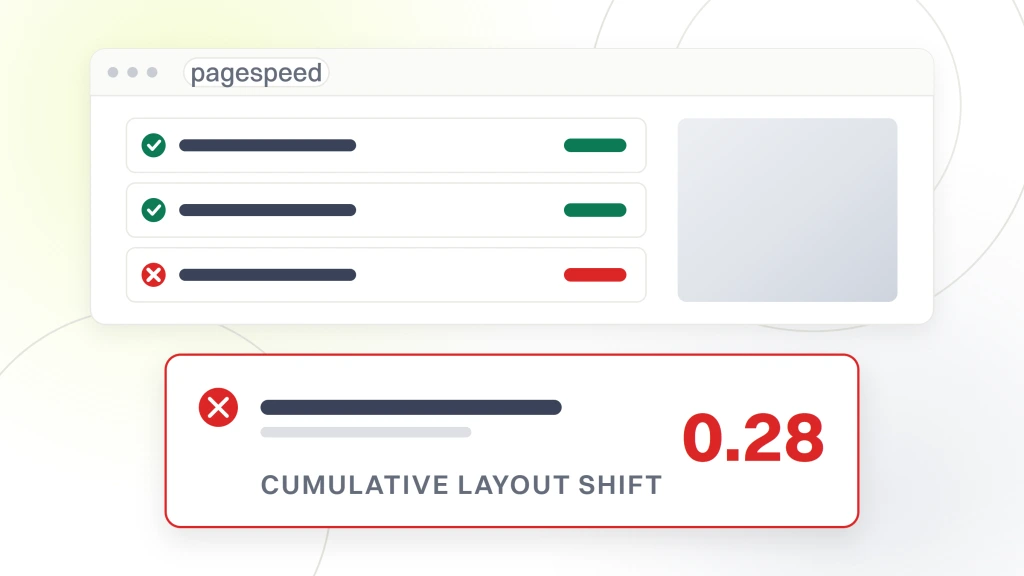
Set width and height attributes on every image, iframe, and video. Reserve space for embeds like Google Business Profile review widgets by wrapping them in a fixed-height container. Load web fonts with font-display optional if you have already preloaded them, so the text does not swap mid-scroll. Test the site on a real Android phone, not just Chrome DevTools mobile mode. Real devices catch layout shifts the emulator misses on mobile-friendly healthcare websites. Fifteen minutes on a real phone flushes out issues that survive a week of desktop testing.
Reserve space for every dynamic element
Google review widgets, live chat widgets, and appointment booking iframes are the top three CLS villains on healthcare sites. Wrap each in a container with a min-height that matches the expected loaded height. The container reserves the space so nothing below it jumps. When the widget loads, it fills the reserved space instead of pushing content around. Two lines of CSS per widget, ten minutes of work, and CLS drops from 0.28 to 0.04 on the same page. That’s a real fix without a rebuild.
Font swap that does not shift the layout
The font swap between the fallback and the custom font is a common CLS source on healthcare websites. If your fallback font is Arial and your custom font is a wider serif, the headline reflows when the custom font loads and pushes body text down 20 pixels. Use size-adjust and ascent-override in the @font-face rule to make the fallback take the same vertical space as the custom font. That trick keeps the layout stable during the swap. Modern browsers support it. Ten minutes to add. Fixes a CLS problem that used to require picking a different font.
Hosting stack for healthcare website speed
No amount of tuning gets you past a slow host. Shared hosting on a $12 per month plan runs healthcare websites in seven-second Largest Contentful Paint (LCP) territory no matter what you do to the images. Managed WordPress hosting on Kinsta, WP Engine, or Cloudways costs $30 to $70 per month and cuts LCP by 500 to 900 milliseconds on the same site. That single host swap is often the biggest performance gain a healthcare website ever posts. Do it first. The tuning work compounds on top of a proper host, not around a broken one.
Add a CDN so images serve from an edge server close to the patient’s location. Cloudflare’s free tier is enough for a solo practice. Paid tiers on Bunny.net or Cloudflare Pro run about $20 to $40 per month and shave another 100 to 300 milliseconds off LCP. Cache HTML aggressively (5 to 30 minutes) with a cache-busting mechanism on booking form pages. Cache CSS and JS with long expiry (one year) with hash-based file names. That stack is boring, standard, and unmovable. Every healthcare website that hits its vitals runs on it.
Host comparison for a healthcare practice
| Host tier | Cost per month | Typical LCP on mobile | Right for |
|---|---|---|---|
| Shared cheap | $3-$15 | 4.5-7.0 seconds | Not healthcare, ever |
| Business shared | $20-$40 | 2.8-4.2 seconds | Solo practice, low traffic |
| Managed WordPress | $30-$70 | 1.8-2.8 seconds | Most healthcare practices |
| Managed WP + CDN | $50-$110 | 1.3-2.2 seconds | Multi-location, higher traffic |
| Enterprise cloud | $200+ | 1.0-1.8 seconds | Hospital systems, DSOs |
HIPAA hosting adds a real cost
Healthcare websites that collect protected health information through intake forms need HIPAA-eligible hosting with a signed Business Associate Agreement. That rules out most standard managed WordPress plans and pushes cost up to $150 to $400 per month for compliant tiers. If your booking form only collects a name, phone, and preferred date, you may not trigger HIPAA at all and can stay on standard managed hosting. Check with your compliance officer first. This is a real cost line, not a nice-to-have.
WordPress tuning for healthcare website speed
WordPress powers about 65 percent of healthcare practice websites and gives you real levers for core web vitals healthcare websites need to pass. The default WordPress install is not slow. The 27 plugins the previous vendor bolted onto it are slow. Every plugin adds queries, CSS, and JS to every page load. Audit the plugin list and cut anything you are not actively using. That single pass drops page weight by 30 to 50 percent on the average healthcare site.
Run a caching plugin like WP Rocket or FlyingPress. Both handle page cache, CSS optimization, JS deferral, and lazy loading in one paid license. That single install typically drops mobile LCP by 800 to 1,200 milliseconds on a healthcare site that was not caching anything before. Free alternatives like LiteSpeed Cache or W3 Total Cache work if you have the patience to tune them. WP Rocket costs about $59 per year and pays for itself in ten minutes of setup time saved. See the Kinsta WordPress performance guide for a deeper walkthrough.
The plugin audit that runs in one afternoon
Open the plugins page in wp-admin. For each plugin, ask three questions. Is it doing something that shows up in the marketing dashboard. Is anyone at the practice actively using it. Is the last update from a maintained version. If all three answers are yes, keep it. If any answer is no, deactivate it, retest speed, and delete it if the site still works after 48 hours. Healthcare practices we audit typically remove eight to twelve plugins on that first pass. LCP drops. INP drops. Nothing breaks. The previous vendor left a lot of ghosts running.
Theme choice determines your speed ceiling
Some healthcare WordPress themes ship with 400 KB of unused CSS and 300 KB of unused JS on every page. A bloated theme sets the speed ceiling. No amount of caching gets you past it. Well-built themes like GeneratePress, Kadence, or a lightweight custom build ship 60 KB of CSS and load JS only where needed. Practices stuck on a heavy theme should budget a theme swap into the healthcare website optimization plan. It costs 30 to 60 hours of development work and adds 500 to 1,200 milliseconds of speed. That’s a real move, not a nice-to-have.
Third-party scripts you forgot are still loading
Every healthcare site we audit carries at least six abandoned marketing pixels loading on every page. A Facebook pixel from an ad campaign that ended in 2022. A LinkedIn tag from a hiring push. A Hotjar recording tool nobody watches. A live chat vendor the front desk stopped using. Each pixel adds 40 to 120 milliseconds of INP and 20 to 80 KB of page weight. Open your tag manager. Kill anything not tied to a live campaign or a tracked KPI. That single pass usually saves 200 to 400 milliseconds of INP without a single line of code.
Compliance tradeoffs on healthcare website speed
Healthcare website optimization runs into HIPAA and accessibility guardrails that other verticals do not care about. You cannot lazy-load the accessibility skip-link. You cannot defer the script that renders the ADA-compliant color contrast on your booking form. Some HIPAA-eligible form vendors ship their own JS bundle that runs 200 KB heavier than a marketing form vendor. That is the tradeoff for the encryption and audit logging you need, not a bug. Plan around these guardrails, do not fight them.
Accessibility overlays that promise instant ADA compliance are almost always a speed disaster and a legal liability. They inject 200 to 400 KB of JS on every page and rarely fix the underlying accessibility failures. Real accessibility work happens in the source code, not in a bolted-on widget. See the WCAG 2.2 guidelines from W3C for the actual standard. Practices that skip the overlay and fix the code save 300 milliseconds of LCP and pass a real audit at the same time.
Tracking that does not break BAA
Google Analytics 4 cannot receive personally identifiable health information under any Business Associate Agreement. That is not a Google policy quirk. That is HIPAA. Configure GA4 to receive booking event counts and anonymized page paths only. Route the real form data to your HIPAA-eligible CRM. That split adds one integration line to the developer scope and keeps you compliant without losing analytics visibility. See HHS HIPAA guidance for the underlying rules.
Consent mode without tanking INP
Cookie consent banners on healthcare websites are increasingly required by state law, even outside California. The banner script itself adds 30 to 100 milliseconds of Interaction to Next Paint (INP) on the first click. Use Google Consent Mode v2 to pass consent signals to your tag stack without blocking scripts. Configure the consent banner to defer optional scripts until consent is granted. That pattern keeps INP green on the first page load while still respecting the visitor’s choice. Practices that ship a bolted-on consent widget usually see a 100 to 200 millisecond INP hit that could have been avoided.
Healthcare website speed case study on real patient growth
North County Dental Care in Vista, California is a family practice of more than 20 years with a strong offline reputation and almost no online visibility. When they partnered with us, their site did not work on phones, had no HTTPS, and carried broken links and dozens of technical errors. Content was thin, and new-patient acquisition was flat at 1 to 2 patients a month. The website was the bottleneck.
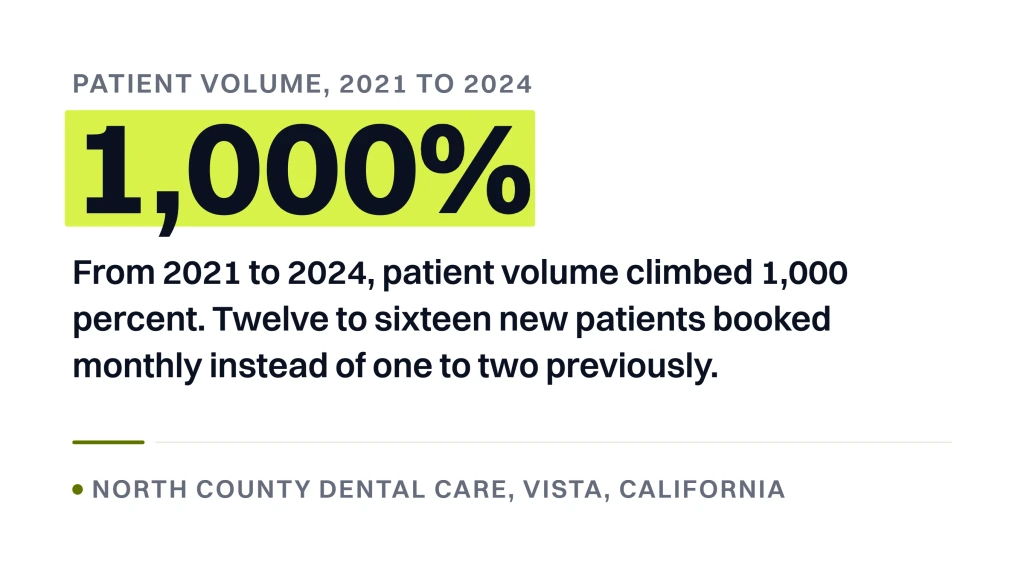
The engagement covered a full website rebuild with fast, secure pages, technical SEO repair, local SEO, Google Business Profile ads, and video production. From 2021 to 2024, patient volume climbed 1,000 percent. Twelve to sixteen new patients booked monthly instead of one to two previously. Every number came from a stack that treated a fast, secure site as the base for booking, not a vanity score.
Multi-location practices need the same discipline
Pelvic Rehabilitation Medicine runs 14 clinics across 10 states, and their pre-engagement site sat on the same performance floor as most single-office practices. A patient-first redesign paired with a scalable architecture pushed organic traffic up 174 percent year over year and gave the community platform enough speed headroom to grow around a national patient base. The lesson repeats. Fast, stable pages let the SEO investment compound. Slow pages cap it at wherever the first three months plateau.
Lessons for other healthcare practices
Two lessons repeat across every engagement. First, hosting sets the ceiling. Fine tuning does not. Practices trying to hit green vitals on shared cheap hosting are wasting the work. Fix the host first. Second, the third-party script audit pays back the most for the least effort. Every practice we audit carries at least six abandoned marketing pixels loading on every page. Cut them, retest, and INP drops without any code changes. Two decisions, weeks of gains.
How healthcare website speed connects to healthcare website seo
Speed is one ranking signal among many. A slow site with strong content still outranks a fast site with thin content. Between two roughly equal healthcare websites competing for the same query, the faster site wins the tiebreaker every time. That’s where the speed signal earns its keep in healthcare website SEO. Google also classifies medical sites as Your Money Your Life (YMYL) pages, which raises the quality bar on every ranking factor including performance.
Speed also improves crawl budget, which matters for practices with hundreds of condition pages and location pages the crawler needs to reach. On top of that, Google’s own research points to a 24 percent drop in abandonment on sites that meet the Core Web Vitals thresholds. That is nearly one in four patients who would have bounced staying long enough to read your credentials.
The bigger win is on click-through and dwell time. Faster pages get clicked more often from the search results because they load before the visitor bails. Faster pages keep visitors on site longer because there is no waiting-room frustration. Both signals feed back into ranking. Practices that hit their vitals see cascading gains in healthcare website SEO over three to six months, not on day one. Play the long game, apply the fixes, and let the algorithm settle.
Crawl budget on multi-page healthcare sites
A DSO or multi-location healthcare group with 200 to 800 pages runs into crawl budget limits when the pages are slow. Google’s crawler stops before it hits every page because each page takes too long to render. Speed up the pages and the crawler visits deeper, indexes more, and ranks the long-tail location plus condition combinations. Practices that neglect vitals on multi-page sites usually see 30 to 45 percent of their location pages permanently sitting in the Discovered – currently not indexed bucket. Fix the speed and Google finds the pages.
Structured data that survives fast rendering
MedicalOrganization, Physician, and Service schema on healthcare pages need to render in the initial HTML, not injected by JS after page load. If the schema loads late, the crawler may miss it on the first pass and take weeks to re-crawl. Server-render every piece of structured data. Validate with the Schema.org validator. Speed optimization sometimes moves scripts to lazy-load, and the developer accidentally lazy-loads the schema. Watch for that specific regression during optimization sprints.
Mobile-friendly healthcare websites decide the ranking outcome
Google reports that 53% of mobile site visits are abandoned if pages take longer than 3 seconds to load. Healthcare searches skew even more mobile than the general web because patients search on their phone in a waiting room, on a train, or in bed at 11 pm. If your homepage LCP is 4.2 seconds on a mid-range Android, you are turning away more than half the traffic before your first paragraph renders. Mobile-friendly healthcare websites that pass the vitals capture that traffic instead.
Monthly monitoring for core web vitals healthcare websites
Core web vitals healthcare websites hit today drift back into the red six months from now if nobody watches them. A plugin update, a new marketing pixel, a fresh hero image someone uploaded at 4000 pixels wide. Any one of those things can send LCP back to 4 seconds without anyone noticing until the rankings drop. Monthly monitoring catches the drift before it becomes a rankings incident. Fifteen minutes of work per month protects the entire engagement.
Set up automated alerts for mobile-friendly healthcare websites. PageSpeed Insights via the Google API on the homepage, contact page, and top three condition pages weekly. Slack or email alert if any URL drops by 10 percent or more. Cron script or a service like SpeedCurve does the work for $40 to $120 per month. Add a Search Console alert on the Core Web Vitals report so any new red-flagged URL surfaces immediately. That monitoring stack is set and forget. It stops the six-month drift that kills half the rebuilt healthcare sites we audit.
Quarterly speed review with the team
Book a quarterly speed review with your developer or agency. Twenty minutes on a Tuesday. Look at the monitoring data. Look at the plugin update log. Look at the marketing pixel list. Ask three questions. Did anything drift. Did anything new get added. Did any regression need a fix. That single 20-minute meeting keeps healthcare website speed and the ranking benefits stable for years. Skip it and you rebuild the site again in 18 months once the vitals fall apart.
Maintenance scope that keeps vitals stable
Post-launch maintenance for a healthcare site should include monthly speed checks, plugin updates on staging first, image optimization on every uploaded asset, and a quarterly speed review. Retainers that cover this stack run $199 and up per month. Our Healthcare Website Maintenance Services guide covers what the full stack looks like. Practices that try to save $200 monthly on skipped maintenance almost always pay $8,000 to rebuild the site 18 months later. That is bad math and a common decision.
Budget planning for healthcare website optimization
Hitting the core web vitals healthcare websites need rarely requires a full rebuild. A targeted optimization sprint on an existing site typically runs $2,500 to $6,000 and delivers green vitals on the top ten URLs. A full rebuild for a site that is beyond tuning runs $8,000 to $22,000 depending on scope. Budget the smaller sprint first and see if it moves the numbers. If the site is broken at the foundation (heavy theme, ancient plugins, terrible host), the rebuild math wins. If the site is basically sound, the sprint pays back inside three months on ranking gains.
The optimization sprint covers a plugin audit, a third-party script cull, a theme evaluation, an image pipeline install, a caching setup, a hosting evaluation, and a testing pass on the top ten URLs. Two to three weeks of work. The rebuild covers everything the sprint covers plus a new theme, a new design, a new IA, and a redirect plan. Six to twelve weeks of work. Both paths need the same monthly monitoring afterward. Both need the same maintenance scope. The gap is upfront cost against depth of change.
In-house vs agency for the optimization work
Practices with a technical office manager can run the plugin audit and image resize pass in-house. That covers roughly 40 percent of the possible speed gain. The remaining 60 percent needs someone who reads Chrome DevTools performance flame charts, knows how to configure WP Rocket properly, and can debug INP regressions caused by a specific script. That is agency work. Trying to do it in-house without the skill usually breaks something on the site and adds two weeks of unwinding. Match the work to the skill. Book the outside help for the pieces the in-house team cannot deliver.
Payback math for the optimization spend
The payback math on healthcare website optimization is simple. A green vitals pass typically drives 15 to 30 percent more organic traffic within three months. Each additional booked patient pays $400 to $2,400 depending on your specialty and average patient value. A $4,500 optimization sprint that adds four booked patients monthly pays back inside four to six months. After that, every additional patient is upside for the life of the site. The numbers work. Owners who wave this off usually lose 12 to 24 months of compounding growth to the practice down the street who ran the same math and ran the same play.
Where to start with core web vitals healthcare websites
Start with the baseline. Run PageSpeed Insights on your homepage, contact page, and top three condition pages. Screenshot the mobile results. That gives you the starting number for the core web vitals healthcare websites conversation with your team. Every optimization decision from that point compares against that starting number. No baseline, no optimization. Start with the baseline the same day you decide healthcare website speed is a priority. Ten minutes of work, saved as a screenshot, becomes the reference for every conversation with the developer or agency for the next six months.
When you’re ready to plan the sprint, look at three specific things. Your host tier. Your plugin count. Your third-party script count. Those three inputs predict 80 percent of the possible speed gain. For deeper reading, our Healthcare Website Design Services guide covers the rebuild path, our Healthcare Web Design (Pillar) covers the design principles, our Healthcare Website Development writeup covers the build requirements, and our Healthcare Marketing Hub covers the full engagement. Ready to scope a sprint? Our Healthcare Website Maintenance plans keep the vitals green after the fix.