
How to Create a Sales Funnel That Books Real Deals
- Define four stages, one metric each, before you build.
- Wire GA4 and a CRM on day one, not day 30.
- One lead magnet per audience segment, not six on day one.
- Nurture sequence: five emails, three to five days apart.
- Run 60 days. Fix the biggest drop-off first.
- How to setup a sales funnel for SaaS products
- How to create a sales funnel for free using open tools
- How to create a sales funnel website that supports every stage
- How to build a sales funnel from scratch with clean tracking
- How to build sales funnels with a working nurture sequence
- Metrics that tell you the funnel is actually working
- Common mistakes when learning how to make a sales funnel
- Where to go next after you learn how to create a sales funnel
How to create a sales funnel from scratch is a three-week job for a small business and an eight-week job for a mid-sized brand. You define four stages. You pick one metric per stage. You wire the tracking. You build the assets. You run for 60 days. You read the numbers. You fix the biggest drop-off. Rinse and repeat every quarter until every stage sits inside benchmark range. This guide is the exact sequence, the tools, and the mistakes to avoid.
You will read how to create a sales funnel for any business model, how to build sales funnels for services, ecommerce, and SaaS separately, which tools go on the tracking stack, the specific asset list you need at every stage, how to build a sales funnel from scratch without hiring a full agency on day one, and the free workflow that gets you to a working funnel inside the first 30 days.
Checkout page as the highest-value asset
Guest checkout available. Three-step maximum. Address autocomplete on the shipping field. Apple Pay and Google Pay buttons on step one. Trust badges below the fold. Return policy linked prominently. Every ecommerce funnel audit we run finds one or two checkout page issues that quietly drop conversion by 15 to 30 percent. Fixing the checkout page always pays back faster than adding more paid ad spend to feed a broken bottom stage.
How to setup a sales funnel for SaaS products
SaaS funnels add Activation and Retention beyond the standard four stages. A signup is not a customer. A signup who never runs the product is churn dressed up as growth. Activation-focused emails, in-app guidance, and a well-designed empty state do more for SaaS growth than any ad spend increase. Retention math compounds. Signup math does not.
Rocket Software is a SaaS subscriber-acquisition tool that came to us with a 7 percent activation rate. We rebuilt the funnel around a fresh drip sequence, activation-focused emails, and a four-channel launch plan. Within the first month, the activation rate hit 300 percent growth. Week one delivered 3,000 customers. Post-launch the funnel now brings in 400-plus new subscribers daily. Same product. Cleaner funnel. Better numbers.
Creating a SaaS sales funnel from scratch takes six to twelve weeks depending on product complexity. The Activation and Retention stages need instrumentation inside the product itself, which usually means a product manager or engineer sits alongside marketing on the build. That cross-functional collaboration is the reason SaaS funnels take longer than services funnels. Once the plumbing is in, though, the compounding growth curve pays back the extra weeks many times over.
SaaS activation email sequence
Day 0: welcome and the one action to take right now. Day 1: reminder of the one action, with a video walkthrough. Day 3: what happens after the one action, with an aspirational customer example. Day 7: nudge to complete the one action if not done. Day 14: check-in and a soft ask to book a call with a customer success rep. Every SaaS activation sequence we build follows a version of this five-touch pattern.
How to create a sales funnel for free using open tools
Every founder asks how to create a sales funnel for free before committing to a paid stack. The answer is that a working four-stage funnel runs on $0 a month for the first 90 days. HubSpot Free CRM, Google Analytics 4, MailerLite Free, and Looker Studio give you tracking, CRM, email, and dashboards.
The free stack has three limits you should know about. No call tracking, so phone-based leads stay invisible in the analytics. No advanced automation, so nurture sequences run on simple time-based triggers. Multi-user permissions get thin, so a team of five is roughly the ceiling. If none of those limits blocks your business today, the free stack is a genuinely good starting point. Upgrade only when a specific limit starts costing you money or time.
Every startup we advise begins with a version of this free stack and gets to a working four-stage funnel inside three weeks. The paid tools earn their spot as revenue scales and specific gaps appear. Buy the paid tools to close a real gap, not to look serious. Every serious pipeline audit we run finds one or two paid subscriptions that the founder could cancel today without losing any capability.
Where the free stack hits its ceiling
HubSpot Free tops out at 1,000 marketing contacts for advanced features. MailerLite Free tops out at 1,000 subscribers and 12,000 emails per month. GA4 has no formal cap but analysis complexity grows past 500K monthly events. Looker Studio pulls from 20 data sources on the free tier. Every one of those caps signals a natural upgrade point. Cross the cap, upgrade the tool. Stay below, save the money.
How to create a sales funnel website that supports every stage
Your website carries most of the funnel work. Awareness runs on blog posts. Interest runs on lead magnet landing pages. Decision runs on service pages and case studies. Action runs on booking, pricing, and checkout flows. Every page maps to one stage, and every stage needs two supporting pages.
A high-converting sales funnel website usually has 30 to 80 pages by the time it matures. Ten to twenty blog posts covering top-of-funnel topics. Three to five lead magnet landing pages. Five to twelve service or product pages. Three to eight case studies. Two to four pricing or booking pages. That page inventory is what makes a website a real funnel, not just an online brochure. Every serious build we run maps the page inventory to the four stages before the design starts.
Creating a sales funnel website from scratch also means investing in the platform choice on day one. WordPress with a proper theme handles almost any funnel. Shopify handles ecommerce funnels well. Webflow handles marketing sites at higher price points. Every platform choice trades design flexibility for build speed and vice versa. Pick the platform that matches the team you actually have, not the team you wish you had.
Platform picks by business type
Services and B2B: WordPress with a purpose-built theme. Ecommerce: Shopify or WooCommerce. SaaS: Framer, Webflow, or a custom Next.js build. Local business: WordPress or Squarespace. Every one of these picks is defensible. Every one has thousands of production funnels running on it today. Pick the platform your team can maintain, not the platform on the trending list this quarter.
Skip funnel software for a week. Write the top 3 questions your best buyer asks in week one on a sticky note. That's your TOFU content brief.
How to build a sales funnel from scratch with clean tracking
Tracking is the biggest reason funnels fail silently. You build the pages, run the ads, close deals, and then cannot answer where they came from. Every serious build we run wires tracking on day one, not day 30. GA4 events, UTM tags, form listeners, CRM contact creates.
The minimum tracking wiring has five pieces. GA4 with four custom events named for the four stages. UTM tags on every ad, email, and social link. Form event listeners that fire on every submit. CRM contact create rules that map form submissions to lifecycle stages. A dashboard that pulls all four into one weekly view. Total setup time: 8 to 20 hours for a small team, 40 to 100 hours for a mid-sized brand with multiple properties and multiple ad accounts.
Every tracking gap we find on client audits produces a specific revenue attribution question the team cannot answer. “Which campaign drove the deals we closed last month?” is the most common one. Without wiring, the answer is “we don’t know.” With wiring, the answer is a chart. That chart drives the next month’s budget allocation. That single chart is the highest-value output of clean tracking, and it justifies every hour of setup time.
Writing a UTM schema you can actually enforce
utm_source: paid, organic, email, referral. utm_medium: google-ads, meta-ads, linkedin-ads, newsletter, blog. utm_campaign: campaign name in kebab-case. utm_content: creative variant. utm_term: keyword or audience segment. Write the schema down. Enforce it via a shared UTM builder tool. Never let a team member drop an ad link without a UTM. Every serious analytics setup we do includes this schema document and a URL builder bookmark for the whole team.
How to build sales funnels with a working nurture sequence
Every mid-of-funnel program lives or dies on the nurture sequence. Five emails, spaced three to five days apart, over about two and a half weeks. Email one delivers the lead magnet. Email two adds a use case. Email three tells a client story. Email four offers a call. Email five re-offers.
Building a sales funnel nurture sequence also means writing every email in the same voice as the founder. Automated emails that read like corporate marketing get archived unread. Emails written in a real human voice get replies. Every high-performing nurture sequence we have built has at least one email that ends with a genuine question and a real reply-to address. That single tactic doubles the reply rate compared with any marketing-team-signed automated blast.
Every serious nurture sequence audit we run finds one or two segments that need their own sequence. A startup founder does not respond to the same content as an enterprise procurement lead. Splitting the nurture by segment grows middle-stage conversion by 20 to 60 percent compared with a one-sequence-fits-all approach. That segmentation work is more valuable than any subject-line A/B test on the existing sequence.
Somewhere in America right now, a founder is copying a nurture sequence template from a Reddit thread and pasting it into HubSpot with no edits, no personalization, and no matching lead magnet. Two weeks later they will send an email that opens with “Hi {firstname}” because the merge tag never got wired up. The sequence will get archived by every recipient. The founder will conclude email nurture does not work. Email nurture works. That specific copy-paste job does not.
The reply-rate tactic that changes everything
End at least one email in the nurture sequence with a genuine question and a real reply-to address monitored by a human. The response volume tells you which segment questions land, which pain points are real, and which prospects are worth a sales team follow-up. Every serious B2B nurture sequence we run includes this tactic, and every one produces a stream of replies that inform the next round of copy edits.
Metrics that tell you the funnel is actually working
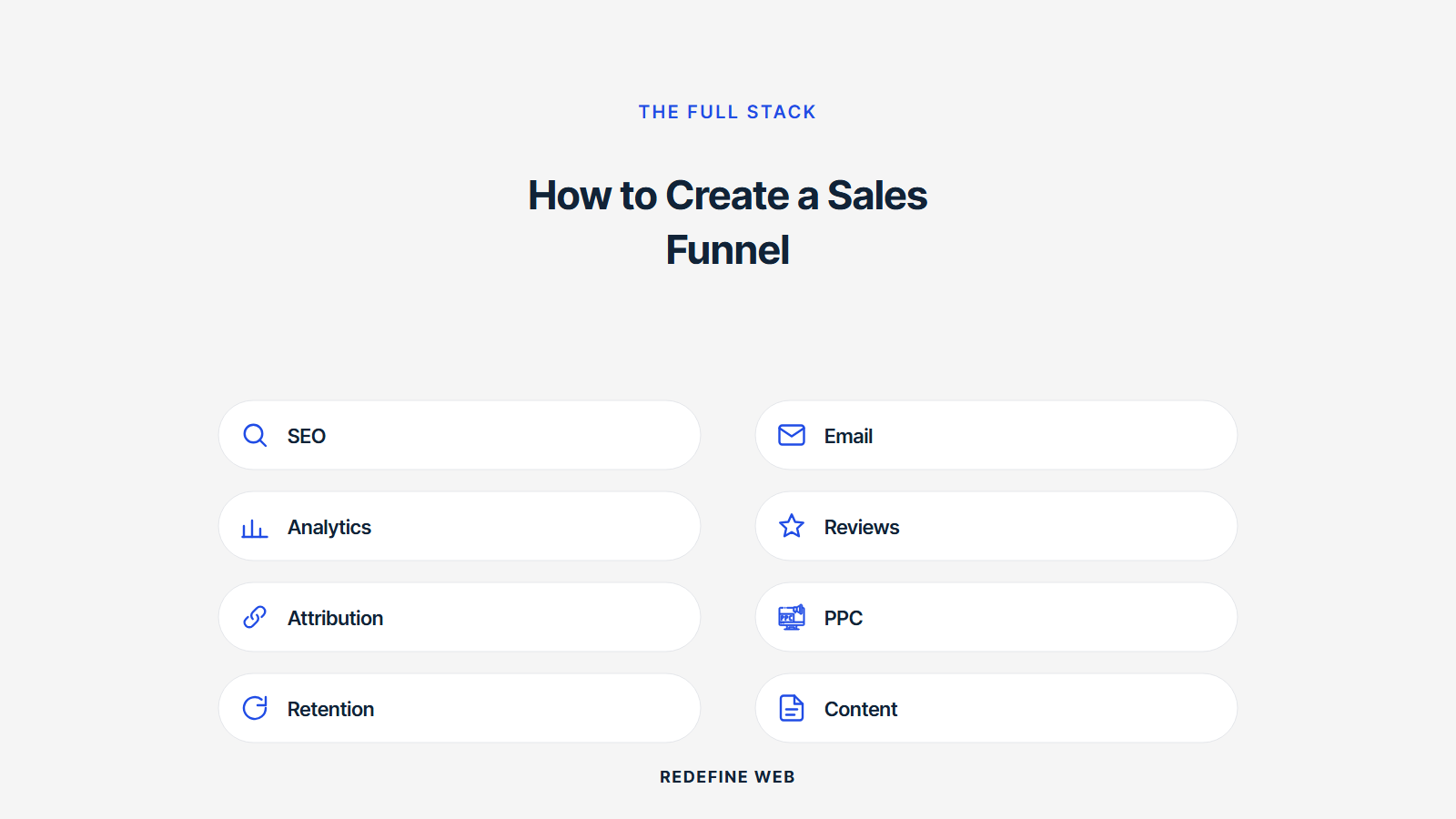
Every funnel needs a small set of weekly numbers. Vanity metrics like total impressions belong on a monthly summary, not a Monday review. Read five numbers every Monday morning: unique visitors, new leads, booked meetings, signed deals, cost per signed deal. Any number more than 15 percent off the four-week rolling average triggers a same-day diagnostic look.
| Stage | Metric | B2B target range | Ecommerce target range |
|---|---|---|---|
| Awareness | Unique visitors / mo | 800 to 5,000 | 20,000 to 250,000 |
| Interest | Visitor to lead rate | 2 to 8 percent | 5 to 15 percent |
| Decision | Lead to opportunity rate | 10 to 30 percent | 60 to 80 percent add to cart |
| Action | Opportunity to deal rate | 20 to 40 percent | 60 to 80 percent checkout |
| Cost | Cost per signed deal | $150 to $2,500 | $18 to $180 |
Use the ranges as guardrails, not targets. Every business drifts to its own benchmark inside 90 days of clean data. That internal benchmark matters more than any industry average printed in a report. The point of the table is diagnostic. Any stage sitting well below the range signals a broken step. Any stage sitting well above the range signals over-optimization at the expense of upstream volume. Both patterns get flagged in the weekly review.
Weekly review pattern for a small team
Monday, 9 a.m. Read the five numbers off the dashboard. Compare against the four-week rolling average. Flag any number more than 15 percent off. Assign an owner to the diagnostic dig-in. Close the meeting inside 15 minutes. That review keeps the funnel honest and catches problems while they are still cheap to fix. Every marketing team we coach runs a version of this review, and every team that dropped it eventually rebuilt the funnel from scratch.
Common mistakes when learning how to make a sales funnel
Every founder who tries to figure out how to make a sales funnel from scratch makes the same short list of mistakes. Read the list before you build. Mark the ones you are about to make. Route around them in the plan. Sequential fixes compound. Parallel mistakes cost more time to unwind than the whole build took to set up.
- Chasing top-of-funnel volume with a broken middle. More clicks on a broken middle produces zero more deals.
- Building six lead magnets on day one. Start with one, tuned to the primary segment.
- Skipping the CRM. Every stage transition lives in someone’s head without one. Buy a CRM before you buy more ads.
- Copying a nurture sequence with no personalization. Every copy-paste sequence gets archived by every recipient.
- Running six channels at half strength. Three well-run channels beat six half-run channels every time.
- No call tracking on a phone-heavy funnel. Half the leads stay invisible in analytics until you install it.
- Announcing a funnel with no follow-up capacity. More leads with no sales follow-up produces angry customers, not deals.
The single biggest first-quarter mistake
Building the whole funnel and forgetting to write the follow-up SLA with sales. Marketing hands over leads. Sales does not work them. Both teams point at each other. Every serious pipeline we help build starts with a written SLA: sales calls every MQL within four business hours. Publish the SLA. Enforce it in the CRM with automated notifications. Review it monthly. That one document fixes more revenue than any additional ad spend can.
Where to go next after you learn how to create a sales funnel
Once you know how to create a sales funnel and have run the first 60 days, three next moves compound. Add a second audience segment with its own nurture sequence. Add cart abandonment or renewal-focused automation. Add a retention program if you serve subscription customers. All three moves layer on top of the four-stage base without disrupting the numbers you already track.
From here, the natural next reads are the deeper posts in this cluster. Start with what is a sales funnel if you want the primer. Continue with sales funnel stages to go deeper on TOFU, MOFU, and BOFU. If your business is B2B, the B2B sales funnel post covers the extra stages a longer cycle needs. For authoritative external reading, see the HubSpot sales funnel guide, the WordStream sales funnel primer, and the HubSpot AIDA model reference.
Ready to hire a team that runs this exact build playbook on your account. Our Sales funnel and automation services ships every project with the full four-stage build, real tracking wiring, and a 90-day pipeline forecast. For broader marketing help alongside the build, our digital marketing services covers SEO, PPC, and web design in the same retainer starting at $599 a month.
The next three cluster reads
The three deepest follow-up posts in this cluster cover the sales funnel primer, the stages breakdown, and the B2B variation. Read in that order. Total time from here to a working funnel plan is about 40 minutes of reading and about three weeks of build for a small team, or eight weeks of build for a mid-sized brand. That is a modest investment for a pipeline your finance team can actually forecast against.
Frequently asked questions
How long does it take to create a sales funnel from scratch?
Three weeks for a small business with one audience segment and one lead magnet. Six to eight weeks for a mid-sized brand with multiple segments, multiple ad accounts, and integrated CRM automation. The build breaks into four workstreams: stage definitions and buyer profile, tracking wiring, asset production, and nurture sequence writing. Small teams run them in sequence. Larger teams run them in parallel. Do not compress the timeline by skipping steps. Every skipped step becomes a diagnostic gap you pay for in the following 90 days.
How much does it cost to build a sales funnel from scratch?
A working four-stage funnel runs on $0 a month for the first 90 days if you use HubSpot Free, GA4, MailerLite Free, and Looker Studio. Once you cross about 1,000 marketing contacts, the paid stack lands between $200 and $2,000 a month depending on volume and features. Agency support for the build typically runs $3,000 to $15,000 as a one-time engagement, plus $599 to $5,000 a month for ongoing retainer work. Cost scales with team size and channel complexity, not with the base funnel structure itself.
What tools do I need to setup a sales funnel?
Four categories cover most builds. Analytics with Google Analytics 4 for stage tracking. A CRM like HubSpot Free or Pipedrive for contact and lifecycle management. Email marketing with MailerLite Free or HubSpot Marketing Hub for nurture sequences. A dashboard tool like Looker Studio or Databox for the weekly review. Add a call tracker like CallRail if any part of your funnel handles phone calls. Total setup effort runs 8 to 20 hours for a small team, 40 to 100 hours for a mid-sized brand with multiple properties.
Can I create a sales funnel for free?
Yes. HubSpot Free CRM, Google Analytics 4, MailerLite Free, and Looker Studio give you tracking, CRM, email, and dashboards without any paid subscription. The free stack works for the first 90 days and often the first year, depending on volume. The limits are no call tracking, no advanced automation beyond time-based triggers, and thin multi-user permissions. If none of those limits blocks your business today, the free stack is a genuinely good starting point that gets you to a working funnel inside three weeks.
What is the first step when building a sales funnel from scratch?
Write the buyer profile. Name. Role. Company size. Industry. Three questions they ask in their first week researching a solution. Three objections they raise inside the first sales call. One number that measures success in their role. That one-page document drives every downstream decision on your funnel, from content topics to lead magnet design to nurture sequence copy. Skip it and you build a funnel for the wrong buyer at the wrong scale. Every serious build we run starts here, before any tooling or page work.
How do I know if my sales funnel is working after I create it?
Read five numbers every Monday morning. Unique visitors. New leads. Booked meetings. Signed deals. Cost per signed deal. Any number more than 15 percent off the four-week rolling average triggers a same-day diagnostic look. Any number more than 25 percent off average triggers an action plan by the end of the day. After 90 days of clean data, you have an internal benchmark that matters more than any industry average. Compare against your own past numbers, not against a report someone published two years ago.
Book your free 30-minute strategy call.
No spam, no sales rep. We use your email to schedule your call with a senior strategist. That is it.
More from the blog
View all articles → Digital Marketing
 Dental Marketing Tips That Compound Into New Patients
Read article Digital Marketing
 Ecommerce Marketing Strategies That Drive Real DTC Revenue
Read article Digital Marketing