Why Healthcare Local SEO Stalls Without Per Location Ownership
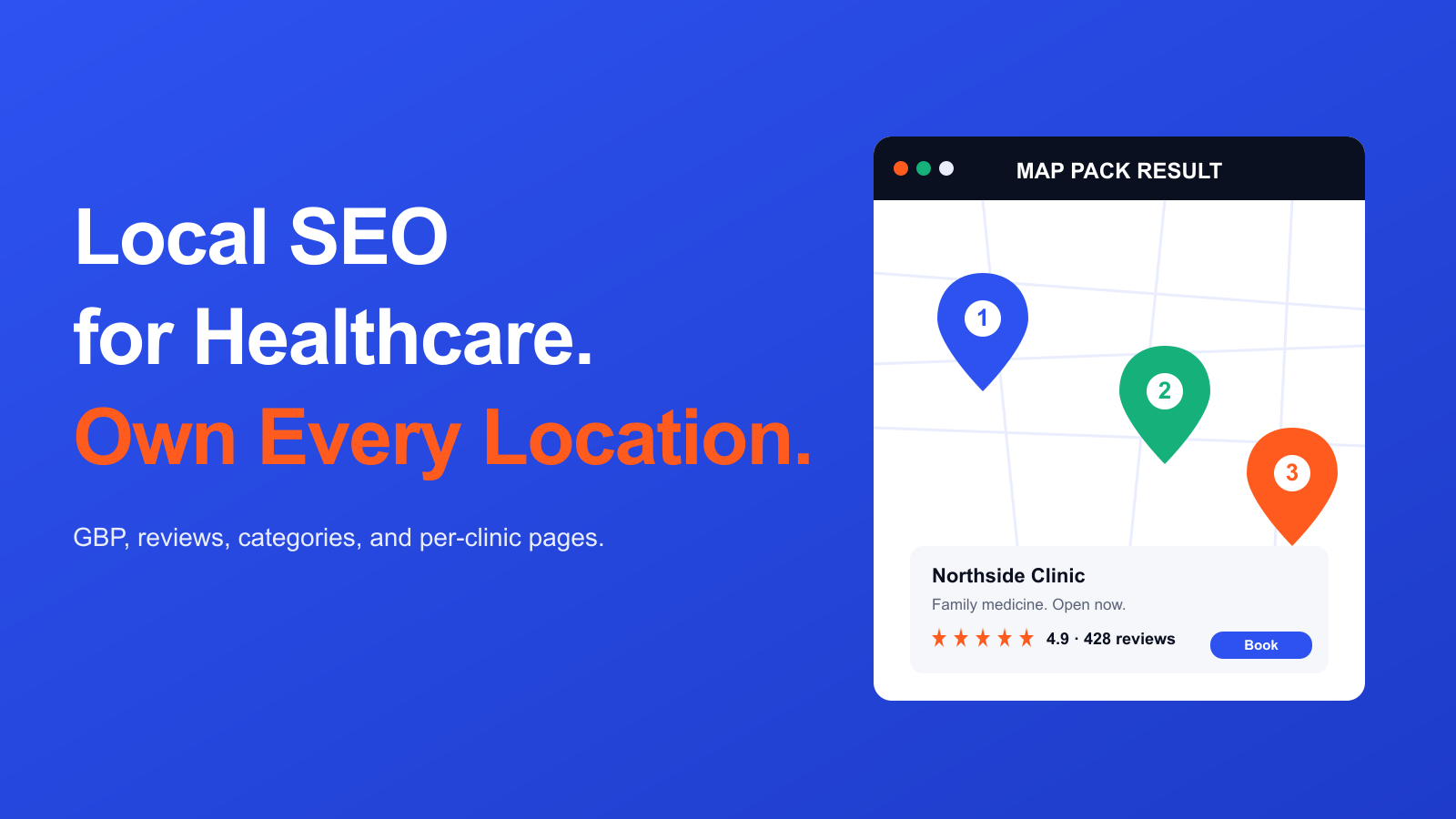
- Local SEO for healthcare is the layer that decides which practice picks up the ready-to-book patient nearby on a phone at a specific hour. Own it per location or lose the map pack to a smaller competitor.
- Google Business Profile primary category is the single-largest ranking lever, and 30 to 60 percent of healthcare profiles land with the wrong Health-Specific Category. Fixing that one field moves Discovery impressions inside 21 days.
- Patient review generation runs under HIPAA guidance. Sign a Business Associate Agreement with the review vendor first, target 20 to 36 fresh reviews per location per month, and respond to every review inside 48 hours.
- Multi-location practices need per-clinic pages with MedicalBusiness schema, embedded map, and unique content per clinic. One shared location page kills every ranking.
- Mission Pet Health grew leads 54 percent year over year across 400-plus animal hospitals after a coordinated per-location local SEO standard replaced fragmented per-clinic work. The gain came from operating discipline, not from more ad spend.
Local SEO for healthcare is the layer most multi-location practices treat as a checkbox and most competitors quietly own. A single-location dermatology group with a strong Google Business Profile, 340 real patient reviews averaging 4.8 stars, and a location page that answers seven booking questions will outrank a 12-location competitor with three claimed profiles, a 60-word footer address, and no per-clinic pages. Local SEO is not one more service line inside the SEO retainer. It is the ranking layer that decides which practice picks up the ready-to-book patient two miles away, on a phone, at 8:14 pm on a Tuesday.
This guide walks the local SEO stack we run on every healthcare engagement, from a single-location physical therapy practice to Mission Pet Health, a 400-plus animal hospital network across the United States. It reads through the frame of per-location ownership. Every clinic gets its own profile, its own review flow, its own page, and its own citation set. The centralized shortcut most vendors sell falls apart at scale, and the sites that run it lose bookings to smaller local competitors who did the per-location work.
What local SEO for healthcare actually covers
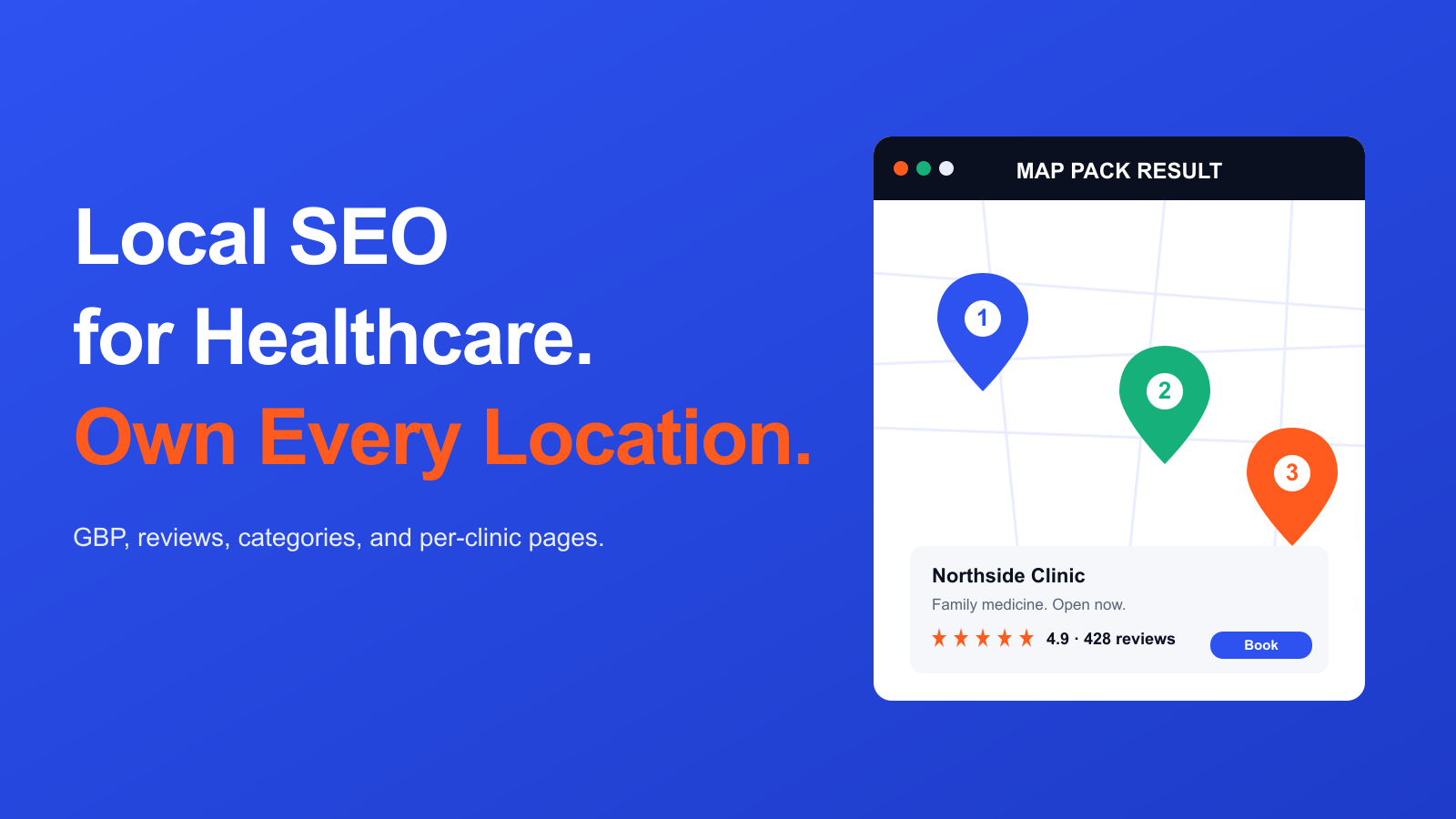
Local SEO for healthcare is the discipline of getting a medical practice’s location or locations to rank inside Google’s map pack, Apple Maps, Bing Places, and every review platform patients check before they book. The map pack sits above the organic blue links on 78 percent of healthcare mobile searches with a local intent, meaning three practices earn the click and every other ranked page fights over the remaining 22 percent of attention. Winning that map pack is a stack of five ranking layers that Google reads together: a claimed and complete Google Business Profile, a steady flow of recent patient reviews, per-location pages on the practice website with MedicalBusiness schema, consistent NAP data across the citation ecosystem, and internal linking that ties every location back to the corporate site.
Healthcare-specific local SEO carries two constraints a generalist agency will miss. First, patient reviews cannot be solicited or gated under HIPAA guidance, meaning the practice cannot review-farm identified patients through a system that stores PHI without a signed Business Associate Agreement with the review platform. Second, Google Business Profile now offers Health-Specific Categories (Medical office, Dentist, Physical therapy clinic, Psychiatrist, and 40-plus more) that map directly to the practice’s clinical specialty and rank stronger than generic categories like Business or Health. Practices we onboard land with the wrong primary category on 30 to 60 percent of their profiles, and fixing that one field moves rankings inside 21 days.
| Local SEO layer | What Google reads | Common healthcare finding | Fix window |
|---|---|---|---|
| Google Business Profile | Claim, categories, hours, photos, services, Q&A | Wrong primary category on 30-60 percent of profiles | Days 1-14 |
| Patient reviews | Volume, recency, average rating, response rate | Fewer than 40 reviews per location, average under 4.3 | Weeks 2-12 |
| Per-location pages | Unique content, MedicalBusiness schema, embedded map | One shared location page with a footer address list | Weeks 2-6 |
| Citations and NAP | Consistency across Yelp, Healthgrades, Zocdoc, Vitals, WebMD | Name, address, or phone variation on 20 percent of listings | Weeks 3-8 |
| Apple Maps and Bing Places | Claim + category + business hours + photos | Both platforms unclaimed on 70 percent of new-client audits | Days 1-21 |
| On-site local signals | Location schema, city-page internal links, service+city combos | No location-hub page linking every clinic | Weeks 3-6 |
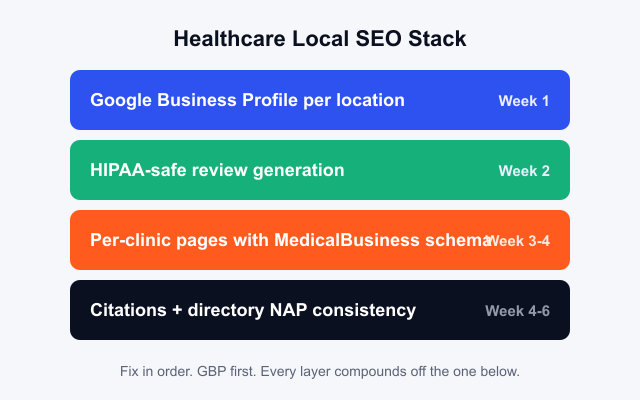
Read that as a sequence, not a pick-list. GBP moves first for one reason: it is the profile Google reads for the map pack ranking itself, and it is the profile patients read before they read the website. Reviews move next since review volume and recency compound over months, so the earliest start earns the largest gain. Everything else supports those two. The single largest local SEO failure we see is a practice pouring six months into citation cleanup and content depth on a website whose primary GBP category is still wrong. Fix the profile first. Then compound the rest.
Google Business Profile is the ranking, not a directory listing
Every healthcare local SEO audit starts with the Google Business Profile of every location, and the audit reads twelve fields per profile. Business name matches the legal name and the sign on the door, no keyword stuffing. Primary category is a Health-Specific Category, not a generic Business or Health. Secondary categories cover the sub-specialties the practice treats, capped at ten. Hours are correct and updated for holidays. Phone number rings the practice directly, not a call-tracking pool that shows a different number on the website. Website field points at the per-location page, not the corporate homepage. Services field lists every treatment the practice offers with 60-word descriptions. Products field lists product-first services like Botox or Invisalign where those apply. Photos cover exterior, interior, waiting room, treatment room, staff, and team, uploaded fresh every 90 days. Questions and Answers has at least 12 practice-authored Q&A pairs. Posts field gets a fresh post every 14 days minimum. Attributes field claims relevant patient-experience flags like Wheelchair accessible, LGBTQ+ friendly, and Accepts new patients.
A well-run profile earns Discovery impressions from queries like family doctor near me, urgent care open now, and knee pain specialist Brooklyn without any advertising spend. A neglected profile earns only Direct impressions from patients typing the practice name, which is the ceiling on the profile’s growth. The audit compares Discovery impression share against Direct impression share as a leading indicator of category and service field quality. A profile pulling 60 to 80 percent Discovery share is doing local SEO work. A profile pulling less than 20 percent Discovery share has the category wrong or the services field empty. Fixing that one gap unlocks Discovery impressions inside 21 to 45 days.
Health-Specific Categories are the ranking lever generalist SEO misses
Google’s Health-Specific Categories set launched to healthcare profiles in phases through 2019 and 2020 and now covers more than 40 clinical categories. Medical office is the general default and it under-ranks against a specific category on every treatment-related search. Dentist beats Medical office for a patient searching dentist near me, even when both profiles are equally complete. Same for Physical therapy clinic, Psychiatrist, Dermatologist, Optometrist, Chiropractor, Podiatrist, and every clinical specialty in the set. Practices that migrated from a legacy Business or Health category to a specific clinical category see 25 to 60 percent gains in Discovery impressions inside 90 days, without any other change.
The audit runs against the full Health-Specific Category set, matches every clinical service the practice performs, and picks the primary category that reflects the highest-volume revenue-generating specialty. Secondary categories fill in adjacent specialties. A multi-specialty group with primary care, urgent care, and orthopedics runs Medical office primary with Urgent care center and Orthopedic clinic secondary. A single-specialty practice runs the specialty as primary and one or two supporting adjacencies. The rule reads simple: primary category names what the practice actually does most, secondary categories name what else it treats. The healthcare SEO services team handles the migration as a scoped one-week project across every location profile.
Patient reviews on HIPAA-safe workflows
Patient reviews carry the second-largest ranking signal inside the map pack after profile completeness, and healthcare practices generate them under a compliance layer no other vertical worries about. HIPAA guidance restricts identified patient data from flowing into third-party systems without a Business Associate Agreement, meaning the practice cannot dump a spreadsheet of appointment emails into a generic review platform. The workflow has to route the review request through a HIPAA-safe channel: a signed BAA with the review vendor (Birdeye, Podium, NiceJob, and Weave all offer BAAs to healthcare accounts), an SMS or email trigger that fires after appointment completion, and a clean unsubscribe path that respects the patient’s opt-out.
The review-generation rate the practice targets is one review per five completed appointments per location per month, sustained across the year. A single-location practice seeing 400 patients per month should generate 80 review requests per month with a conversion rate of 25 to 45 percent, meaning 20 to 36 new reviews per month per location. Over 12 months that yields 240 to 432 new reviews, moving the practice from a 40-review baseline to a 280 to 470 review count. Reviews after the 40th one weigh less individually but the running total, the recency, and the average rating all feed Google’s local ranking algorithm. Practices that add 20 to 30 fresh reviews per month per location outrank practices that added 200 reviews five years ago and stopped.
The response rate matters as much as the review count. Every review, positive or negative, gets a response from the practice inside 48 hours. Positive responses thank the patient by first name and reference the specific treatment or team member without disclosing PHI. Negative responses acknowledge the concern, apologize where appropriate, and offer to talk offline through a HIPAA-safe channel. The response rate signals to Google that the practice is active on the profile, and it signals to prospective patients that the practice reads and cares about feedback. Practices with a 90-plus percent response rate rank higher than practices with the same review count and a 20 percent response rate. The dental review generation guide covers the same workflow with dental-specific compliance notes that translate cleanly to the broader healthcare set.
Per-location pages, MedicalBusiness schema, and the internal-linking layer
Multi-location practices break local SEO at the website layer more often than at the profile layer. A 12-clinic practice with one page titled Our Locations that lists all 12 addresses in a footer block has one indexable page for 12 locations. Google indexes it as one page. The map pack ranks per location, so one page loses to 12 competitors with dedicated location pages every time. For the dental-specific playbook on building these pages, see our guide on dental location pages SEO. The fix is per-clinic pages, one page per location, each with a unique URL like /locations/brooklyn-heights or /clinics/atlanta-buckhead, and each carrying its own content, its own schema, its own embedded map, and its own internal linking.
Every per-location page carries MedicalBusiness schema with a specialty subtype, the exact NAP from the GBP profile, the accepted insurance plans, an areaServed array covering the neighborhoods the clinic pulls from, and a hasMap link pointing at the GBP itself. The page body carries a 600-to-900-word write-up that names the specific clinic, the physicians who practice there, the conditions treated at that clinic (some conditions might only be treated at some locations in a multi-specialty group), the parking situation, the transit access, and a booking widget scoped to that location. The location hub page links to every clinic page, and every clinic page links back to the hub and to two or three adjacent clinics. That internal linking pattern lets Google understand the practice as a network, not a single monolithic entity.
Citations, NAP consistency, and the healthcare directory set
Citations are the third ranking layer inside local SEO, and they cost far less than a generalist agency will charge for them. The healthcare citation set is smaller and higher-authority than the general local business set, meaning a targeted 20-directory pass beats a scattered 400-directory pass. The set that matters for a healthcare local SEO program: Google Business Profile, Bing Places, Apple Maps Connect, Yelp, Healthgrades, Zocdoc, Vitals, WebMD Care, Doctor.com, RateMDs, DocSpot, US News Health, Sharecare, Wellness.com, and the two or three specialty directories that match the clinical specialty (Psychology Today for mental health, 1-800-Dentist for dentistry, ChiroDirectory for chiropractic, and so on).
The audit reads every citation for NAP consistency: name spelled identically, address formatted identically (including whether it uses Suite or Ste), phone number identical (no call tracking pools that inject a different number). A 20 percent NAP variation rate is common on new-client audits and it costs 15 to 30 percent of the potential local ranking signal. The remediation is a one-time cleanup pass through Whitespark, BrightLocal, or Yext, followed by a quarterly delta audit that catches new listings scraping stale data from aggregators. Practices past two locations should treat citation hygiene as ongoing work, not a one-time project. Business-data aggregators (Data Axle, Localeze, Foursquare) republish stale data quarterly, and every republish risks re-corrupting a clean citation.
Apple Maps Connect and Bing Places as the two forgotten profiles
Every healthcare local SEO audit lands with the same finding on Apple Maps Connect and Bing Places: both unclaimed on 60 to 75 percent of the locations. Apple Maps drives every iPhone user’s default map query, which is roughly 50 percent of the US mobile market. A patient searching family doctor near me on iOS gets Apple Maps as the default response, not Google Maps. If the practice is unclaimed on Apple Maps, the phone number, the hours, and the specialties may all be scraped from stale data, and the profile may not exist at all. Bing Places drives the map pack results inside Bing search and Cortana voice queries, still a meaningful 6 to 10 percent of US search share and a much higher share among older patients.
The claim workflow on both platforms takes 20 to 40 minutes per location, and it is a one-time project that pays back for years. Apple Maps Connect uses a business.apple.com account, requires the practice to verify ownership through a phone call to the listed number, and offers a category set that overlaps 70 percent with Google’s Health-Specific Categories. Bing Places for Business offers a bulk import from Google Business Profile for practices past 10 locations, cutting the claim time to a single upload. Both profiles get the same treatment as the GBP: correct category, complete hours, real phone number, high-quality photos, and a link to the per-location page. Practices that skip both platforms lose 20 to 40 percent of their patient discovery from mobile search across the year.
Multi-location networks. The Mission Pet Health story
Mission Pet Health came to us as a veterinarian-owned and operated network of more than 400 animal hospitals nationwide, locally branded with shared operational and marketing support from the network. Local ranking work was fragmented before the engagement started. Each hospital ran its own Google Business Profile, its own Yelp listing, and its own citation set, with no coordinated standard across the network. Some profiles were fully claimed and well-run. Others had wrong primary categories, missing hours, and 3-year-old exterior photos. The paid media stack sat on top of that fragmentation and paid for it every day. Ad platforms pulled conversion signals through 400 separate GBP profiles with wildly different completeness scores, and the cost per lead varied by up to 4x across the network for the same clinical service.
The remediation ran the same per-location standard we run on a single-location practice, replicated 400 times through a shared operational framework. Every profile moved to a Health-Specific primary category (Veterinarian, with adjacent secondary categories for the sub-specialties each hospital offered). Every hospital got a per-clinic page on the network website with local schema, embedded map, and hospital-specific team bios. Review generation moved to a HIPAA-safe workflow through Birdeye with a BAA covering pet-owner contact data. Citation cleanup ran through Yext for the 400-location scale, with a quarterly delta audit built into the operating cadence. Paid media consolidated onto a shared account structure with Performance Max and Local Services Ads tied to the per-location standard.
The compounding gain showed up as a 54 percent year over year lead growth across the network, a 74 percent beat over the 12-month ROAS goal, and an 11 percent efficiency gain at scale even as the network integrated new hospitals. None of that came from spending more on ads. It came from a local SEO standard that made every paid dollar work harder on top of a fixed local ranking foundation. That is the pattern most multi-location healthcare groups miss. Fix the per-location local SEO standard first, and every marketing dollar on top of it earns more without any additional budget.
The local SEO reporting layer that ties to bookings
The local SEO deliverable is a monthly report that ties each layer to a leading indicator the practice can read without a specialist’s help. GBP Discovery impressions per location, tracked as a percentage of total profile impressions. Review count added per location per month, split by platform. Average review rating per location, tracked as a rolling 90-day window. Response rate to reviews per location. Per-location page rankings for the two or three highest-value patient queries. Citation consistency score across the top 20 healthcare directories. And the outcome number, always: booked patients from map pack and organic local search, per location, split by new patient versus established patient.
| Local SEO KPI | Month 3 target | Month 6 target | Month 12 target |
|---|---|---|---|
| GBP Discovery impression share | 40 percent of profile impressions | 55 percent of profile impressions | 65-75 percent of profile impressions |
| Reviews added per location per month | 10-15 fresh reviews | 18-24 fresh reviews | 24-36 fresh reviews sustained |
| Average review rating per location | 4.4 or higher | 4.6 or higher | 4.7-4.9 sustained |
| Response rate to reviews | 75 percent within 48 hours | 90 percent within 48 hours | 95 percent within 24 hours |
| Citation consistency across top 20 directories | 85 percent NAP match | 95 percent NAP match | 98 percent NAP match, quarterly delta clean |
| Booked patients from map pack + local organic | Baseline set, per location tracked | Up 20-40 percent per location | Up 60-140 percent per location |
The reporting table is the same one the practice takes with them at the end of an engagement. It is not proprietary. It is a checkable plan the practice team runs against any future vendor. Local SEO for healthcare is not a black box. It is a stack of measurable per-location metrics that compound if run in order.
Common healthcare local SEO mistakes practices keep making
Every practice we’ve onboarded has committed at least one of these. Recognizing them saves the next 12 months of remediation.
- Wrong primary category on the GBP. Medical office or Business as primary on a profile that should read Physical therapy clinic, Psychiatrist, or Dermatologist. Fix moves rankings inside 21 days.
- One shared location page for every clinic. A footer address list is not a location page. Every clinic needs its own URL, its own content, its own schema, and its own embedded map.
- Review requests through a non-BAA platform. Sending patient emails to a review vendor without a Business Associate Agreement exposes the practice to HIPAA enforcement risk. Sign the BAA first, then start the workflow.
- Ignoring Apple Maps Connect and Bing Places. Both platforms unclaimed loses 20 to 40 percent of mobile discovery. Both claim in a one-day project.
- Call tracking pools that break NAP consistency. A dynamic phone number on the website that differs from the GBP phone number breaks the NAP signal. Use static numbers on the GBP and pipe call tracking through the network hardware, not through client-side phone-swap scripts.
- Skipping the Services and Products fields on the GBP. Both fields feed Discovery impressions on treatment-specific queries. Every profile fills every field. Empty fields cost impressions.
- Response rate under 50 percent. A practice that stops responding to reviews signals to Google that the profile is inactive. Response rate is a live signal, not a one-time metric.
- Chasing 400 directories instead of 20. The healthcare citation set is smaller and higher-authority than the general local business set. Own the 20 that matter. Skip the rest.
The pattern under every mistake: local SEO gets treated as a checklist instead of a per-location operating discipline. A healthcare network changes every quarter with new hires, new services, new hours, and new locations. The local SEO work has to change with it. Practices that run a per-location monthly review stay ahead of drift. Practices that set it and forget it quietly lose 15 to 25 percent of their local ranking base inside the first year.
Where local SEO sits inside the wider healthcare SEO program
Local SEO for healthcare is layer three of the four-layer program. Layer one is technical, covered in our technical SEO for healthcare guide. Layer two is on-page and content, covered in the on-page SEO for healthcare guide. Layer three is local, which is this guide. Layer four is authority, covering digital PR, physician thought leadership, and reviewer author pages. The layers compound on top of each other. A practice with clean technical foundations, deep on-page work, and a strong local SEO stack outranks a practice with only one of those layers on 90 percent of the queries that matter to the booking calendar.
The sequencing rule is fixed. Technical first, then on-page, then local, then authority. Practices that jump straight to local SEO without a clean technical foundation waste 40 to 60 percent of the local ranking work. A broken sitemap or a client-side pixel gates every ranking regardless of GBP quality. The healthcare SEO pillar guide walks the full four-layer program in sequence, and the healthcare SEO strategy guide covers how the four layers get scoped inside a real retainer. Local SEO is not a standalone project. It is the layer that ties the technical and on-page work to the actual booking calendar.
Frequently asked questions about local SEO for healthcare
What is local SEO for healthcare?
Local SEO for healthcare is the discipline of getting a medical practice’s location or locations to rank inside Google’s map pack, Apple Maps, Bing Places, and the healthcare review platforms patients check before they book. It covers Google Business Profile management, patient review generation through HIPAA-safe workflows, per-location pages with MedicalBusiness schema, citation consistency across the healthcare directory set, and internal linking that ties every location back to the corporate site. Local SEO for healthcare sits between on-page and authority work in the wider SEO program and it is the ranking layer that decides which practice picks up the ready-to-book patient nearby on a phone at a specific hour.
How is local SEO for healthcare different from regular local SEO?
Local SEO for healthcare adds two constraints a generalist local SEO program never worries about. First, review generation runs under HIPAA guidance, meaning the practice cannot route identified patient data through a review vendor without a signed Business Associate Agreement. Second, Google Business Profile offers Health-Specific Categories (Medical office, Dentist, Physical therapy clinic, Psychiatrist, Dermatologist, and 40-plus more) that rank stronger than the generic Business or Health categories that most industries use. A local SEO program that treats a healthcare profile like a restaurant profile will underperform on both compliance and ranking. Every layer of the local SEO stack gets a healthcare-specific fix window that matches the compliance and category constraints.
How long does local SEO for healthcare take to work?
Local SEO for healthcare shows leading indicators inside 21 to 45 days and outcome moves inside 90 to 180 days on a well-scoped engagement. GBP category fixes and profile completeness improvements move Discovery impressions inside three weeks. Review generation compounds monthly, meaning month-three review counts are 3x the month-one baseline and month-six counts are 6x the baseline. Per-location page rankings for local queries move inside 60 to 120 days on clean technical foundations. Booked patients from map pack and organic local search grow 20 to 40 percent by month six and 60 to 140 percent by month 12 on the practices we operate. Practices past 10 locations see faster gains at scale since the per-location standard replicates cleanly across the network.
How much does local SEO for healthcare cost?
Local SEO for healthcare runs $599 to $1,800 per month for a single-location practice, $1,800 to $4,500 per month for a multi-location group of 2 to 10 clinics, and $4,500 to $18,000 per month for a regional network of 10 to 30 clinics. The retainer covers GBP management, review generation workflow operation, per-location page updates, citation cleanup, and monthly reporting per location. Practices past 30 locations move to a scoped operating framework that fits the enterprise scale. A one-time local SEO audit runs $2,500 to $6,500 for a single-location practice and does not include ongoing work. Practices past two locations typically pick the retainer path since local SEO is a running program, not a one-time project.
What are the best local SEO strategies for healthcare systems?
The best local SEO strategies for healthcare systems all start with a per-location standard applied at scale. Every location gets the same GBP completeness bar, the same Health-Specific Category treatment, the same review generation workflow, the same per-location page template, and the same citation set. Centralized ownership of the standard through the corporate marketing team combined with per-location ownership of daily updates through the practice manager or office lead beats every other operating model. Second-best strategy: quarterly delta audits that catch drift before it compounds. Third: consolidated reporting per location so the corporate team can spot the profiles that are falling behind and route support to them inside 30 days. Systems that skip the per-location standard and centralize everything under one profile lose the map pack ranking on every non-flagship location.
How important is AEO in local SEO for healthcare?
Answer Engine Optimization matters inside local SEO for healthcare on two ranking surfaces. First, Google’s AI Overviews now cite local practices in response to treatment-specific queries with a local intent, and the profiles cited are the ones with strong per-location pages, MedicalBusiness schema, FAQPage schema, and answer-first content structure. Second, voice queries on Siri (Apple Maps), Alexa (Yelp partnership), and Google Assistant read local business data from the map platforms directly, meaning a claimed Apple Maps Connect profile and a claimed Bing Places profile carry direct AEO signal for voice search. Practices that skip the AEO layer inside their local SEO program lose the AI Overview citation slot to a competitor that ran the same local SEO work with answer-first content on the location pages.
Running a per-location local SEO reset on a multi-clinic healthcare group this quarter? Talk to our healthcare marketing team about a scoped 90-day local SEO framework your operations team can act on before renewal.
Book your free 30-minute strategy call.
No spam, no sales rep. We use your email to schedule your call with a senior strategist. That is it.