Local SEO for Home Services: How to Rank in the Map Pack
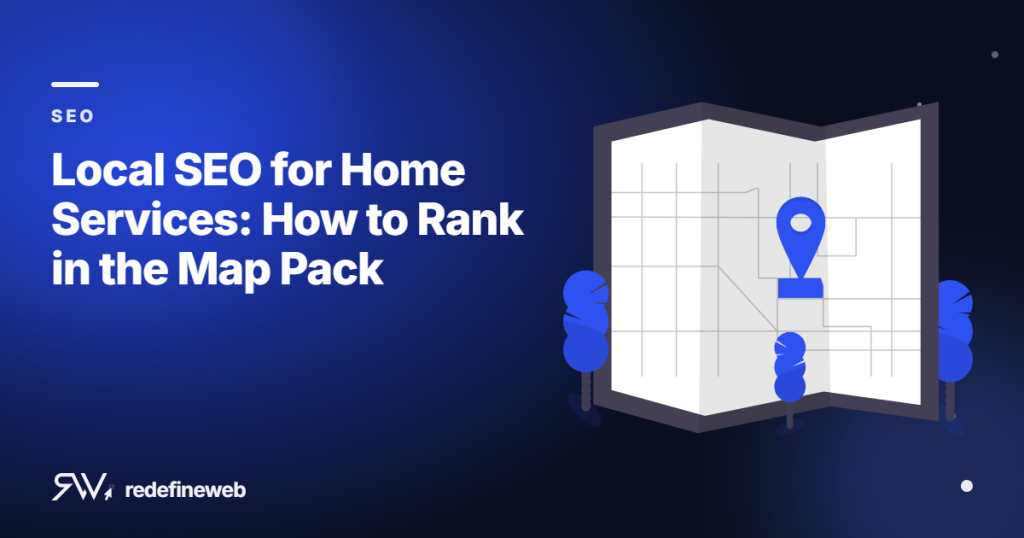
The Google map pack generates more calls for home service companies than almost any other organic channel. Three local businesses appear above the organic results when someone searches for a home service. Getting into those three spots is the goal of local SEO. This guide explains exactly how the map pack works and what it takes to rank in it.
What Is the Map Pack and Why Does It Matter?
The Google map pack (also called the local pack or 3-pack) is the block of three local business listings that appears prominently in local search results, usually above organic website rankings. Each listing shows the business name, star rating, review count, address, phone number, and hours.
Map pack listings generate clicks at a significantly higher rate than organic results for service searches. When someone searches “plumber near me” on mobile, they see the map pack first and the call button is right there. Most people call from that listing without ever visiting the plumber’s website. That’s why ranking in the map pack translates directly into inbound calls, often more directly than organic website rankings.
Google determines map pack rankings using three primary factors: relevance (does the business match what was searched?), distance (how close is the business to the searcher?), and prominence (how well-known and trusted is the business?). You can optimize for relevance and prominence. Distance is a geographic fact. Your strategy should maximize relevance and prominence for your target service area.
Google Business Profile Optimization: The Core of Map Pack Rankings
Your Google Business Profile (GBP) is the primary lever for map pack rankings. An incomplete or poorly optimized GBP is the most common reason qualified home service companies don’t appear in the map pack for their target searches.
Complete optimization checklist for GBP: Business name matches your legal business name exactly. Primary category is your most specific core service (not just “Contractor” but “Plumber” or “HVAC Contractor”). Secondary categories cover additional services you offer. Service list is complete with individual service descriptions. Hours are accurate and updated for holidays. Address is accurate and matches all other directories. Service area includes every city and zip code you serve. Description (750 characters) includes your primary services, city, and years in business. Photos include exterior, interior, team, trucks, and work photos.
GBP posts signal active engagement. Post weekly: a completed project photo, a seasonal tip, an announcement, or a promotion. Active GBP profiles rank above dormant ones with equivalent review counts. Set a reminder to post every Monday morning.
Reviews: Volume, Rating, and Recency All Matter
Reviews are among the most significant ranking signals in the map pack. Google’s local algorithm favors businesses with more reviews, higher ratings, and recent review activity. A company with 150 reviews at 4.7 stars will consistently outrank one with 20 reviews at 5.0 stars in competitive markets.
The recency factor is often underestimated. A business that got 100 reviews two years ago and hasn’t gotten new ones since is losing ground to competitors who are actively generating reviews today. Google interprets fresh reviews as a signal that the business is active and currently providing service. Aim to generate new reviews every week, not just in bursts after a marketing push.
Systematize review generation. After every completed job, send a text within two hours with a direct link to your Google review form. Train your team to verbally request a review before they leave the job site. Track review count weekly. Set a monthly minimum. A company that generates 10 new reviews per month will have a substantial review count advantage within 12 months, which directly supports map pack rankings.
NAP Consistency: The Citation Foundation
NAP stands for Name, Address, Phone number. Consistency in how these three pieces of information appear across the web is a foundational local SEO signal. Google cross-references your business information across dozens of directories to verify that your business is real, located where you say it is, and reachable at the number you list.
Inconsistencies in NAP, even minor ones, create conflicting signals that can suppress map pack rankings. Common inconsistencies: “St.” vs “Street,” a missing suite number, an old phone number that still appears on some directories, a business name that includes “LLC” on some sites and not others. Run a citation audit through BrightLocal, Whitespark, or Moz Local to find all instances of your business information online and identify conflicts.
After finding inconsistencies, correct them one by one. For major directories (Yelp, Angi, BBB, Facebook, Apple Maps, Bing Places), log in directly and correct the information. For smaller directories, many have self-service correction tools. Citation management services can automate corrections across hundreds of directories but manual correction of the top 15-20 sources delivers 80% of the benefit.
On-Site Signals That Support Map Pack Rankings
Your website reinforces your GBP’s ranking signals. A website that clearly corresponds to the GBP listing, with consistent NAP, relevant content, and proper schema markup, outranks competitors with equivalent GBP profiles but weaker websites.
LocalBusiness schema markup is the most directly impactful on-site signal for map pack rankings. Add schema markup to your homepage and key pages with your business name, address, phone, service area, business hours, and review data. Use Google’s Rich Results Test to verify your schema is implemented correctly.
Your website should include a dedicated page for each service area you target. Each page mentions the city name in the title, H1, and body content. These pages signal to Google that you genuinely serve that area, which reinforces your GBP’s service area claims and can extend your map pack visibility into cities beyond your immediate location.
Building Local Authority Through Links and Mentions
Google’s “prominence” factor in local ranking is partly driven by links and mentions from other websites. A home service company mentioned in local news articles, listed on the Chamber of Commerce website, and linked to by local community organizations signals more local prominence than one with no external presence beyond basic directories.
Local link building for home services: join the local Chamber of Commerce and get your business listed on their member directory. Sponsor community events and get linked from the event website. Reach out to local real estate blogs or home improvement websites for mentions or feature opportunities. Each local link adds to your prominence score and supports map pack rankings.
Common Map Pack Mistakes That Cost Rankings
Incorrect primary category: choosing “General Contractor” when your actual service is HVAC. This reduces relevance for your target searches significantly. Use the most specific category that accurately describes your main service.
Keyword stuffing the business name: adding city names or services to your GBP business name (“ABC Plumbing – Reading PA Emergency Plumber”) violates Google’s guidelines and can result in profile suspension. Your GBP name should match your legal business name.
Failing to respond to reviews: both positive and negative. Responses signal active management of the profile. Google’s own documentation suggests that responding to reviews helps your ranking. More practically, potential customers read your responses when evaluating whether to call you.
For a complete local SEO framework that covers both map pack and organic rankings, read local SEO for home service companies covering all key ranking factors.
FAQ
How long does it take to rank in the Google map pack?
Timeline varies by market competition and starting point. In less competitive local markets, a fully optimized GBP with active review generation can achieve map pack visibility within 60-90 days. Competitive markets (large cities, popular services) may take 6-12 months of consistent optimization before map pack positions become stable. Review generation and citation consistency are the most time-sensitive factors.
Does my physical location affect map pack rankings?
Yes. Google’s local algorithm factors the distance between the business address and the searcher’s location. Businesses closer to the searcher rank higher for the same search. This means a plumber in downtown Reading ranks better for “plumber Reading PA” than one located at the edge of the county. You can partially compensate with strong reviews and on-site optimization, but physical location is a factor you can’t fully override.
Can I rank in the map pack for cities where I don’t have a physical location?
Yes, but it’s more challenging. Google allows service-area businesses (those that travel to the customer) to hide their physical address and set a service area in GBP. You can rank in the map pack for cities within that service area, but you’ll generally rank lower than businesses with a physical location in that city. City-specific landing pages on your website and strong citation presence in those cities improve your map pack visibility beyond your home base.
How many reviews do I need to rank in the top 3?
Review requirements vary by market. In small markets, 20-30 reviews with a strong rating may be sufficient. In major metros competing for high-value searches like “HVAC installation,” 150+ reviews may be needed to break into the top 3. Check the review counts for the current top-3 listings in your target searches to set a realistic target. Then build a system to close the gap.
What is the difference between map pack rankings and organic rankings?
Map pack rankings are driven primarily by Google Business Profile signals: reviews, GBP completeness, citation consistency, and proximity to the searcher. Organic rankings are driven by website content quality, backlinks, page speed, and on-page SEO. They’re related but separate systems. You can rank well organically and poorly in the map pack, or vice versa. The strongest local presence combines top map pack positions with strong organic rankings on the same search results page.
Book your free 30-minute strategy call.
No spam, no sales rep. We use your email to schedule your call with a senior strategist. That is it.