
Local SEO for Med Spas That Books More Treatments
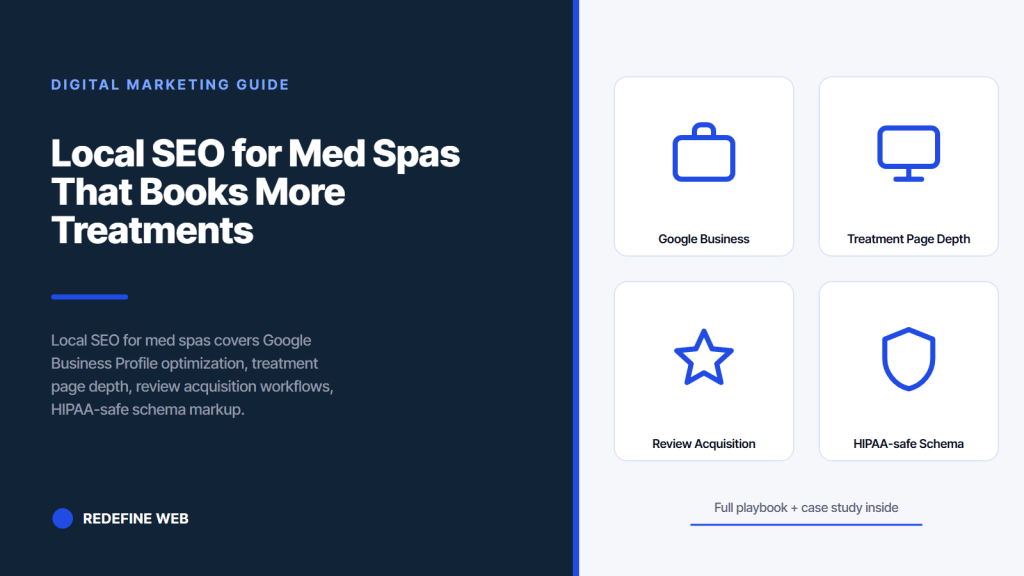
- Google Business Profile depth drives 40 to 70 percent of clinic-level Map Pack results.
- Treatment page depth per location beats generic city page content for local rankings.
- Review velocity of 8 to 20 monthly reviews holds Map Pack positions past month 6.
- HIPAA-safe schema markup avoids exposing patient data in local search results.
- Neighborhood-level content beats city-level content on competitive treatment queries.
- Google Business Profile depth drives local seo for med spas
- Treatment page depth per location for local seo for med spas
- Review acquisition workflows for local seo for med spas
- HIPAA-safe schema markup architecture
- Neighborhood-level content strategy for competitive markets
- Competitive density adjustments to local seo for med spas
- Beauté Aesthetics New York case study on program depth
- Local seo for med spas benchmarks table
- Photo compliance for local seo for med spas
- Wrapping up local seo for med spas program design
- Program launch checklist for the first 90 days
Local SEO for med spas drives Map Pack rankings, per-treatment-query visibility, and neighborhood-level discovery that paid search and paid social alone cannot deliver at sustainable cost per booked treatment consult. Skincare and injectables clinics competing in Manhattan, Los Angeles, Miami, and Dallas face 15 to 35 percent higher paid search costs per click than three years ago, which pushes the ROI math toward organic local visibility. Programs that build Google Business Profile depth, treatment page depth per location, review velocity, and HIPAA-safe schema architecture typically hold Map Pack positions past month 6 that competitors relying on shortcuts lose to the next algorithm update.
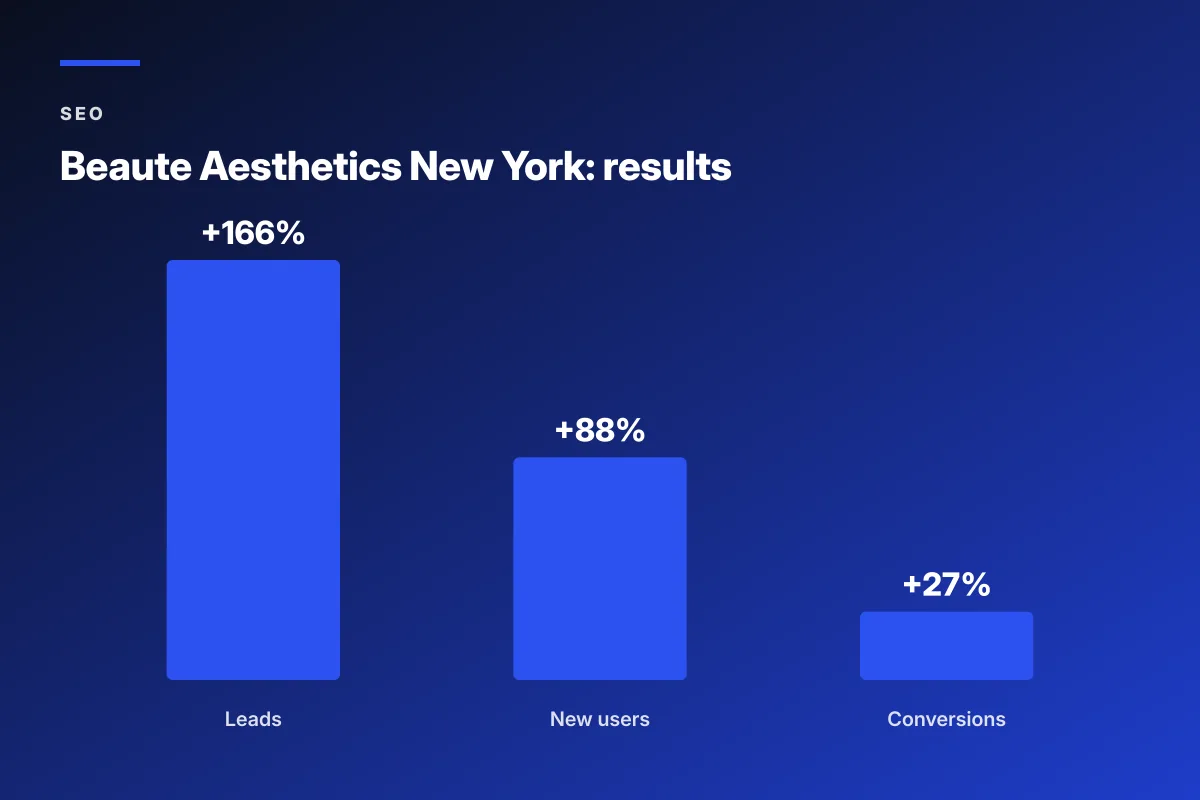
This guide walks through Google Business Profile optimization for med spas, treatment page depth per location, review acquisition workflows, HIPAA-safe schema architecture, neighborhood-level content strategy, competitive density adjustments, plus the Beauté Aesthetics New York twelve-month program that grew clinic bookings 166 percent while growing organic search attribution from 3.2 percent to 42 percent of monthly bookings across skincare, injectables, and wellness treatment services. Programs that treat local SEO as an afterthought to paid advertising typically miss the compounding curve that separates enterprise-scale local visibility from ad-dependent visibility.

Google Business Profile depth drives local seo for med spas
Google Business Profile depth drives 40 to 70 percent of clinic-level Map Pack results in competitive markets before any on-site SEO work fires at all. Profile depth means service list completeness across every treatment line offered, 340 plus photos organized by treatment category, weekly post cadence with treatment updates and staff highlights, service area accuracy tied to the physical clinic address, hours updated for holidays and events, and product listings for retail-side skincare inventory carried at the clinic. Profiles running under 60 photos, under weekly post cadence, or with incomplete service lists rarely hold top-three Map Pack positions past month 6.
Building profile depth from a bare baseline typically takes 90 to 120 days because photo shoots, service list writeups, and post cadence buildout stack across multiple weeks. According to Google Business Profile guidelines for medical practices, service list accuracy and photo relevance both weight the Map Pack ranking algorithm. Clinics that rush profile buildout in 30 days typically miss photo diversity, service list completeness, and post cadence consistency that Google rewards when consistency shows up across the trailing 90-day window. Our med spa SEO services handle profile depth buildout as a standalone workstream.
Photo strategy across treatment categories
Photo strategy across treatment categories for local seo for med spas splits into six buckets. Facility exterior and interior photos build local relevance signals. Provider photos with licensed dermatologist, RN, and licensed esthetician staff carry HIPAA-safe brand personality. Treatment room photos show clinical infrastructure without exposing patient identifiers. Before-after photos require signed consent forms and FTC-compliant caption wording. Product retail photos for in-clinic skincare inventory support product search visibility. Event and community photos support seasonal freshness signals. Rotating 8 to 12 fresh photos monthly maintains profile freshness signals that Google weights on the trailing 60-day window across active Map Pack competitors.
Treatment page depth per location for local seo for med spas
Treatment page depth per location for local seo for med spas beats generic city page content on competitive treatment queries almost every time. Each treatment line at each location deserves a dedicated page covering the treatment description, licensed provider bio, before-after photo gallery with signed consent, price range or consult-required note, FAQ block, related treatment cross-links, and neighborhood-level content that ties the treatment to specific service area references. Clinics running generic city pages listing 15 to 25 treatments in bullet form rarely rank on competitive queries because the pages carry no depth signals search algorithms weight for local intent matching.
Per-location per-treatment page architecture produces 2,400 to 8,200 dollar cost per booked consult on competitive treatment queries versus 60 to 220 dollar cost per booked consult from paid search alone. The math flips over 18 to 30 months as compounding organic traffic pays back the initial content investment. Growth-stage med spas benefit from prioritizing the top 8 to 12 treatment lines by revenue rather than trying to build page depth across every treatment simultaneously. Category-leading agencies build a 24 to 36 month content roadmap that sequences treatment page depth across revenue-weighted prioritization rather than random treatment line coverage.
Provider bio linking discipline
Provider bio linking discipline on treatment pages matters because Google now weights medical author expertise signals on health-adjacent content. Every treatment page should carry an author byline linked to a licensed provider bio page containing state license number, board certification credentials, medical school and residency details, published research citations, and social profile links to LinkedIn, Instagram, or professional society membership. Provider bio pages without external verification links rank meaningfully lower on competitive treatment queries versus provider bio pages with 8 to 15 external verification links across professional society directories and licensing board profiles.
Review acquisition workflows for local seo for med spas
Review acquisition workflows for local seo for med spas produce the 8 to 20 monthly review velocity that holds Map Pack positions past month 6 on competitive treatment queries. Review acquisition typically runs through automated post-treatment SMS follow-up 24 to 48 hours after the consult, tablet-based in-clinic review request stations at checkout, email follow-up sequences with review request in the third or fourth message, and post-purchase QR codes on retail skincare receipts. Category-leading review workflows produce 8 to 15 percent review conversion rate on total consult volume versus 2 to 4 percent conversion rate on ad hoc review requests without workflow discipline.
Review response discipline matters as much as review volume. Response times under 24 hours on both positive and negative reviews signal profile activity that Google weights heavily. Response wording needs HIPAA-safe patterns that never confirm or deny patient status, treatment specifics, or provider identity. According to HHS HIPAA guidance on marketing and social media, patient-identifying information in review responses can trigger breach notification requirements. Category leaders train front desk staff on HIPAA-safe review response wording as part of onboarding rather than treating it as an afterthought.
Negative review handling
Negative review handling within local seo for med spas programs matters because 1 to 3 negative reviews per year is normal on any active clinic. Response wording should acknowledge the reviewer without confirming patient status, offer to move the conversation offline through a general clinic contact channel, and avoid engaging on specific treatment details in the public response. Escalation to Google review removal requests works when reviews violate specific policy conditions (spam, off-topic, personal attacks, defamatory content without evidence). Removal requests on legitimate negative reviews rarely succeed and often backfire by drawing attention. Focus on generating fresh positive reviews rather than fighting individual negative reviews.
Med spa profiles with under 60 photos get penalized in competitive metros. Upload 20 treatment-tagged photos this week. Map pack shifts inside 30 days.
HIPAA-safe schema markup architecture
HIPAA-safe schema markup architecture for local seo for med spas uses MedicalBusiness or Physician schema paired with review filtering, testimonial anonymization, and Q and A moderation to keep structured data fields free of patient-identifiable content. Schema markup that pulls from unfiltered review corpus can expose patient names, appointment dates, treatment specifics, or provider identity through structured data indexed by search engines. Category-leading local SEO agencies configure schema field population from moderated review lists rather than raw review feeds. Skipping HIPAA-safe schema architecture exposes clinics to HIPAA breach notification requirements when patient-identifying content surfaces in indexed structured data.
Schema field population for MedicalBusiness type should include name, address, telephone, opening hours, accepts reservations, service list, provider list linked to Physician schema entries, and aggregate rating from filtered review corpus. According to schema.org MedicalBusiness type documentation, the medicalSpecialty field carries specific accepted values that match search intent when populated correctly. Skipping the medicalSpecialty field or populating it with free-form text reduces schema effectiveness on medical vertical queries. Category-leading agencies validate schema markup through Google Rich Results test on every deployed page rather than site-wide sampling. Sampling-only validation misses per-page schema issues that surface only at the specific treatment page URL level. Building schema validation into the same weekly review cadence that tracks profile depth and review velocity produces meaningfully cleaner schema deployment than treating schema as a set-and-forget item. Programs that skip weekly schema validation frequently discover schema issues 60 to 120 days after deployment when ranking movement on affected pages plateaus below competitor benchmarks across the trailing quarterly review.
Neighborhood-level content strategy for competitive markets
Neighborhood-level content strategy beats city-level content on competitive treatment queries in Manhattan, Los Angeles, Miami, and Dallas because search intent at neighborhood granularity carries higher purchase intent than city-level intent. Botox Upper East Side, laser hair removal West Village, and CoolSculpting Miami Beach all outperform city-level equivalents on cost per booked consult because the neighborhood terms filter out research-intent queries that never convert. Building neighborhood pages requires 800 to 1,600 word depth per neighborhood with real local landmarks, transit access notes, parking guidance, and neighborhood-specific patient testimonials referenced without PHI.
Neighborhood pages should link to the primary treatment page rather than replace it, tied to the site architecture our med spa PPC management team also feeds landing pages into for paid amplification. Each treatment offered at the clinic gets a primary treatment page plus 4 to 12 neighborhood-level pages depending on service area size and competitive density. Total neighborhood page count for a Manhattan clinic offering 15 treatments across 12 target neighborhoods sits at 180 pages of neighborhood-treatment content. Building this at pace requires content operations discipline, not a general-purpose SEO agency shipping 4 to 6 pages per month. Category-leading local SEO programs ship 12 to 20 neighborhood-treatment pages per month while maintaining depth.
Neighborhood landmark references
Neighborhood landmark references on local seo for med spas neighborhood pages produce real ranking value because Google weights entity-neighborhood relationships in local search results. Referencing Central Park, MoMA, Rockefeller Center, or specific subway station entrances in Upper East Side treatment pages produces topical relevance signals that copy-pasted content across neighborhoods cannot replicate. Landmark references should come from real local knowledge rather than random name-drops. Neighborhoods where the writer has never visited produce landmark references that read as generic and rank below neighborhood pages written by real local content operators who reference relevant landmarks accurately across the treatment page depth.
Competitive density adjustments to local seo for med spas
Competitive density adjustments to local seo for med spas program design matter because low-competition markets reward foundational GBP and review work while high-competition markets require deeper content architecture. Low-competition markets (under 8 med spa competitors within 3 miles) typically produce Map Pack results with 60 to 90 photos, monthly post cadence, and 4 to 8 monthly reviews. High-competition markets (12 plus competitors within 3 miles) require 340 plus photos, weekly post cadence, 8 to 20 monthly reviews, and neighborhood-level content depth to reach top-three Map Pack positions. Programs designed for low-density markets rarely rank in Manhattan or Los Angeles without upgraded depth investment.
Competitive density audits should run before program scope is finalized. Google Maps competitor scans within 3-mile radius, review corpus analysis across top-5 competitors, treatment page depth benchmark against top-5 competitors, and neighborhood coverage benchmark all inform whether the program needs low-density or high-density scope. Clinics arriving with generic SEO retainer scopes without competitive density audits frequently under-invest by 40 to 70 percent on the content operations side and over-invest on link building that produces limited local ranking value. Category-leading agencies begin with a 4-week competitive density audit before scope finalization.
Multi-location signal separation
Multi-location signal separation for med spa groups running 3 plus locations matters because Google can misattribute Map Pack rankings across nearby locations when NAP data, service lists, and category selections are not carefully differentiated. Location A ranking on queries meant for Location B typically drops booking conversion because patients arrive at the wrong clinic. Signal separation includes per-location NAP data with tight formatting consistency, per-location service list variations reflecting actual treatment availability differences, per-location primary category alignment, per-location review acquisition workflows tied to on-site QR codes, and per-location Google Business Profile management by different staff members to avoid cross-location content bleed.
Beauté Aesthetics New York case study on program depth
Beauté Aesthetics New York, a Manhattan luxury beauty and aesthetics clinic offering skincare treatments, injectables, and wellness protocols for male and female clients, engaged Redefine Web on a twelve-month local seo for med spas program that included Google Business Profile depth buildout, treatment page depth per treatment line, review acquisition workflow rebuild, HIPAA-safe schema architecture, and neighborhood-level content across 12 Manhattan neighborhoods. Baseline organic search attribution ran at 3.2 percent of monthly appointments. Google Business Profile carried 42 photos, sporadic post cadence, and 2 to 4 monthly reviews with 34 percent response rate.
The program buildout across months 1 through 4 rebuilt Google Business Profile depth to 340 photos, weekly post cadence, complete service list across 22 treatment lines, and updated hours for holidays and clinic events. Review acquisition workflow rebuilt through automated post-consult SMS follow-up produced 12 to 18 monthly reviews at 92 percent response rate under 24 hours. Treatment page depth buildout across months 3 through 8 shipped 22 treatment pages plus 4 to 6 neighborhood-level variants per treatment across the top 12 target Manhattan neighborhoods.
By month 12, Beauté grew organic search attribution from 3.2 percent to 42 percent of monthly bookings across skincare, injectables, and wellness services. Total qualified leads across all channels grew 166 percent. Google Business Profile Map Pack rankings hit top-three for 68 percent of target treatment queries across the Upper East Side, Midtown East, and West Village service areas. Neighborhood-level organic search brought in 24 percent of monthly bookings versus zero baseline. Cost per booked consult on organic search held under 32 dollars across the mix during Q3 and Q4 with organic scaling steadily month over month.
The compounding curve on organic Map Pack rankings plus neighborhood-level content investment produced results that paid ads alone could not deliver at the same cost per booked consult. Building profile depth, review velocity, and neighborhood page architecture in parallel is the operational discipline that separates programs that plateau at month 5 from programs that compound past year one. Weekly review cadence caught profile drift, review response gaps, and content operations bottlenecks early enough to keep the compounding curve intact through Q4 holiday cycles and Q1 recovery windows.
Local seo for med spas benchmarks table
The table below maps typical benchmarks for local seo for med spas programs across low-density, medium-density, and high-density competitive markets. Reading the table with the clinics specific market density, treatment line breadth, and current baseline in mind produces cleaner planning than reading any single row in isolation. Low-density markets reward foundational profile and review work at lower monthly retainer spend. High-density markets require deeper content architecture, higher review velocity, and neighborhood-level page depth. Benchmarks reflect real ranges observed across 40 plus med spa programs run at Redefine Web across three years of engagements spanning solo clinics, growth-stage groups, and enterprise med spa platforms. Clinics arriving at intake with baseline metrics below the low-density benchmarks should expect 90 to 180 days of foundational catchup work before Map Pack movement begins. Clinics arriving at or above the medium-density benchmarks can enter the Map Pack ranking movement phase faster because foundational depth is already in place. Reading the table with baseline metrics measured against the appropriate density row produces cleaner scope negotiation than treating any single benchmark row as the target for every clinic profile in the vertical.
| Market density | Photos on GBP | Monthly reviews | Content pages | Monthly retainer | Time to Map Pack top-3 |
|---|---|---|---|---|---|
| Low (under 8 competitors within 3mi) | 60 to 120 | 4 to 8 | 15 to 30 | $2.8K to $5K | 90 to 150 days |
| Medium (8 to 15 competitors) | 120 to 240 | 6 to 14 | 30 to 90 | $4.5K to $9K | 120 to 180 days |
| High (12+ competitors, Manhattan/LA) | 240 to 400 | 10 to 20 | 90 to 240 | $7.5K to $18K | 150 to 270 days |
| Enterprise (multi-location 5+) | 340+ per loc | 12 to 24 per loc | 180 to 600 | $18K to $55K | 180 to 360 days |
Photo compliance for local seo for med spas
Photo compliance for local seo for med spas covers before-after photo consent forms, HIPAA-safe treatment room photos, provider photo release forms, and FTC-compliant caption wording on any before-after photos surfaced in Google Business Profile or on treatment pages. Photos uploaded to Google Business Profile become publicly accessible immediately, which means any patient-identifiable content in the photo triggers HIPAA breach requirements at upload time. Category-leading local SEO programs run photo compliance review as a separate workstream parallel to profile updates rather than after-the-fact quality checks that discover compliance issues weeks later.
Before-after photo workflows should require signed consent forms specifying use in Google Business Profile, treatment page galleries, and paid ads with distinct signature boxes for each usage type. Consent forms lasting only 12 to 24 months require refresh cycles that many clinics never build into operations, which produces expired-consent photos still surfacing in indexed pages. Category leaders build photo consent tracking into the same review workflow that tracks review acquisition velocity. Our med spa web design services handle photo compliance workflows as part of site architecture rather than treating it as content moderation.
Provider consent renewal cadence
Provider consent renewal cadence matters because provider turnover in med spas runs 15 to 25 percent annually across licensed staff. Provider photos, provider bio content, and provider-attributed testimonials all need consent that survives provider departures. Category-leading local SEO programs schedule provider consent reviews quarterly with prompt content removal when providers depart. Clinics that keep departed provider content live on treatment pages, Google Business Profile, or paid ads for months after departure produce trust issues with prospective patients and legal exposure with the departed provider. Building the departure content review into HR offboarding workflows prevents most of these issues before they surface.
Wrapping up local seo for med spas program design
Local seo for med spas program outcomes track back to seven decisions. Build Google Business Profile depth to 240 plus photos, weekly post cadence, and complete service list across every treatment line. Ship review acquisition workflows producing 8 to 20 monthly reviews with under 24 hour response times. Build treatment page depth per location covering description, licensed provider bio, before-after gallery, price range, FAQ, and cross-links. Implement HIPAA-safe schema markup with review filtering and testimonial anonymization. Ship neighborhood-level content across the top 8 to 12 target neighborhoods. Adjust program depth to competitive density in the market. Run photo compliance as a standalone workstream rather than after-the-fact quality control.
The Beauté Aesthetics New York twelve-month program that grew clinic bookings 166 percent and grew organic search attribution from 3.2 percent to 42 percent of monthly bookings ran the same seven-decision framework. Digital marketing modernization in the vertical rewards depth over breadth, which is why generic SEO agencies claiming vertical experience rarely produce the compounding curve category-leading agencies deliver over 12 months. According to Google Business Profile guidelines, profile freshness signals weight the Map Pack ranking algorithm on the trailing 60-day window across active competitors.
Clinic owners evaluating local seo for med spas partners should insist on competitive density audits at intake, weekly reporting on profile and review metrics, monthly reporting on ranking movement across target treatment queries and neighborhoods, and quarterly reviews on program scope adjustments. Our med spa marketing retainer covers the full local SEO scope alongside paid, social, and email channels. Clinic owners running local SEO in isolation from paid, social, and email programs typically produce 30 to 60 percent less program-level ROI than clinic owners running an integrated retainer scope across every channel.
Program launch checklist for the first 90 days
Program launch checklist for the first 90 days of local seo for med spas splits into three 30-day blocks. Days 1 through 30 cover Google Business Profile audit, competitive density audit, review workflow rebuild, photo shoot planning, and treatment page depth prioritization across the top 8 to 12 treatment lines by revenue. Days 31 through 60 cover Google Business Profile depth buildout, first 8 treatment pages shipped, review workflow launch producing first cohort of new reviews, schema markup implementation, and site architecture updates supporting per-location treatment page depth.
Days 61 through 90 cover neighborhood-level content shipping, review velocity ramping to 8 to 20 monthly on primary GBP, schema markup validation across every deployed page, treatment page ranking benchmark against top-5 competitors, and first program-level report on Map Pack movement across target treatment queries. Category leaders complete this 90-day launch checklist without gap. Mid-tier agencies frequently push weeks 4 through 8 deliverables into weeks 8 through 14, which stretches the compounding curve start by 30 to 60 days and delays the payback timeline meaningfully across the full 12-month program.
A clinic owner in the West Village asked whether we could just port her cosmetic dentist husbands local SEO checklist over to her new injectables clinic. The dental checklist did not include HIPAA-safe schema markup, before-after photo consent forms specific to injectables, FDA cosmetic-versus-drug wording review, or provider consent workflows for licensed RN injector rotations. Copy-pasting the dental local SEO checklist onto a med spa program rarely holds Map Pack positions in Manhattan, no matter how similar the two verticals look on the outside during a first program review meeting.
Frequently asked questions
What matters most for local SEO for med spas in 2026?
Google Business Profile depth matters most for local SEO for med spas because Map Pack results drive 40 to 70 percent of clinic-level local search traffic before any on-site SEO fires. Profile depth means service list completeness across every treatment line offered, 340 plus photos organized by category, weekly post cadence, service area accuracy, hours updated for holidays and events, and product listings for retail-side skincare inventory. Profiles running under 60 photos, under weekly post cadence, or with incomplete service lists rarely hold top-three Map Pack positions past month 6 no matter what site-side SEO work runs in parallel.
How many reviews do local SEO for med spas programs need?
Review velocity of 8 to 20 monthly reviews across the primary Google Business Profile holds Map Pack positions past month 6 for competitive treatment queries in top-10 markets. Below 5 monthly reviews, positions drift as competitors accumulate faster. Above 20 monthly reviews, diminishing returns kick in unless the clinic is defending against 3 plus aggressive competitors in the same 2-mile radius. Review response rate under 24 hours on both positive and negative reviews matters as much as review volume for maintaining Map Pack signals across the trailing 90-day window Google weights on the profile.
Do local SEO for med spas programs need HIPAA-safe schema?
Local SEO for med spas programs need HIPAA-safe schema markup because generic MedicalBusiness schema fields can expose patient-identifiable data through review response wording, testimonial fields, or Q and A content when the clinic staff responds without training. Category-leading local SEO agencies use MedicalBusiness or Physician schema paired with review filtering, testimonial anonymization, and Q and A moderation to keep schema fields free of PHI. Skipping HIPAA-safe schema architecture exposes clinics to HIPAA breach notification requirements when patient-identifying content appears in structured data indexed by search engines.
What treatment page depth works for local SEO for med spas?
Treatment page depth for local seo for med spas works best when each treatment line gets a dedicated page per location covering the treatment description, licensed provider bio, before-after photo gallery (with signed consent), price range or consult-required note, FAQ block, related treatment cross-links, and neighborhood-level content. Generic city pages listing 15 to 25 treatments in bullet form rarely rank on competitive queries. Per-location per-treatment pages produce meaningfully better Map Pack signals when tied to service area pages and reinforced through internal linking across treatment categories.
How long does local SEO for med spas take to show results?
Local SEO for med spas typically shows Map Pack movement in 60 to 90 days on the primary Google Business Profile if profile depth and review velocity foundations are in place. On-site treatment page ranking movement takes 90 to 180 days on competitive treatment queries. Neighborhood-level page ranking movement takes 120 to 240 days because content depth accumulates and internal linking compounds slower than off-site profile signals. Programs claiming results in under 60 days rarely produce ranking movement that survives the next algorithm update because shortcuts on foundational depth backfire.
How much does local SEO for med spas cost in 2026?
Local SEO for med spas retainers run 2,800 to 8,500 dollars monthly for single-location clinics depending on competitive density and treatment line breadth. Multi-location groups run 6,000 to 18,000 dollars monthly across 3 to 12 locations with dedicated Google Business Profile management per location, per-location review workflows, and cross-location schema architecture. Enterprise groups with 15 plus locations run 20,000 to 55,000 dollars monthly with in-house-adjacent local SEO teams handling per-location optimization at scale.
Book your free 30-minute strategy call.
No spam, no sales rep. We use your email to schedule your call with a senior strategist. That is it.
More from the blog
View all articles → Digital Marketing
 Dental Marketing Tips That Compound Into New Patients
Read article Digital Marketing
 Ecommerce Marketing Strategies That Drive Real DTC Revenue
Read article Digital Marketing