Med spa email marketing campaigns that rebook lapsed patients and drive repeat consult volume look nothing like the monthly newsletter most spas send. This vertical rewards specific behavioral triggers. Post-treatment follow-ups timed to the recovery window. Birthday and anniversary flows tied to the practice management system. Reactivation sequences that name the patient’s actual treatment history. Educational content that keeps the practice front of mind between visits. Spas that treat email as a monthly send waste the channel. Spas that build triggered campaigns capture 22 to 45% of repeat treatment revenue from email alone.
This guide walks the seven core med spa email marketing campaigns every practice should build in Klaviyo, Attentive, or a PMS-integrated tool. It plugs directly into the broader med spa marketing plan your practice runs across channels. You’ll get the segmentation rules, the trigger wiring, the copy patterns that work in aesthetics, deliverability practices that keep messages out of Promotions, and a Skinceuticals teardown that shows what mature medical-aesthetics email looks like at scale. Read straight through in 15 minutes and you’ll have a plan you can hand to a marketing manager Monday morning.
Med Spa Email Marketing Campaigns Run on Behavioral Triggers, Not Broadcasts
Med spa email marketing campaigns built as monthly newsletters land 15 to 22% open rates and near-zero conversion, so the message rarely matches what the recipient needs that day. The math is simple. Send the same content to a Botox patient who visited last week and a first-time facial patient who visited a year ago and neither message earns the click. Behavioral triggers flip the math. Open rates climb to 42 to 68% and conversion rates land at 3 to 8%, and the reason is simple. The message arrives at the right moment for the right patient. The gap between the two approaches is the difference between email as a checkbox and email as a channel that pays for itself 20 times over.
The triggers that work in aesthetics are narrow. Treatment completion fires a post-treatment care sequence. Treatment interval elapsed fires a rebooking reminder based on the treatment window. Birthday fires a birthday offer. Practice anniversary fires a loyalty message. Consultation completion fires a nurture sequence for shoppers who haven’t booked. Lapsed status (90 to 180 days) fires a reactivation flow. Stated interest fires treatment-specific education. Spas that build all seven capture email revenue that manual campaigns can’t match. Each flow runs independently and compounds across the patient base without ongoing manual work.
Segmentation Decides Whether the Campaign Converts or Annoys
Segmentation inside med spa email marketing campaigns decides whether messages convert or push the reader to unsubscribe. The same segmentation logic powers most beauty marketing ideas that hold up under paid traffic. Five dimensions actually matter. Treatment history (which services the patient has received). Treatment frequency (regular versus occasional). Spend tier (annual treatment spend range). Consultation stage (booked versus researching versus new). And engagement tier (opens and clicks across a rolling 90-day window). Spas that segment on all five send messages that feel personal. Spas that broadcast to the whole list lose engagement week over week.
Triggers Should Fire Off the PMS, Not the Email Tool
Automation triggers in med spa email marketing campaigns should fire off practice management system events, not off email tool events. The PMS holds the ground truth on patient behavior. Treatment completed, next appointment interval elapsed, no-show, cancellation. The email tool sees only opens and clicks. Wire the PMS into Klaviyo, Attentive, or your email tool via API or Zapier so triggers fire at the right moment for each patient’s actual history. Skip the integration and you send timed generic campaigns that miss the real behavior. See the Klaviyo API integration documentation for the technical pattern.
The Post-Treatment Care Sequence Is the First Campaign to Build
The post-treatment care sequence is the first med spa email marketing campaign to build, and it captures the highest-engagement moment in the patient relationship. A patient who just received Botox, filler, laser hair removal, or a facial is actively thinking about the treatment and hungry for aftercare guidance. Open rates on these sequences run 65 to 88%, and the flow carries multiple chances to educate on aftercare, upsell complementary services, and set the next appointment.
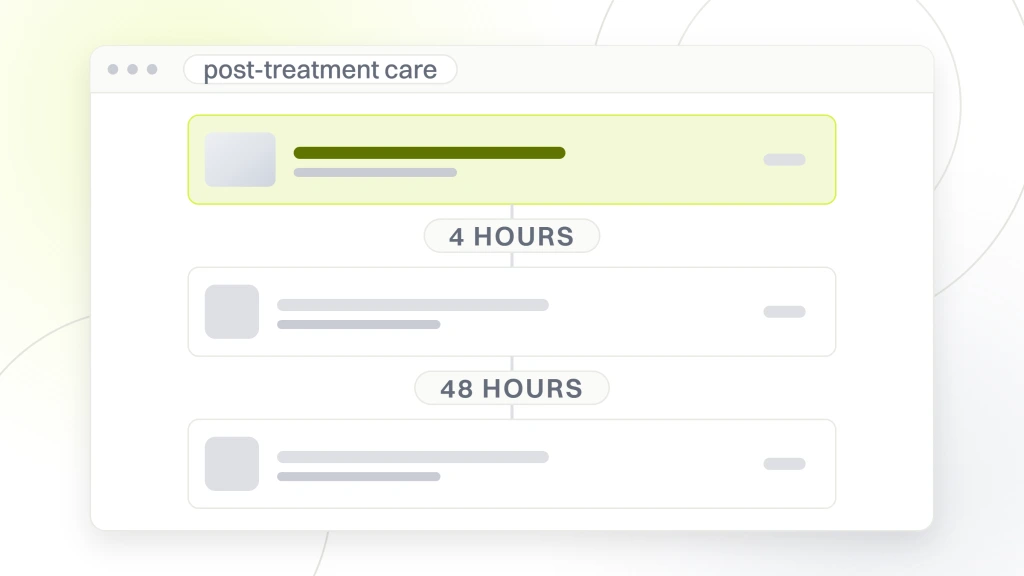
The structure that works runs 4 to 6 messages across the recovery window for that specific treatment. For Botox, message one fires 4 hours post-treatment (immediate aftercare, what to avoid for 24 hours). Message two fires at 48 hours (results starting to appear, what to expect over 7 to 14 days). Message three fires at day 7 (results at peak, when to book the next appointment). Message four fires at day 90 (rebooking reminder tied to typical Botox interval). Each message earns its slot. Together the sequence grows rebooking rates 30 to 55% versus practices without a post-treatment flow.
Treatment-Specific Sequences Beat Generic Aftercare
Treatment-specific sequences inside med spa email marketing campaigns beat generic aftercare every time. A patient who received Botox needs different care than one who received laser hair removal or a chemical peel. Build separate flows for Botox, filler, laser hair removal, chemical peels, hydrafacials, microneedling, coolsculpting, and IV therapy. Messages that match the actual patient experience hold the engagement moment. Generic aftercare sent to every patient regardless of treatment loses it.
Aftercare Should Include Rebooking Prompts, Not Just Instructions
Aftercare messages in med spa email marketing campaigns should carry rebooking prompts next to the care instructions. The final message in each post-treatment flow names the next optimal treatment interval and includes a direct rebooking link. Spas that skip this step leave rebooking to chance and forfeit 20 to 40% of potential repeat visits. The pattern that works. Soft rebooking mention in message three. Direct rebooking link in message four. Follow-up after message four with a light incentive (loyalty points, complimentary add-on, priority scheduling) for patients who haven’t booked yet.
Lapsed Patient Reactivation Sequences Recover Revenue Otherwise Lost
Lapsed patient reactivation sequences are the second highest-ROI med spa email marketing campaign to build. A patient who hasn’t visited in 90 to 180 days represents lost repeat revenue that a smart reactivation flow can recover at 12 to 28% of the lapsed segment. The approach that works matches the message to the patient’s actual treatment history instead of firing a generic “we miss you” broadcast to every lapsed name.
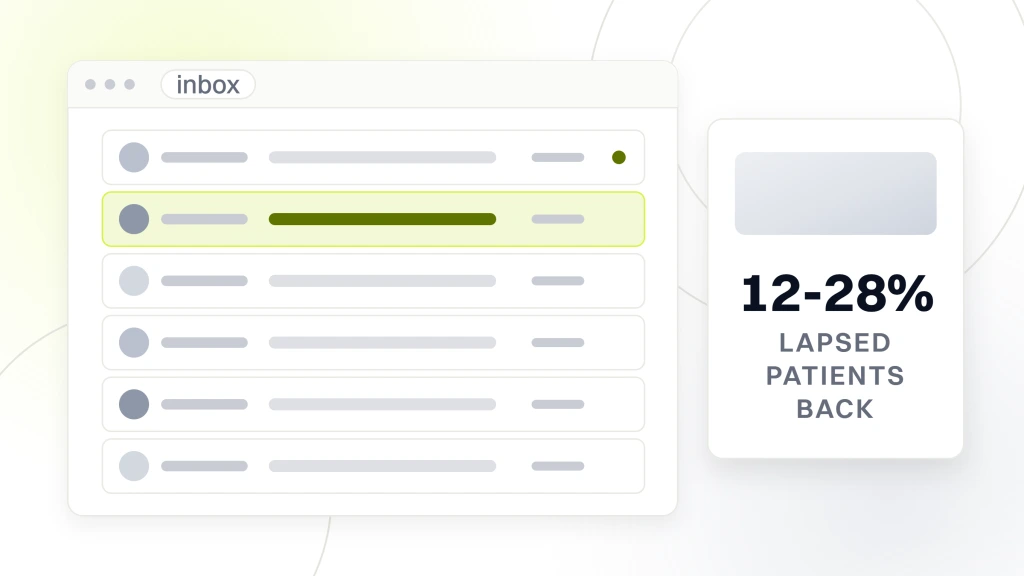
The structure runs 3 to 4 messages across a 14 to 21 day window. Message one names the patient’s last treatment by name and asks how they’re feeling about results (not sales, just care). Message two shares treatment-relevant education (new research on the service, related treatment options, seasonal considerations). Message three offers a reactivation incentive tied to spend tier and treatment history (loyalty bonus, complimentary consult for a related service, priority scheduling). Message four (if no response) softens the ask and reminds the patient the practice is here when they’re ready. Personalized sequences reactivate 12 to 28% of lapsed patients. Generic “we miss you” blasts reactivate 3 to 6%.
Beauté Aesthetics New York, a Manhattan luxury aesthetics clinic, moved from weak digital UX to a redesigned funnel and saw website leads climb 166%, new users grow 88%, and site conversion rate improve 27%. The email flows layered on top of that funnel are where reactivation revenue lives across quarters. The same flow architecture is documented for ecommerce catalogs in our email marketing for ecommerce flows and campaigns playbook. The pattern applies to any medical aesthetics practice with a working funnel and a segmented email tool.
Segment Lapsed Patients by Treatment History, Not Just Time Elapsed
Segmenting lapsed patients in med spa email marketing campaigns by treatment history (not just time elapsed) produces better reactivation results. A Botox patient who lapsed at 6 months is behaving differently than a laser hair removal patient who lapsed at 6 months. The Botox patient likely switched to a competitor or paused treatment. The laser patient likely completed the series and moved to maintenance. Different messages fit each pattern. Spas that segment on treatment history send reactivation flows that fit the real behavior and produce measurably better results.
Reactivation Incentives Should Match Patient Spend Tier
Reactivation incentives in med spa email marketing campaigns should match the lapsed patient’s historical spend tier, not sit at a flat discount across everyone. A patient who spent $8,000 annually before lapsing responds to a different offer than a patient who spent $600. Higher-spend patients respond to priority scheduling, exclusive treatment access, or complimentary add-ons. Lower-spend patients respond to loyalty bonuses or introductory offers on new services. Tier the incentives to historical spend and you recover higher-value patients at higher rates.
Birthday and Anniversary Flows Drive Predictable Revenue
Birthday and treatment anniversary flows inside med spa email marketing campaigns drive predictable revenue that shows up on the calendar the same weeks every year. Birthday flows fire in the two weeks before the patient’s birthday with a birthday-specific offer (loyalty points doubled, complimentary add-on, priority scheduling for a birthday appointment). Treatment anniversary flows fire on the first, second, and third anniversary of the patient’s first visit, acknowledging the relationship duration and offering anniversary-specific benefits.
The birthday structure runs 2 to 3 messages. Message one at 14 days out (birthday coming, book your birthday appointment for a special add-on). Message two at 7 days out (last week to book, offer detail). Message three at 3 days after (birthday week extension if not booked, softer follow-up). Spas running birthday flows capture 15 to 32% of the birthday segment as booked appointments. Practices without a birthday flow capture zero incremental birthday bookings. The revenue is predictable, the flow runs on autopilot, and the patient experience feels personal so it references a date the patient cares about.
Anniversary Flows Reinforce Long-Term Relationships
Treatment anniversary flows in med spa email marketing campaigns reinforce long-term relationships and generate loyalty-driven repeat visits. A patient in year three of the practice is a different segment than a new patient and responds to messaging that acknowledges the relationship. Send a short thank-you on each anniversary of the first treatment, mention the services the patient has received across the relationship, and offer an anniversary-specific benefit (complimentary consult for a new service, upgraded tier, loyalty milestone reward). Practices that build first, second, and third-year anniversary flows see loyalty patient repeat rates run 15 to 30% higher than practices without anniversary recognition.
Birthday Flows Should Fire Off the PMS, Not the Email Signup Date
Birthday flows in med spa email marketing campaigns should fire off the practice management system birthday field, not off an email tool subscription date. The PMS carries the actual patient birthday captured at intake. The email tool carries only the date the patient joined the list. Birthday flows that fire off email signup dates miss the actual birthday for most patients and send the message at the wrong moment. Wire the PMS to the email tool and the birthday flow lands on the right day for every patient.
Consultation Nurture Sequences Convert Shoppers Who Haven’t Booked
Consultation nurture sequences inside med spa email marketing campaigns capture shoppers who booked a consult but haven’t converted to a first treatment yet. This segment is high-intent, they researched the practice enough to book a consult, but they haven’t committed to spending on treatment. The nurture flow’s job is to close the gap between consult and first booking through targeted education, social proof, and clear next-step guidance.
The structure runs 5 to 8 messages across a 30 to 60 day window post-consult. Message one within 24 hours (thank you, summary of what was discussed, next-step guidance). Message two at day 3 (treatment-specific education based on the consult topic, patient results, social proof). Message three at day 7 (financing options if relevant, membership benefits, package pricing). Message four at day 14 (treatment FAQ addressing common concerns). Message five at day 30 (soft check-in, personal note from the consulting provider). Optional message six at day 45 and seven at day 60 if no booking. Spas that build this flow convert 22 to 38% of consultations into first treatments. Spas without one convert 8 to 14%.
A Pacific Northwest med spa client is a working example of what happens when the funnel and nurture layer are in place. Consult requests grew 3.4× as a price-simulator captured high-intent visitors who would have bounced, organic traffic grew 178%, and paid cost per lead dropped 38% on the same monthly budget. The consultation nurture flow is what converted those captured intent signals into first treatments.
Address Objections Head-On in the Nurture Sequence
Handling objections directly in med spa email marketing campaigns nurture flows moves conversion. Common med spa objections. Pricing concerns (answer through financing, membership, or package pricing). Fear of results (answer through before-and-after photos with patient consent and specific timeline expectations). Fear of pain or downtime (answer through treatment-specific FAQs on discomfort and recovery). Trust concerns (answer through provider credentials, patient testimonials, and safety protocols). Sequences that address each objection category across the nurture window convert measurably better than sequences that skip objection handling.
Personal Notes From Providers Increase Conversion
Personal notes from the consulting provider inside med spa email marketing campaigns nurture flows grow conversion 15 to 30% above generic practice messages. The pattern. Message five of the nurture flow sends from the specific provider who ran the consult, uses a personal tone, names the treatment discussed, and offers to answer any lingering questions. That message reads as personal outreach, not automation, and converts prospects who felt lost in the automated stream.
Educational Content Campaigns Position the Practice Between Visits
Educational content campaigns in med spa email marketing keep the practice top of mind between visits and position the provider as the trusted source for aesthetic questions. Content that works. Seasonal treatment guides (what to consider in your skincare routine each season). Treatment comparison content (Botox versus Dysport, filler types explained). New treatment announcements when the practice adds services. Ingredient education for retail skincare carried at the practice. Evidence-based content on emerging treatments.
The cadence that works runs 1 to 2 educational emails per month to engaged segments and monthly educational summaries to less engaged segments. Educational content should link to treatment pages, blog posts, or booking pages where the education leads to a natural next step. Spas that send only promotional content watch open-rate decay every week. Spas that mix educational and promotional content hold higher open rates and lower unsubscribe rates across quarters.
Content Should Cite Research and Provider Expertise
Educational content inside med spa email marketing campaigns should cite specific research and provider expertise rather than reading as generic beauty blog copy. Citations that build trust. Peer-reviewed research (with links where appropriate). Provider commentary on the research (what it means for patients). Treatment recommendations based on the evidence. Content that reads as generic beauty writing without clinical perspective loses credibility fast. Content that surfaces the provider’s clinical read on specific research builds the trust that converts engaged readers into booked appointments over time.
Segmentation Matters More for Education Than for Promotion
Segmentation matters more for educational content in med spa email marketing campaigns than for promotional messages, and that surprises most practices. Generic education produces low engagement. A patient who receives Botox regularly wants different educational content than a patient who received a single facial six months ago. Segment education by treatment interest, treatment history, and stated concerns and the messages feel relevant. Broadcast the same education to the whole list and the messages feel generic and lose engagement fast.
SMS Integration Compounds Email Campaign Performance
SMS integration inside med spa email marketing campaigns compounds performance across every campaign type. SMS open rates land at 95%+ against email at 30 to 55%, and SMS click rates hit 12 to 32% against email at 2 to 6%. SMS use cases that work in the med spa vertical. Appointment reminders and confirmations. Same-day availability offers for last-minute openings. Post-treatment care check-ins. Birthday follow-ups. Time-sensitive promotion notices.
SMS should complement email, not replace it. The split that works. Email carries education, monthly nurture, and detailed content. SMS carries time-sensitive prompts, appointment logistics, and immediate follow-up. Practices that build an SMS-plus-email program capture engagement across both channels without over-messaging on either. The opt-in pattern that works. Patients opt into SMS at intake with clear expectations on message frequency, opt into email through website signup or first booking, and manage preferences through a center that lets them pick which channels they want for which message types.
SMS Compliance Requirements Are Strict
SMS compliance rules inside med spa email marketing campaigns are strict and demand explicit opt-in from every patient. What you need. Written consent captured at intake or through an SMS opt-in flow, clear disclosure of message frequency and content, unsubscribe instructions in every message (STOP to unsubscribe), and compliance with TCPA and state-specific SMS regulations. Practices that skip these rules face legal exposure and platform penalties. Building the compliant opt-in into intake is the cleanest path.
SMS Response Handling Requires a Live Team
SMS response handling inside med spa email marketing campaigns needs a live team to reply to patient messages. Unlike email, SMS creates the expectation of a quick response when the patient writes back. Practices that send SMS but ignore replies lose the engagement moment and frustrate patients. Staffing pattern that works. Front desk or patient coordinator monitors SMS during business hours. Out-of-hours replies acknowledge receipt and promise a next-business-day answer. Automated responses handle common questions inside the platform (hours, location, appointment availability).
Deliverability Practices That Keep Messages Out of Promotions
Deliverability practices in med spa email marketing campaigns determine whether messages land in the inbox or in the Gmail Promotions tab. Practices that improve deliverability. SPF, DKIM, and DMARC authentication set up correctly on the sending domain. Consistent sender name and address across campaigns. List hygiene that removes unengaged subscribers. Engagement-based segmentation that reduces sending to low-engagement recipients. Content practices that avoid spam-trigger words and heavy formatting.
List hygiene rules that matter. Quarterly removal of subscribers who haven’t opened in the last 180 days. Re-engagement campaigns for subscribers approaching the 180-day threshold. Immediate removal of hard bounces. Periodic review of soft bounces that persist. Spas that skip hygiene watch open rates decay quarter over quarter as engagement metrics drag down deliverability across the entire list. Regular hygiene keeps the engaged portion of the list performing and prevents the domain from getting flagged as low-engagement.
Sender Reputation Compounds Across Time
Sender reputation in med spa email marketing campaigns compounds across time based on engagement metrics. High open rates, low bounce rates, low spam complaint rates, and consistent sending volumes build reputation across quarters. Erratic sending patterns, high bounce rates, or spam-complaint spikes damage reputation fast and recovery takes months. Practices launching new email programs should ramp sending volume across the first 60 to 90 days to build reputation rather than blasting the full list from day one. See the Google Postmaster Tools for reputation monitoring.
Content Practices That Avoid Spam Filters
Content practices in med spa email marketing campaigns that avoid spam filters center on natural writing, balanced text-to-image ratios, and avoiding known spam triggers. What to do. Skip all-caps subject lines. Skip excessive exclamation points. Keep text-to-image ratio balanced (at least 60% text). Avoid known spam trigger phrases in medical aesthetics (guaranteed results, miracle treatment, click here now). Use plain HTML instead of heavy CSS or JavaScript. Messages that read as human-written editorial content deliver at higher rates than messages that read as heavy sales copy.
Skinceuticals Customer Email Marketing Teardown
Skinceuticals runs one of the best customer email programs in the medical aesthetics vertical and offers a clean case study on what mature med spa email marketing campaigns look like at scale. The Skinceuticals approach segments content across skin concerns, sends regular educational content on ingredients and skincare science, uses provider partnerships to layer clinical credibility, and mixes educational content with product promotion in a balance that keeps engagement high.
What Skinceuticals gets right that spas should copy. Segmentation across skin concerns (acne, aging, sensitivity, hyperpigmentation) with content matched to each segment. Provider partnership content that surfaces specific dermatologist voices. Ingredient education that establishes clinical expertise. Product promotion tied to treatment recommendations, not generic sales blasts. Practices that adapt this content strategy to their own treatment mix build email programs that create long-term patient loyalty instead of chasing short-term promotional response.
The frequency Skinceuticals runs matters too. Roughly two educational emails per week for engaged segments, one educational email per week for less engaged segments, and monthly product promotions layered in. That cadence keeps the brand front of mind without over-messaging. Practices copying this pattern (adjusted for their own list size and engagement) build programs that patients look forward to reading, not programs that trigger unsubscribes. See the Skinceuticals site for the content strategy that supports the program.
Comparison of Med Spa Email Marketing Campaigns by Priority
Different med spa email marketing campaigns carry different priority levels based on revenue impact and build complexity. The table below sequences the seven core campaigns by expected revenue impact, time to implement, and typical performance benchmarks for the campaign type.
| Campaign Type | Revenue Impact | Implementation Time | Typical Open Rate |
|---|---|---|---|
| Post-treatment care sequence | Very high | 3 to 6 weeks | 65 to 88% |
| Lapsed patient reactivation | Very high | 4 to 8 weeks | 32 to 48% |
| Consultation nurture sequence | High | 4 to 10 weeks | 48 to 68% |
| Birthday and anniversary flows | High | 2 to 4 weeks | 55 to 72% |
| Educational content campaigns | Medium | Ongoing | 28 to 42% |
| SMS appointment reminders | Medium | 2 to 4 weeks | 95%+ |
| Product promotion campaigns | Low to medium | Ongoing | 18 to 32% |
Build Post-Treatment and Reactivation First
The two highest-ROI med spa email marketing campaigns to build first are post-treatment care sequences and lapsed patient reactivation. Post-treatment flows capture the peak engagement moment and drive rebooking. Reactivation flows recover otherwise-lost repeat revenue. Together the two produce 40 to 65% of the total revenue email marketing generates for the practice. Every other campaign type layers on top of that foundation and produces incremental gains, but nothing else moves the number as much as the first two flows.
Educational Content Requires Ongoing Investment
Educational content campaigns in med spa email marketing require ongoing investment so the content library stays current with treatment evolution and seasonal patient concerns. Practices launching educational content should plan for 2 to 4 posts per month across the first year to build a library, then 4 to 6 posts per month once the library is set. Content development is where most spa email programs underinvest and lose engagement over time.
Voice Notes From Our Med Spa Email Marketing Team
Voice note (Email lead, aesthetics vertical). The single biggest win we see when we take over a med spa email program is switching from monthly newsletter broadcasts to behaviorally triggered flows. Revenue per email typically climbs 4 to 8 times inside 90 days from that structural change alone.
Voice note (Reactivation lead). Lapsed patient reactivation sequences that reference specific treatment history reactivate at 3 to 5 times the rate of generic “we miss you” broadcasts. The specificity is the edge. Segment by treatment type, then write to each segment.
Voice note (Deliverability engineer). Spas that skip SPF, DKIM, and DMARC authentication end up in Gmail Promotions or spam regardless of content quality. Get the authentication right first, then worry about copy and design.
How Redefine Web Runs Med Spa Email Marketing Campaigns
Redefine Web runs med spa email marketing campaigns as a phased build across 90 to 120 days. Phase one integrates the PMS with the email tool and sets up authentication and list hygiene. Phase two builds post-treatment and reactivation flows across the top five treatments. Phase three adds birthday, anniversary, and consultation nurture sequences. Phase four layers in educational content strategy and ongoing production. Patients following this phased structure typically see email revenue grow from 4 to 8% of total practice revenue to 12 to 22% inside two quarters.
The work covers strategy, technical integration, copy and design, ongoing content production, deliverability monitoring, and monthly performance reporting. Each engagement includes a full audit of current email performance, PMS integration setup, campaign sequence builds, content development, and post-launch optimization. Retainers start at $1,499/mo for foundation-tier email programs and scale to $2,499, $3,999, and from $6,000/mo for larger practices that need paid media, SEO, and content work layered on top. See our med spa marketing services for the paid media, SEO, and content work that supports the email program across quarters.