Email marketing for ecommerce flows quietly carries 25% to 40% of monthly revenue on healthy DTC accounts, and most founders don’t spot the gap until a paid channel starts underperforming. This guide walks the retention program we build for Klaviyo and Attentive stores. Six core flows. The weekly campaign calendar. Segmentation logic. Deliverability guardrails. List growth. And real ecommerce email marketing examples pulled from live client dashboards across beauty, apparel, supplements, and food brands from $500,000 to $30M in yearly revenue. Read straight through and finish with a written priority order for the first 90 days of a retention rebuild.
Ecommerce Email Marketing Examples Across Categories
Ecommerce email marketing examples matter when they tie to a real category, a real subject-line pattern, and a measured revenue outcome. Not abstract creative theory. The examples below come from our client work across skincare, coffee, apparel, and luxury home decor. Each one maps to a flow or campaign type with a measured revenue share on the account dashboard.
Skincare Welcome Series Example
A skincare brand at $3M in yearly revenue runs a four-email welcome series across ten days. Email one carries a 15% code and a founder note on ingredient philosophy. Email two walks a routine builder tied to skin-concern segmentation. Email three shows social proof and dermatologist quotes. Email four reinforces the incentive window and links a bestseller bundle. The flow drove 11% of monthly email revenue on its own across the trailing 90 days and cut welcome-to-first-order time from 14 to 6 days for the median new subscriber.
Coffee Replenishment Example
A specialty coffee roaster at $1.8M yearly revenue runs a replenishment flow triggered by the first-order shipping notification. Three emails land at day 18, 25, and 32, timed against the median reorder point across the buyer base. Subject lines carry the roast name and a one-click reorder link tied to the subscribe-and-save price. The flow drove 22% of monthly email revenue at the 90-day mark and pushed the day-60 second-order rate from 24% to 38%. Replenishment flows are the highest-payback single move any consumable category can run.
Apparel Cart Abandonment Example
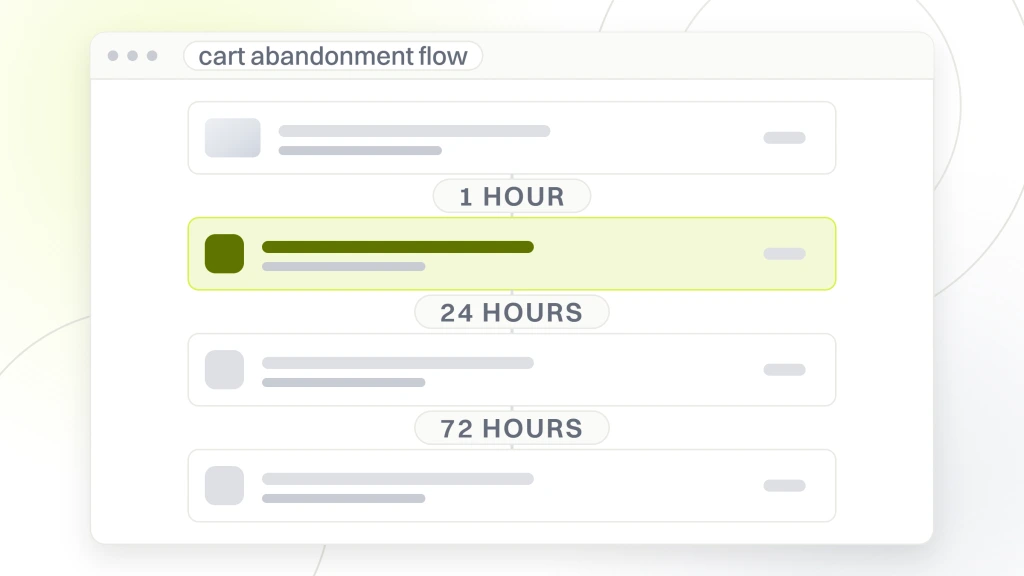
An apparel brand at $6M yearly revenue runs a three-email cart abandonment flow at 1 hour, 24 hours, and 72 hours after checkout drop. Email one repeats the cart with product photos and a light nudge. Email two adds a size guide, shipping speed, and a link to reviews. Email three offers a 10% code only for shoppers who have not opened the first two emails. The flow recovers 8.2% of dropped carts by revenue, driving 9% of monthly email revenue. Cart abandonment is the flow every DTC store gets first and rebuilds last, since the payback compounds across every campaign the brand runs on top of it.
The Six Core Email Marketing for Ecommerce Flows
Every DTC brand needs six core email marketing for ecommerce flows live before layering in growth flows or SMS. Welcome. Cart abandonment. Browse abandonment. Post-purchase. Day-90 winback. Category-specific replenishment or cross-sell. The six cover roughly 80% of automated email revenue on most accounts inside the first 90 days.
Welcome Series
Welcome greets new subscribers with a three to five-email arc across seven to ten days. Email one carries the incentive and the founder note. Email two teaches the buyer how to shop the catalog. Email three surfaces social proof. Email four reinforces the incentive. Email five, when used, invites the buyer into loyalty or a subscription. Welcome routinely drives 8% to 15% of monthly email revenue on a mature retention program.
Cart and Checkout Abandonment
Cart abandonment recovers shoppers who added to cart and left. Checkout abandonment recovers shoppers who reached the payment step and dropped. Run both. Three sends across 1, 24, and 72 hours works for cart. Two sends across 1 and 24 hours works for checkout, since the intent signal is stronger. Together they recover 8% to 12% of dropped revenue on a healthy account.
Browse Abandonment
Browse abandonment catches shoppers who visited a product or category page more than twice inside 48 hours without adding to cart. One email at 6 hours, one at 24 hours, tied to the product viewed and a clear CTA back to the product page. Revenue share sits at 2% to 5% of monthly email revenue, small on its own, meaningful across the paired flow set.
Post-Purchase
Post-purchase covers order confirmation, shipping updates, care instructions, and a cross-sell prompt inside the first 30 days after checkout. The flow protects the customer experience and pulls repeat orders forward on consumables. On skincare, coffee, and supplements, post-purchase pushes the day-60 second-order rate from a mid-20s baseline into the high 30s.
Day-90 Winback
Day-90 winback targets buyers who have not purchased inside a 90-day window against the category’s median reorder cadence. Three sends over 14 days, escalating from a soft touch to a stronger incentive on the third send. Winback recovers 4% to 8% of at-risk revenue and buys time on the acquisition side, since a recovered buyer costs a fraction of a net-new one.
Replenishment and Cross-Sell
Replenishment fires on consumables against the median reorder point. Cross-sell fires on complementary categories once the first-order category is confirmed. Consumables see 15% to 22% of monthly email revenue from replenishment alone. Cross-sell layers 3% to 6% on top. Both flows read the product catalog directly, which is why Klaviyo’s Shopify integration keeps them cleaner than a manual list build.
Best Ecommerce Email Marketing Platforms
The best ecommerce email marketing platform for a DTC brand depends on stage, catalog complexity, and how tightly the store runs SMS alongside email. Klaviyo dominates Shopify past $500,000 in yearly revenue since native product-catalog integration, deep segmentation, and predictive customer lifetime value (LTV) features clear a bar most competitors miss. Attentive leads the paired SMS conversation at scale. Sendlane and Omnisend fit smaller brands well. Shopify’s email marketing guide covers platform basics for stores still on Mailchimp. Mailchimp runs pre-$500,000 starter stores decently before the segmentation ceiling pushes brands off the platform.
Klaviyo for Shopify Brands
Klaviyo pricing scales with active subscribers, and most $1M to $10M brands land between $600 and $3,200 monthly. The platform covers flows, campaigns, segmentation, predictive analytics, product-recommendation blocks, and native Shopify and WooCommerce integration. Klaviyo’s reporting lines up with the metrics rhythm every retention program needs. Pair Attentive with Klaviyo past $2M in yearly revenue once SMS starts pulling its own share of monthly revenue. Read the wider platform view inside the marketing automation ecommerce deep read.
Omnisend and Sendlane Alternatives
Omnisend runs cleanly for stores under $2M in yearly revenue with a lower platform fee and tight Shopify integration. Sendlane serves stores that want deeper journey-builder control on smaller lists. Mailchimp fits pre-launch brands under $250,000 in yearly revenue, but the segmentation cap starts to hurt once the calendar carries more than three or four segments weekly. Nine out of ten brands outgrow Mailchimp before $1M in yearly revenue, and the switch to Klaviyo pays back inside a quarter on recovered flow revenue alone.
Ecommerce Email Campaigns Calendar and Cadence
Ecommerce email campaigns run on top of the flow set as scheduled broadcast sends tied to launches, seasonal moments, and offers. The right send cadence sits at two to three campaigns weekly against the engaged 30-day segment. Below two weekly, deliverability drifts and revenue share shrinks. Above four weekly, complaint rates climb and inbox placement drops. The calendar carries the pace, the flows carry the compounding revenue underneath.
Weekly Cadence Split
Split the weekly campaign calendar three ways. One campaign sells directly against a bestseller, a launch, or a sale window. One campaign educates against a category topic, a founder story, or a customer proof point. One campaign entertains against a seasonal or brand-personality moment. The 1-1-1 split keeps the list warm, drives revenue on the sell campaign, and protects deliverability on the educate and entertain campaigns that carry lower unsubscribe rates.
Segmentation Against Broadcasts
Send every broadcast against the engaged 30-day segment first. Then layer the engaged 60-day segment on the second send of the same theme. Send the engaged 90-day segment only on a monthly major moment. The layered send pattern protects deliverability and pulls dormant subscribers back into engagement across a 60-day window without spiking complaint rates. Suppress non-engaged 120-day contacts entirely until a formal winback series runs.
What Do Ecommerce Email Marketing Services Cost
Ecommerce email marketing services cost $499 to $12,000 monthly depending on scope, list size, and campaign volume across paired channels. Foundation retainers at $1,499 to $2,499 monthly cover the six core flows plus two weekly broadcast campaigns for DTC brands under $500,000 in yearly revenue.
Growth retainers at $3,999 monthly cover a full campaign calendar, monthly flow audits, and a quarterly creative refresh. Mid-market retainers from $6,000 per month cover a paired SMS plus email program with dedicated strategy and creative capacity across a wider send calendar.
Every retainer runs on a six-month contract with a monthly plan review, a shared reporting dashboard, and clear ownership on strategy, creative, and platform execution. Scope shifts depending on whether you already run Klaviyo, need a full migration from Mailchimp, or want a paired SMS build alongside email. See the full retainer scope inside the ecommerce digital marketing services deep read that walks per-tier deliverables end to end.
How Abigail Ahern Scaled With Ecommerce Email Marketing
Abigail Ahern, a London luxury home-decor brand on Shopify, hired Redefine Web in August 2020 with a retention program leaning hard on discount-anchored broadcast sends. Paid carried the growth conversation. Email quietly under-delivered.
The rebuild started with a flow audit against the six core flows every DTC brand needs live. Welcome, cart abandonment, browse abandonment, post-purchase, day-90 winback, and category-specific replenishment tied to the interior-refresh cadence luxury home-decor buyers follow. Segmentation moved off demographic guesswork onto behavioral signals split by engagement window, purchase count, and category preference. Creative pulled off constant discount banners onto premium mood-led content that matched the brand voice and the design-conscious buyer. Deliverability guardrails caught a suppression backlog that had been costing 12% of the active list to spam placement.
Results across the 12-month window on the rebuilt email plus paid rhythm. Ecommerce revenue climbed 179% year over year. Paid search return on ad spend (ROAS) reached 1,588% on the non-branded rebuild. Paid social ROAS reached 3,000% through disciplined retargeting supported by retention flows catching every buyer signal. Ecommerce conversion rate roughly doubled. Contribution margin per order recovered as discount reliance dropped across email and paid together. Retention went from compliance line item to compounding growth channel that pulled the whole account forward.
Boogie Board Case Study, $31 Cost Per Sale
Boogie Board hit a $31 cost per sale on $650K in managed ad spend across a paired paid plus retention build. The account layered Google Ads and LinkedIn Ads with dedicated landing pages, then paired the acquisition side with automated email follow-ups and retargeting to capture repeat purchases and loyalty. The email plus paid layer produced higher-quality traffic, better conversion rates, and less wasted spend, plus long-term customer engagement across the buyer base. Blended cost per sale settled inside a range most single-channel ecommerce email marketing programs never reach.
RAFZ Case Study, +28% Conversions on Fast Store
RAFZ Cirkulära Interiörer rebuilt a plugin-heavy Shopify store loading 15+ seconds down to a lightweight custom theme loading in 2 seconds. Conversion rate climbed 28% post-launch. Cart abandonment dropped 82% on the new load speed. The paired email flow set on the faster store caught buyer signals a slow page had been quietly killing, and repaint plus place2place features drove measurable revenue growth on the sustainability angle. The takeaway across both accounts is the same. Ecommerce email flows compound faster on a store that loads quickly and converts cleanly.
Measuring Ecommerce Email Marketing Strategy Outcomes
Measurement discipline for ecommerce email marketing strategy sits on four numbers most retention programs skip. Track them on one dashboard the team reads weekly. Email’s share of total ecommerce revenue. Revenue per subscriber against the active list. Flow revenue split by flow name. Engagement-segment health across the last 30, 60, and 90 days. Track the four together and you’ll catch deliverability drift, flow degradation, and segment fatigue two to four weeks before the weekly revenue print drops.
Revenue Share and Revenue Per Subscriber
Revenue share from email should land at 25% to 40% of total ecommerce revenue on a healthy DTC account once the flow set matures. Revenue per subscriber against the active list should land at $0.35 to $1.20 monthly depending on category and average order value (AOV). Consumables run higher, since reorder cadence pulls repeat email revenue every month. Apparel and home goods run lower, since between-purchase cycles stretch further apart. Brands running below the category floor usually have a segmentation problem or a flow rebuild waiting to happen.
Deliverability and Engagement Health
Deliverability and engagement health carry the leading indicators that predict revenue drift long before the founder catches it on the P&L. Inbox placement rate against Gmail, Yahoo, and Apple Mail. Open rate against the engaged 30-day segment. Click rate against opens. Complaint rate against total sends. Unsubscribe rate per campaign. Track those monthly and you’ll beat a brand chasing a single weekly revenue print every quarter, since the leading signals move first. The Klaviyo ecommerce benchmarks report is a useful outside read for category benchmarks.
List Growth and Deliverability Guardrails
List growth is the second half of every ecommerce email marketing program. A growing list feeds the flow set. A stagnant list slows every metric downstream. Two levers matter most. On-site capture through pop-ups and inline forms. And paid capture through lead-gen ads that pull qualified email signups off Meta and TikTok. Every new subscriber enters the welcome series and starts contributing to monthly email revenue inside 10 days on a well-built program.
Pop-Up and Inline Capture
Pop-ups on Shopify convert at 3.5% to 6.2% for well-built stores using a two-step offer with a real incentive and a category preference. Inline forms in the footer, on blog posts, and inside the account section pick up another 0.5% to 1.5% of site traffic. Tie every capture point to a preference tag so the welcome series can personalize the first three sends against the shopper’s declared interest. Preference-tagged subscribers convert 30% to 50% higher on first order than untagged subscribers on the same welcome flow.
Deliverability Guardrails
Deliverability guardrails protect the send reputation the whole program depends on. Warm every new sending domain across a 21-day ramp. Segment sends against the engaged 30-day list first, then layer wider segments. Suppress non-engaged 120-day contacts until a formal winback runs. Watch complaint rate against Gmail below 0.10%. Watch unsubscribe rate per campaign below 0.30%. Every guardrail breach triggers a one-week send pullback to the engaged 30-day segment only until the metric recovers.
Where Email Marketing for Ecommerce Flows Fit Your Stack
Email marketing for ecommerce sits inside the retention layer of the marketing stack as the highest-payback single channel most DTC brands run. Paid social and paid search sit above it as acquisition. SMS sits alongside as the paired retention channel that carries the urgency moments email can’t. Organic search and content sit underneath as demand generation. The stack works when every layer feeds every other layer through one metrics dashboard and one campaign calendar.
Founders ready to rebuild retention against real category benchmarks can start with a free audit of the current flow set, segmentation, deliverability posture, and campaign calendar. The audit produces a written priority order before any retainer conversation opens. If you’re at $300,000 in yearly revenue or past $15M, anchoring on the six core flows plus a category-aware campaign calendar and disciplined segmentation beats chasing the next Klaviyo template pack every quarter. Read the wider retention rhythm inside our ecommerce marketing agency hub for the cross-channel view, then book a free audit for a written priority list.
See our sibling read on content marketing strategy for ecommerce for the framework version of the same playbook.
Teams selling into procurement committees should read our sibling guide on b2b ecommerce marketing strategies for the long-cycle nurture pattern that fits a 6 to 18-month decision.
Start Your Ecommerce Email Marketing Rebuild
The fastest path from a stagnant list to a compounding email channel is a written priority order tied to real category benchmarks. Book a free flow audit, get the priority list, then decide on scope. No decks. No pitch. Just the numbers behind your revenue share, your flow health, and your next 90-day plan.