A med spa marketing agency earns its retainer on one number. Booked treatment consults per month, split by source, delivered against a specific cost target. Everything else is decoration. Clicks are decoration. Impressions are decoration. Follower counts and engagement rates are decoration. The spa owner signing the check needs the calendar to fill with injectables, laser, and body work consults every week. The agency either produces that or gets replaced inside two quarters. That is the honest bar.
This guide covers what a real med spa marketing agency looks like from the inside. What the retainer buys. What the ad spend does. Which channels carry the weight in the first 90 days versus the second year. How to tell if the partner you already hired is producing revenue or slides. Our Med Spa Pacific Northwest client grew consult requests 3.4x in 9 months on this exact structure, and the numbers below track what we see across active accounts at Redefine Web.
What a med spa marketing agency does that a generalist cannot
A specialist runs the injectables, laser, body work, and skin playbooks on day one. The team has already worked through them across dozens of spa accounts. That specialization shows up in speed to first booked consult and cost per booked consult, both of which move sharply in the first 90 days versus a generalist.
A generalist agency spends the first 3 to 4 months of any med spa engagement learning the vertical. The injectables buyer. The seasonality of body contouring. The compliance edge cases in Meta ad copy. The treatment-page structure that converts high-intent shoppers. The price signaling that works in your market versus the one down the highway. A med spa marketing agency runs those playbooks on day one after working through them dozens of times across other spa accounts.
The gap shows up in two places. Speed to first booked consult drops from 90 days to under 30. Cost per booked consult drops between 35% and 55% across the accounts we audit inside the first 90 days of a switch. On a $6,000 monthly ad budget you keep $2,100 to $3,300 per month that a generalist was wasting on the wrong keywords, weak audience layers, or a landing page that never mentions treatment cost.
- Treatment-specific landing pages for injectables, laser, body work, and skin, not one generic services page.
- Ad creative built around before-and-after, provider bio, and treatment timeline, not stock photos.
- Google Business Profile posts targeting the treatment queries where consult intent lives.
- Retention automation across the first 90 days, month 6, and month 12.
- Weekly reporting on cost per booked consult, not weekly reporting on impressions.
- Compliance-aware ad copy that Meta approves the first time instead of the third.
That last point matters more than most spa owners realize. Meta rejects med spa ad copy that reads as a health claim (“get rid of your double chin”) but approves the same idea in benefit language (“book a Kybella consult in Seattle”). A generalist learns the rule by getting three ads pulled. A specialist writes to the pattern from day one and keeps the account live. Live ads produce revenue. Ads under review do not.
What a working med spa marketing retainer buys
A working med spa marketing retainer buys strategy, paid ad management across Meta and Google, treatment-page landing work, local SEO, retention automation, and weekly reporting on booked consults. Retainer tiers at Redefine Web run $1,499 / $2,499 / $3,999 / from $6,000 per month, and the spa keeps the ad spend on its own card, separate from the agency invoice.
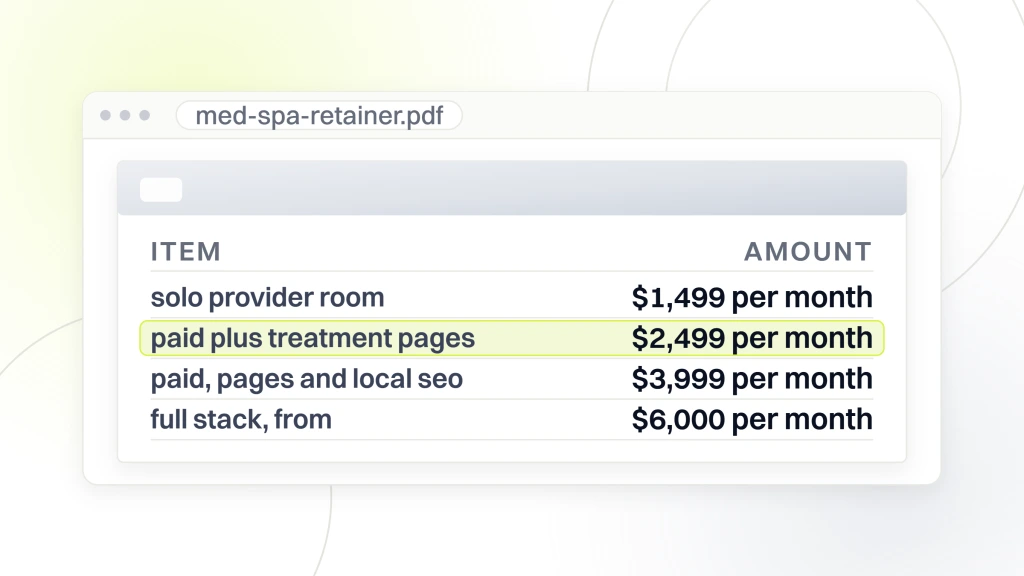
The $1,499 floor buys strategy, creative production, and basic reporting for a solo-provider room. The $2,499 and $3,999 tiers layer in paid ad management, treatment-page work, and local SEO. The from-$6,000 tier covers full-stack execution across paid, SEO, retention, and revenue-level reporting for multi-provider spas. Under $1,499 usually means the agency stripped out creative refresh, which is where campaign performance stalls at week 4.
The retainer covers the labor. Ad spend is separate and lives on the spa credit card, not the agency invoice. Typical monthly ad spend for a single-location spa runs $2,000 to $8,000 across Meta and Google Ads, and the working accounts we run produce 40 to 180 booked consults per month against that spend. Total program cost, retainer plus ad spend, lands at $2,500 to $11,500 per month for a growing single-location spa targeting real consult volume.
- Strategy and quarterly planning covering treatment focus, seasonal ad angles, and pricing tests.
- Meta ad management across 4 to 6 ad sets with creative refresh every 2 weeks.
- Google Ads management across 3 to 5 treatment-specific ad groups with weekly negative-keyword sweeps.
- Landing page work: 2 to 4 treatment pages built or rebuilt in the first quarter.
- Local SEO: Google Business Profile posts, review response, treatment schema, city page tune-up.
- Retention automation: email plus SMS across day 3, day 14, day 30, month 6, and month 12 touchpoints.
- Weekly reporting: cost per booked consult by channel, consult show rate, treatment mix.
What the retainer does not buy is the calendar filling itself in month one. Google Ads produces booked consults in the first 2 weeks. Meta ads take 3 to 5 weeks to hit the winning creative and audience mix. SEO takes 4 to 9 months to compound. Any partner promising 30 booked consults in the first 30 days is either sitting on inherited campaigns from a previous agency or lying about the timeline. Both are red flags. See how Redefine Web structures the full med spa program for the fuller picture.
If your Meta ad account has fewer than 3 approved video creatives per treatment, refresh creative before you touch bid strategy. Creative fatigue drives 60% of cost drift.
Meta ads in a med spa advertising program
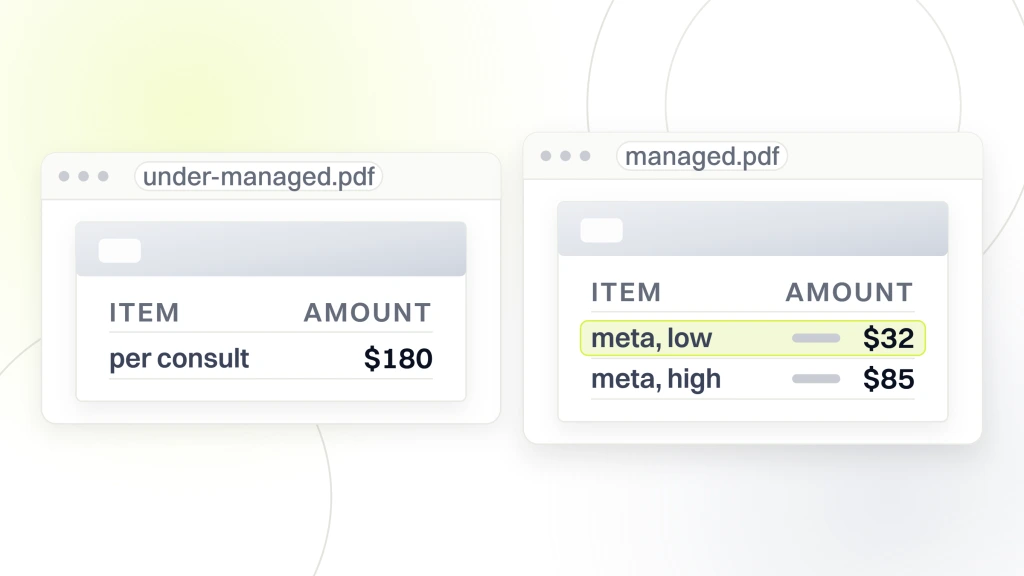
Meta ads carry the largest share of booked consults for most spa accounts. Instagram and TikTok audiences map to med spa buyer demographics almost perfectly, and the platform rewards visual before-and-after content over static price-focused creative. Cost per booked consult on Meta sits between $32 and $85 across the accounts we run when creative and audience layers hold. Static image ads to a homepage produce cost per consult north of $180 in the same markets, which is where most under-managed accounts sit before an audit.
The winning Meta creative is 10 to 20 second video showing a real before-and-after with the provider explaining the treatment. Static works as retargeting support. Cosmetic shoppers scroll past static ads in under 1.3 seconds on average. Video creative that shows a real result gets watched 4 to 6 times longer, per Meta creative benchmarking. That watch-time gap drives cost per thousand impressions down, which drives cost per booked consult down.
- Injectables ad set: Botox and filler consults, before-and-after video, cost focus.
- Laser ad set: hair removal and skin, package-based offers, seasonality tuned.
- Body work ad set: CoolSculpting, Emsculpt, treatment area focus.
- Skin ad set: HydraFacial, chemical peel, membership-friendly framing.
- Retargeting ad set: page visitors, video watchers, past patients, higher-frequency creative.
- Creative refresh: 3 to 5 new video assets monthly, ideally shot at the spa in a single afternoon.
Retargeting produces the cheapest booked consults inside the Meta account. Shoppers who saw the ad, visited the landing page, and did not book still convert at 6% to 10% inside a 14-day retargeting sequence. That is the highest retargeting conversion rate in the aesthetics category, per Meta creative benchmarks. Skipping the retargeting layer costs 25% to 35% of possible booked consult volume every month.
Google Ads inside a med spa lead generation program
Google Ads captures the active searcher. Cost per click on med spa queries runs $4 to $14 depending on treatment and market. Cost per booked consult through Google Ads sits between $55 and $140 when campaign structure holds. Broad-match against “med spa” alone drives cost per consult past $250 since the auction pulls in low-intent traffic. Structure matters more than budget, and this is where a specialist earns the retainer on Google Ads. The Google Ads campaign structure guide covers the framework in depth.
Ad group split by treatment intent produces cleaner data and lower cost per consult than any other lever. The winning account structure runs 3 to 5 treatment-anchored ad groups side by side, each pointing at its own landing page. Blending them into one ad group hides the intent and burns budget on the weakest keyword. Location targeting sits at 12 to 25 miles depending on market density, and location bid adjustments favor the neighborhoods where the target patient actually lives.
- Injectables ad group: “botox near me”, “botox {city}”, “filler consult {neighborhood}”.
- Laser hair removal ad group: “laser hair removal cost”, “laser hair removal {city}”.
- Body contouring ad group: “coolsculpting {city}”, “emsculpt cost”, “double chin treatment”.
- HydraFacial and skin ad group: “hydrafacial {city}”, “chemical peel cost”, “acne treatment consult”.
- Brand ad group: your spa name plus common misspellings, defensive against competitors bidding on your brand.
- Conversion tracking: booked consults in the practice management system, not form fills alone.
The brand ad group looks small but pays back the entire Google Ads retainer if a competitor is bidding against your name. Roughly 8% to 15% of med spa accounts we audit have a competitor running paid ads against the brand term. Adding the defensive brand campaign costs $80 to $220 per month in ad spend and recovers 12 to 30 booked consults per quarter that would otherwise walk to the competitor. That is the fastest ROI win inside a Google Ads account.
Under $1,499 in monthly retainer, the agency has cut creative refresh. Cost per consult drifts up 12% to 25% inside 60 days. Cut spend before cutting refresh.
SEO work inside a med spa marketing program
SEO is the compounding channel. Rankings take 4 to 9 months to move meaningfully on treatment queries. Once they move, the traffic pulls booked consults at a fraction of the cost per consult that paid channels produce. A treatment-anchored SEO program covers a page per treatment, a cost transparency page, a comparison page (in-office versus at-home versus another provider), city-level pages for each core service area, and a real reviews and results section on every page.
Content that hits all 7 categories ranks for 40 to 120 treatment-related keywords in the first year of a well-run program. Practices that skip cost transparency see 30% to 45% lower conversion from organic traffic. Cost-curious shoppers bounce to whoever shows the number without a gated form. Google’s search quality guidance rewards transparency, and buyer psychology rewards transparency. Skipping cost pages is one of the highest-cost mistakes we see in the med spa vertical.
- Treatment page for injectables: process, timeline, cost range, provider bio, before-and-after gallery.
- Treatment page for laser: hair removal and skin sub-categories, session counts, package pricing.
- Treatment page for body work: CoolSculpting, Emsculpt, treatment area guide, results timeline.
- Treatment page for skin: HydraFacial, chemical peels, membership pricing, monthly cadence.
- Cost transparency page: real ranges by treatment, financing options, package savings.
- Comparison pages: “med spa versus dermatologist”, “our spa versus at-home devices”.
- City pages: treatment-anchored pages for each core service area.
Local pack rankings matter more than blue-link rankings in this vertical. The three-pack takes the bulk of the click share on any local treatment query. Google Business Profile optimization, weekly posts, review response, and consistent NAP citations across directories carry the local pack. A working partner runs the local pack work every week, not once at onboarding. See the Redefine Web med spa SEO program for the fuller layout.
Retention inside a med spa advertising program
Acquisition fills the top of the funnel. Retention pays the bills. The retention layer inside a working program runs email plus SMS across day 3, day 14, day 30, month 6, and month 12. Every touchpoint has a clear purpose. Confirm the treatment result. Bring the patient back for the second treatment inside the recommended window. Cross-sell into a complementary treatment category. Bring the patient into the membership that anchors the yearly relationship.
Spas that skip retention treat each new patient as a single transaction. Second-treatment conversion rate sits below 25% and yearly revenue per acquired patient stays under $900. Spas that run the retention playbook see second-treatment conversion climb above 55% and yearly revenue per acquired patient reach $2,400 to $4,800 depending on treatment mix. That gap is where ad spend earns back its cost. A booked consult costing $65 grows to $1,600 to $3,200 in year-one revenue instead of $340.
- Day 3 email: welcome, aftercare, refer-a-friend prompt with a specific offer.
- Day 14 SMS: check-in text from the provider, second-treatment window reminder if applicable.
- Day 30 email: treatment result confirmation, second-treatment scheduling nudge.
- Month 6 email: membership offer, complementary-treatment introduction.
- Month 12 email: yearly refresh, loyalty pricing, anniversary offer.
- Lapsed-patient sequence: 90-day and 180-day reactivation touchpoints for anyone quiet.
The retention playbook runs on marketing automation, which most spa management systems handle natively or through an add-on. Setup takes 8 to 14 hours across the templates, the trigger logic, and the compliance review on the SMS side. Once running, the retention layer produces 30% to 40% of a spa’s monthly revenue with almost no ongoing effort. That alone is why the retainer pays for itself in year two.
Cost per booked consult benchmarks for a med spa marketing agency
The table below tracks what we see across active accounts running a full-stack program at Redefine Web. Numbers shift quarter over quarter with auction pressure and creative refresh cycles. The shape of the range holds across markets. Solo-provider practices sit at the lower volume end. Multi-provider spas sit at the higher volume end. Discount-only campaigns sit in the bottom row where the math stops working.
| Channel mix | Cost per booked consult | Consult show rate | Second-treatment rate (90 days) | Consults per month (single location) |
|---|---|---|---|---|
| Google Ads only | $75 to $140 | 62% to 74% | 32% to 44% | 18 to 36 |
| Google Ads plus Meta | $48 to $85 | 68% to 78% | 42% to 55% | 34 to 68 |
| Full stack (SEO + Ads + Meta + retention) | $28 to $58 | 74% to 84% | 52% to 68% | 52 to 120 |
| Undermanaged or discount-only | $140 to $260 | 44% to 58% | 18% to 28% | 10 to 22 |
The full-stack row is where a med spa marketing agency turns into a real revenue partner. Cost per booked consult drops. Show rate climbs. Second-treatment conversion doubles versus a discount-only campaign. Compounding kicks in around month 4, when the acquired patient base begins producing membership and second-treatment revenue on top of new consults. By that point, paying $6,000 in retainer feels cheap against the revenue the retention layer alone produces.
Spas sitting in the undermanaged band usually have one fixable issue. A discount-only offer that attracts one-and-done shoppers. No retention layer. A paid campaign spending on non-local queries. Fixing the biggest of those 3 moves the account from the bottom row to the middle row inside 60 days with no change in ad spend. That is one of the cheapest performance improvements available in aesthetics marketing.
Full-stack accounts book 52 to 120 consults per month at $28 to $58 each. Discount-only accounts book 10 to 22 at $140 to $260. Same market, same budget.
Attribution and reporting inside a med spa marketing program
Attribution for a spa program covers 3 channels. Google Ads, Meta ads, and organic search. The measurement layer runs GA4 with UTMs on every campaign, CallRail for phone tracking, and a source field in the spa management system with these options. Google Ads, Google search, Meta, Instagram DM, referral, walk-in, existing patient. The front desk fills the field in 8 seconds per new patient. Those 8 seconds make the reporting layer trustworthy.
Reporting cadence sits at 3 tiers. Weekly ad spend review by channel. Monthly booked consult review by source. Quarterly revenue per acquired patient review by channel. Spas that track revenue per acquired patient by source see clearly that Meta-acquired patients cross-sell into second treatments at higher rates than Google Ads-acquired patients in most markets. That changes the budget allocation over the next 90 days. Without the reporting layer, the agency guesses. With it, the agency tunes.
The measurement layer feeds back into offer testing. When the agency runs two versions of a first-consult offer, one bundled and one straight price, the reporting layer shows which drives more booked consults and which drives higher second-treatment conversion. Small optimization tests compound over 12 months into higher yearly revenue per acquired patient.
Attribution matters for the local pack too. Google Business Profile calls and direction requests need to feed the same reporting layer as paid channels, so the agency can compare consult volume across paid and organic side by side. Skipping the GBP tracking hides 20% to 30% of the total consult volume in most local markets. That is a lot of revenue to leave uncounted.
How to pick a med spa marketing agency that produces revenue
Pick a partner by asking for a client dashboard sample showing booked consults by source, a case study in your treatment category with real numbers, and a clear answer on who owns the ad accounts and pixels when the engagement ends. Any agency that dodges those questions gets removed from the shortlist immediately.
The sales call should answer 5 questions. Has the agency delivered comparable spa programs with real cost-per-consult numbers, and can it show a live dashboard on the call. Does reporting cover second-treatment conversion, or does it stop at booked consults. What is the setup timeline for retention automation. How does the agency handle Meta compliance edge cases. Who owns the ad accounts, tracking pixels, and landing pages when the engagement ends.
The last question matters more than most spa owners realize. If the agency owns the Meta ad account, you cannot leave without losing pixel history worth 6 to 12 months of audience learning. If the agency owns the landing pages, you cannot leave without losing SEO equity. A working partner sets everything up in the spa’s own accounts from day one. The agency has admin access, but the spa owns everything. That is the industry standard, and any agency arguing otherwise is a walk-away signal.
- Ask for a client dashboard sample showing booked consults by source over the last 90 days.
- Ask for a case study in your treatment category with real numbers, not stock language.
- Ask what the creative refresh cadence is and who produces the video assets.
- Ask who owns the ad accounts, the pixels, the landing pages, and the automation logic.
- Ask about compliance. how many Meta ad rejections happened in the last 90 days across the book of business.
- Ask for the escalation path. when cost per consult drifts up, what is the response inside 72 hours.
Compare the answers side by side with 2 or 3 other agencies. Any agency that dodges the client dashboard question or refuses to name a comparable client account is out. Any agency that talks about branding for the first 30 minutes of the sales call is out. Any agency that will not commit to a specific cost-per-consult target inside the first 90 days is out. That leaves the shortlist small on purpose. See how the Redefine Web med spa marketing retainer is structured for a working example.
How a med spa marketing agency handles the first 90 days
A working partner spends week one on audit, tracking, and access. Weeks 2 through 5 launch Google Ads and Meta ads on treatment-specific creative. Weeks 6 through 9 tune winning creative and expand audiences. Weeks 10 through 12 finish the SEO on-page pass and lock the reporting cadence.
Week one covers audit, access, and setup. The agency pulls the current Meta and Google Ads accounts, GA4, Google Business Profile, and the spa management system reporting into one working dashboard. Landing pages get an initial pass. Tracking pixels get verified. The measurement layer gets stood up so the first paid campaign has real conversion data flowing back into the ad platform. Nothing goes live in week one, by design.
Week 2 through 4 turns campaigns on and enters the learning phase. Google Ads produces booked consults inside the first 10 days. Meta ads take 3 to 5 weeks to hit the winning creative and audience mix. Landing pages get rewritten for the 2 highest-priority treatments. The retention automation gets built and tested. Reporting rolls up weekly during this phase since campaign structure is still moving.
- Week 1: audit, account access, tracking setup, landing page inventory.
- Week 2: Google Ads campaign launch, retention automation build.
- Week 3 to 4: Meta ads campaign launch, first creative refresh cycle.
- Week 5 to 8: winning creative identification, audience layer expansion.
- Week 9 to 12: SEO on-page pass complete, GBP posting cadence in rhythm.
- End of quarter 1: first cost-per-consult stabilization, retention layer producing.
The 90-day check-in should show cost per booked consult trending toward the target, second-treatment automation live and producing, and a specific SEO ranking improvement on at least one core treatment query. Any partner that finishes the first 90 days without those 3 signals has missed the timeline. That is not automatic grounds for firing the agency, but it does mean an escalation conversation before quarter 2 starts.
Where med spa lead generation work is heading next
Two shifts are changing what a marketing partner has to deliver on med spa lead generation. Google AI Overviews now appear on a growing share of treatment-related queries. Spas cited in those AI answers pick up a click-through advantage that compounds week over week. The winners share 4 traits. Structured treatment and cost pages. Recent verified reviews. Real before-and-after content with case details. Provider bios with credentials.
The second shift is on the creative side. Short-form video keeps taking share from static ad creative in the aesthetics vertical. Spas that produce 3 to 5 short-form video assets per month for Meta and TikTok build a compounding creative library that keeps cost per booked consult stable even as ad platform costs climb. Spas relying on quarterly photo shoots and static creative see cost per consult drift up 12% to 25% per year. That gap decides the next 12 months of margin.
If booked consult volume has flattened over the last 2 quarters and paid ads feel more expensive month after month, the first move is a 2-week audit of the offer structure, the retention layer, the creative refresh cadence, and the tracking. The audit produces a specific list of fixes ranked by expected revenue impact, and a decision on which channel to fund first. Everything else follows from that number. See the Redefine Web med spa PPC program or general PPC management services if paid is the anchor channel to test first.
Our Med Spa Pacific Northwest client is the working proof. Consult requests climbed 241% in 9 months on the same media spend. Organic traffic nearly tripled. Cost per lead on paid dropped 38%. The gain came from treatment-mapped pages, a price-simulator lead capture, indexable before-and-after galleries, and a treatment-by-neighborhood PPC matrix. Same market, same spend, 3.4x the consults.
The Pacific Northwest account started with every treatment on one bloated page and a before-and-after gallery hidden behind a PDF download. Google Images traffic was zero. Paid ran on a single broad ad group with no neighborhood, treatment, or device segmentation, and cost per lead was climbing month over month. Rebuilding the site into one conversion-mapped page per treatment family, adding the instant price-simulator lead capture, publishing the gallery as native indexable image pages, and splitting PPC into a treatment-by-neighborhood matrix moved every core number inside 9 months. The retention layer then compounded the gain into second-treatment revenue that keeps the yearly patient value climbing.
The bottom line. Book more treatment consults by treating the partner as a revenue engine, not a slide vendor. The right med spa marketing agency reports the number that pays the rent.