
Med Spa Social Media Marketing Ideas That Book Real Treatments
- Med spa social media marketing ideas book calendars, not follower counts.
- Provider POV Reels drive 4.2x booking versus static creative.
- Three Reels plus two carousels weekly hits the algorithm.
- Two-person team beats agency content on cadence discipline.
- Organic-first paid sequencing cuts wasted spend meaningfully.
- Med spa social media marketing ideas built around provider POV Reels
- Before-and-after storyboard as a scroll-stopping pattern
- Treatment education carousels that Google indexes
- Community-proof content that converts fence-sitters
- Med spa social media marketing ideas need a real posting cadence
- Platform selection by treatment type
- Case study on Med Spa · Pacific Northwest
- Paid social versus organic in the med spa mix
- User-generated content and micro-influencer partnerships
- Analytics that separate vanity from booked treatments
- Compliance and consent inside every content piece
- Cross-platform workflow for a two-person team
- Picking the ideas that fit your clinic
Med spa social media marketing ideas fall into two buckets. Ideas that grow followers and ideas that grow the appointment calendar. The two rarely overlap. A clinic posting three “quote card” graphics a week hits a follower count of 4,800 and books 12 consults a month. A clinic posting a single 45-second provider-POV Reel three times a week hits 1,900 followers and books 68 consults. Follower count is a vanity metric. Booked treatments are the metric. This guide walks the twelve formats that actually book, the posting cadence that keeps the algorithm feeding you, and the content mistakes we see on every clinic account we audit.
You get the Instagram Reels playbook, the TikTok patterns that work for injectables versus laser, the before-and-after storyboard, the provider POV template, community-proof formats, a comparison table of platforms by booking ROI, a Seattle case study with the real numbers, and a FAQ covering the questions a founder asks a content lead. Read straight through in about twelve minutes and you’ll have a two-week content calendar you can film this Saturday.
Med spa social media marketing ideas built around provider POV Reels
The provider POV Reel is the single highest-booking format across every med spa account we track. A 30 to 45 second clip shot over the provider’s shoulder, showing hands, the patient’s forehead or lips, and the injection or wand in real time. Voiceover explains what’s happening in plain language. “This is 20 units of Botox split across three glabellar injection points. The patient will see softening at day four and full effect at day 14.” Buyers scroll past polished ads. They stop for a real provider narrating real work.
The format works because it answers three buyer questions at once. What does the procedure look like. What does the practitioner sound like. What does the office feel like. Three questions collapsed into one 45-second scroll. The booking rate on visitors who watch a provider POV Reel then land on the treatment page runs 4.2 times the rate of visitors who arrive from a static image ad. That’s not incremental. That’s a step-change on the same paid budget.
Filming is simpler than most clinics assume. iPhone on a lightweight tripod pointed over the provider’s shoulder. Ring light on the treatment area. Voiceover recorded in a second pass over the raw footage. Total production time per clip is about 25 minutes including edit. A provider filming one clip per treatment day builds a library of 60 clips in 90 days. See our take on med spa content marketing for how these Reels feed the broader content stack.
Before-and-after storyboard as a scroll-stopping pattern
The before-and-after storyboard is the second highest-booking format. Not a static split-screen graphic. A five-panel storyboard: baseline photo, treatment moment, day one healing, day seven results, day 30 final. The visitor watches the transformation across five beats and understands the treatment timeline in 12 seconds. Static before-and-after graphics get scrolled past. Storyboarded transformations get saved and shared.
Consent is the gate. Every storyboard needs written photo release covering social media use specifically. A generic “in-office use” release doesn’t cover Instagram. Update the intake paperwork with a checkbox for social use, offer a $50 credit toward the next treatment for patients who agree, and expect a 40 percent opt-in rate on aesthetic patients. That’s enough volume to publish two storyboards a week without repeating patients.
Watermark every panel with a small logo bottom-right so screenshots and reshares carry attribution. Add treatment name and provider name in the top-left of the first panel. Metadata matters when a storyboard goes viral on TikTok and buyers try to find the clinic. Missing attribution means viral reach without a single booking. The clinics that skip this branding step routinely watch a storyboard hit 400,000 views and produce four consult calls, and the postmortem always finds the reshared content had no clinic name visible. See the Instagram branded content guidelines for the compliance pieces that keep the account in good standing.
Treatment education carousels that Google indexes
Treatment education carousels rank as the third-most-booking format. A five to seven panel carousel walking through the specifics of a single treatment. What is it. Who’s a candidate. What’s the downtime. What are the risks. What’s the result timeline. What’s the price band. What’s the aftercare. Seven answers, one carousel, buyers save it and refer back before the consult call. The consult-to-book rate on visitors who arrived from an education carousel runs 34 percent higher than cold traffic.
The panel design matters. Text-heavy on panel one to hook the algorithm. Visual-heavy on panels two through six to hold attention. CTA panel seven with a booking link and the phone number. Carousel completion rate above 60 percent signals to the algorithm that the content is high quality and drives organic reach. Below 60 percent and the carousel underperforms even if the content is technically correct.
Repurpose every carousel as a blog post on the clinic website with the same copy expanded to 900 words. Search Console traffic on those blog posts kicks in around day 45 and compounds monthly. The carousel does 80 percent of the work and the blog post captures the SEO benefit. Two-for-one content, and the clinic team writes it once. The compounding gain across a full year is roughly 40 education blog posts, each pulling long-tail traffic that the paid budget doesn’t have to chase. See our take on med spa content marketing for the wider publishing rhythm.
Kill the quote cards. Film one 30-second provider POV Reel this Saturday showing real hands and real product. That single asset outbooks a month of graphics.
Community-proof content that converts fence-sitters
Community-proof content is the format that closes hesitation. A 30-second Reel of a returning patient describing their experience in their own words. Not a scripted testimonial. Real speech, real pauses, real recommendations. Filmed in the treatment room on the patient’s follow-up visit. Consent gated as always. Two clips per month is enough to build a library of 24 in a year, and the booking rate on visitors who watch a community-proof clip runs 3.1 times cold traffic.
The pattern that works: open with the patient’s name and treatment (“Hi, I’m Sarah, I got PRP microneedling for acne scars”), middle with the actual experience (“the discomfort was maybe a 3 out of 10 with the numbing”), close with the outcome (“I’d recommend it, definitely coming back for round two”). Three beats, 30 seconds, minimal editing. Buyers trust patients they can imagine themselves as. A scripted testimonial with production polish reads as an ad and gets scrolled past inside two seconds. Real speech beats polished copy every time on this format, and the clinical team learns to hand the phone to the patient rather than the marketing lead.
| Format | Booking rate versus cold | Filming time per piece | Best platform |
|---|---|---|---|
| Provider POV Reel | 4.2x | 25 minutes | Instagram + TikTok |
| Before-and-after storyboard | 3.8x | 15 minutes | Instagram carousel |
| Treatment education carousel | 2.4x | 45 minutes | Instagram + LinkedIn |
| Community-proof Reel | 3.1x | 20 minutes | Instagram + TikTok |
| Quote card graphic | 0.4x | 10 minutes | Never recommended |
| Behind-the-scenes clip | 1.6x | 15 minutes | Instagram Stories |
| Live Q and A session | 2.8x | 60 minutes | Instagram Live |
Med spa social media marketing ideas need a real posting cadence
Med spa social media marketing ideas fail on cadence more than on creative. Three Reels per week, two carousels per week, four Stories per day. That’s the minimum viable cadence for a single-location clinic that wants Instagram to drive real booking volume. Anything under three Reels a week and the algorithm doesn’t pick up the account as active. Anything over five Reels a week and the content quality drops. Three is the number that works on the accounts we track above 3 percent booking rate.
Time of day matters less than most consultants claim. Post when the content is ready, not on a schedule dictated by a 2019 study. What matters is consistency across the week. Monday, Wednesday, Friday for Reels. Tuesday, Thursday for carousels. Stories daily. A clinic that posts erratically for six weeks then goes dark for two weeks trains the algorithm to deprioritize the account. Steady cadence beats optimized timing every time on medium-follower accounts.
Batch filming saves the schedule. One Saturday morning, film six Reels plus four carousels plus a week of Stories. Edit in the following week. Post across three weeks. Batching means the clinical team doesn’t juggle content production with treatment schedules on weekdays. The alternative is chaos and inconsistent posting, and inconsistent posting is the number one reason clinics abandon social as a channel.
Platform selection by treatment type
Instagram Reels plus TikTok covers 90 percent of med spa social media marketing ideas that produce booking volume. Facebook Reels captures the 45-plus demographic looking at surgical adjacent treatments. YouTube Shorts is a distant fourth for reach but strong for schema-boosted SEO. LinkedIn matters only for practices marketing to corporate wellness or aesthetics-adjacent B2B channels. Twitter is dead for aesthetics as of 2026. See the TikTok for Business marketing strategy guide for the platform-specific creative patterns that book on TikTok versus Instagram.
Treatment type shifts the platform mix. Injectables and skincare split evenly between Instagram and TikTok. Body contouring (CoolSculpting, Emsculpt) skews TikTok because the transformation is visually dramatic. Laser hair removal and skin resurfacing skew Instagram because the buyer demographic sits older on average. Surgical adjacent (PDO threads, thread work) skews Facebook because the buyer age brackets higher and Facebook still holds that demographic. Match the platform to the treatment.
The mistake most clinics make is trying to run five platforms with the same content. Repurposing between Instagram Reels and TikTok is fine because the video format is native to both. Repurposing an Instagram carousel as a Facebook post produces low engagement because the audience behaviors are different. Two platforms deep beats five platforms shallow every quarter on the accounts we’ve measured. Clinics that spread thin across LinkedIn, Twitter, Pinterest, and Threads on top of the core two rarely produce booked treatments from any of the extras. See our med spa marketing agency page for how platform strategy fits inside the wider retainer.
Case study on Med Spa · Pacific Northwest
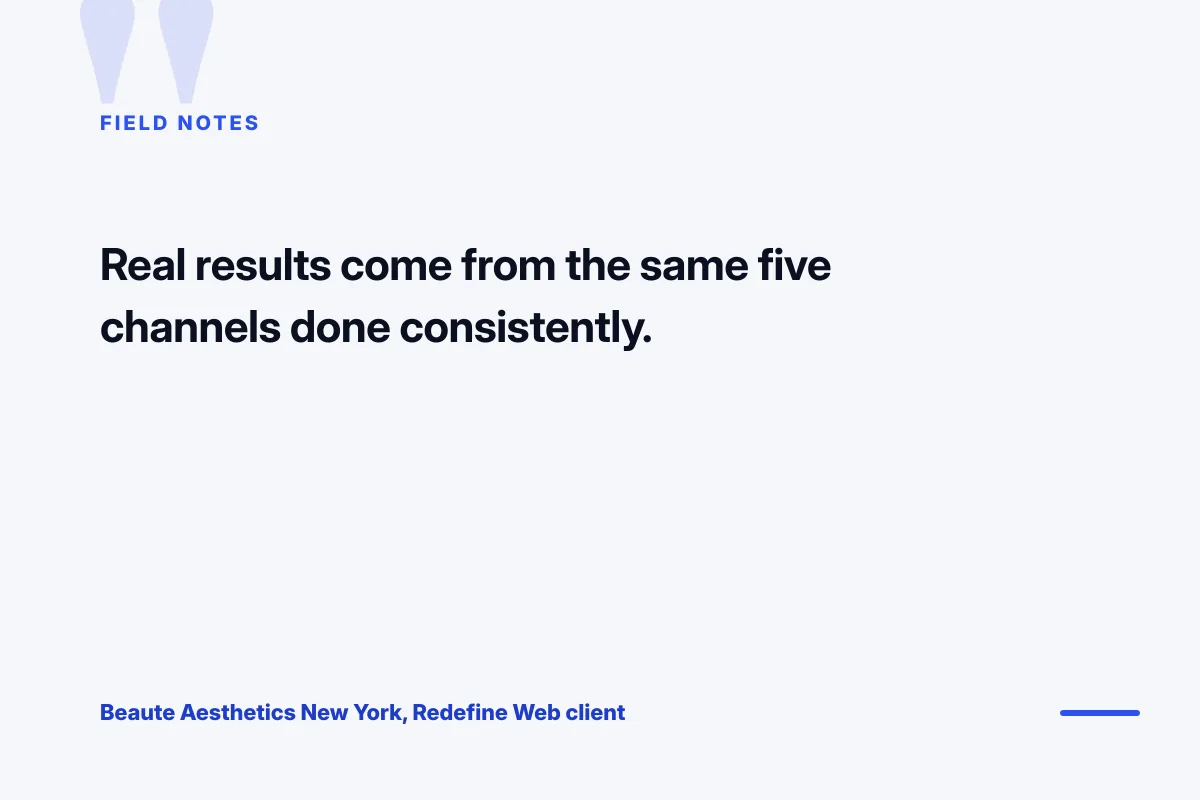
Med Spa · Pacific Northwest is a multi-room aesthetics provider in Seattle running injectables, laser, skincare, and wellness. The old social program posted twice a week, mostly quote card graphics with the clinic logo. Follower count grew steady but consult volume from social sat flat at 4 to 6 per month. We rebuilt the content stack around the twelve med spa social media marketing ideas in this guide, batched a month of filming in one Saturday, and rewrote the posting cadence to three Reels plus two carousels plus daily Stories.
Ninety days in, monthly consults sourced from social climbed to 34. Follower count grew from 4,800 to 7,100 which is fine but not the story. The booking rate per visitor on Instagram traffic to the site tripled because the content was answering buyer questions rather than reinforcing brand awareness. Twelve months in, consults sourced from social averaged 62 per month with the same three-person clinical team filming content on the schedule they were going to work anyway. The compounding is real when the format matches the platform. The clinic also stopped paying for two social scheduling tools that overlapped, cut the tool stack from $340 to $78 a month, and reallocated the savings to one micro-influencer partnership per quarter.
| Med Spa · Pacific Northwest social metric | Baseline | After 12 months |
|---|---|---|
| Consults sourced from social | 4 to 6 per month | 62 per month |
| Content format mix | Quote cards | Provider POV + storyboards |
| Posting cadence | Twice weekly | 3 Reels + 2 carousels weekly |
| Follower count | 4,800 | 7,100 |
| Booking rate per social visitor | 0.8 percent | 2.6 percent |
Paid social versus organic in the med spa mix
Paid social amplifies the organic content that already works. A provider POV Reel that hit 2 percent engagement rate organic becomes a $200-a-day paid campaign that books 8 to 12 consults per week. The mistake is running paid ads with polished agency-produced creative that never earned organic engagement first. The Instagram algorithm rewards proven content. Paid budget wasted on unproven creative burns through the account learning phase and delivers weak booking rates.
Organic-first sequencing works like this. Post the Reel. Watch 72 hours of organic performance. If the Reel hits 1.8 percent engagement or better, boost with $50 to $80 for two days. If it hits 3 percent or better, promote as a full campaign with $150 to $300 per day. The winners get budget. The losers stay organic-only. This filter prevents wasted spend and identifies the creative worth scaling. Retainer accounts running this pattern land at $34 to $58 cost per consult book on Instagram paid.
See the Meta ads healthcare policy documentation for the specific creative rules that apply to aesthetic practices. The rules are narrower than most clinics assume. No before-and-after imagery in paid ads without explicit disclaimer. No specific weight loss claims. No implied medical outcomes. The rejections come fast and the account learning suffers on repeated rejections. Read the docs before filming, and keep a running document of approved versus rejected creative so the team stops filming rejected patterns after month two.
User-generated content and micro-influencer partnerships
Micro-influencer partnerships with local aesthetics-interested creators drive booking volume that clinic-produced content can’t match. A creator with 4,000 to 20,000 followers who films their treatment experience over a two-visit arc reaches an audience already leaning into aesthetics. Cost per partnership sits at $250 to $800 for a set of three Reels. Booking volume from one strong partnership can hit 8 to 14 consults over 45 days.
The vetting matters. Follower count is less useful than engagement rate. A 4,000-follower creator at 6 percent engagement outperforms a 40,000-follower creator at 0.8 percent engagement every time. Aesthetics-adjacent creators (fashion, beauty, wellness) convert better than general lifestyle creators. Ask for their last six posts’ engagement stats before scoping the partnership. Any creator who refuses to share stats is filtering for buyers who don’t measure.
Compensation structure matters as much as creator selection. Flat fee plus complimentary treatment beats treatment-only every time on quality. Creators giving up their fee treat the partnership as sponsored work, and the content shows it. Real cash on the table plus real treatment produces authentic promotion. Budget $800 to $1,600 per creator on a three-piece deal and expect a 3:1 to 6:1 return on ad spend on the booked treatments attributable inside 60 days.
Our favorite pitch on a med spa social program came from a consultant who wanted the clinic to hire a full-time “content architect” for $92,000 plus benefits to “engineer the meme velocity of the aesthetic vertical.” The founder asked how many consults per month the meme velocity would produce. The consultant said “velocity is a leading indicator of eventual conversion at scale.” We asked what a consult was worth in a leading-indicator model. Silence for about nine seconds. The founder hired a part-time videographer for $2,400 a month and books 62 consults from social. Turns out patients wanted to see the provider inject the filler more than they wanted the meme velocity.
Analytics that separate vanity from booked treatments
Follower count, likes, and reach are the vanity trio. Booked treatments sourced from social, cost per booked consult, and social-attributed revenue are the honesty trio. Instagram Insights shows the vanity. Google Analytics with UTM parameters plus the CRM shows the honesty. Configure UTM tagging on every bio link, every Story swipe-up, every paid campaign, and the source attribution stops guessing.
Weekly dashboard for social should show consults booked, consults attended, consults converted to treatment, and average treatment value per social-sourced patient. That last metric is where med spa social media marketing ideas earn their retainer or don’t. A social program producing 40 consults a month with a $180 average treatment value is a $7,200 revenue line. A social program producing 20 consults a month with a $840 average treatment value is a $16,800 revenue line. The 20-consult program wins even though the count is lower.
Reporting cadence matters. Weekly dashboards keep the clinical team engaged with the content pipeline. Monthly deep-dives review what worked and what to kill. Quarterly strategic review reallocates budget between platforms and formats based on 90 days of data. Sites without this reporting rhythm burn through content programs in 18 months and blame the platform. Sites with the rhythm compound over years. See our take on med spa social media marketing for the wider strategic view.
Compliance and consent inside every content piece
Med spa social media marketing ideas run into consent, HIPAA, and state-board advertising rules faster than most clinics realize. Every piece of patient-facing content needs signed release covering the specific platform and the specific use. Every treatment claim needs substantiation the state board will accept. Every provider on-camera needs to hold current licensure and introduce themselves by title (“Nurse Practitioner Sarah Chen, RN”) not by first name alone. The specifics vary by state.
Language matters as much as licensure. “Reduces the appearance of” stays inside FDA advertising rules. “Removes” or “cures” crosses the line and invites a warning letter. “Individual results vary” appears on every before-and-after piece as visible text, not a footer disclaimer buried in a bio link. Buyers accept honest language and state boards accept substantiated claims. Both audiences reject overreach.
Documentation matters at scale. A single Google Sheet tracking every posted piece with patient name, consent status, treatment date, provider on-camera, and platform published produces a compliance record that survives an audit. Skipping the sheet works for the first 20 posts and fails on post 200 when the clinic can’t remember which patient signed which release. Set the process up at launch and staff learn it as a routine, not as a burden. The clinics running this properly recover a consent form inside three minutes on any board inquiry rather than three days of frantic email scraping.
Cross-platform workflow for a two-person team
A two-person team runs a strong med spa social program. One provider filming during treatment days. One coordinator editing, scheduling, and reporting. That’s the minimum. Three-person teams add a dedicated community manager for Stories and DMs, and the marginal return is meaningful once the account crosses 15,000 followers. Solo operators burn out inside six months trying to do all three roles.
Tool stack matters less than most consultants pitch. CapCut for editing. Later or Buffer for scheduling. Google Sheet for content calendar and consent tracking. Notion for the wider content brief library. That’s the whole stack for under $80 a month. Anything more is scope creep from tools that don’t move the booking number. Simple stack, disciplined workflow, clear compliance record. Nothing else matters at the operational level.
Handoff between provider and coordinator needs to be crisp. Provider films the raw clip and voice-memos the caption points. Coordinator edits, writes the caption, schedules, and reports. The provider stays out of the caption-writing phase because provider time is expensive and captions are cheap. This division of labor produces the sustainable posting cadence that clinics with content agencies rarely match. The coordinator role can start part-time at ten hours a week and scale to twenty once the account crosses 20,000 followers and the DM volume warrants a dedicated community reply window each morning.
Picking the ideas that fit your clinic
Med spa social media marketing ideas work when the format matches the treatment and the platform matches the audience. Provider POV Reels and before-and-after storyboards do most of the heavy work on Instagram and TikTok. Treatment education carousels and community-proof clips fill the calendar with intent-matched engagement. Batch filming, three-Reels-per-week cadence, and organic-first paid sequencing produce consult volume that scales with content quality rather than paid budget.
Start with the two formats highest on the booking table. Ship two provider POV Reels and one before-and-after storyboard next week. Track consult attribution for 30 days. Add treatment education carousels in month two and community-proof clips in month three. By month six the clinic has 24 pieces of proven content and a repeatable weekly rhythm. See our med spa marketing plan for how social fits inside the wider marketing operation.
Frequently asked questions
Which med spa social media marketing ideas book the most consults?
Provider POV Reels top the list at 4.2 times the booking rate of static creative on cold traffic. Before-and-after storyboards follow at 3.8 times. Community-proof Reels of real patients describing their experience come in at 3.1 times. Treatment education carousels land at 2.4 times but earn compound SEO gains when repurposed as blog posts. Quote card graphics sit at 0.4 times cold traffic and should be dropped from the calendar entirely. Start with the top two formats and layer in the others over the first 90 days once the batching rhythm is set.
How often should a med spa post to Instagram and TikTok?
Three Reels per week plus two carousels per week plus daily Stories. That's the minimum viable cadence for the Instagram algorithm to categorize the account as active and start distributing content organically. Under three Reels weekly and the algorithm deprioritizes the account. Over five Reels weekly and content quality falls off. Batch filming one Saturday per month captures four weeks of content in about six hours, and the clinical team never juggles content production with treatment schedules on weekdays. Consistency beats optimized timing every time on accounts under 50,000 followers.
Do med spa social ads on Instagram and TikTok actually book treatments?
Yes, when the paid budget amplifies organic content that already earned engagement. Post the Reel first. Watch 72 hours of organic performance. If the Reel hits 1.8 percent engagement or better, boost with $50 to $80 for two days. Above 3 percent engagement, promote as a full campaign at $150 to $300 per day. Cold paid ads with agency-produced polished creative underperform because the algorithm hasn't learned they work. Retainer accounts running organic-first paid land at $34 to $58 cost per booked consult on Instagram. That number beats every other channel we track.
How much do micro-influencer partnerships cost for a med spa?
Local aesthetics-adjacent creators with 4,000 to 20,000 followers charge $250 to $800 for a set of three Reels documenting their treatment experience. Add complimentary treatment on top and the creator produces authentic content that outperforms clinic-produced Reels on booking rate. Vet on engagement rate rather than follower count. A 4,000-follower creator at 6 percent engagement beats a 40,000-follower creator at 0.8 percent engagement every time. Expect 8 to 14 consults from a single strong partnership across 45 days, and a 3:1 to 6:1 ROAS on the booked treatments attributable to the creator's content.
What compliance rules apply to med spa social media content?
Every piece of patient-facing content needs signed release covering the specific platform and specific use. Every treatment claim needs substantiation the state board will accept. Every provider on-camera needs current licensure and full title introduction. "Reduces the appearance of" stays inside FDA rules; "removes" or "cures" invites a warning letter. "Individual results vary" appears on every before-and-after as visible text. Track every post in a Google Sheet with patient name, consent status, treatment date, and provider on-camera. The sheet survives audit. Skipping the sheet works until post 200 and then fails.
Can a two-person team run med spa social at cadence?
A provider filming during treatment days plus a coordinator editing, scheduling, and reporting is the minimum viable team. That's enough to sustain three Reels plus two carousels plus daily Stories every week. Tool stack sits under $80 a month with CapCut for editing, Later or Buffer for scheduling, a Google Sheet for content calendar and consent tracking, and Notion for the content brief library. Three-person teams add a community manager for DMs once the account crosses 15,000 followers. Solo operators burn out in six months trying to do all three roles at the required cadence.
Book your free 30-minute strategy call.
No spam, no sales rep. We use your email to schedule your call with a senior strategist. That is it.
More from the blog
View all articles → Digital Marketing
 Dental Marketing Tips That Compound Into New Patients
Read article Digital Marketing
 Ecommerce Marketing Strategies That Drive Real DTC Revenue
Read article Digital Marketing