Affordable website packages for small businesses are fixed-price or pay-monthly bundles that cover design, build, hosting, and basic SEO under one predictable number, usually landing between $2,500 flat and $349/mo for what a service business actually needs to launch and rank. The gap between what small owners pay and what they get is wider than most vendors admit. This guide breaks the market down by price, timeline, and what each tier really delivers.
Published website cost benchmarks put a typical small business build across a range so wide it cannot be used as a quote. That range is huge for a reason: hidden fees, template quality, and content ownership swing the real number by thousands. You need a shortlist that maps price to outcome, not a builder that quotes cheap and bills expensive on month two.
I’ve helped hundreds of small businesses launch their first (and second, and third) websites. The pattern is consistent. Cheap builds either miss the leads entirely or trap owners in $29/mo subscriptions that never rank. Below is the honest tour: what $2,500, $4,500, $7,500, and monthly plans really buy, where the traps sit, and how to pick the tier your revenue can back.
Here is what you can expect to walk away with by the end of this guide: a real number for each package tier, a checklist for spotting hidden costs, a two-step method for picking the right vendor, and a look at two case studies where affordable packages produced serious revenue for small businesses. No hedging on prices, no theoretical scopes, no upsell traps.
What affordable website packages for small businesses actually include
The word “affordable” gets stretched to mean anything from a $9/mo DIY builder to a $15,000 agency build. In the real market, an affordable small business website package is a fixed scope of pages, one round of design, launch on your domain, and 30 to 90 days of post-launch support, priced between $2,500 and $3,500. Under $2,500 you’re usually buying a template with your logo pasted on top. Above $3,500, you’re funding a custom design system your first 500 visitors won’t notice.
Every honest package answers five questions on paper before you sign:
- Page count. A working service-business site needs 5 to 10 pages: home, services (one per offer), about, contact, and 2 to 4 location or trust pages. Anything less looks thin; anything more is padding.
- Content ownership. Who writes the copy, and do you own the final files? If the vendor keeps the CMS keys or the copy is licensed to you, that’s a rental, not a purchase.
- Hosting and renewals. One flat year of hosting is standard. Year-two rates should be printed on the same quote so there are no surprises.
- Design proofs. One design round with two revisions is the minimum; three revisions is fair for a $7,500+ tier.
- Launch timeline. Two to six weeks for a template-driven build; four to ten weeks for a custom-designed one. Anything over 12 weeks needs a written milestone plan.
💡 Rule of thumb: if the quote can’t fit on one page and answer those five questions, you’ll pay the difference later in change orders. Ask for a scope sheet before deposits.
The 2026 price ladder for affordable website design packages for small businesses
Here is what real budgets buy right now, based on quotes we see across the U.S. market and our own package sheet. Prices align with 2026 vendor benchmarks, and every tier below is deliverable in production, not a bait number.
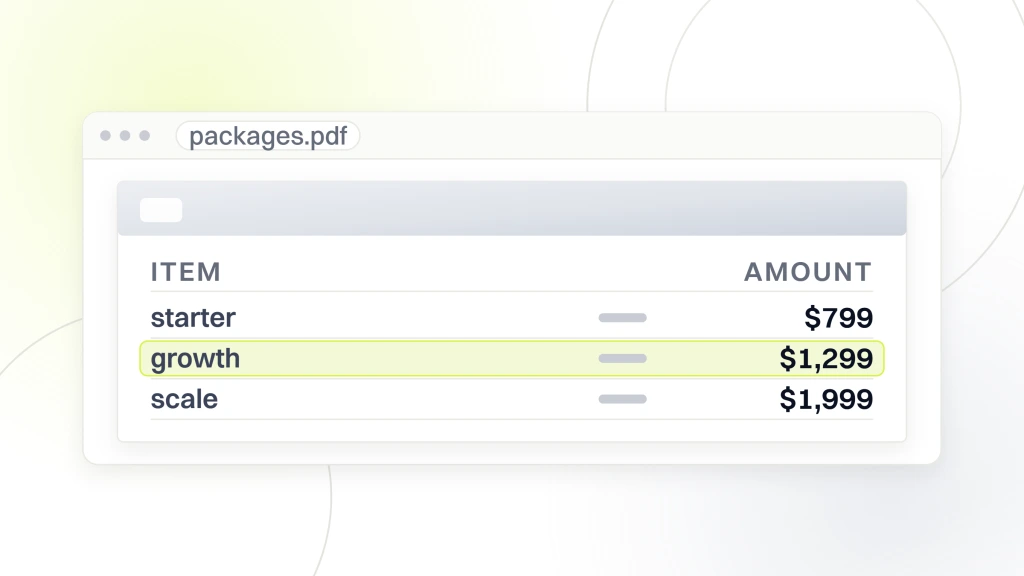
| Tier | Fixed price | Best for | Included pages | Timeline |
|---|---|---|---|---|
| Starter | $2,500 | Sole trader, single service, quick launch | 5 pages | 2 to 3 weeks |
| Growth | $4,500 | Local service business, 2 to 4 services | 8 pages | 3 to 5 weeks |
| Scale | $7,500 | Multi-service or multi-location small business | 10 to 12 pages | 4 to 6 weeks |
| Redesign | $2,500 flat | Existing site, keep domain, refresh design + speed | Same page count | 2 to 4 weeks |
Three notes on this ladder. First, $2,500 is a real number for a template-driven 5-page WordPress build with your copy and one design round. It’s not a scam, but it won’t win a competitive local SERP on its own without paid ads or ongoing SEO. Second, the $7,500 tier is where custom photography, custom sections, and structured schema start being included in scope. Third, the redesign tier at $2,500 is a legitimate shortcut when the domain has age and rankings you don’t want to reset.
What does each tier drop when the price goes down? Starter drops custom design blocks, custom photography, and any schema beyond the WordPress defaults. Growth drops custom photography and heavy SEO configuration. Professional keeps custom design, custom photography, and full schema, but drops advanced integrations (HubSpot, Salesforce, custom booking systems). Know the drops before you pick the tier. If your business relies on an integration, add $500 to $1,500 to the base build cost for connector work.
For a fuller side-by-side of our own package sheet, see Website Design Packages | Fixed Price.
Pay-monthly website plans: when they beat a fixed build
Pay-monthly plans spread the upfront cost across 12 to 24 months, usually with hosting, maintenance, and small edits folded in. For a small business with cash flow that can’t clear a $2,000 deposit but can absorb $199/mo, they’re the right answer. For a business that already has $2,000 sitting there, they’re a slow-burn markup.
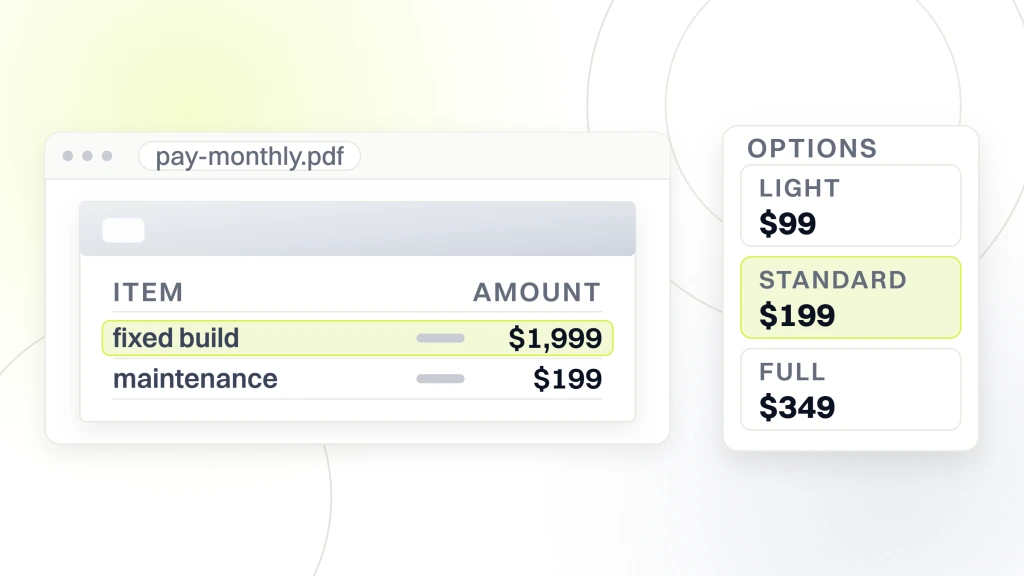
Realistic monthly package tiers we see (and offer):
- $99/mo, 24-month term. 5-page starter site, template layout, hosting included, 1 edit per month. Best for solo operators.
- $199/mo, 24-month term. 8-page site with light custom design, hosting, basic on-page SEO, 2 edits per month. Best for local service businesses.
- $349/mo, 24-month term. 10+ page site with custom design, hosting, monthly SEO refreshes, up to 30 small edits per month, priority support. Best for growth-stage owners.
The math tip most vendors skip: multiply the monthly rate by the term and compare to the fixed-price equivalent. A $199/mo, 24-month plan totals $4,776. That buys the same functional site you could launch at $4,500 flat plus a $199/mo maintenance retainer for the remaining 18 months and still come out $500 ahead. Pay-monthly wins on cash flow, not on total spend.
🔎 Quick test: if you can pay the fixed price in 90 days without hurting operations, the fixed build is cheaper. If not, the monthly plan is worth the premium.
Where the hidden costs sit in cheap website packages
Cheap quotes get expensive after launch. The five line items that eat small business budgets in year one:
- Renewal shock. A first-year hosting promo of $2.99/mo often renews at $12.99/mo. Over three years that’s the difference between $107 and $467. Ask for year-two and year-three rates in writing.
- Copy add-ons. Most $2,500 to $4,500 packages assume you write the copy. If the vendor writes it, expect $75 to $150 per page. Ten pages of ghostwritten copy quietly adds $750 to $1,500 to the invoice.
- Stock photo licensing. Some vendors bundle stock images into the price; others license them to you and revoke rights at renewal. Get a full asset ownership clause.
- SEO baseline add-ons. Schema markup, alt text, and a proper title tag pattern should be included at the $7,500 tier. If the vendor sells them as extras, that’s a signal the base build is thinner than it looks.
- Maintenance retainers. Almost every “cheap” build recommends a $99 to $499/mo maintenance plan after launch. That’s fine, and often necessary, but the retainer needs to be a choice, not a hidden requirement to keep the site online.
The WordPress documentation library spells out most of what a maintenance retainer covers: core updates, plugin updates, security patches, and daily backups. If your vendor charges $299/mo for those four items and nothing else, you’re paying agency rates for what a managed host bundles at $25/mo. Push for content updates, monthly reports, and SEO refreshes to be part of the retainer.
Case study: how one small business scaled on an affordable package
A Sydney-based renovation company, Passion Built, came to us with two underperforming websites and referral dependency. Their sites ranked for exactly 6 keywords, converted under 1% of visitors, and drained budget on costly third-party lead platforms. They needed one focused build, not a bigger marketing budget.
We consolidated the two sites into a single WordPress + Elementor build with SEO-driven service pages, project galleries, an overhauled Google Business Profile, and targeted Google Ads. Twelve months later, Passion Built ranked for 300+ keywords, drew 800+ monthly visitors, and generated over $60,000 in booked renovation projects direct from the site. Not a $10,000 build. Not a marketing overhaul. A single focused package tied to a clear conversion path.
What made it work: the scope stayed tight. One site. Ten pages. Real photography of finished projects. Schema on every service page. A GBP tied to the same NAP. No feature bloat.
The parallel U.S. story is Tilghman Builders, a family-owned renovation firm that started at $1.5M in annual revenue on a referral-only model. Nine years of compounding work on inbound, HubSpot integration, paid ads, and a modern site pushed them to $6.8M annually, a 353% revenue increase, with website traffic up 784% and qualified leads up 637%. The lesson isn’t that every small business will hit $6.8M. It’s that the site is the compounding asset. Start affordable, keep the domain, add depth over time.
How to pick affordable website packages for small businesses that actually book work
Choosing a tier is a two-step call. First, match the price to the number of services you sell. Second, match the timeline to your next revenue push (season, trade show, product launch).
- Count your services. One service = Starter ($2,500). Two to four services = Growth ($4,500). Five or more services or two locations = Scale ($7,500).
- Set a launch deadline that ties to revenue. Pick a date 4 to 8 weeks out that maps to a real driver: peak season, a scheduled ad campaign, a trade event. Working backward from that date forces vendor discipline.
- Ask for three portfolio links from the last 6 months. Not “here’s our whole portfolio.” Three recent, live small business sites you can click. Old work hides quality drift.
- Confirm content ownership in the contract. You should own the final HTML/CSS or CMS export, and every stock asset should be licensed to you, not the vendor.
- Get the maintenance rate on the same quote. If maintenance is optional but required for renewals, the vendor is bundling revenue behind soft language. Insist on a clean line item.
For deeper walkthroughs of everything a small business site needs at launch, see Web Design Services for Small Business.
Ongoing costs after launch: hosting, maintenance, and SEO
A launch is one payment. Keeping the site alive, safe, and ranking is a monthly one. Realistic 2026 numbers for a small business site:
- Hosting. $10 to $30/mo on managed WordPress, or $2 to $8/mo on shared hosting. Managed is worth the delta for speed and support.
- Maintenance retainer. $199/mo covers updates, backups, uptime monitoring, and small content edits. $299/mo adds monthly reporting and priority response. $499/mo adds SEO refreshes, form testing, and page-speed audits.
- SEO baseline. $999 to $2,499/mo for real work: keyword tracking, on-page fixes, link building, GBP posts, monthly reports.
- Ads. Google Ads for a local service business needs $1,500 to $5,000/mo in media plus 10 to 15% management. Under $1,000/mo, results are noise.
Our retainer sheet, with what each tier includes, sits at Website Maintenance Packages from $199/mo. If ads sit on the roadmap, PPC Management Services lays out the retainer tiers we run for local businesses.
The Kinsta WordPress maintenance guide lists 15 maintenance tasks a vendor should cover monthly. Use that list as a checklist against any retainer quote. If your vendor covers fewer than 10 of them, negotiate down or move on.
Timeline: what a real 4-week affordable package build looks like
The 4-week build is the standard for the $4,500 to $7,500 tier. Weeks one and two are content and design; weeks three and four are development and launch. Here is the honest week-by-week breakdown so you know what a vendor should be doing (and what they should be asking of you).
- Week 1, discovery and content intake. You fill an intake form covering brand assets, services, target keywords, and competitor references. The vendor sends a sitemap draft for approval. Expect 3 to 5 hours of your time this week.
- Week 2, design proof and copy draft. Vendor delivers a homepage design proof plus one interior page. You review, request up to two rounds of revisions, and approve. Copy drafts go out in parallel. Expect 2 to 3 hours of your time.
- Week 3, development and staging. Vendor builds every page on a staging URL, wires forms, adds schema, installs SEO plugins, sets up hosting. You review the staging link, flag anything missing, request small edits. Expect 2 hours of your time.
- Week 4, QA and launch. Vendor runs cross-browser tests, page-speed audits, mobile checks, and form tests. DNS points to the new host, and the site goes live. Post-launch, the vendor monitors for 30 days on the Starter tier, 60 days on Growth, 90 days on Professional.
If your vendor cannot show you a staging link by end of week 3, that is a scope or capacity problem. Push for a milestone email at the end of each week so slippage is visible before it becomes a launch delay.
Two tips from running these launches at volume. First, the fastest builds land in 2 to 3 weeks when the client has copy ready, a logo file, and a clear service list on day one. Second, the slowest builds go 8 to 12 weeks when the client rewrites the sitemap at the design proof stage. Lock the sitemap in week 1 or expect a 6-week build to stretch to 10.
Do-not-buy signals in cheap website quotes
A cheap quote can still be a good buy. A cheap quote with any of these five red flags will cost you more than a fair-price competitor.
- “Starting at” pricing with no scope sheet. Every legitimate fixed-price package has a scope document you can read before you sign. “Starting at $499” with no PDF means the number is a hook.
- No exported files or CMS access at launch. If the vendor keeps the CMS admin login “for security,” you don’t own the site. Walk away.
- Locked-in 24-month contracts with early-termination fees over $500. Legitimate pay-monthly plans have a fair cancellation clause. A $2,000 exit fee on a $99/mo plan is a trap.
- Templates from marketplaces sold as “custom design.” If the design looks familiar, reverse-image search the hero graphic. Some cheap vendors buy $59 templates and resell them at $1,500.
- Reviews that all landed in the same 30-day window. Check the vendor’s Google reviews for a natural distribution. A flood of 5-star reviews from one month is a paid campaign, not organic trust.
Cross-check the quote against our maintenance-tier reference sheet at Website Maintenance Packages from $199/mo so the retainer language on your quote matches industry standard, not vendor-specific weasel words. Every honest vendor selling affordable website packages for small businesses will show you the maintenance rate on the same document as the build price.
When affordable packages are the wrong choice
Being honest about failure modes builds trust with buyers. Affordable packages are the wrong call in three cases.
You’re running a lead-heavy paid ads engine. If you spend $5,000+/mo on Google Ads, a template site will bleed conversions. Custom landing pages at $2,500 to $5,000 each are cheaper than the lost bookings.
You need e-commerce with 100+ SKUs. A $7,500 template site can carry maybe 20 to 30 products. Beyond that, you need a proper WooCommerce or Shopify build starting around $6,000.
Your brand is the differentiator. If you compete on a premium positioning (luxury, wellness, high-touch B2B), a template will undercut every trust signal you’re trying to build. Budget for custom design at $5,000 to $12,000.
For everyone else (sole traders, local service businesses, multi-service small businesses under 20 employees) affordable packages between $2,500 and $3,500 are the correct tool. The bottom line: start affordable, keep the domain, add depth every 12 months.
Make an affordable package work for your business
Small business owners don’t lose money on cheap websites when the site is cheap. They lose money when the scope is fuzzy, the ownership is unclear, and the ongoing costs balloon after launch. Pick a tier that matches the number of services you sell, sign a contract that spells out ownership and year-two rates, and pair the launch with a $199/mo maintenance retainer from day one. That combination (a $2,500 to $7,500 build plus $199 to $499/mo in maintenance) is what actually books work for small businesses in 2026.
If you want a quote on a real fixed-price package, or a redesign of an existing site at the $2,500 redesign tier, our team can send a scoped proposal within 48 hours. See Website Design Packages | Fixed Price for the full ladder, or pair a build with Website Maintenance Packages from $199/mo so the site stays fast, safe, and current from launch onward.