
A healthcare SEO strategy that earns its keep pulls 15 to 60 new patients a month from organic search at a cost per booked appointment of $12 to $40. That is the number that decides everything. Your rankings are a leading indicator. Booked, shown, paid patients are the scoreboard. This guide covers the 5 layers of a real healthcare SEO strategy, the practice-size bucketing that tells you where the budget lands, the numbers behind each layer, one proof point from a 14-location group, and a 90-day plan you can hand to your team on Monday. Twelve-minute read. A working healthcare SEO agency runs 3 parallel workstreams that turn organic search into a patient acquisition asset.
The short version. Rankings alone do not pay a rent check. A working healthcare SEO strategy has to move 3 things at once. The map pack. The service pages. The appointment tracker. Skip any one of them and the phone stays quiet. This piece is the full map, not the sign at the trailhead. For the wider ranking playbook, see our full guide to healthcare SEO across the 5 buckets that move patient bookings.
SEO Strategy for Healthcare Industry Specifics
An SEO strategy for the healthcare industry has to respect 4 constraints other verticals get to ignore. HIPAA on every form and tracking pixel. YMYL treatment by Google’s quality raters. Clinician-reviewed editorial on every clinical article. Ad-platform limits on retargeting. Miss one of the 4 and your work either dies at legal review or gets buried by the algorithm. Get all 4 right on day one and every downstream effort compounds.
HIPAA on forms and tracking
Any web form that touches protected health information needs a signed BAA (Business Associate Agreement) with the form vendor. Any analytics or ad-platform pixel that catches PHI in URL parameters is a compliance risk. Strip PHI from URL parameters before it ever hits GA4, Meta Pixel, or Google Ads. This is not optional. HHS enforcement fines for healthcare tracking misconfigurations ran into 8 figures in 2023 and 2024.
YMYL and expertise signals
Google treats healthcare pages as YMYL (Your Money or Your Life) content and applies a stricter quality bar. Every service page and clinical article needs a named clinician author with credentials printed on the page. A dated review line. Citations to primary sources like the CDC or peer-reviewed journals. Miss any of the 3 and the page rarely cracks the top 10, no matter how strong the on-page work looks.
Editorial review and the credentialed byline
Every clinical article needs a credentialed reviewer named on the page with a review date and a link to their bio. Not a marketing manager. A clinician. Practices that skip this step underperform peers by 2 to 3 ranking positions on average for the same target keyword. Practices that add it usually see the target keyword move up inside a re-crawl cycle of 2 to 6 weeks. That is one of the cleanest, cheapest wins in the healthcare SEO strategies playbook.
SEO Strategies for Healthcare Practice Websites
SEO strategies for healthcare practice websites live or die on 4 site-level fundamentals. Mobile page speed. Clean information architecture. Schema markup that names the service, the provider, and the location. Internal linking that pushes ranking authority from your strongest page into your service pages. Fix these 4 before you write a single blog article. Skip them and the writing does not compound, no matter how much content you publish on top.
Mobile speed and Core Web Vitals
Mobile Largest Contentful Paint under 2.5 seconds. Interaction to Next Paint under 200 milliseconds. Cumulative Layout Shift under 0.1. Practices that pass all 3 see a 10 to 15% gain in ranking position for their target queries versus practices that fail 1 or more. Passing means compressing hero images to WebP, deferring third-party scripts, and moving from shared hosting to a real host. See web.dev on Core Web Vitals for the current thresholds and how the metrics get measured on real user data.
Information architecture a crawler and a patient can navigate
Three-click depth to every service page from the homepage. Location pages at their own top-level URL, not nested 3 folders deep. Provider bios linked from every service page they can perform. Not every practice needs 100 pages. Every practice needs the pages it does have arranged so a crawler and a first-time patient both find what they came for in under 15 seconds. That is the bar. Miss it and no amount of content marketing rescues the ranking work.
Schema markup that pulls its weight
Every service page gets MedicalWebPage or Service schema. Every location page gets LocalBusiness or MedicalBusiness schema with the full NAP block. Every clinician bio gets Person schema with credentials in the honorificSuffix property. Practices that run this schema stack correctly see rich results and knowledge-panel enrichment inside 4 to 8 weeks. Practices that skip schema leave the rich results on the table and hand the map pack to any competitor with a decent developer.
Healthcare SEO for Patient Acquisition
Healthcare SEO for patient acquisition works when the strategy ties every ranking to a downstream metric the practice cares about. Ranking position is a leading indicator. Clicks, bookings, shown appointments, and revenue are the trailing indicators. If your reporting stops at position tracking, you are measuring the wrong thing and paying a retainer to prove it. Fix the reporting first. The rest of the strategy is guesswork on top of a broken scoreboard.
The metric chain that ties SEO to revenue
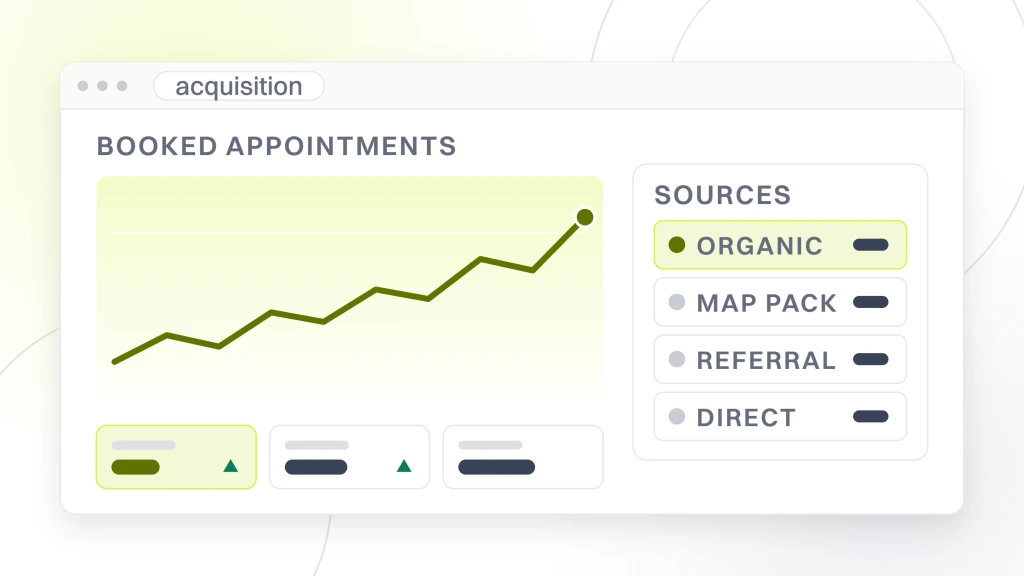
Impressions to clicks. Clicks to form submits or phone calls. Form submits or phone calls to booked appointments. Booked appointments to shown patients. Shown patients to revenue and lifetime value. Every link in the chain gets tracked and reported. A healthcare SEO strategy without this chain is guessing at what works, and quietly overpaying for the channels that do not move patient volume.
- Impressions from Google Search Console, broken out by target keyword and location.
- Clicks and click-through rate from Search Console, benchmarked against the industry average of about 6% for position 1.
- Form submits from GA4 conversion events, deduplicated against phone submissions.
- Booked appointments from your practice management system, tagged by traffic source.
- Shown patients from the same system, filtered by no-show rate.
- Revenue and lifetime value tied back to the traffic source that produced the initial booking.
Attribution that survives cookie deprecation
Third-party cookies are gone in most browsers. Attribution now runs on first-party data plus modeled conversions. That means UTM tagging on every organic link you can, call tracking with dynamic number insertion for organic traffic, and a CRM that stores the first-touch source next to the booked appointment record. Practices that build this stack once run reporting on it for years. Practices that skip it argue about which channel gets credit forever.
Where healthcare SEO for patient acquisition breaks down
Healthcare SEO for patient acquisition breaks down in 3 predictable spots. The intake form fires a conversion event but the CRM never learns which page produced it. Call tracking is not on the organic pages, so the phone rings and nobody knows why. The practice management system stores booked appointments in a silo the marketing team cannot query. Fix any one of the 3 and your reporting sharpens. Fix all 3 and every downstream budget call gets easier.
A Real Healthcare SEO Strategy in Action
Pelvic Rehabilitation Medicine, a 14-location pelvic pain group, ran the same 5-layer healthcare SEO strategy across the network and posted 174% keyword growth year over year with 166% organic traffic growth on top. That is one proof point for what the framework produces when a practice runs it end to end instead of picking 2 layers and hoping the rest fall into place on their own.
What layer moved first
The keyword and content layer moved first because the group had underserved service depth on day 1. Adding 600 to 900 words per condition page, with a credentialed reviewer and a dated review line, pushed half the target keyword set into the top 10 inside a single re-crawl cycle. The technical layer moved second when a hosting migration cut mobile Largest Contentful Paint from 4.5 seconds to under 2. Local moved third with a Google Business Profile audit across all 14 locations.
The plan on Monday versus the plan on Friday
The plan on Monday. Rank for 40 local terms by Friday. The plan on Friday. Get the phone number back on the homepage. Every healthcare practice has run both plans in the same week. The Friday version wins more often than the Monday version. Do the boring fundamentals first. Save the ambitious plans for once the boring ones are already in place. That ordering is what separates the practices that grow from the practices that redo the same audit every 18 months.
What Pelvic Rehabilitation Medicine would repeat next time
The engagement pattern that worked. Audit in week 1. Framework locked in week 2. Content and technical work running in parallel from week 3. Monthly reporting tied to booked appointment volume, not ranking screenshots. That same pattern maps to a solo practice at one-tenth the scale. The lesson is the discipline of running all 5 layers together, not the scale of the group. See our Healthcare SEO Services for the retained-engagement version of the framework.
A 90-Day Healthcare SEO Plan
A 90-day plan sequences the 5 layers so the fastest wins land in the first 30 days and the compounding work runs behind them. Use it as a starting sequence. Adjust based on which layer is the most broken on day 1 at your practice. Every plan gets rewritten in month 2 once you see which layer produced the real gains and which one needs a second pass.
Days 1 through 30, the audit and quick wins
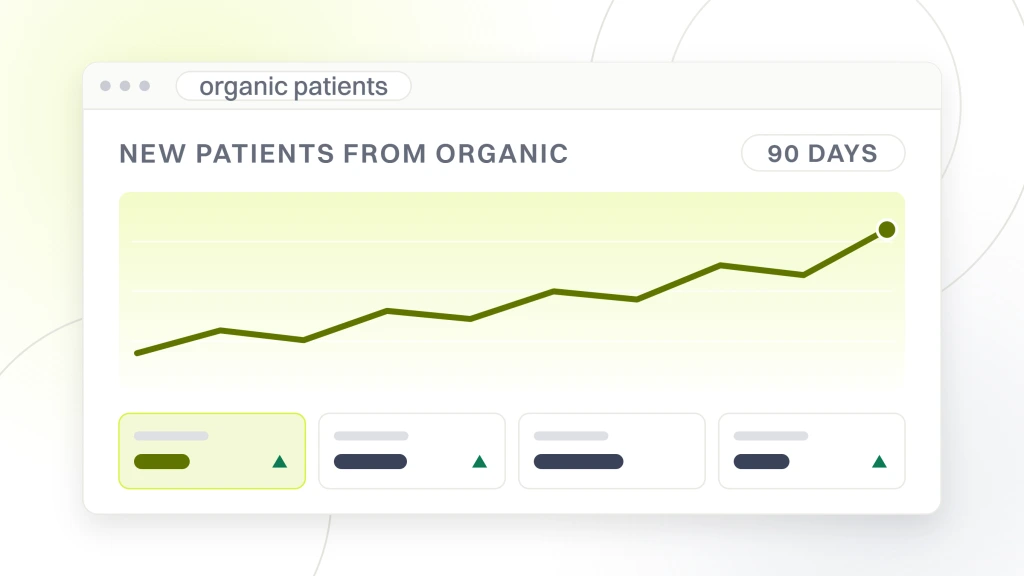
Run the healthcare SEO audit. Fix broken schema. Compress hero images. Claim and clean the Google Business Profile at every location. Add call tracking with dynamic number insertion. Set up Search Console and GA4 with conversion events. Rewrite the homepage headline. Get the phone number back in the header. First-30-days work costs about 20 developer hours and moves ranking positions 2 to 5 spots on average across the target keyword set.
Days 31 through 60, the content and page builds
Expand every service page to 700 to 900 words with the 6-section structure. Add a credentialed reviewer byline. Build the location pages if you have more than 1 location. Publish the first 2 educational articles targeted at research-intent queries that feed the service pages. Second-30-days work costs about 40 writer hours plus 10 hours of developer time for the location page templates. This is where the compounding starts.
Days 61 through 90, the review and the sequel
Read the numbers. Compare ranking positions and booked appointments against baseline. Kill the 2 lowest-performing pages. Double the budget behind the 2 highest-performing services. Decide whether to keep running this framework in-house or hand it to a retained partner. For the retained option, see our Healthcare SEO Services and the sibling Healthcare SEO Audit playbook.
Local SEO Inside the Strategy
Local SEO sits inside a healthcare SEO strategy as one layer, not the whole thing. It carries roughly 40 to 60% of the ranking weight for solo and small-group practices in a defined service radius. Multi-location groups run local SEO at each location on top of a national content layer. Ignore local and you cede the map pack to the practice down the street, no matter how strong the rest of your site looks.
Google Business Profile is the core
A fully filled Google Business Profile with accurate categories, weekly posts, service listings, and reviews responded to inside 48 hours outranks a beautifully designed website with a neglected profile every time. Every location gets its own profile with its own primary category and its own review flow. This is boring work that pays every month. See Local SEO for Healthcare for the full checklist.
Citations and NAP consistency
Name, address, and phone match across every citation source. Google Business Profile. Healthgrades. Zocdoc. Yelp. Vitals. Insurance provider directories. Practices with clean NAP across the top 20 citation sources outrank practices with inconsistent NAP by an average of 3 positions in the map pack for the same keyword set. Fix NAP once. Audit it quarterly. That single discipline separates the practices that own the map pack from the practices that keep wondering why they do not.
Review velocity and response cadence
Aim for 6 to 12 new reviews a month per location. Respond to every review inside 48 hours, positive and negative. Practices that hit this cadence pull ahead in the map pack even when their websites are technically weaker than the competition. Review velocity signals a live business. Old reviews signal a dormant one, no matter how good the practice really is behind the door. Do not let a strong practice look dead in the results.
Healthcare SEO Strategy Decision Summary
You now have the 5-layer framework, the practice-size bucketing, the healthcare-specific constraints, the metric chain, one proof point, and a 90-day plan. The decision reduces to 2 questions. Do you have the internal bandwidth to run this framework yourself. If yes, run it. If no, hire a partner who runs it for you and reports against booked patients, not ranking screenshots. Either path works when it is chosen honestly. The one that fails is picking neither and hoping the audit will do the work.
Signals you should run it in-house
You have a marketing lead with 10 to 15 hours a week for SEO. You have a developer available for on-page and schema work. You have a clinician willing to review content on a regular cadence. Under those 3 conditions, in-house runs the framework well and saves the retained fee. Miss any of the 3 and the in-house version stalls at month 4, right before the compounding is supposed to start paying.
Signals you should hire a partner
You do not have the bandwidth above. You have tried SEO twice and given up on it. You want the framework to start moving numbers inside 60 days instead of 6 months. When you are ready to run this across the whole practice, our Healthcare Marketing Agency for Patient Growth covers the full stack, retainer starts at $1,499 a month. For the audit-first entry point, see the sibling Healthcare SEO Audit.