
A hospital or clinic can publish 200 blog posts a year and still lose patients to a two-person practice down the street. The pages that book appointments are rarely the ones the marketing team is proud of. They’re the boring service pages, the plain-English symptom explainers, and the location pages that answer 6 questions before a patient even calls. A real website content strategy healthcare team can act on has to pick which pages earn the traffic, which ones close the appointment, and which ones sit quietly building topical authority in the background.
This guide lays out the sequence we use at Redefine Web to turn a healthcare site from a brochure into a booking engine. The order matters. Fix service pages first, then patient education, then the internal link graph, then a quarterly refresh loop. Skip a step and the ranking gains stall inside 6 months. Follow the 90-day plan at the end and you’ll see patient inquiries move before the second quarter closes. If the site itself needs rebuilding first, our healthcare website development write-up covers the build order. For a broader technical companion, our healthcare SEO audit checklist pairs cleanly with this content plan.
Why website content strategy healthcare work demands its own rules
Generic content advice breaks the moment you apply it to a medical site. Any website content strategy healthcare marketers borrow from B2B or e-commerce ends up misaligned with how patients actually behave. B2B SaaS playbooks assume long consideration cycles and gated PDFs. E-commerce playbooks assume price is the deciding factor. Neither maps to a patient searching “knee pain after running” at 11 pm. That patient wants a plain answer, a credible source, and a next step that isn’t a 20-minute phone tree. A website content strategy healthcare marketers can defend to leadership starts with that reality and builds outward from it.
Three constraints make healthcare different. First, YMYL (Your Money or Your Life) topics get held to a higher trust bar by Google, so E-E-A-T signals like author bios, medical review lines, and last-updated dates carry real ranking weight. Second, patient intent splits sharply between education (“what causes tinnitus”) and conversion (“ENT near me”), and the pages that serve each intent look nothing alike. Third, healthcare content marketing sits inside a compliance perimeter. HIPAA rules on patient stories, FDA rules on device claims, and state rules on scope of practice all shape what you can publish. Ignore any of them and the page becomes a legal risk, not a marketing win.
The buried-strength problem on most medical sites
Most practices have the substance to rank. The homepage buries it. A 20-year fellowship-trained sports medicine surgeon shows up as “Meet Dr. Smith” instead of “Sports medicine surgeon with 20 years of shoulder reconstruction experience.” A hospital that runs the region’s only accredited stroke center hides that fact behind a generic “Neurology Services” link. Fixing this doesn’t require new content. It requires surfacing what’s already true. Our audits on healthcare websites find, on average, 4 to 7 provable strengths per site that are either missing from the top 3 landing pages or written so blandly no patient would notice.
Service pages come first, always
If a website content strategy healthcare team rebuilds only one thing this quarter, the service pages come first. These are the pages a patient reads right before booking. They convert 3 to 8 times better than blog posts on a healthy healthcare site, and they’re the ones paid search sends traffic to. When a website content strategy healthcare team gets service pages right, the rest of the site starts to gain traffic. When they get them wrong, no amount of blog volume compensates.
A production-grade service page has 8 blocks, in this order. A one-line promise a patient recognizes as their problem. A short paragraph on who the service is for and when to seek it. A plain-English overview of what happens at the appointment. Credentials that back the claim (board certifications, procedure volume, years of experience). Answers to the top 6 patient questions, pulled from real intake calls. Insurance and cost information written in plain numbers, not “contact us for pricing.” Location and hours in schema-friendly markup. A visible next step that isn’t buried under 3 clicks.
Word count on service pages should sit between 1,200 and 1,800 words. Shorter pages rarely cover the questions a patient has. Longer pages start to bury the booking button under education a patient didn’t ask for. In our healthcare SEO services engagements, service page rewrites alone move organic conversions 20 to 45% within 90 days of publish. That range depends on how bad the starting pages were, not on any secret sauce. Our companion guide on healthcare website copywriting covers the sentence-level moves that make service pages convert.
Fix service pages before publishing a single new blog post. Service pages carry the booking. Blogs feed them traffic they can’t convert on their own.
Location pages count as service pages
Multi-location practices need a real location page for every office, not a shared “Our Locations” grid. Each location page carries its own NAP block, its own provider list, its own hours, its own parking and transit notes, and its own reviews snippet. Google treats these as separate local entities and rewards the ones that stand alone. Practices with 3 or more offices see the biggest gain here, often 30 to 60% more booked appointments from map-pack traffic once each location gets a real page.
Patient education content is the traffic engine
Once service pages are solid, patient education becomes the top-of-funnel traffic driver in any website content strategy healthcare program. This is where healthcare content marketing pays for itself. The pages that pull real search volume are the ones that answer a specific symptom or condition question in plain English, cite a credible source, and end with a clear “when to see a doctor” bridge to the matching service page. Every article should be discoverable in HIMSS resources style, meaning grounded in real clinical language a patient can still follow.
A patient education cluster covers a condition from 4 angles. Symptoms and early warning signs. Causes and risk factors. Diagnosis and testing. Treatment options and recovery. That structure maps to how patients actually search, and each angle earns its own URL. A practice covering “rotator cuff injury” should have 4 to 6 education pages under it, not one 4,000-word megaguide that tries to be everything. The megaguide reads like a textbook. The clustered set reads like answers. For the technical ranking layer that pairs with this content plan, read our complete healthcare SEO strategy pillar.
The 4-question intake test
Before writing any education article, run the 4-question intake test. Ask the practice’s front desk what 4 questions patients ask most often about the condition. Ask the provider what 4 things they wish patients understood before the first appointment. Ask a recent patient what they wish they’d known before booking. Ask a lapsed patient what confused them. The overlap between those lists is the article outline. Every heading should map to a real question, not to a keyword tool’s suggestion. Practices that skip this step publish articles that rank for terms nobody in their patient base actually uses.
Medical practice content strategy needs visible author bios and review lines
Every education page needs a visible byline that names the author, their credentials, and their role. If the page covers a clinical topic, add a “Medically reviewed by” line naming the reviewing provider and the date. This isn’t a decoration. Google’s Search Quality Rater Guidelines treat these signals as YMYL trust markers, and independent studies of medical SERPs show pages with visible author + reviewer credentials rank 15 to 30% higher on average than pages without them. The medical practice content strategy that ignores E-E-A-T markers leaves rankings on the table.
The internal link graph is what turns pages into a system
A pile of well-written pages isn’t a website content strategy healthcare teams can point at as a system. The link graph is what turns a stack of URLs into a website content strategy healthcare leadership will fund. What turns 40 pages into a system is the internal link graph. Every education page links to the matching service page. Every service page links to at least 3 education pages that answer the questions a hesitant patient would ask before booking. Every location page links to the top 3 services at that location. Every blog post links to the service page it supports. Nothing floats loose.
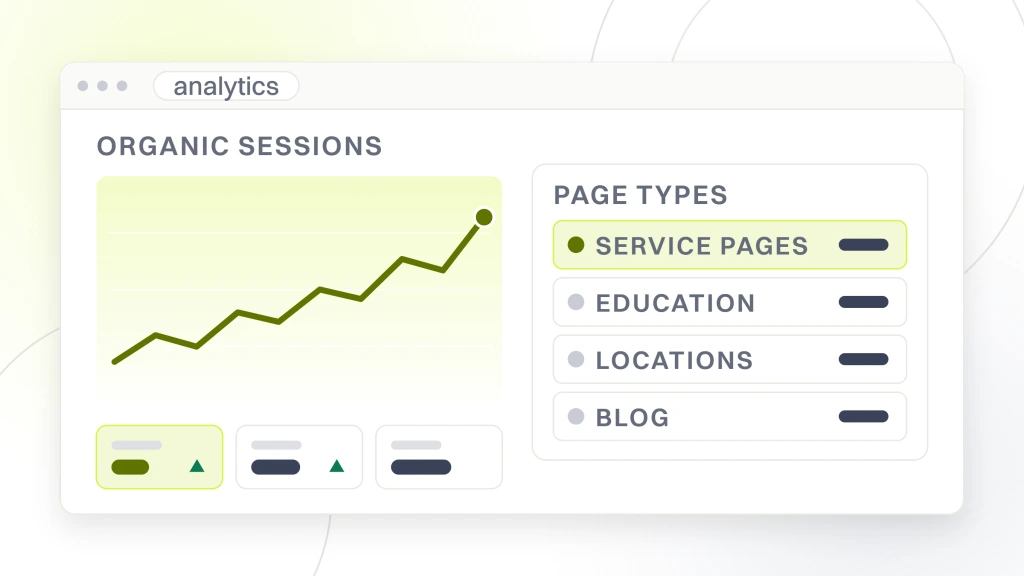
The rule we use inside healthcare CRO engagements: no page can be more than 2 clicks from a booking action. If a patient lands on “causes of hip pain” and can’t reach the orthopedic booking flow in 2 clicks, the page is a dead end. Fix the internal links, not the copy. Practices that rewire link graphs without touching content still see conversion gains of 8 to 18% inside 60 days.
Every clinical page should be no more than 2 clicks from a booking flow. Add links first, rewrite copy only after the link graph is solid.
Anchor text matters more on medical sites
Generic “learn more” links waste a ranking signal. Use anchor text that matches the target page’s primary intent. “Rotator cuff surgery recovery timeline” as anchor text tells Google what the target page covers. “Learn more” tells Google nothing. On healthcare sites, descriptive anchor text has a compounding effect. YMYL pages get scrutinized more heavily, and clear semantic signals help the crawler categorize the destination correctly.
Compliance and trust markers you can’t skip
Every website content strategy healthcare team runs into 4 compliance walls. HIPAA on patient stories and testimonials. FDA on device and drug claims. State medical board rules on scope of practice, advertising, and superlatives. ADA on accessibility. Any content pipeline that doesn’t build these into the review step ends up with pages that either get pulled after a complaint or expose the practice to a fine. The fix is a 10-minute compliance checklist attached to every draft, not a separate legal review that stalls publishing.
Patient stories need explicit written consent covering the specific quote, image, and channels. “Best in the region” claims need factual backing. Device brand names need matching FDA-cleared use language. Every image needs alt text that works for screen readers. Practices that get this right build trust with both patients and search engines. Practices that skip it publish pages that get flagged and demoted. The federal AHRQ research publications are a solid free source for clinical claims that need backing.
Schema markup does the trust work for healthcare website content at scale
The healthcare-specific schema types (MedicalOrganization, Physician, MedicalCondition, MedicalProcedure, Hospital, Dentist, DrugsAndSupplements) let search engines parse the page’s clinical meaning directly. Rich results driven by proper schema markup grow click-through rates 20 to 35% for the pages that qualify. Most healthcare sites either skip this markup entirely or apply it inconsistently. Getting it right across the top 30 pages is a 2-week project with an outsized return.
A quarterly healthcare content marketing refresh keeps rankings from decaying
A website content strategy healthcare teams treat as evergreen will decay fast without a refresh loop. Guidelines change. Insurance codes shift. Provider rosters turn over. A page written 18 months ago that no one has touched is a ranking liability, not an asset. The healthcare content marketing teams that hold rankings run a quarterly refresh cycle. Every quarter, the top 20 pages by traffic get audited against 6 checkpoints, updated where needed, and republished with a fresh last-updated stamp. Everything below the top 20 gets rotated on an annual cycle.
The 6 refresh checkpoints. Are the clinical facts still current against the latest guidelines. Are the provider names, credentials, and photos accurate. Are the insurance carriers and cost ranges still right. Are the internal links still pointing to live pages. Are the FAQs still matching what patients are actually asking on intake calls. Does the schema markup still validate. A refresh that touches all 6 in a single pass takes 30 to 45 minutes per page. That’s roughly 15 hours per quarter for the top 20 pages, and it’s the single highest-return content investment a practice can make.
Refresh the top 20 pages every quarter against 6 checkpoints. Skip a quarter and organic traffic on those pages slides 8 to 15% inside 6 months.
Publish dates and last-updated stamps aren’t cosmetic
Show both the original publish date and the last-updated date on every clinical page. Patients trust recent content. Google rewards freshness signals on YMYL pages. Hiding the date to look evergreen backfires on both fronts. Practices that add visible last-updated stamps to their top 50 pages see click-through improvements of 5 to 12% within a month, even before any content changes.
Real numbers from healthcare content work
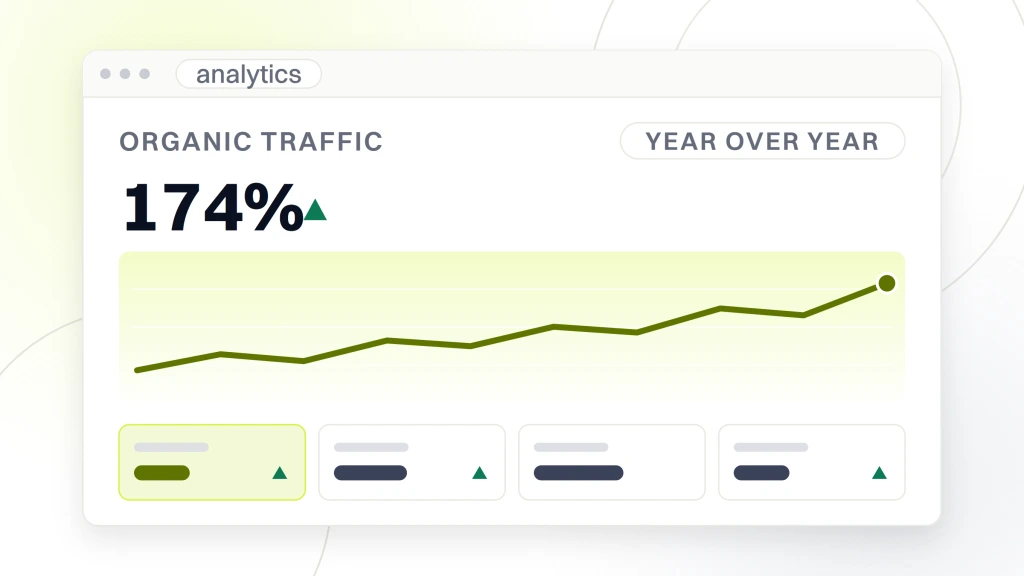
A well-run website content strategy healthcare program holds up in the field. Pelvic Rehabilitation Medicine, a specialty practice we work with, saw a +174% year-over-year organic traffic gain after we rebuilt their service pages, wired the internal link graph around 4 condition clusters, and added medical review lines to every clinical page. Traffic was already flat when we started. The rewrite plus refresh cycle turned it around inside a full-year window.
Hightop Health, an integrated care group, saw +450% keyword rankings growth on a launch curve after publishing 22 new patient education articles built around the 4-question intake test and cross-linked into the matching service pages. The Awareness Centre, a UK counseling practice, saw +157% web traffic on an annual curve after we sequenced the same fix order (service pages first, then education, then link graph, then refresh). Same website content strategy healthcare sequence, same result across 3 very different practice types. A healthcare patient content marketing motion built on this sequence is repeatable, not a one-off win.
What the numbers do not promise
None of these gains happened in 30 days. Real healthcare content work needs 90 to 180 days to move traffic and another 30 to 60 to move bookings. Any agency promising 30-day rankings on a competitive medical term is either running black-hat tactics that will hurt the practice or lying. Patients ask hard questions before booking, and the pages that earn their trust take real effort to build.
The 90-day website content strategy healthcare rollout plan
The sequence below is the exact website content strategy healthcare rollout we run for new clients over 90 days. It assumes a mid-sized practice or hospital service line with 30 to 80 existing pages. Larger sites stretch each phase by roughly 50%. Smaller sites compress the timeline but never skip the phase order. Skipping the order is where 80% of failed content programs go wrong.
Days 1-30. Audit and service page rebuild
- Full content inventory with traffic, conversion, and last-updated data on every URL.
- Identify the top 6 service pages by booking value and rewrite each to the 8-block spec.
- Publish schema markup on every rewritten service page.
- Add medical review lines and author bios where clinical content appears.
- Baseline analytics so the next 60 days have something to measure against.
Days 31-60. Patient education cluster build
- Pick the top 3 conditions the practice treats and build a 4-article education cluster around each.
- Every article ties back to the matching service page with descriptive anchor text.
- Run the 4-question intake test on every draft before publishing.
- Wire the internal link graph so no clinical page is more than 2 clicks from a booking flow.
- Add descriptive alt text to every image, including provider photos.
Days 61-90. Location pages, refresh cadence, and reporting
- Build a real location page for every office if the practice runs more than one location.
- Set the quarterly refresh cadence on the top 20 pages by traffic.
- Add last-updated stamps to every clinical page.
- Report on organic traffic, booked appointments, and ranking movement against the day-1 baseline.
- Lock in the maintenance retainer that funds the ongoing quarterly refresh work.
Run the 90-day plan in this exact order. Skip a phase and organic gains stall inside 6 months on 80% of medical sites.
Measurement for healthcare patient content marketing, not vanity metrics
Sessions and pageviews aren’t the point of a website content strategy healthcare leadership will keep funding. The point is booked appointments, ranked service terms, and the cost per new patient the site produces. Track those, and the content program earns its next quarter of budget. Track sessions in isolation and the program gets cut in the next reorg. The healthcare website content programs that survive budget season report on 5 numbers.
- Booked appointments from organic search, tracked through call tracking or form completions with UTM tags.
- Ranking positions on the top 20 commercial service terms, sampled monthly.
- Organic sessions on the top 20 pages, month over month.
- Cost per new patient from organic vs. paid, compared quarter over quarter.
- Provider directory clicks and downstream booking rate, since these convert 4 to 8 times better than blog traffic.
The reporting cadence that keeps stakeholders bought in
Report monthly to the marketing team, quarterly to leadership. Monthly reports cover ranking and traffic movement so the content team can react. Quarterly reports cover booked appointments, cost per new patient, and revenue attribution so leadership sees the business case. Practices that report on the right cadence keep their content budgets. Practices that report only on sessions lose them by the second budget cycle. For a deeper look at how to classify your existing content before starting the plan, review our healthcare website classification criteria guide.
Common mistakes that sink healthcare content programs
Even careful teams inside a mature website content strategy healthcare program hit the same 5 mistakes. Publishing blog posts before rebuilding service pages, so the traffic lands on pages that can’t convert. Writing megaguides that try to cover an entire condition on one URL, so no single page ranks well for any specific query. Ignoring the internal link graph and leaving education pages as dead ends. Skipping medical review lines to save time on the review step. Chasing generic head terms owned by WebMD and Mayo Clinic instead of the mid-tail terms the practice can actually win.
Fixing any one of these moves the needle. Fixing all 5 in sequence transforms the site. The healthcare patient content marketing programs that hit their targets treat these as gates, not suggestions. A page doesn’t publish if it fails any of them. That discipline is boring and it works.
The AI-content trap
Large language models will draft a plausible-sounding article on any medical topic in 90 seconds. That’s the trap. Plausible isn’t accurate, and medical content that’s plausible but wrong is a liability. Every AI-drafted paragraph on a clinical topic needs a real provider to verify it against current guidelines before it publishes. Teams that use AI as a first draft and a real clinician as the editor get 3 to 5 times the output at the same trust bar. Teams that publish AI drafts without review get their pages demoted or, worse, get themselves sued.
Bringing the plan into your next quarter
The website content strategy healthcare teams keep asking for isn’t a secret framework. It’s the discipline to fix service pages first, cluster patient education around real intake questions, wire the internal link graph so every page ties to a booking flow, and refresh the top 20 pages every quarter. Do those 4 things for 90 days and the site starts to book patients on autopilot. Skip any of them and you’re back to running content as a cost center.
If the internal team is stretched thin, the fastest path is to run the first 90-day website content strategy healthcare cycle with outside help, then hand the quarterly refresh cadence back to the marketing team as a standing 15-hour-a-quarter commitment. That’s the model our healthcare clients use to hold gains without ballooning agency spend. The plan stays the same. The execution shifts to whoever has the bandwidth to run it consistently.