Your practice ran the last healthcare SEO audit ten months back, or nobody ran one at all. Either way, this checklist surfaces the fixes worth doing this quarter and the ones that can wait. The audit covers 15 items across 5 layers, produces a written priority list, and turns into applied changes inside 30 days. If your last audit ended as a PDF nobody opened, this piece is the version that gets fixes into production. You’ll read the 15 items, the priority order, the common failures, the tools that make the audit trustworthy, and one real proof point from a 14-location group. Read it straight through in about 12 minutes.
The short version. It isn’t a report. It’s a fix list with priorities, effort estimates, and named owners. 15 checks. 5 layers. 30-day plan. Anything longer than that reads as billable padding.
What a Healthcare SEO Audit Covers
The audit covers 15 items across 5 layers. Technical health. On-page content. Local and Google Business Profile. Off-site authority and citations. Measurement and tracking. Each item gets a pass or fail rating, a priority score, and an effort estimate. That produces a fix list you can hand to a developer, writer, or agency on Monday morning.
The 15-item checklist at a glance
The checklist runs across 5 layers. Layer one, technical: crawlability, indexation, Core Web Vitals, schema, sitemap. Layer two, on-page: title tags, meta descriptions, headings, content depth. Layer three, local: Google Business Profile completeness and citation NAP consistency. Layer four, authority: backlink profile, brand mentions, review velocity. Layer five, measurement: Search Console setup, GA4 conversions, call tracking. Every one of these gets a written finding in the deliverable.
What a real audit deliverable looks like
A real audit deliverable is a spreadsheet, not a 50-page slide deck. Every row is a finding. Every row has a priority score from 1 to 5, an effort estimate in hours, an owner name, and a due date. The narrative summary sits on top in three paragraphs and calls out the two or three template-level patterns worth taking to the exec team. That format gets fixes into production the same week the audit closes. The 50-page deck gets read once and archived where nobody finds it again.
Ask any prospective audit vendor to show you the deliverable format before you sign. Real ones send a redacted example inside a day. Weak ones ask for a discovery call first and then send a marketing PDF. For the audit-then-services next step, see our Healthcare SEO Services.
Technical Checks in a Healthcare SEO Audit
Technical checks are the first layer of the audit. A beautifully written service page that a crawler can’t access ranks nowhere. 5 checks carry the weight: crawlability, indexation, Core Web Vitals, schema, and sitemap health. Each one takes 2 to 4 hours to audit properly. Skipping any of them leaves ranking positions on the table for competitors to take.
Crawlability and indexation
Every service page and every location page needs to be crawlable and indexed. Common failures include noindex tags left on by a developer, robots.txt disallowing the whole site after a migration, and orphaned pages nobody links to. Pull the Search Console coverage report and compare indexed pages against the sitemap. Any gap larger than 5% is a red flag worth investigating. See Google Search Central on robots.txt for the crawl directive reference.
Core Web Vitals on real user data
Pull the Core Web Vitals report from Search Console and PageSpeed Insights for the top 10 pages. Mobile Largest Contentful Paint under 2.5 seconds. Interaction to Next Paint under 200 milliseconds. Cumulative Layout Shift under 0.1. Practices that pass all three see ranking gains inside a re-crawl cycle. Failing any one of the three is the most common technical failure across healthcare websites in 2026.
Schema markup coverage for YMYL healthcare content
Every service page needs MedicalWebPage or Service schema. Every location page needs LocalBusiness or MedicalBusiness schema. Every clinician bio needs Person schema with credentials in the honorificSuffix property. Test with the Rich Results tool. Any warning or error is a fix. Missing schema is the second most common technical failure across healthcare sites, and it hits YMYL categories hardest because Google reads it as a trust signal.
Enterprise Healthcare SEO Audit Scope
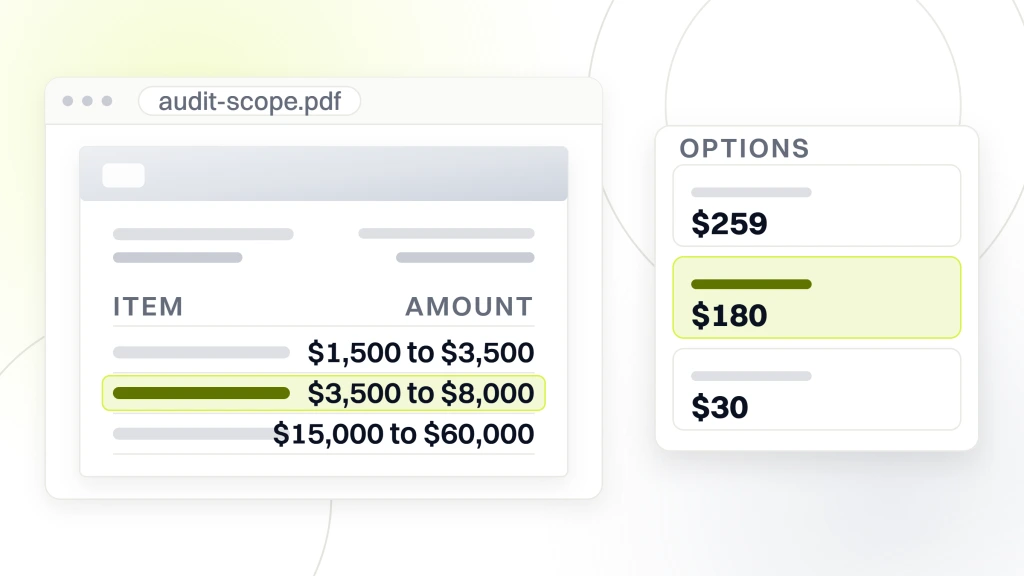
Enterprise scope scales the same 15-item checklist across hundreds or thousands of pages and multiple regions. Multi-location groups, DSOs, and hospital systems need this bigger scope because sample audits on 10 pages miss the site-wide patterns that carry the real ranking impact. Enterprise scope costs $15,000 to $60,000 and takes 4 to 6 weeks. Anything faster is a sample, not a full audit.
Callout. If a vendor promises a full multi-location audit in 5 days, they mean a canned tool report. Real enterprise scope takes 4 to 6 weeks minimum.
| Audit scope | Pages covered | Cost range | Timeline | Deliverable |
|---|---|---|---|---|
| Solo practice audit | Up to 50 pages | $1,500 to $3,500 | 1 to 2 weeks | Fix list, 30 rows |
| Small group audit | 50 to 200 pages | $3,500 to $8,000 | 2 to 3 weeks | Fix list, 60 rows plus location review |
| Multi-location audit | 200 to 800 pages | $8,000 to $18,000 | 3 to 4 weeks | Fix list, per-location scorecards |
| Enterprise audit | 800+ pages | $15,000 to $60,000 | 4 to 6 weeks | Site-wide patterns plus template fixes |
What enterprise audits catch that sample audits miss
Enterprise audits catch site-wide template failures that hit thousands of pages at once. A broken schema template on the location page type. A canonical rule that self-canonicalizes every URL parameter variant. An hreflang tag on a single-language site. These template bugs cost enterprise sites more ranking positions than any single page-level issue. Sample audits on 10 pages never surface them.
How enterprise audits get sequenced
Week one is discovery. Pull the crawl, pull Search Console, pull GA4, interview stakeholders. Week two is analysis. Run the 15-item checklist across the crawl output. Week three is prioritization. Turn findings into a scored fix list. Weeks four through six are enablement. Work with in-house developers to unblock the highest-priority template fixes before the audit closes.
Healthcare Website Audit Services Practices Actually Need
Healthcare website audit services worth paying for share four traits. Healthcare-specific vertical experience. A defined checklist with public methodology. Findings that name owners and deadlines, not just problems. Follow-up capacity to fix the highest-priority items rather than handing off a PDF. Practices that filter their audit vendors on these four traits get audits that produce real fixes. Practices that pick on price alone get PDFs that sit unread.
Healthcare vertical experience isn’t optional
A generalist SEO auditor runs the same playbook they use on ecommerce and misses healthcare-specific issues. HIPAA violations in tracking pixels. Missing clinician byline schema. Condition page depth thresholds specific to YMYL. Ad platform policy limits on retargeting. Ask the vendor for three healthcare case studies with real numbers. Real ones show them. Generalists dodge.
One proof pattern to look for. Our work with iSmile Dental Spa in Carmichael, CA drove +900% patient growth, +800% organic traffic, and 75 page-one keywords inside 6 months. Numbers that specific mean the vendor kept the audit deliverable and can show it.
The public methodology test
Real audit vendors publish their methodology on their website. You can read it before you sign the contract. Weak vendors keep the methodology opaque so they can bill for whatever they feel like doing. Ask to see the audit checklist template before signing. Any vendor who refuses is either running black-box work or has no template at all.
Named owners and deadlines in the deliverable
Every finding in the audit deliverable needs a named owner and a deadline. Without those, the audit becomes a wish list nobody works on. The owner is either an in-house developer, an in-house writer, or the vendor itself if the engagement includes follow-up implementation.
Content Layer of a Healthcare SEO Audit
The content layer looks at every page for depth, expertise signals, and search intent match. Most healthcare service pages fail on depth, missing at least three of the six sections that a real service page needs. Fixing depth alone moves ranking positions 2 to 5 spots for the target keyword inside a re-crawl cycle. Content is the layer with the biggest gap between what practices publish and what actually ranks.
Callout. Fix the credentialed clinician byline before you fix anything else on a service page. It’s the cheapest content fix on the checklist and moves ranking 2 to 3 spots.
The six-section service page test
Every service page needs six sections. What the service is. Who it’s for. What happens at the appointment. How insurance handles it. Typical cost range. What patients ask about it. Pages missing any section get a fix. Pages hitting all six move up in the rankings when other layers cooperate. 200-word service stubs almost never rank against competitors with real service pages.
Expertise and credentialed byline check
Every clinical page needs a named clinician byline with credentials, a review date, and a link to a bio page. Missing any of these three costs ranking positions in YMYL categories. Pages with a named clinician reviewer outperform pages without one by an average of 2 to 3 positions for the same keyword. Adding a credentialed reviewer is the single cheapest content fix in the audit.
- Named clinician author with credentials on the page.
- Review date within the last 18 months.
- Link to the reviewer’s bio page.
- At least one citation to a primary source (CDC, NIH, peer-reviewed journal).
- Related conditions cross-linked from the page.
- Booking or contact CTA above the fold.
Search intent match
Every content page needs to match the search intent of the query it targets. Ready-to-book queries get service pages. Comparison queries get comparison pages. Research queries get educational articles. Practices that publish the same page shape for three different intents underperform because Google reads the intent mismatch and demotes the page. The audit flags every intent mismatch by pulling the top three ranking pages for each target query and checking the format of the page against the format of the winners.
Tools Behind a Trustworthy Healthcare SEO Audit
A trustworthy audit runs on a specific stack of tools that make the output reproducible and defensible. The tools aren’t the strategy, but a vendor that runs everything on free tools alone is either underinvesting or covering it up. Practices evaluating audit vendors should understand what sits behind the audit output.
Crawler tools
Screaming Frog SEO Spider at $259 a year for the licensed version. Sitebulb at $180 a month for cloud crawls. DeepCrawl or Lumar for enterprise scope at $2,000+ a month. Any auditor working without one of these tools is running eyeball comparisons on twenty pages and calling them an audit. The crawler output is where site-wide patterns actually surface.
Keyword and rank tracking
Ahrefs at $99 a month for the starter tier or Semrush at $139 a month for keyword research and backlink profile. Local Falcon for map pack ranking checks at $30 a month. BrightLocal for citation audits at $39 a month. Practices doing DIY audits can substitute free tools like Google Search Console for the ranking layer and get 70% of the value.
Analytics and Search Console
GA4 for user behavior and conversions. Google Search Console for indexation, Core Web Vitals, and query performance. Looker Studio for dashboards. Every audit that skips Search Console misses the ground truth on how Google sees the site. Any auditor that doesn’t pull the Search Console coverage report is running from second-hand data. See web.dev on Core Web Vitals for the metric definitions the audit report needs to cite verbatim.
A Real Healthcare SEO Audit in Action
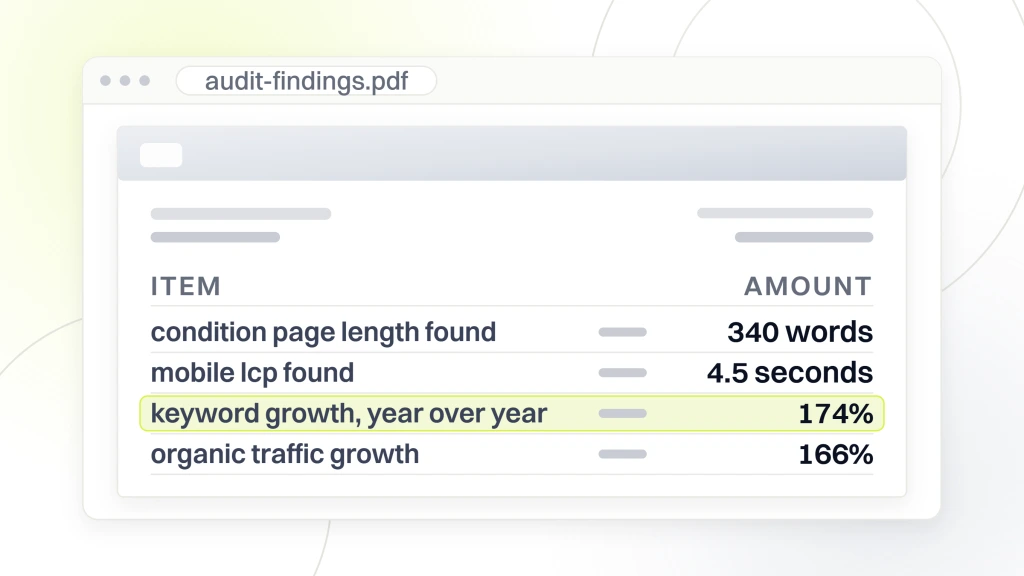
Pelvic Rehabilitation Medicine, a 14-location pelvic pain group, ran a full audit at the start of a retained engagement. That audit surfaced the fixes that produced +174% keyword growth year over year and +166% organic traffic growth. Here’s what the audit found and how the fixes got sequenced.
Callout. If your practice has more than 5 locations and you’ve never run an audit against the checklist, expect at least 2 template-level failures hitting every location page at once.
Top three findings from week one
Finding one. Condition pages averaged 340 words with no credentialed byline. Priority score 5. Finding two. 14 Google Business Profiles carried inconsistent category taxonomy across the network. Priority score 5. Finding three. Hosting environment produced mobile Largest Contentful Paint of 4.5 seconds against a target of 2.5. Priority score 4.
Fix sequence and applied changes
Content fix ran first. It required no infrastructure change. Google Business Profile audit ran in parallel because it needed no dev involvement. Hosting migration ran third because it needed a maintenance window. The plan on Monday. Fix everything at once. The plan on Friday. Pick the two highest-priority items and do those first. Every real audit plan ends up as the Friday version, and every reader of this checklist has already tried the Monday version at least once.
Numbers 90 days later
Ranking positions gained an average of 3 to 5 spots across the target keyword set. Organic traffic pattern started compounding at month 4. Booked appointment volume moved at month 6. Full-window results landed at +174% keyword growth and +166% organic traffic year over year. That sequence is normal, not exceptional. Audits don’t book patients directly. Audit fixes book patients over a two-quarter window when the practice actually implements them. See our Healthcare SEO Services for the retained follow-through.
10 Common Fixes a Healthcare SEO Audit Surfaces
Across the medical SEO audits we’ve run in the last two years, 10 fixes come up on almost every site. Knowing this list gives you a shortcut. Even before you run the audit, you can probably push half of these fixes today and gain ranking positions inside the next re-crawl cycle.
Callout. Fix the clinician byline and Google Business Profile categories before spending a dollar on paid work. Both take under 2 hours per location and reliably move ranking positions.
The 10 fixes that surface on almost every audit
Missing clinician byline on service pages. Missing schema markup on location pages. Broken canonical rules from a legacy theme. Third-party scripts blocking Core Web Vitals. Duplicate content across similar service pages. Missing internal links from the homepage to money pages. Inconsistent NAP across citations. Google Business Profile categories left on default. No call tracking installed. Search Console verification missing on the primary domain.
Which two to fix first
The clinician byline and the Google Business Profile categories. Both take under 2 hours per location. Both move ranking positions inside a re-crawl cycle. Neither requires a developer. Practices that fix these two first free up budget for the harder items later. Fix the free wins before spending money on the paid ones.
Which two to fix last
The hosting migration and the schema markup rebuild. Both take 2 to 6 weeks and cost real developer hours. Both matter, but neither pays off inside the first 60 days. Do the fast fixes first, book the wins, then take on the slower structural work with the momentum already established. See Technical SEO for Healthcare for the deeper walk-through on the migration side.
Real proof the sequence works
North County Dental Care in Vista, CA replaced fragmented agencies with a single strategy after an audit surfaced broken links, inconsistent listings, and thin content. Result. +1,000% patient growth, +385% organic traffic, and 12 to 16 new patients each month. VP Dental doubled new monthly patients, added $8,100/month in recurring revenue, and grew search impressions +776% after a similar audit-then-services sequence. The proof points share one common thread. Fast fixes first, then paid work.
Healthcare SEO Audit Frequency and Cadence
How often should a practice run the full audit. Once every 12 to 18 months for the full checklist. Once every 90 days for a technical health scan. Once a month for Google Business Profile and citation checks. Cadence beats depth for maintenance. A 90-day scan catches drift before it costs ranking positions.
The annual full audit
The full audit runs annually with 15-item coverage. It resets the fix list, catches new patterns, and re-baselines the metric chain. Practices that skip the annual audit end up two or three quarters behind before anyone notices. The annual audit is the equivalent of a full inspection on a building. Skip it once and the next one costs three times as much.
The quarterly technical scan
Every 90 days, run the technical layer. Core Web Vitals, indexation report, schema validation, sitemap health. 10 hours of work. Catches drift from theme updates, plugin updates, hosting changes, and content additions that push a template past a size threshold. Practices that skip the quarterly scan get surprised by ranking drops every three months.
The monthly local check
Every month, check the Google Business Profile at each location and the top 20 citation sources. Review response cadence, category accuracy, and NAP consistency. 2 hours per location per month. Missing this cadence is the single most common reason practices lose map pack ranking to a competitor across the street. See Local SEO for Healthcare for the local layer walk-through.
Healthcare SEO Audit Decision Summary
You now have the 15-item checklist, the enterprise scope map, the tool stack, the 10 common fixes, one real proof point, and a cadence to keep the audit from going stale. The decision reduces to one question. Do you have the internal team to run it, or do you hire it out.
Signals for running the audit in-house
You have a marketing lead comfortable with Search Console, GA4, and Screaming Frog. You have a developer available for schema and technical fixes. You have a writer available for content depth work. Under those three conditions, in-house audit works and saves the vendor fee. Practices without those three roles filled either don’t finish the audit or finish it as a partial fix list that misses the highest-priority items.
Signals for hiring an audit vendor
You don’t have the bandwidth above. You want a second set of eyes on a site your team has been maintaining for years. You want the fix list handed to you rather than built from scratch. When you’re ready to run this across the whole practice, our Healthcare Marketing Agency for Patient Growth covers the full stack. The audit is free, and the retainer is a fixed monthly price we quote once the audit shows what needs fixing. For the strategy-side companion, see the sibling Healthcare SEO Strategy.