
Pet SEO services split into two camps that most founders never see clearly. One camp runs a generic ecommerce audit and swaps the word “pet” into a template. The other camp knows a treat brand ranks on subscription retention signals, a pet food brand ranks on ingredient sourcing pages, and a toy brand ranks on category education because product pages alone do not hold long-tail queries. Same category, three product types, three different ranking strategies. This guide walks the operational questions to ask any pet SEO services vendor in the first sales call, the retainer bands where the spend pays back, and the technical audit items that stop a DTC pet brand from losing organic share to Amazon and Chewy every quarter. You get a vendor screening framework, a technical audit checklist, content patterns by product type, retainer bands by revenue stage, four real client references, and a set of Google People Also Ask questions answered inline so a founder can walk into a paid SEO meeting and control the conversation. Twelve minutes of reading gives you the audit prompts to bring to the next agency proposal. For the wider category context, read our take on pet industry SEO for DTC pet brands before the first vendor call.
Pet SEO services vendor screening in the first call
The first sales call decides whether a vendor is worth a proposal. Ask six specific questions and watch the answers. Name three pet DTC accounts you have run for more than 18 months and their organic traffic growth. What is the target ranking timeline on category keywords for a treat brand. Which technical audit tools do you run and in what order. How do you write ingredient-claim content that stays inside FTC substantiation rules. Show a real client dashboard from last month with names redacted but numbers intact. What is your view on Amazon versus DTC SEO trade-offs. Specialists answer inside 60 seconds. Generalists circle back with slide decks two days later.
The dashboard demo is the single most useful screening tool. If the vendor shows cost per click, cost per thousand impressions, and impression counts as top metrics, they are reporting activity. If they show organic sessions, keyword rankings at the search result position level, revenue attributed to organic, and category share of voice, they are reporting outcomes. If the dashboard does not exist as a template ready to modify for your brand, they will build one during the retainer and you will fund the framework. Specialist shops have a dashboard ready in the first call, populated with an old client’s redacted numbers, and can explain every column in plain English.
Account lead tenure inside the agency is the third screen. Ask who your account lead will be and how long they have been at the shop. Under 12 months means churn risk mid-retainer. Under 24 months means competence risk on complex content pipelines. Specialists retain their strongest leads because the category work is interesting. Generalist shops burn junior labor on pet accounts because the vertical feels adjacent to whatever they actually specialize in. Read our companion piece on pet industry SEO company selection for the full 12-point screening rubric we walk into every DTC pet vendor call with.
Technical audit checklist any pet SEO services vendor should run
Any real engagement should open with a technical audit that covers eight specific items. Site speed on category and product pages measured against Core Web Vitals thresholds. Indexation health on category and product pages via Search Console coverage report. Schema markup on Product, Review, Organization, and BreadcrumbList. Internal linking density between category and product pages. Crawl budget efficiency for large SKU catalogs. Canonical tag hygiene across faceted product pages. Sitemap accuracy and submission status. Mobile usability across all templates.
Screaming Frog runs the initial crawl. Ahrefs or Semrush runs the competitive gap analysis. PageSpeed Insights runs the Core Web Vitals baseline. Search Console runs the indexation and coverage checks. Vendors who use one tool and hand-wave the others miss issues that compound across quarters. The audit deliverable should walk 20 to 40 specific findings with priority tiers, effort estimates per fix, and expected ranking or traffic impact per fix. Anything vaguer is a template deliverable, not a real audit. Read the Google Product structured data documentation for the exact schema required to trigger rich results on category and product pages.
The most common technical issues on pet DTC sites are duplicate category pages from faceted navigation, weak schema on individual product SKUs, thin content on collection pages, missing product images causing rich result failures, and slow Time to First Byte on Shopify or WooCommerce sites running over 40 collections. Fixing the first five items usually recovers 20 to 40 percent of latent organic traffic within 90 days. That recovery pays back the first two months of any serious retainer and buys the trust needed to greenlight the content pipeline scope.
- Core Web Vitals score above 75 on category and product pages, tested mobile-first
- Product schema on 100 percent of SKU pages, validated in Search Console rich results report
- Faceted navigation set to noindex on filter combinations that produce no unique inventory
- Internal link count of 3 to 8 relevant cross-links per product page, none orphaned
- Sitemap submitted, updated on publish, and free of 404s or redirect chains
- Time to First Byte under 600 milliseconds on the top 20 landing pages
Content patterns pet SEO services should build by product type
Content patterns split by product type. Treat brands rank on ingredient education, feeding guides, and pet-parent lifestyle content. Food brands rank on breed-specific feeding recommendations, ingredient sourcing transparency, and life-stage nutrition guides. Toy brands rank on category education (what makes a good chew for aggressive chewers), enrichment guides, and safety comparisons. Supplement brands rank on condition-specific content (hip and joint, calming, digestive), veterinarian-reviewed pages, and ingredient efficacy citations. A vendor that treats all four the same way is running a template, not a real strategy.
Volume matters at scale. A pet DTC brand targeting real organic growth needs 60 to 120 published pages in the first year, split roughly 40 percent product-supporting content, 30 percent educational category content, 20 percent comparison and buyer-decision content, and 10 percent brand storytelling. Vendors quoting 6 posts a month at $2,400 are underpricing the work. The realistic monthly output for a serious retainer is 10 to 16 pieces per month including product page rewrites, category page expansion, and net-new blog posts. Anything less produces motion without traction.
Each piece has to answer a real query and rank inside 4 to 7 months. Vendors who publish and pray without keyword-mapping their calendar rank nothing after 12 months. Every content brief should include the target keyword, the search volume, the current search result competition, the estimated ranking difficulty, and the linked internal page structure. Anything vaguer is content marketing dressed up as SEO. Read our companion piece on pet company SEO keywords that drive DTC traffic for the keyword mapping approach we use inside every content brief for treat, food, toy, and supplement brands.
- Treats: ingredient education, feeding schedules, training reward guides, allergen callouts
- Food: breed-specific portion guides, life-stage nutrition, ingredient sourcing pages
- Toys: chew-strength education, enrichment routines, safety comparison content
- Supplements: condition guides, veterinarian-reviewed pages, ingredient efficacy citations
- Accessories: fit and size guides, care instructions, seasonal buying content
Retainer bands for pet SEO services in 2026
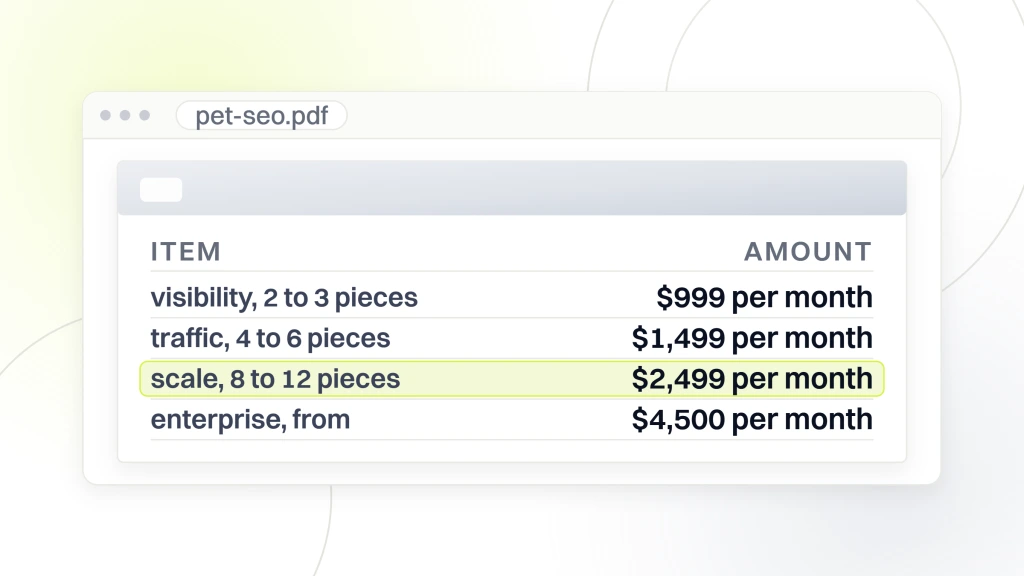
Retainer pricing depends on scope, publishing cadence, and technical work included. The Redefine Web retainer bands run from $999 per month for maintenance-plus-support scope on established DTC brands who need consistent oversight without a heavy content pipeline, $1,499 per month for growth-stage brands adding 4 to 6 pieces monthly with quarterly technical work, $2,499 per month for scale-stage brands running 8 to 12 pieces monthly with monthly technical work and light digital PR, and from $4,500 per month for full-service programs that layer digital PR, category expansion, and international rollout on top of the core retainer. The tiers scale with scope, not with headline revenue.
The retainer to organic revenue ratio should sit at 1 to 6 or 1 to 12 by month twelve on a healthy program. A $2,499 monthly retainer that grows organic revenue to $15,000 monthly at 1 to 6 is a strong ratio worth scaling into the next tier. A $2,499 monthly retainer that grows organic revenue to $7,500 monthly at 1 to 3 is a losing model that needs a rebuild or a vendor change. Vendors who refuse to project ratios in the first sales call are hedging against poor results. Specialists project ratios by month three, month six, and month twelve at the proposal stage and put those numbers in the contract.
| Retainer tier | Monthly retainer | Publishing cadence | Best fit stage |
|---|---|---|---|
| Visibility | $999 | 2 to 3 pieces | Under $500K |
| Traffic | $1,499 | 4 to 6 pieces | $500K to $1.5M |
| Scale | $2,499 | 8 to 12 pieces | $1.5M to $5M |
| Enterprise | Starts at $4,500 | 12 to 20 pieces + digital PR | $5M and above |
Client references our team names on the first pet SEO services call
Pet Insurance Australia partnered with our team on a paid program in prior years that produced 455 conversions in five months at a 31.06 percent conversion rate and 1,132 percent return on ad spend. The organic side ran alongside the paid to grow sessions on the same policy signup pages the paid campaigns were driving to. The strategy focused on educational content that answered new-pet-parent questions before they searched for insurance, plus city-level landing pages targeting Sydney, Melbourne, Brisbane, and Perth policy shoppers. Twelve months in, organic sessions to the policy signup pages contributed an additional 22 percent of total conversion volume with zero incremental paid spend.
Mission Pet Health engaged our team on a subscription retention and DTC SEO scope that combined content expansion with product page rewrites across the wellness and supplement catalog. The educational content around new puppy checklists, senior dog wellness, and functional supplement guides ranked page one for 40-plus terms with buyer intent inside twelve months. The compound effect showed clearly in the six-month view when organic traffic began driving subscription signups at a lower cost per acquisition than paid channels could match. The retainer paid back at a 4.2 to 1 ratio inside the first year.
Pet Shop · Independent Retail · UK engaged our team on a local plus category SEO scope, layering Google Business Profile optimization for the storefront on top of a national category ranking push on treats and toys. City-modified category pages captured shoppers in Manchester, Leeds, and Birmingham while the national category pages picked up long-tail chew and enrichment queries. Passion Built, a DTC accessory brand, ran a full-service scope with digital PR and coverage in Wirecutter and The Spruce Pets. Both accounts hit the 1 to 6 retainer to revenue ratio by month nine and re-signed at a higher scope for year two.
Amazon versus DTC pet SEO services for 2026
Any serious program in 2026 has to cover both Amazon SEO and traditional DTC SEO. Amazon SEO runs on A9 algorithm signals (keyword-loaded titles, backend search terms, review velocity, sales velocity) rather than Google’s ranking signals. Vendors who only think about Google leave 30 to 60 percent of a pet brand’s discoverable revenue on the table because Amazon is where category buyers search first for anything under $40 average order value. Ask any prospective vendor whether they run Amazon separately or as an add-on to the DTC scope. If they answer “we do not touch Amazon” the retainer is capped at half the possible upside from day one.
Amazon SEO deliverables are different. Backend search term optimization, product title restructuring, A+ Content built for both conversion and keyword coverage, review generation programs compliant with Amazon’s terms of service, and Sponsored Products campaigns that push organic rank higher through velocity signals. Google SEO experience does not translate to any of these Amazon-specific plays. A vendor with real Amazon capability names the account manager for that channel, shows a redacted Seller Central dashboard, and prices Amazon as a discrete workstream rather than folding it into a generic content retainer. Read Amazon’s search optimization documentation for the specific A9 ranking factors.
DTC SEO focuses on the buyer who wants to know the brand story, understand ingredient sourcing, read veterinarian citations, and join the subscription program. Chewy, Petco, and BarkBox dominate transactional category queries in Google search results. Winning DTC organic means capturing the informational and comparison queries that funnel toward subscription rather than one-off purchase. Both channels matter and neither replaces the other for a serious pet DTC brand.
Red flags in a pet SEO services proposal
Six red flags separate serious pet SEO shops from paid link farms and content mills. Guarantees of top-three rankings in 90 days. Vague deliverables that do not specify page count, keyword targets, or ranking timelines. Refusal to name the account lead and their tenure. Refusal to share a dashboard template pre-contract. Retainer pricing under $999 monthly on a Visibility scope with real deliverables (below that number the work is a template drop). And any mention of “buying backlinks” or “private blog networks” as a link building strategy. The last one triggers a manual action from Google inside 60 days on the average pet DTC domain.
The link building red flag is the most dangerous long-term. Cheap link farms drop a pet brand into a manual action within 60 days when Google catches the pattern. Manual actions recover slowly and expensively. Real link building for pet brands is digital PR (earned coverage on Wirecutter, The Spruce Pets, Rover blog), broken link outreach (finding dead links in editorial content and pitching replacements), and founder-led thought leadership on named publications. All slower, all more expensive per link, all safer and higher-quality.
Ask the vendor for three named link building tactics they would run in your first 90 days. Specialists list three specific plays with expected outcomes. Generalists say “blogger outreach and directory submissions.” Directory submissions were dead by 2018 and blogger outreach without specifics is a template. Watch the response speed. Watch the specificity. Both signals separate real programs from theater. Competing pet SEO shops name specific publications where they earned coverage in the last twelve months. That specificity separates real capability from marketing copy that reads well in the deck and dies at the execution stage.
- Ranking guarantees inside 90 days on head terms (nobody controls Google that tightly)
- Vague deliverables with no page counts, keyword targets, or ranking timelines
- Refusal to name the account lead or share their agency tenure in months
- Retainer under $999 monthly with real deliverables (below that is a template drop)
- Any mention of paid backlinks, private blog networks, or link exchanges
- Reports padded with charts on cost per click and impressions rather than sessions and revenue
Reporting cadence that keeps a pet SEO retainer honest
Weekly dashboards on ranking positions and sessions matter less than most agencies pitch. SEO progress is monthly, not weekly. The right cadence is a monthly ranking review with 30-day trend analysis, a quarterly business review with ranking, traffic, and revenue tied together, and an annual strategic review that reallocates scope. Weekly reports become theater when the underlying work runs on 30 to 90 day cycles. Push back on any vendor pitching weekly SEO reports as extra value. The extra reporting labor gets billed back into your retainer as filler that nobody reads past the second month.
The metrics that matter in a monthly report are organic sessions to money pages, ranking positions on tracked keywords with change month-over-month, backlinks acquired with domain rating context, and organic-attributed revenue via GA4 or the ecommerce platform. Everything else is filler. A three-page report is enough. Ten-page reports pad the retainer with charts nobody reads and mask underperformance behind visual density.
Quarterly business reviews should end with three specific decisions. Which content pieces to double down on. Which keywords to shift focus toward. Which technical debt to prioritize next. Reviews that end with “we are on track and continuing execution” are theater. Reviews that end with specific decisions and changed scope are honest. See our pet products SEO service page and the wider agency services page for the retainer bands and scope we run today across pet DTC, insurance, and specialty retail accounts.
Contract terms worth negotiating in a pet SEO services agreement
Retainer contracts default to 6 or 12-month terms. Six-month terms are increasingly common for smaller foundation and growth-tier retainers. Watch for hidden clauses. Auto-renewal without written notice binds you for another 12 months by default. Change-of-scope clauses that let the agency raise fees without a new signature. Content ownership clauses that leave the deliverables owned by the agency rather than the client. Read every clause, not just the price. Contract diligence at signing prevents legal fees at renewal, and the diligence pass costs an hour of a founder’s time.
Deliverable specifics belong in the contract, not in the sales deck. Number of posts monthly. Number of ranking keywords tracked. Number of backlinks pursued per quarter. Technical audit frequency. Reporting cadence. If it is in the sales deck and not in the contract, it does not exist. Force specificity into the signed agreement and the retainer stays honest. Vague contracts protect the agency. Specific contracts protect the client. That single sentence saves more brands from bad retainers than any other line in this guide.
Exit clauses matter as much as entry clauses. What happens if performance falls below defined thresholds. Who owns the content library on contract exit. What data gets transferred on offboarding. What onboarding to a new vendor looks like. These questions decide whether a bad retainer is a temporary setback or a two-year trap. Specialists answer exit questions cleanly. Generalist shops dodge them because their contract design is the moat, not the work quality. Founders who negotiate exit clauses upfront rarely need them. Founders who skip that step pay legal fees later to unwind a contract they should have read before signing.
In-house SEO team versus a pet SEO services retainer
A senior in-house SEO manager on a pet DTC brand runs $110,000 to $140,000 in base salary plus 20 percent loaded cost for benefits and equipment, which lands at $132,000 to $168,000 all-in for one head. That head still needs freelance writers, a technical audit contractor, and paid tooling (Ahrefs plus Screaming Frog plus PageSpeed monitoring) that adds another $18,000 to $30,000 in annual tooling cost. Total year-one cost for a competent in-house program lands between $150,000 and $198,000 before a single blog post ships.
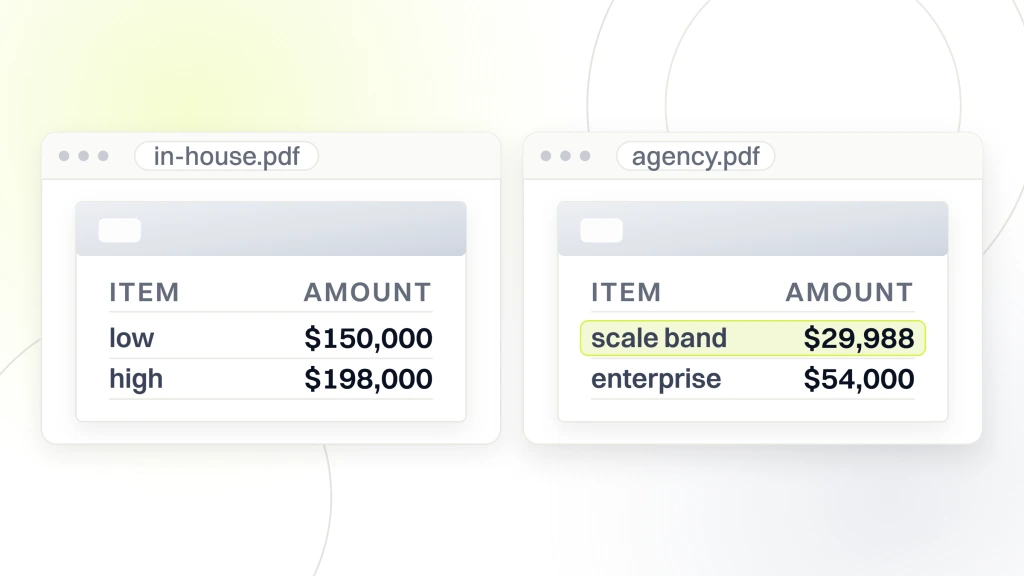
An agency retainer at $2,499 monthly (the Scale band above) runs $29,988 per year for content, technical, reporting, and light link building. A $4,500 monthly Enterprise-band retainer runs $54,000 per year and adds digital PR. The math favors an agency retainer until a pet DTC brand crosses roughly $8 million in revenue, at which point the in-house head starts to pencil out because the volume of work justifies dedicated capacity. Below $8 million, the agency retainer is the cleaner economic pick and the faster path to compounding organic revenue. Read our take on pet product marketing agency selection for the wider agency versus in-house framework.
Hybrid models work at the top of the range. A senior in-house SEO director owns the strategy and vendor relationships while a specialist agency handles execution on content, technical audits, and digital PR. The director costs $140,000 loaded. The agency costs $42,000 to $60,000. Total spend of $182,000 to $200,000 per year matches the in-house-only cost but delivers roughly three times the output capacity and covers Amazon plus Google plus digital PR without hiring a channel-specific specialist for each surface.
First 90 days of a pet SEO services retainer
The first 30 days is discovery and audit. Full technical audit delivered in week two. Content gap analysis versus Chewy, Petco, and the top three DTC category peers in week three. Keyword map for the first 90-day content pipeline in week four. Vendors who spend the first 30 days on “getting to know the brand” without shipping a technical audit are burning your retainer on discovery calls that should have happened during sales. Push for the audit deliverable inside week two or shorten the contract.
Days 31 to 60 is execution. The top five technical fixes from the audit go live. The first four to six content pieces from the keyword map publish. Internal linking gets restructured on the category and product pages that showed up as orphaned or thin in the audit. Google Business Profile (if the brand has a physical retail footprint) gets optimized. Baseline rankings get logged in the tracking tool so the next 90 days have a real comparison point. This is when the retainer starts producing measurable output rather than deliverable slides.
Days 61 to 90 is compound. Content published in month one starts moving from position 60-plus toward the top 20 on category terms. Technical fixes from month one start showing up as recovered impressions in Search Console. The next content pipeline cycle plans out based on which pieces gained the fastest traction. The quarterly business review at day 90 covers rankings, sessions, revenue attribution, and a scope decision for the next quarter. A retainer that produces zero movement by day 90 is a template drop that needs a vendor change, not a longer runway.
Making the pick on pet SEO services
Pet SEO services work when the vendor understands the specific ranking dynamics of pet DTC (subscription retention signals, ingredient-claim compliance, category share of voice against Chewy and Amazon) rather than running your account on a generic ecommerce template. Ask the six vendor screening questions in the first call. Watch response speed and specificity. Review a redacted dashboard, check account lead tenure, and match the Visibility, Traffic, Scale, or Enterprise retainer band to your revenue stage rather than the vendor’s default proposal. Six months is enough to know whether the retainer is compounding. Twelve months is enough to prove it. Beyond twelve, the retainer either doubles down on what worked or you replace it with a shop that can. Read our founder launch guide to marketing pet products and the pet product marketing agency page for the wider category strategy that a good SEO retainer plugs into.