
Real Estate Marketing Automation That Nurtures Leads Without Losing the Human Touch
- Seven workflows cover 95 percent of follow-up gaps.
- Instant-response converts leads at 21x delayed follow-up.
- Deliverability drives more outcome than workflow depth.
- Human signal detection preserves the relationship trust.
- First-touch attribution credits the automation properly.
- Trigger logic that keeps real estate marketing automation from feeling robotic
- Real estate marketing automation platform comparison for 2026
- Balancing real estate marketing automation with human touch
- A real estate marketing automation case reference from our books
- Common mistakes that quietly kill real estate marketing automation programs
- Tracking real estate marketing automation back to closed transactions
- Wrapping up real estate marketing automation as a live program
Real estate marketing automation is the discipline that runs your CRM, your text follow-ups, your email nurture, your review requests, and your appointment reminders on autopilot while you focus on showings and closings. Not chatbots that annoy buyers. Not spam sequences that hit the promotions tab. Real workflows that fire the right message at the right week and convert 6 to 14 percent of cold leads into booked conversations across an 18-month lead life cycle.
This guide covers the seven automation workflows every agent needs running, the CRM and platform stack that works in 2026, the trigger logic that fires messages without being creepy, the human-touch balance that keeps automation from feeling robotic, and the tracking that ties an automated text to a closed transaction 8 months later. Every framework here comes from live 2026 accounts we run for solo agents, teams, and brokerages between $180K and $9.4M in annual GCI.
Trigger logic that keeps real estate marketing automation from feeling robotic
The line between helpful automation and creepy automation runs through trigger logic. Well-designed triggers fire messages that feel like they came from a friend who happened to notice a specific thing. Poorly designed triggers fire messages that feel like a marketing platform tracking your every move. Real estate marketing automation trigger logic runs on three signal types: behavior triggers, time-based triggers, and CRM stage change triggers.
Behavior triggers with human-touch language
A buyer lead clicks 3 listings in one neighborhood inside 7 days: fire a text saying “I saw you looked at a few in Silver Lake recently, want me to send a full pocket of what is available this week?” A seller lead opens the recent-sales email twice inside 48 hours: fire a text saying “I noticed you have been checking the market on your block, thinking about listing?” These behavior triggers book 4 to 10 conversations per month at zero incremental cost since the automation is already running.
Time-based triggers on client life cycle
Closing anniversary. Birthday. Home purchase 5-year mark. Property tax deadline reminders. Each date deserves an automated touch that feels personal rather than templated. A one-year closing anniversary text produces 12 to 18 percent reply rate on real estate marketing automation accounts. A five-year home-purchase anniversary produces the highest referral generation rate of any single automation in the vertical because past clients are actively considering their next move around the 4-to-7 year mark. Pair the anniversary program with the PPC Management Services · Flat-Fee, Senior US Team program so paid channels backfill the pipeline while the anniversary layer generates warm referrals.
Stage-change triggers that hand off cleanly to humans
Every real estate marketing automation platform needs stage-change triggers that pause the automation and hand off to a human when the lead engages. Reply to an automated text: pause the automation and notify the agent. Book a showing: pause every marketing sequence and switch to the under-contract stage sequence. Attend a listing appointment: pause the seller nurture and switch to the pre-listing sequence. Automation that keeps blasting messages after a human engagement destroys trust and produces angry unsubscribes.
Real estate marketing automation platform comparison for 2026
Every real estate marketing automation platform has strengths and gaps. The table below compares the four combinations that carry the vertical in 2026 across monthly cost, workflow depth, deliverability tier, and typical reply rate on cold buyer nurture sequences.
| Stack | Monthly cost | Workflow depth | Deliverability | Reply rate |
|---|---|---|---|---|
| FUB + Zapier + Mailchimp | $108 < cost < $173 | Deep with connectors | 92% primary inbox | 18 to 32% |
| Sierra Interactive | $300 < cost < $500 | Deep native | 84% primary inbox | 14 to 24% |
| kvCORE all-in-one | $500 < cost < $1,200 | Very deep native | 82% primary inbox | 12 to 22% |
| HubSpot Sales Hub Pro | $500 < cost < $3,200 | Very deep native + branching | 94% primary inbox | 20 to 38% |
Why deliverability drives more outcome than workflow depth
Automation depth matters less than deliverability tier. An account with a 4-step nurture that lands 94 percent in the primary inbox produces 3 to 5x the reply rate of an account with a 12-step nurture landing 78 percent in promotions. The stack ranking is not about feature depth. It is about whether the emails and texts actually arrive in front of a human. Real estate marketing automation accounts that optimize workflow depth without watching deliverability tier waste 40 to 60 percent of the platform investment on sends that never see the primary inbox.
The dedicated IP versus shared IP question
Dedicated IPs are only worth it above 30,000 emails per month. Below that volume, shared IPs from a reputable provider land at 88 to 94 percent primary inbox placement. Above that volume, dedicated IPs let you control your own sending reputation and land at 92 to 97 percent. Solo agents and small teams should stay on shared IPs. Brokerages above 15 agents should evaluate dedicated IPs at the 30-agent scale. Real estate marketing automation accounts that jump to dedicated IPs prematurely see deliverability drop because they cannot generate the send volume needed to warm and maintain the IP reputation.
Balancing real estate marketing automation with human touch
Real estate is a relationship business. Automation without human touch feels transactional and produces one-time customers, not lifetime referral partners. The right balance runs 70 percent automation on repetitive follow-up and 30 percent human touch on high-value moments. Miss the balance in either direction and the numbers collapse. All-automation accounts see high unsubscribe rates and low referral rates. All-manual accounts see low volume and inconsistent follow-up.
The moments that must always be human
First conversation with a new lead. Post-showing debrief. Offer negotiation. Under-contract updates when something goes wrong. Post-closing thank-you within 48 hours. Referral partner introductions. Real estate marketing automation accounts that try to automate any of these moments produce 40 to 60 percent client satisfaction scores versus 82 to 94 percent for accounts that keep humans in the loop on the high-value moments. Automation is for the 200 touches a year no human can consistently execute. Not for the 6 moments a year that decide whether a client refers you to their sister.
Human-signal detection inside automation
Every well-designed real estate marketing automation workflow includes a stop condition that fires on the first signal a human is engaged. Reply to an automated text pauses the sequence. Click on a landing page pauses the drip. Open the same email three times in 24 hours pauses the marketing layer and fires an internal task for the agent to reach out personally. Automation that ignores human-signal detection blasts messages at engaged leads and destroys the goodwill the automation was supposed to build in the first place.
That's your gap. Before you buy automation software, count your average touches per lead over the last 30 days. If it's under 5, tools won't fix a process problem.
A real estate marketing automation case reference from our books
Abels Residential is a London letting agency we launched from zero. Their client base was cold, their referral pipeline was minimal, and the whole business needed a marketing engine that did not depend on paid ads. We built a conversion-focused website, layered on-page and off-page SEO, and added a full automation stack running lead nurture across landlords and tenants as two segments. Inside 12 months they ranked 300+ keywords on page one and drove 20+ qualified leads per month at page load under 2 seconds.
The automation layer produced most of the compounding effect. Manual follow-up across 900 landlord and tenant contacts monthly was impossible for the team. The automation ran 6 workflows across landlord and tenant segments with stage-change triggers, behavior-triggered follow-ups, and calendar-triggered anniversary touches. According to the HubSpot marketing automation statistics report, real estate is one of the top three verticals for automation ROI when the workflow design respects human-touch escalation rules.
What the automation stack looked like at month three
By month three the automation stack ran 6 workflows: instant-response for new tenant leads, instant-response for new landlord leads, 30-day nurture for cold tenants, quarterly touch for existing landlords, closing anniversary for completed transactions, and dormant-lead re-engagement for contacts over 90 days without engagement. Total automated touches ran 4,200 monthly against a database that reply-rated at 6 to 11 percent. Booked conversations tied to automation sat at 18 monthly at month three, climbing month over month.
What the stack looked like at month twelve
By month twelve the stack had grown to 12 workflows including behavior-triggered follow-ups, stage-change handoffs from viewing to offer to signing, and referral-generation touches on closed transactions. Reply rate on the full stack averaged 8 percent across all segments. Monthly booked conversations tied to the automation sat at 28 across a database that had grown to 2,600 contacts. The Real Estate Marketing Agency for Brokerages program brought the same automation-plus-website integration to every real estate account we ran across residential lettings, sales, and commercial letting operations.
Common mistakes that quietly kill real estate marketing automation programs
Every real estate marketing automation account we audit shows the same seven mistakes on intake. Fix them and reply rate doubles inside 60 days. Skip them and the account keeps sending automated touches into inboxes that hit the promotions tab and the spam folder at 40 to 60 percent rates while the account down the block produces 20 booked conversations off the same size database.
- Automating first-conversation touches with new leads produces cold impersonal replies at 3x higher unsubscribe.
- Skipping the human-signal detection layer keeps blasting engaged leads and destroys trust inside 30 days.
- Using corporate HTML templates in every automated message lands 22 percent of sends in promotions.
- Sending automated texts from a shared platform number instead of the agent’s real number cuts reply rate 60 percent.
- Blasting the same weekly newsletter to all segments burns the list at 6 percent monthly unsubscribe.
- Skipping stage-change triggers keeps under-contract clients on cold-lead nurture sequences and confuses them.
- Running instant-response outside business hours without a follow-up plan produces annoyed reply-quotes at 2am.
The vendor red flag list for real estate marketing automation services
Some vendors pitch a full real estate marketing automation package at $199 monthly. Pull the cover off and the “custom workflows” are the same 6 corporate templates configured for every agent across the vendor’s 800-account book with the {first_name} placeholder swapped between sends from a VA copying and pasting from a shared Google Doc. Real production of custom automation stacks runs 8 to 24 hours of setup plus 4 to 10 hours a month of ongoing management. Real fees run $850 to $3,400 monthly depending on database size and workflow count.
Green flags in a real proposal
Green flags: a written workflow design for 5 or more automation tracks, human-signal detection built into every workflow, plain-text sender formatting over corporate HTML, stage-change triggers documented per workflow, monthly deliverability reporting, and a monthly one-page report tied to booked conversations rather than opens and clicks. Any proposal missing 3 or more of these green flags means the vendor is running a template shop, not a real estate marketing automation pod. Pair the automation buildout with the Sales Funnel Services · Done-For-You program so the funnel and the automation get built as one connected system.
Tracking real estate marketing automation back to closed transactions
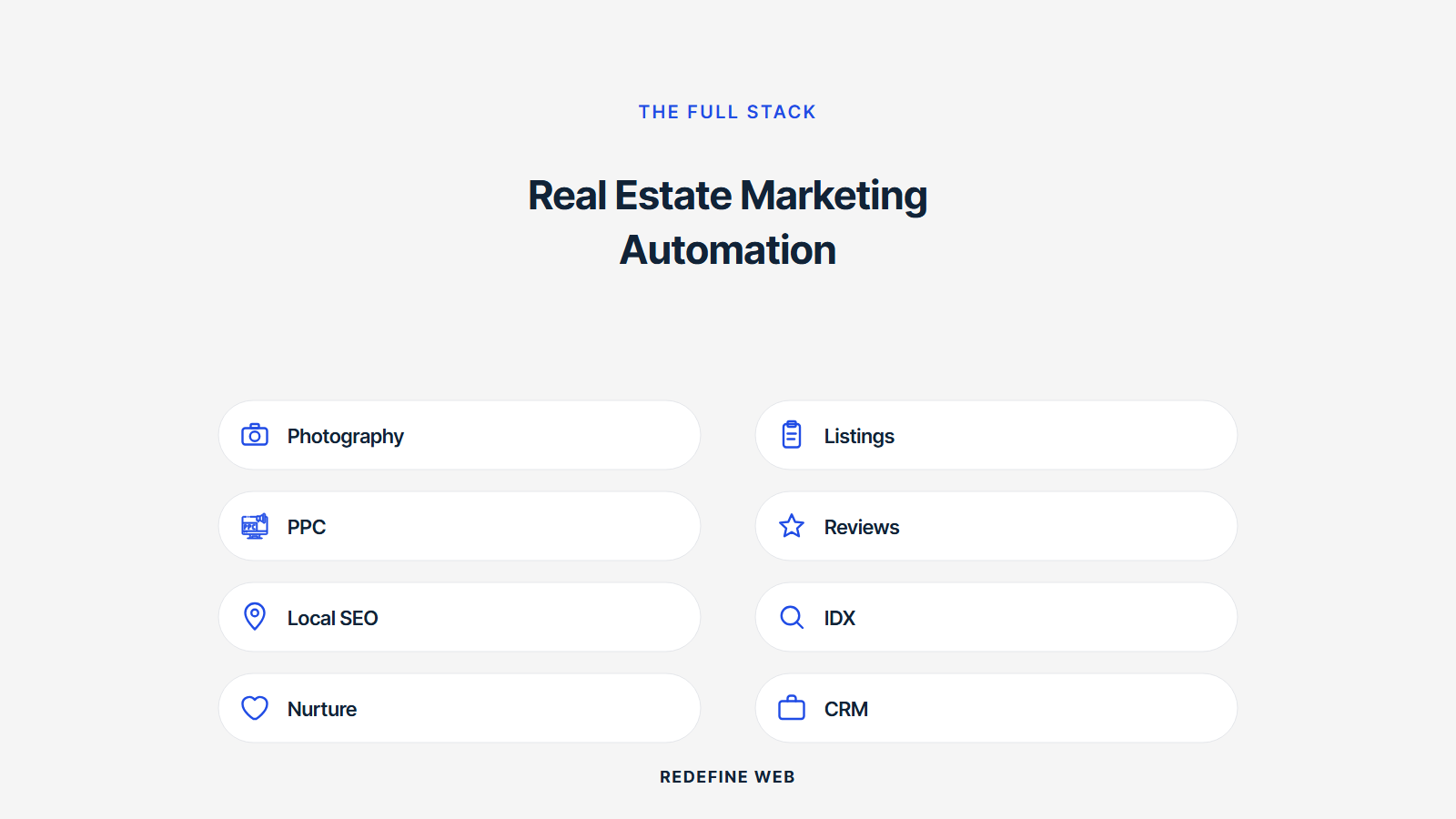
Automation without attribution is expensive theater. Every real estate marketing automation account needs a three-layer tracking system: workflow-level metrics, funnel-level metrics, and CRM-level revenue attribution. Miss any layer and the ROI conversation collapses when the market softens and the automation budget always gets cut first because nobody can prove the platform investment produced deals. According to the Salesforce marketing automation statistics, revenue attribution is the single biggest gap in most real estate operations running automation stacks today.
Workflow-level metrics that matter
Reply rate per workflow, unsubscribe rate per workflow, and stage-progression rate per workflow. These three metrics track directional health. Vanity metrics like open rate deceive because iOS 15+ inflates opens by 30 to 60 percent through Mail Privacy Protection pre-fetching. Real estate marketing automation accounts that report on reply rate rather than open rate produce 3 to 5x the booked-conversation output because the team optimizes for the metrics that actually predict conversion inside the 18-month cycle.
CRM revenue attribution across a slow cycle
Every closed transaction gets a first-touch source and a last-touch source tagged in the CRM. Automation-driven deals show up in first-touch 6 to 14 months earlier as the lead moved through the drip sequences. According to the HubSpot attribution modeling guide, first-touch attribution is the correct model for slow-consideration purchases like real estate because it credits the channel that started the relationship rather than the channel that finished it. Tie every closed transaction back to the specific workflow that fired first, the specific email that produced the first reply, and the specific text that scheduled the first showing. This attribution discipline is what turns automation from a cost center into a measurable revenue channel your broker can defend inside a budget review.
Wrapping up real estate marketing automation as a live program
Real estate marketing automation is the discipline that turns your CRM into a follow-up machine that never sleeps. The seven workflows cover the pipeline. The four platform stacks scale from solo agent to brokerage. The trigger logic keeps the automation feeling personal. The human-touch balance preserves the relationship. The tracking layer ties automation back to closed transactions inside the ROI conversation with your broker. Every layer works together as one live program.
If you have a CRM with 400+ contacts and no automation running today, you are leaving $180K to $600K of annual GCI on the table depending on database size. Redefine Web builds and runs real estate marketing automation stacks for agents and brokerages inside the Real Estate Marketing Retainer from $599/mo program. Book a discovery call and we will walk through the last three real estate accounts we automated from a stale CRM, line by line, with the exact workflows, the trigger logic, and the specific booked-conversation counts each account produced in months two, four, and six.
Frequently asked questions
What workflows does a real estate marketing automation stack need to run?
Seven workflows cover 95 percent of what a real estate marketing automation stack needs. New lead instant response inside 30 seconds. Lead nurture drip across 30 days. Appointment reminder plus confirmation. Post-showing follow-up. Under-contract stage updates. Post-closing anniversary series across 5 years. Review generation request. Each workflow has a specific trigger, message sequence, human escalation, and goal metric. Real estate marketing automation accounts that skip any of the seven leave 15 to 30 percent of the total pipeline uncovered because leads fall through the tracking cracks when they change stages without a trigger to catch them.
Which CRM platform is best for real estate marketing automation in 2026?
Four combinations work for real estate marketing automation in 2026. Follow Up Boss plus Zapier plus Mailchimp for solo agents and small teams at $108 to $173 monthly with 92 percent primary inbox placement. Sierra Interactive all-in-one at $300 to $500 monthly with 84 percent placement and simpler management. kvCORE all-in-one at $500 to $1,200 monthly with the deepest native automation depth. HubSpot Sales Hub Pro for teams above $2M annual GCI at $500 to $3,200 monthly with 94 percent placement and the strongest reply rates. Pick based on database size, team headcount, and how much time you want inside a single dashboard.
How does real estate marketing automation avoid feeling robotic?
The line between helpful automation and creepy automation runs through trigger logic and human-signal detection. Well-designed triggers fire messages that feel like a friend noticed a specific thing about your search history. Poorly designed triggers feel like a marketing platform tracking your every move. Real estate marketing automation trigger logic runs on behavior signals, time-based signals, and CRM stage change signals. Every workflow includes a stop condition that fires on the first signal a human is engaged so the automation pauses and hands off to the agent for personal follow-up on high-value moments.
What is the right balance between automation and human touch?
The right balance runs 70 percent automation on repetitive follow-up and 30 percent human touch on high-value moments. Miss the balance in either direction and the numbers collapse. First conversation with a new lead, post-showing debrief, offer negotiation, under-contract updates when something goes wrong, post-closing thank-you within 48 hours, and referral partner introductions must always be human. Automation is for the 200 touches a year no human can consistently execute across a 1,200-contact database. Not for the 6 moments a year that decide whether a client refers you to their sister down the road.
How much does real estate marketing automation cost when done professionally?
Professional real estate marketing automation buildout plus management runs $850 to $3,400 monthly depending on database size and workflow count. Setup takes 8 to 24 hours of workflow design plus configuration. Ongoing management runs 4 to 10 hours a month covering deliverability monitoring, list hygiene, workflow refinement, monthly reporting tied to booked conversations, and template rotation across the 7 core sequences. Anything below $500 monthly from a full-service vendor is a template shop configuring the same 6 corporate workflows across every agent in their book of 800 accounts. Solo agents self-serving with Follow Up Boss plus Mailchimp still produce meaningful output at 3 to 5 hours weekly of hands-on time.
How long before real estate marketing automation shows booked conversations?
Month one covers workflow buildout and initial automation firing on new leads. Reply rate stays modest as the deliverability warms up and the workflows tune based on early data. Month two shows the first meaningful reply-rate gains as the nurture sequences compound and the stage-change triggers catch leads moving through the pipeline. Month three most disciplined accounts hit 12 to 22 booked conversations monthly from the automation layer alone on top of whatever the manual follow-up produces. Months four through six are where the compounding hits and cost per booked conversation drops below $18 as the dormant-lead re-engagement workflows catch leads from 8 months prior.
Book your free 30-minute strategy call.
No spam, no sales rep. We use your email to schedule your call with a senior strategist. That is it.
More from the blog
View all articles → Digital Marketing
 Dental Marketing Tips That Compound Into New Patients
Read article Digital Marketing
 Ecommerce Marketing Strategies That Drive Real DTC Revenue
Read article Digital Marketing