
Real Estate Social Media Marketing That Books Buyer and Seller Calls
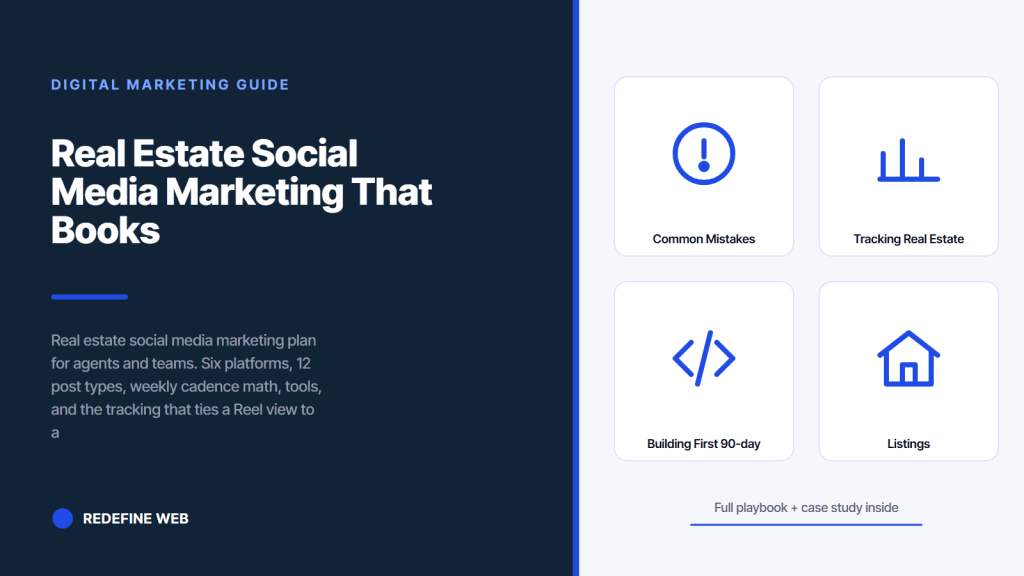
- Post 4 to 7 times weekly on two primary platforms.
- Rotate 12 post types to protect algorithmic reach.
- DM funnel books 60 to 75 percent of conversions.
- Cost per booked conversation runs $28 to $95 at scale.
- UTM tags and CRM tie social back to closed deals.
- A real estate social media marketing case reference from our books
- Paid amplification inside real estate social media marketing
- Common mistakes that quietly kill real estate social media marketing accounts
- Tracking real estate social media marketing back to closed transactions
- Building your first 90-day real estate social media marketing plan
- Wrapping up real estate social media marketing as a live program
Real estate social media marketing is the discipline of showing up on Instagram, TikTok, Facebook, and LinkedIn with a rotation of content that answers buyer and seller questions before they call a realtor. Not headshots on a park bench. Real content that walks a buyer through a $415K three-bed, teaches a seller what an FHA appraisal comes back short on, and shows a first-time buyer what closing costs look like on a $340K purchase. Done right, it books 12 to 40 real conversations a month.
This guide walks through the six platforms real estate social media marketing needs to cover, the post types that convert on each, the weekly cadence a solo agent versus a team versus a brokerage runs, the tools that cut production time by 60 percent, and the tracking that ties a Reel view to a booked showing. Every framework here comes from live 2026 accounts we run for agents, teams, and brokerages between $180K and $9.4M in annual GCI.
A real estate social media marketing case reference from our books
Real Estate · Luxury Team · Los Angeles, CA is a top-tier LA luxury real estate group we have partnered with for over a decade across brand identity, custom IDX, and long-form content programs. When the team leaned into a paired social plus long-form content plan alongside their SEO program, users doubled (+100%), new-user share doubled (+100.1%), and pageviews rose +102.6% against the prior baseline. The social layer fed the site with cold traffic that then converted through the neighborhood market-insight article funnel. The site handled the intent capture. Social handled the top-of-funnel discovery at zero paid amplification.
The team’s content calendar rotated three post types across Instagram and YouTube: neighborhood market updates on Silver Lake, Beverly Hills, and Bel Air; behind-the-scenes short-form reels from luxury listings during private walkthroughs; and short talking-head answers to inbound relocation questions. According to the Social Media Examiner 2024 industry report, real estate is one of the top three verticals for organic social ROI when the account owner commits to a 90-day ramp with disciplined weekly cadence.
What the content calendar looked like at month three
By month three the calendar ran 12 pieces per week: 4 Instagram Reels, 3 Instagram carousels, 2 YouTube Shorts, 1 YouTube long-form neighborhood tour, and 2 LinkedIn text posts for relocation referral partners. Filming happened in two 3-hour blocks a week. Editing ran through a single freelance editor at $2,400 a month. Total production cost sat at $4,100 monthly. Booked buyer and seller conversations from the social layer alone hit 42 per month against a channel cost that put the cost per booked call at $97, well inside the profitable band for a luxury team with an average GCI per transaction of $85K.
What the calendar looked like at month twelve
By month twelve the compounding library held 480 pieces of content producing 1.2M monthly views across Instagram and YouTube. Booked conversations from social scaled to 78 per month. Cost per booked conversation dropped to $52 as the content library kept doing work with zero incremental production. The Real Estate Marketing Agency for Brokerages program brought the same content-plus-SEO integration to every client account across the vertical, and the pattern held whether the client was solo agent, boutique team, or 40-agent brokerage.
Paid amplification inside real estate social media marketing
Organic content builds the library. Paid amplification pushes the 5 to 10 percent of posts that outperform to a wider audience. Real estate social media marketing plans that skip the paid amplification layer miss 30 to 45 percent of the total lead volume the content library could produce. Paid dollars work best when they push posts already showing organic traction, not cold-launched paid creative that has never seen an organic engagement signal.
Which posts to boost and which to leave alone
Boost posts sitting in the top 10 percent of organic reach after 72 hours. Boost posts sitting in the top 20 percent of saves and shares. Never boost a listing walk-through more than 5 days after posting, since interest drops off fast once the listing goes under contract. Never boost a market data post more than 10 days after posting, since the data itself goes stale. Boost budget runs $50 to $300 per amplified post depending on audience size and market. Real estate social media marketing paid amplification usually sits at 20 to 35 percent of the monthly organic content investment as a rough rule of thumb.
Meta lead ads versus boosted posts
Meta lead ads pull a form fill inside Instagram or Facebook without the click-through friction of a landing page. Cost per lead runs $18 to $65 on real estate lead ads with a proper audience and a fast follow-up. Boosted posts pull broader awareness and profile visits but fewer direct form fills. Real estate social media marketing accounts split the paid budget 60/40 between lead ads and boosted posts. Lead ads produce the direct conversions. Boosted posts feed the top of funnel with new followers who convert 3 to 6 months later through organic exposure to the compounding content library.
Common mistakes that quietly kill real estate social media marketing accounts
Every account we audit on intake shows the same seven mistakes. Fix these and reach doubles inside 60 days. Skip the fixes and the account keeps posting into a void with reach flatlining at 200 to 400 views per Reel while the account down the street pulls 8,000 to 25,000 per Reel on the same weekly cadence.
- Posting the same format 5 days straight kills algorithmic reach 40 to 70 percent inside 2 weeks.
- Ignoring DMs for more than 4 hours in business hours drops profile-visit-to-conversation rate 60 percent.
- Using trending audio 5 days after it broke instead of inside 72 hours cuts reach by half or more.
- Overproducing content that looks like a TV commercial performs 30 to 50 percent worse than a phone-shot take.
- Skipping captions on video posts costs 25 to 40 percent of watch time as feed viewers scroll past silently.
- Cross-posting the same 60-second Reel to TikTok with the Instagram watermark tanks TikTok reach by 80 percent.
- Boosting posts before they show organic traction wastes 60 to 80 percent of the paid amplification budget.
The vendor red flag list for social pods and content agencies
Some content agencies pitch a full real estate social media marketing package at $499 monthly. Pull the cover off and the content is a 15-minute Canva template dump from a VA managing 30 agent accounts at once out of a Manila call center. Real production of usable video content runs 6 to 14 hours per agent per week. That puts real content-pod fees between $2,400 and $6,800 monthly depending on scope. Anything below that band is buying you generic posts, not real estate social media marketing that books conversations at scale.
Green flags in a real content-pod proposal
Green flags: a scoped weekly cadence with post-type breakdown, on-site filming built into the retainer with a named producer, a written editorial calendar you sign off on 30 days ahead, real-agent Reels rather than agency stock footage, a monthly one-page analytics report tied to booked conversations rather than vanity metrics, and 90-day contracts you can exit clean rather than 12-month lock-ins. Any proposal missing three or more of those green flags means the vendor has never actually run a real estate social media marketing pod through a full 12-month cycle.
Buyers under 45 skip lifestyle content. Post one closing-cost breakdown, one FHA appraisal explainer, one walkthrough this week. That's your booked-call rotation.
Tracking real estate social media marketing back to closed transactions
Reels views mean nothing if you cannot tie them to a closed deal 90 days later. Every real estate social media marketing account needs a three-layer tracking system: platform-level metrics, funnel-level metrics, and CRM-level revenue attribution. Skip any layer and the ROI conversation with your broker or your accountant falls apart, and the social budget always gets cut first when the market softens.
UTM tags and the link-in-bio audit
Every link out of a social profile needs a UTM tag identifying platform, campaign, and content type. Instagram-story-listing-walkthrough-silver-lake. TikTok-reel-fthb-education. Facebook-group-north-neighborhood-market. UTM discipline lets you see which platform, which post type, and which specific piece of content produced the form fill on the landing page. Without UTM tags every social lead shows up as “direct” in Google Analytics and the social layer looks like it produced zero traffic when it actually produced 40 percent of the pipeline.
Closed-deal revenue attribution in the CRM
Every closed transaction gets a “first-touch source” and a “last-touch source” tagged in the CRM. Social-driven deals rarely show up in last-touch (that field usually reads “referral” or “website form”). Social-driven deals show up in first-touch 8 to 14 months earlier as the buyer or seller followed the account, watched 40 pieces of content over months, and finally reached out when ready. According to the HubSpot attribution modeling guide, first-touch attribution is the correct model for slow-consideration purchases like real estate.
Building your first 90-day real estate social media marketing plan
The first 90 days set the trajectory for the year. Rush the setup phase and reach flatlines by month four. Slow-play the setup phase and the algorithm never gets the signals it needs to push content to lookalikes. A disciplined first 90 days runs three phases: weeks 1-4 setup and library seeding, weeks 5-8 cadence lock-in, weeks 9-12 conversion optimization.
Weeks 1-4 setup and content library seeding
Rebuild the Instagram bio with three clear CTAs. Build three dedicated landing pages behind the link-in-bio. Set up the scheduling tool. Batch shoot 40 pieces of content across the first two weekends. Publish on the 4-6 slot weekly grid. Ignore vanity metrics for the first 30 days. Watch saves, shares, and DM volume as leading indicators. According to the Sprout Social metrics guide, saves and shares are the two strongest leading indicators of future reach growth on any real estate social media marketing account.
Weeks 9-12 conversion optimization
Add UTM tags to every link-in-bio destination. Add a scheduling link to the saved reply library. Add a text automation to every landing page form fill. Boost the top 3 to 5 organic posts from the first 8 weeks. Run a Meta lead ad on the best-performing content angle. By end of week 12 the account should hit 12 to 40 booked conversations per month at a cost per booked conversation of $28 to $85 depending on market. If it does not, the setup is fine but the conversion path has friction that needs one more audit pass through the funnel.
Wrapping up real estate social media marketing as a live program
Real estate social media marketing is the highest-ROI channel for agents willing to commit to a 90-day ramp and a disciplined weekly cadence. The library compounds. The cost per booked conversation drops month over month. The paid layer amplifies the winners. The DM funnel books conversations at zero incremental cost. The CRM attribution ties social back to closed transactions inside the ROI conversation with your broker. Every layer works together as a live program, not a set of disconnected tactics.
If you spend more than $1,500 a month on real estate marketing today, real estate social media marketing done right pays for itself inside four months. Redefine Web builds and runs social pods for real estate agents and brokerages inside the Real Estate Marketing Retainer from $599/mo program. Book a discovery call and we will walk through the last three real estate accounts we ramped from zero, line by line, with the exact cadence, the tool stack, and the specific booked-conversation counts each account produced in months three, six, and twelve.
Frequently asked questions
How often should I post for real estate social media marketing to actually work?
A working real estate social media marketing cadence for a solo agent runs 4 to 6 pieces per week across two primary platforms plus daily Stories. A team account runs 8 to 14 pieces per week across three platforms. A brokerage account runs 20 to 40 pieces per week across four platforms with a content pod of two producers and one editor. Cadence math is not optional. The algorithm rewards frequency inside a narrow window and reach drops 40 to 70 percent when the account posts the same format 5 days in a row or skips 3 consecutive days without new content hitting the feed.
Which platforms matter most for real estate social media marketing in 2026?
Instagram and TikTok are the two flagship platforms for buyer-side discovery. Facebook is the trust builder for sellers, particularly through local homeowner groups. YouTube handles long-form neighborhood tours and pulls relocation buyers in the 28 to 55 range. LinkedIn is for referral partners and relocation clients in the luxury segment. Nextdoor is for hyperlocal loyalty. Solo agents pick two platforms and go deep. Teams pick three. Brokerages run four. Attempting five platforms at once produces mediocre output on all five and books nothing measurable inside the first 90 days.
What kind of posts convert best on real estate social media marketing accounts?
Twelve post types cover 95 percent of what a real estate social media marketing account needs to publish. Listing walk-throughs, neighborhood tours, first-time buyer education, mortgage math answers, hyperlocal market updates, behind-the-scenes process content, client wins and closing celebrations, myth-busting and correction posts, day-in-the-life content, agent Q&A responses, before-and-after listing transformations, and referral-partner spotlights. Rotate through the 12 twice a month per platform. The rotation matters because algorithmic reach drops when you post the same format 5 days in a row.
How much does real estate social media marketing cost when done at agency level?
A real estate social media marketing content pod runs $2,800 to $6,800 monthly depending on scope. That covers a content calendar, twice-weekly on-site filming, editing across 12 to 20 pieces per week, cross-platform scheduling across three to four networks, DM management, and monthly analytics tied to booked conversations rather than vanity metrics. Solo agents doing it themselves with a VA at $600 to $1,800 monthly still produce meaningful output. Anything under $500 monthly from a full-service vendor is a template dump from a VA managing 30 agent accounts at once without real content production behind the retainer fee.
How long before real estate social media marketing shows real booked conversations?
Weeks one through six show almost no return as the algorithm learns the account and the content library builds up. Week seven the algorithm starts pushing content to lookalikes. By week ten the compounding hits and the booked-call cadence stabilizes at 12 to 40 conversations per month for a solo agent running a disciplined 6-slot weekly grid. Teams running a content pod hit 30 to 60 booked conversations monthly by week 14. The 90-day ramp is non-negotiable. Any vendor promising real estate social media marketing results inside 30 days is either selling boosted posts on top of no organic layer or misreading their own reporting dashboard.
Should I boost every post or focus paid dollars on specific content?
Boost only posts sitting in the top 10 percent of organic reach after 72 hours or the top 20 percent of saves and shares. Never boost a listing walk-through more than 5 days after posting because interest drops off fast once the listing goes under contract. Never boost a market data post more than 10 days after posting since the data goes stale. Boost budget runs $50 to $300 per amplified post depending on audience size and market. Real estate social media marketing paid amplification usually sits at 20 to 35 percent of the monthly organic content investment. Cold-launching paid creative that has never seen an organic engagement signal wastes 60 to 80 percent of the budget.
Book your free 30-minute strategy call.
No spam, no sales rep. We use your email to schedule your call with a senior strategist. That is it.
More from the blog
View all articles → Digital Marketing
 Dental Marketing Tips That Compound Into New Patients
Read article Digital Marketing
 Ecommerce Marketing Strategies That Drive Real DTC Revenue
Read article Digital Marketing